
Overview
By the opening months of 1942, Japan stood at the height of its power in the Pacific.
The attack on Pearl Harbor had crippled the U.S. Pacific Fleet, and Japanese forces swept through Southeast Asia and the western Pacific with remarkable speed.
Within six months, Japan had captured the Philippines, Malaya, Singapore, Hong Kong, and the Dutch East Indies, establishing a defensive perimeter that stretched from Burma to the Solomon Islands.
The empire appeared invincible, its naval and air forces dominating the region and its armies entrenched across newly conquered territories.
...immense logistical burdens...
Yet this rapid expansion concealed deep strategic flaws. Japan’s industrial base was limited, its merchant fleet overstretched, and its supply lines vulnerable to disruption.
The vast distances of the Pacific imposed immense logistical burdens, while the Allies - though initially disorganised - possessed the industrial capacity to recover and retaliate.
The year 1942 therefore became the pivot on which the balance of power began to turn.
...unprecedented cooperation...
The Allied response was shaped by two distinct command structures.
In the Southwest Pacific, General Douglas MacArthur directed operations from Australia, focusing on the defence of New Guinea and the eventual return to the Philippines.
In the Central Pacific, Admiral Chester Nimitz commanded the U.S. Pacific Fleet, orchestrating naval and air operations that would culminate in decisive engagements.
Both commands faced the challenge of coordinating land, sea, and air forces across immense distances - a task that demanded new doctrines and unprecedented cooperation.
...dominated by Japanese initiative...
The first half of 1942 was dominated by Japanese initiative, culminating in the battles of the Coral Sea and Midway.
These engagements marked the beginning of Japan’s strategic decline.
At Coral Sea, Japan’s attempt to isolate Australia was checked; at Midway, four Japanese carriers were destroyed, shifting the momentum irreversibly in favour of the Allies.
The remainder of the year saw the launch of the Guadalcanal campaign, the first sustained Allied offensive in the Pacific.
Strategic Situation in Early 1942
At the beginning of 1942, Japan’s military position in the Pacific appeared unassailable.
The Imperial Japanese Navy had achieved a string of victories that stunned the world: the attack on Pearl Harbor crippled the U.S. Pacific Fleet, while coordinated offensives across Southeast Asia and the western Pacific dismantled Allied defenses.
Within months, Japanese forces had seized the Philippines, Malaya, Singapore, Hong Kong, and the Dutch East Indies, securing vital oil, rubber, and mineral resources.
The empire’s defensive perimeter now stretched thousands of miles - from Burma and the Andaman Islands in the west to Wake Island and the Solomons in the east - forming what Tokyo believed to be an impregnable shield against Allied counterattack.
...contained inherent weaknesses...
Japan’s strategic vision was shaped by the Imperial General Headquarters, which sought to consolidate these gains and force the Allies into a negotiated peace.
The plan relied on rapid conquest followed by defensive consolidation, using fortified island bases to protect sea lanes and deny Allied access to Asia.
Yet this strategy contained inherent weaknesses. Japan’s industrial output was dwarfed by that of the United States, and its merchant fleet lacked the capacity to sustain prolonged operations across such vast distances.
The empire’s expansion had outpaced its logistical infrastructure, leaving supply lines thin and vulnerable to interdiction.
...reeling from Pearl Harbor...
For the Allies, the situation was dire but not hopeless.
The United States, though reeling from Pearl Harbor, retained its aircraft carriers and industrial potential.
Britain, despite losses in Asia, maintained naval strength in the Indian Ocean, while Australia became a critical base for Allied operations.
Two distinct command structures emerged: General Douglas MacArthur’s Southwest Pacific Area, focused on defending Australia and advancing through New Guinea, and Admiral Chester Nimitz’s Pacific Ocean Areas, responsible for naval and air operations across the Central Pacific.
Coordination between these commands was complex but essential, marking the beginning of integrated Allied strategy.
...a series of decisive confrontations...
By mid‑1942, Japan’s momentum began to slow. The vastness of its new empire strained resources, and Allied intelligence - particularly U.S. codebreaking efforts - started to reveal Japanese intentions.
The stage was set for a series of decisive confrontations that would test Japan’s ability to maintain its dominance.
The battles of the Coral Sea and Midway would soon expose the limits of Japanese expansion and signal the beginning of a strategic reversal that would define the remainder of the Pacific War.
Japanese Expansion and Early Successes
In the opening months of 1942, Japan’s military expansion reached its zenith.
The Imperial Japanese Navy and Army executed a series of coordinated offensives that dismantled Allied defenses across Southeast Asia and the Pacific.
Following the attack on Pearl Harbor, Japanese forces advanced with remarkable speed, capturing territory vital to their strategic and economic ambitions.
The Philippines fell after the surrender at Bataan and Corregidor; Malaya and Singapore were overrun, marking one of Britain’s greatest wartime defeats; and the Dutch East Indies was seized for its oil reserves, securing Japan’s access to critical resources.
Within six months, Japan controlled an empire stretching from Burma to the Solomon Islands, encompassing nearly all of East Asia’s major colonial possessions.
...meticulous planning and operational coordination...
These victories were achieved through meticulous planning and operational coordination.
Japan’s military doctrine emphasised rapid movement, surprise, and the integration of air and naval power. Carrier‑based aircraft provided air superiority, while amphibious landings delivered troops directly onto key objectives.
The capture of Rabaul in New Britain established a major forward base, enabling Japan to project power deep into the South Pacific.
The conquest of the Dutch East Indies secured oil supplies essential for sustaining Japan’s fleet and air operations, while the occupation of Burma threatened British India and cut off Allied supply routes to China.
...inherent vulnerabilities...
However, Japan’s success carried inherent vulnerabilities.
The empire’s expansion had outpaced its logistical capacity.
Supply lines stretched thousands of miles across contested seas, and the merchant fleet was insufficient to maintain the flow of fuel, ammunition, and food.
Industrial production in Japan could not match the scale of Allied manufacturing, particularly that of the United States.
Moreover, Japan’s strategic planning underestimated the speed at which the Allies could recover and reorganise.
...diluted Japan’s strength...
By mid‑1942, cracks began to appear in Japan’s defensive perimeter.
The costly victories at Bataan and Java had consumed resources and manpower, while the need to defend an enormous area diluted Japan’s strength.
The Imperial General Headquarters faced the challenge of consolidating its gains while preparing for inevitable Allied counterattacks.
The next phase of the war would test Japan’s ability to hold its empire against an enemy whose industrial and technological capacity was beginning to mobilise on an unprecedented scale.
Coral Sea
By May 1942, Japan sought to extend its defensive perimeter southward, aiming to isolate Australia and secure its hold on the Pacific.
The plan centred on capturing Port Moresby in New Guinea and Tulagi in the Solomon Islands, which would provide forward bases for further operations.
The Allied response culminated in the Battle of the Coral Sea - a confrontation that marked a fundamental shift in naval warfare and the first engagement in which opposing fleets fought entirely through aircraft launched from carriers.
...intense combat...
Japanese forces, led by Vice Admiral Takeo Takagi and Rear Admiral Tadaichi Hara, advanced with two carrier groups: Shōkaku and Zuikaku, supported by the light carrier Shōhō.
The U.S. Navy, under Rear Admiral Frank Jack Fletcher, deployed the carriers Lexington and Yorktown to intercept the invasion fleet.
Over several days of intense combat between 4 and 8 May, aircraft from both sides launched strikes without the fleets ever sighting one another - a revolutionary development in naval tactics.
...contest Japan’s dominance...
The battle’s outcome was tactically inconclusive but strategically significant.
The Japanese lost Shōhō and suffered heavy damage to Shōkaku, forcing the cancellation of the Port Moresby invasion.
The U.S. Navy lost Lexington and sustained damage to Yorktown, yet succeeded in halting Japan’s southward advance.
For the first time, a Japanese offensive had been checked, demonstrating that Allied forces could contest Japan’s dominance at sea.
...a decisive blow...
Coral Sea revealed the growing importance of carrier aviation, radar coordination, and aerial reconnaissance.
It underscored the vulnerability of surface fleets to air attack and established the carrier as the decisive instrument of naval power.
The lessons learned - particularly in communication, strike coordination, and damage control - proved invaluable weeks later at Midway, where the U.S. Navy would deliver a decisive blow to Japan’s carrier strength.
...define the remainder of the Pacific conflict...
Strategically, Coral Sea preserved Australia as a vital Allied base and marked the beginning of Japan’s strategic contraction.
It was a battle of innovation and adaptation, signalling the transition from traditional naval engagements to modern air‑sea warfare - a transformation that would define the remainder of the Pacific conflict.
Midway
In June 1942, the Pacific War reached a decisive turning point with the Battle of Midway, a confrontation that fundamentally altered the strategic balance between Japan and the United States.
After months of rapid expansion, the Imperial Japanese Navy sought to eliminate the U.S. Pacific Fleet’s remaining carrier strength and secure a dominant defensive perimeter.
Midway Atoll, located roughly halfway between Hawaii and Japan, became the focal point of this plan.
By seizing the atoll and destroying any American forces that attempted to defend it, Japan aimed to force the United States into a weakened negotiating position.
...to ambush the Japanese fleet...
The operation, led by Admiral Isoroku Yamamoto, relied on complex coordination between multiple carrier groups, invasion forces, and supporting fleets.
However, Japanese planners were unaware that U.S. cryptanalysts at Station HYPO had broken key portions of the JN‑25 naval code.
Through careful analysis, American intelligence determined that “AF” referred to Midway and predicted the timing and direction of the Japanese attack.
This breakthrough allowed Admiral Chester Nimitz to position his carriers - Enterprise, Hornet, and the hastily repaired Yorktown - to ambush the Japanese fleet.
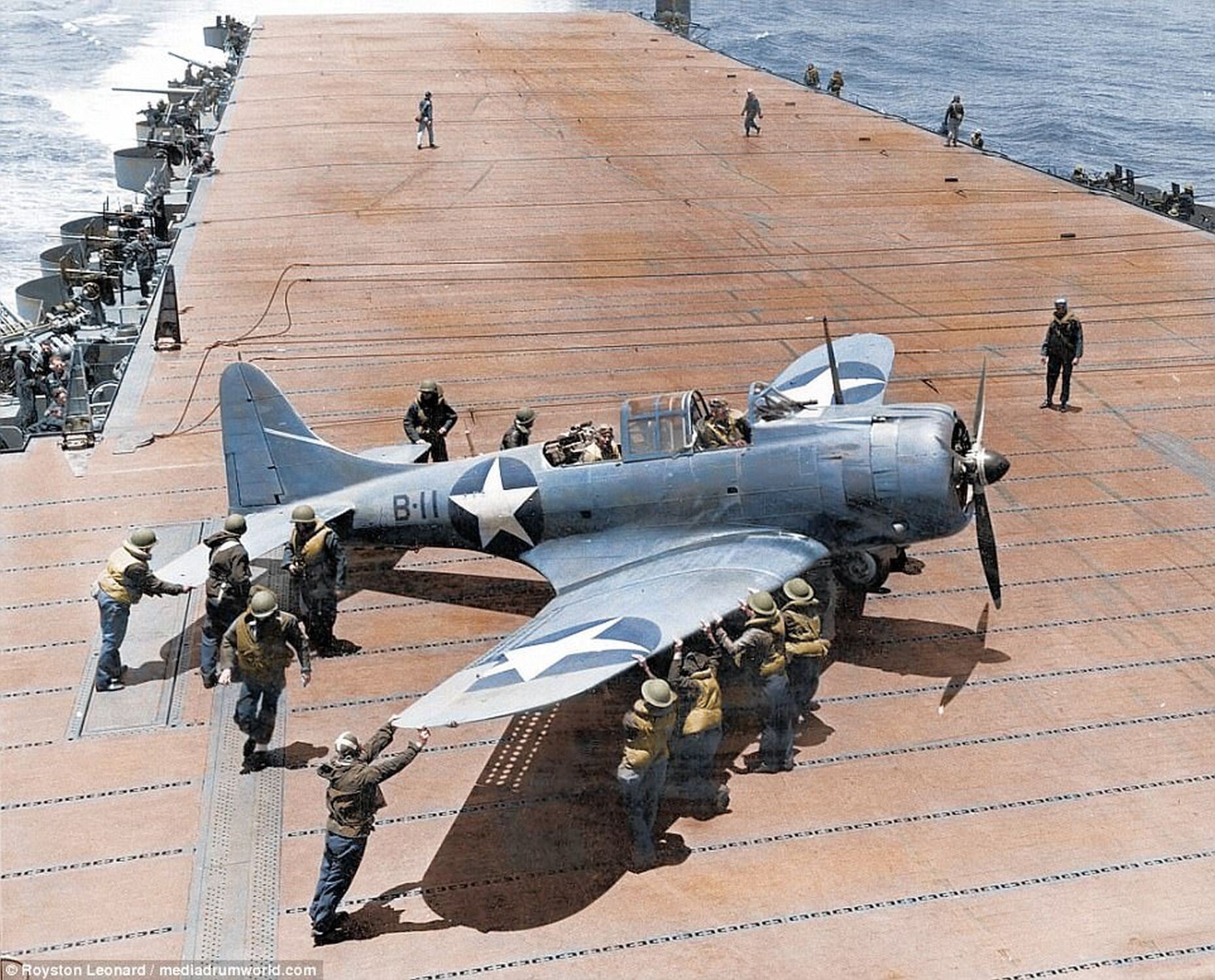
a US Navy Douglas SBD-3 Dauntless of bombing squadron VB-8 on the deck of the aircraft carrier USS Hornet (CV-8) during the Battle of Midway in 1942.
Colourised by Royston Leonard
...a critical moment...
The battle unfolded between 4 and 7 June. Early Japanese strikes heavily damaged Midway’s installations, but U.S. land‑based aircraft launched persistent, though largely ineffective, attacks on the Japanese carriers.
The turning point came when American carrier aircraft located the Japanese fleet at a critical moment: Japanese carriers were rearming and refuelling their planes, leaving their decks cluttered with ordnance.
Dive‑bombers from Enterprise and Yorktown struck Akagi, Kaga, and Sōryū in rapid succession, setting them ablaze.
Later that day, Hiryū launched counterattacks that severely damaged Yorktown, but Hiryū herself was located and destroyed by U.S. aircraft.
...losses it could not replace...
By the end of the battle, Japan had lost four frontline carriers and many of its most experienced aircrews - losses it could not replace.
The United States lost Yorktown, but its carrier force remained intact and capable of sustained operations.
Midway ended Japan’s ability to conduct large‑scale carrier offensives and shifted the strategic initiative to the Allies.
The battle demonstrated the decisive impact of intelligence, timing, and carrier aviation. It marked the moment when Japan’s expansion halted and the United States began its long counteroffensive across the Pacific.
Midway was not merely a tactical victory; it was the strategic pivot that reshaped the entire course of the Pacific War.
Guadacanal
The Guadalcanal campaign, fought between August 1942 and February 1943, marked the first sustained Allied offensive in the Pacific and the beginning of Japan’s strategic decline.
Following the victory at Midway, the United States sought to seize the initiative by targeting the Solomon Islands, where Japanese forces were constructing an airfield on Guadalcanal.
Control of this airfield - later named Henderson Field - would allow Japan to threaten Allied supply routes to Australia and the South Pacific.
Its capture became essential to halting Japanese expansion and securing the region.
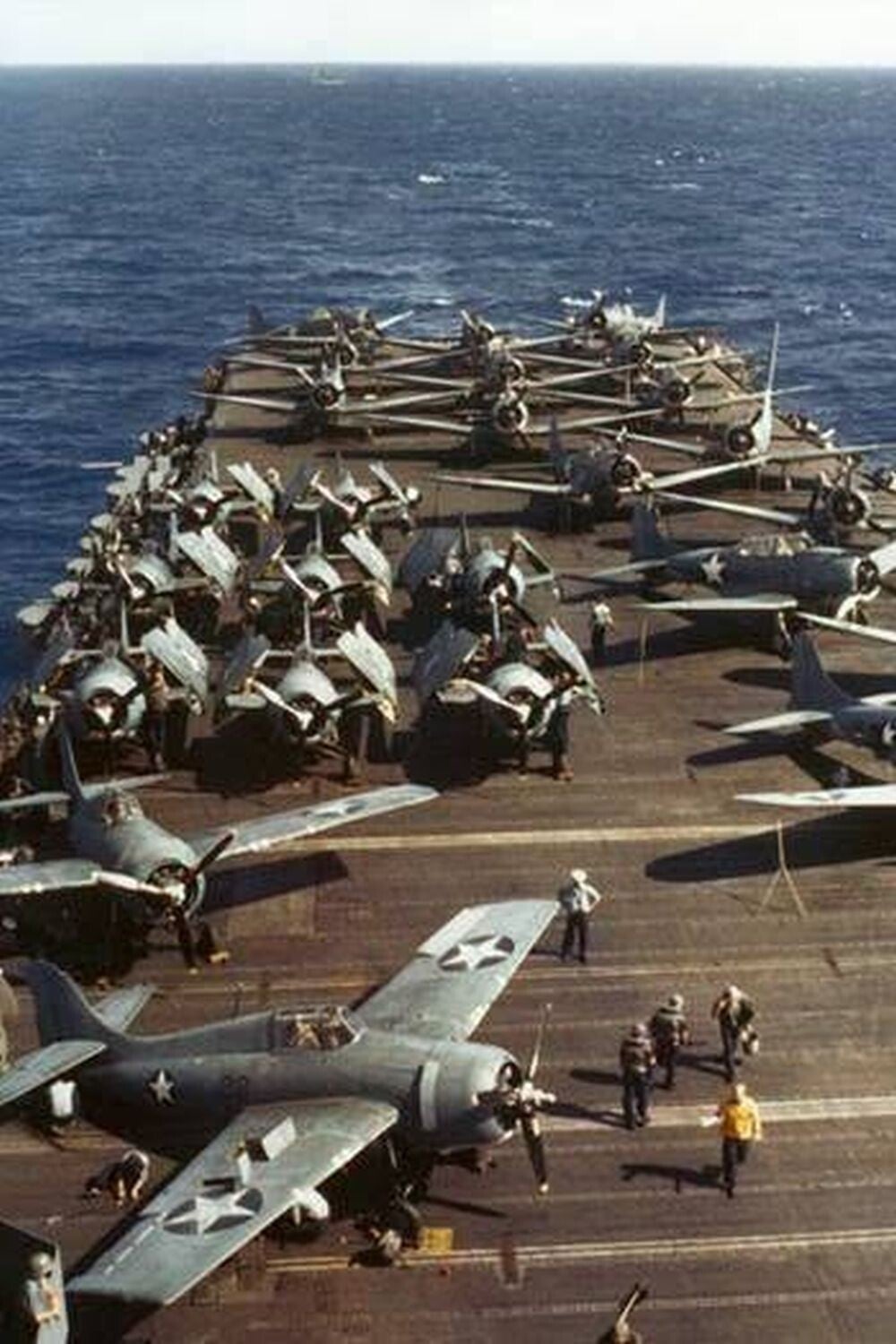
Grumman F4F-4 Wildcat fighters and Douglas SBD-3 Dauntless dive bombers lined up on the flight deck of the U.S. Navy aircraft carrier USS Wasp (CV-7) in 1942. USS Wasp (CV‑7) operated in the Pacific in 1942 during the Guadalcanal campaign, providing vital air support for Allied operations. She launched fighters and dive‑bombers that protected convoys and ground forces. On 15 September 1942, the Japanese submarine I‑19 torpedoed and fatally damaged the carrier, leading to her loss during the hard‑fought Pacific war.
...Japan responded swiftly...
On 7th August 1942, U.S. Marines of the 1st Marine Division landed on Guadalcanal, Tulagi, and nearby islands under the protection of carrier aircraft and naval gunfire.
The initial landings met limited resistance, as Japanese construction crews and small garrisons withdrew inland.
Within days, the Marines captured the unfinished airfield and began fortifying it against counterattack.
Japan responded swiftly, launching repeated attempts to retake the island through naval bombardments, air raids, and infantry assaults.
...the ferocity of night engagements...
The campaign evolved into a brutal contest of attrition.
The battles of Savo Island, Cape Esperance, and the Naval Battle of Guadalcanal demonstrated the ferocity of night engagements between opposing fleets.
Japanese destroyers and cruisers inflicted heavy losses, yet failed to dislodge Allied forces from the island.
Control of Henderson Field proved decisive: American aircraft operating from the airstrip disrupted Japanese supply convoys - known as the “Tokyo Express” - and gradually eroded Japan’s ability to reinforce its troops.
...who refused to surrender...
Conditions on the island were severe.
Tropical disease, shortages of food and ammunition, and constant bombardment tested the endurance of both sides.
The Marines and later U.S. Army reinforcements fought in dense jungle terrain against determined Japanese defenders who refused to surrender.
By early 1943, Japan’s losses in ships, aircraft, and manpower had become unsustainable.
On 9 February 1943, Japanese forces evacuated Guadalcanal, conceding the island to the Allies.
...it shattered Japan’s ability...
Guadalcanal’s significance extended far beyond its immediate tactical outcome.
It marked the transition from defensive operations to a sustained Allied offensive across the Pacific.
The campaign validated the concept of joint operations - integrating naval, air, and ground forces - and demonstrated the importance of logistics and air superiority in island warfare.
Strategically, it shattered Japan’s ability to maintain its southern perimeter and opened the path for Allied advances through New Guinea and the Central Pacific.
Guadalcanal was the moment when the Pacific War’s momentum shifted irreversibly toward Allied victory.
Technology, Logistics, and Intelligence in 1942
The year 1942 marked a decisive evolution in the technological and logistical foundations of the Pacific War.
Both Japan and the Allies recognised that victory depended not only on battlefield performance but on the ability to sustain operations across immense distances.
The Pacific’s geography - dominated by oceanic expanses and isolated islands - demanded innovation in naval engineering, aviation, and supply management.
The campaigns of that year revealed how technology and intelligence could determine the outcome of entire operations.
...a critical defensive advantage...
Aircraft carriers became the central instruments of naval power.
The battles of the Coral Sea and Midway demonstrated that air superiority, rather than surface gunnery, now dictated naval success.
Carrier‑based aircraft extended operational reach by hundreds of miles, allowing fleets to strike without direct visual contact.
The U.S. Navy refined radar systems for early warning and fire control, giving its carriers a critical defensive advantage.
Japan’s carriers, though formidable, lacked comparable radar capability and suffered from slower aircraft replacement rates - a weakness that became evident after Midway’s losses.
...isolated and vulnerable...
Logistics proved equally decisive.
The Allies faced the challenge of projecting force across the Pacific while maintaining supply lines from the continental United States to forward bases in Australia and the South Pacific.
The establishment of mobile repair ships, floating depots, and advanced base sections allowed continuous fleet operations far from home ports.
Engineering units - later known as Seabees -constructed airfields, docks, and storage facilities under combat conditions, enabling sustained offensives.
Japan, by contrast, struggled to maintain its extended perimeter; its merchant fleet was insufficient to transport fuel and supplies to distant garrisons, leaving many isolated and vulnerable.
...directly influenced the outcome at Midway...
Intelligence emerged as a strategic weapon. American cryptanalysts at Station HYPO and other codebreaking centres achieved major breakthroughs against Japan’s naval code JN‑25.
The success of these efforts directly influenced the outcome at Midway, where foreknowledge of Japanese plans allowed Admiral Nimitz to set an ambush.
Signals intelligence also guided submarine patrols and air strikes, gradually eroding Japan’s operational secrecy.
The integration of intelligence into planning marked a new era of warfare—one in which information could be as decisive as firepower.
...begun to shift irreversibly...
By the end of 1942, the technological and logistical balance had begun to shift irreversibly.
The Allies had learned to coordinate carriers, radar, and intelligence within a unified operational framework, while Japan’s capacity to sustain its empire was already faltering.
These developments laid the groundwork for the Allied counteroffensives that would dominate the Pacific in the years to come.
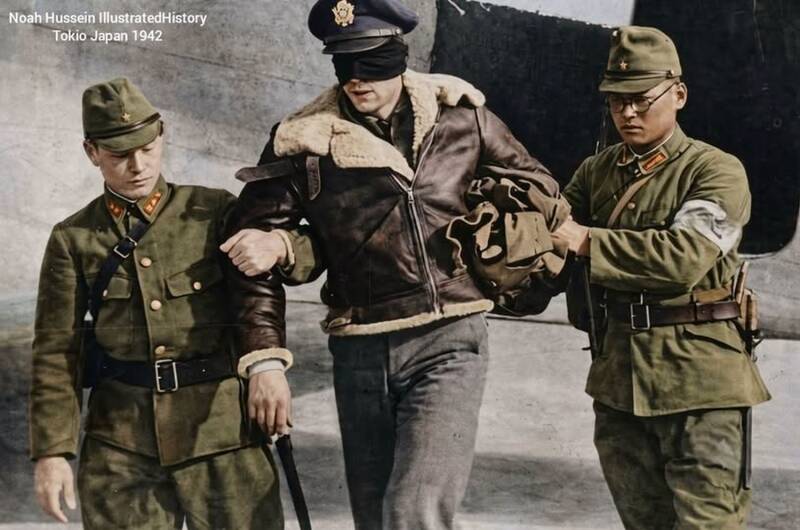
First Lieutenant Robert L. Hite, an American bomber co-pilot, blindfolded and detained by Imperial Japanese Army soldiers in 1942. Hite was one of the Doolittle Raiders who took part in the 18 April 1942 bombing raid on Tokyo, the first U.S. strike against Japan after Pearl Harbor. Captured in China, he endured harsh imprisonment, interrogation, and malnutrition under Japanese custody. Hite survived the war, returning home in 1945 after years of confinement, and remained a symbol of the raid’s courage and the heavy cost borne by its aircrews.
Noah Hussein IllustratedHistory https://www.facebook.com/groups/1599549446950675/user/100080908814723/