The Ukrainian Auxiliary Police was a German‑created policing structure established in Eastern Galicia and the Reichskommissariat Ukraine after the launch of Operation Barbarossa. Formed in mid‑August 1941 under Heinrich Himmler and subordinated to the German Ordnungspolizei, it drew heavily from the Ukrainian People’s Militia organised by the OUN‑B earlier that summer. Two main branches emerged: mobile Schutzmannschaft battalions, which carried out security warfare and mass shootings, and the local Ukrainian Police (UP), a constabulary most firmly rooted in the District of Galicia. Although both operated in occupied Ukraine, Galicia and the Reichskommissariat were administratively separate.
Across cities such as Kyiv, Ukrainian police units were placed under German command through the Schutzpolizei and Gendarmerie. No independent Ukrainian command structure existed; the highest‑ranking Ukrainian officer, Vladimir Pitulay, reached only the rank of major. A police school in Lviv attempted to expand the force, but recruitment remained limited due to public hostility toward German occupation policies.
The auxiliary police performed routine policing but operated alongside more authoritative German organisations such as the Sonderdienst, Kripo, Bahnschutz, and Werkschutz. In the Reichskommissariat Ukraine, the Schutzmannschaft numbered over 35,000 men. While most policemen were Ukrainian, the force also included Russians, Poles, and Volksdeutsche, though leadership roles were largely reserved for ethnic Germans.
The Ukrainian Auxiliary Police played a central role in the Holocaust. They registered Jews, conducted raids, guarded ghettos, escorted victims to execution sites, and cordoned off killing areas. In Volhynia, they participated in the murder of an estimated 150,000 Jews. Units assisted in massacres at Babi Yar, Dnipro, and Kryvyi Rih. They also took part in killings of Polish civilians in Obórki, Jezierce, and Lviv.
By 1943, thousands of policemen deserted with their weapons to join the OUN‑B’s emerging Ukrainian Insurgent Army. Despite variations across regions, the auxiliary police remained a key instrument of German occupation and mass violence.

Members of the Ukrainian Auxiliary Police, June 1943. The Ukrainian Auxiliary Police, created by Nazi Germany in 1941, operated across Eastern Galicia and the Reichskommissariat Ukraine under German command. Composed mainly of Ukrainians alongside Russians, Poles, and Volksdeutsche, it performed constabulary duties but played a major role in the Holocaust—registering Jews, conducting raids, guarding ghettos, and assisting in mass shootings, including Babi Yar. Units also participated in killings of Polish civilians. In 1943, thousands deserted to join the emerging Ukrainian Insurgent Army.
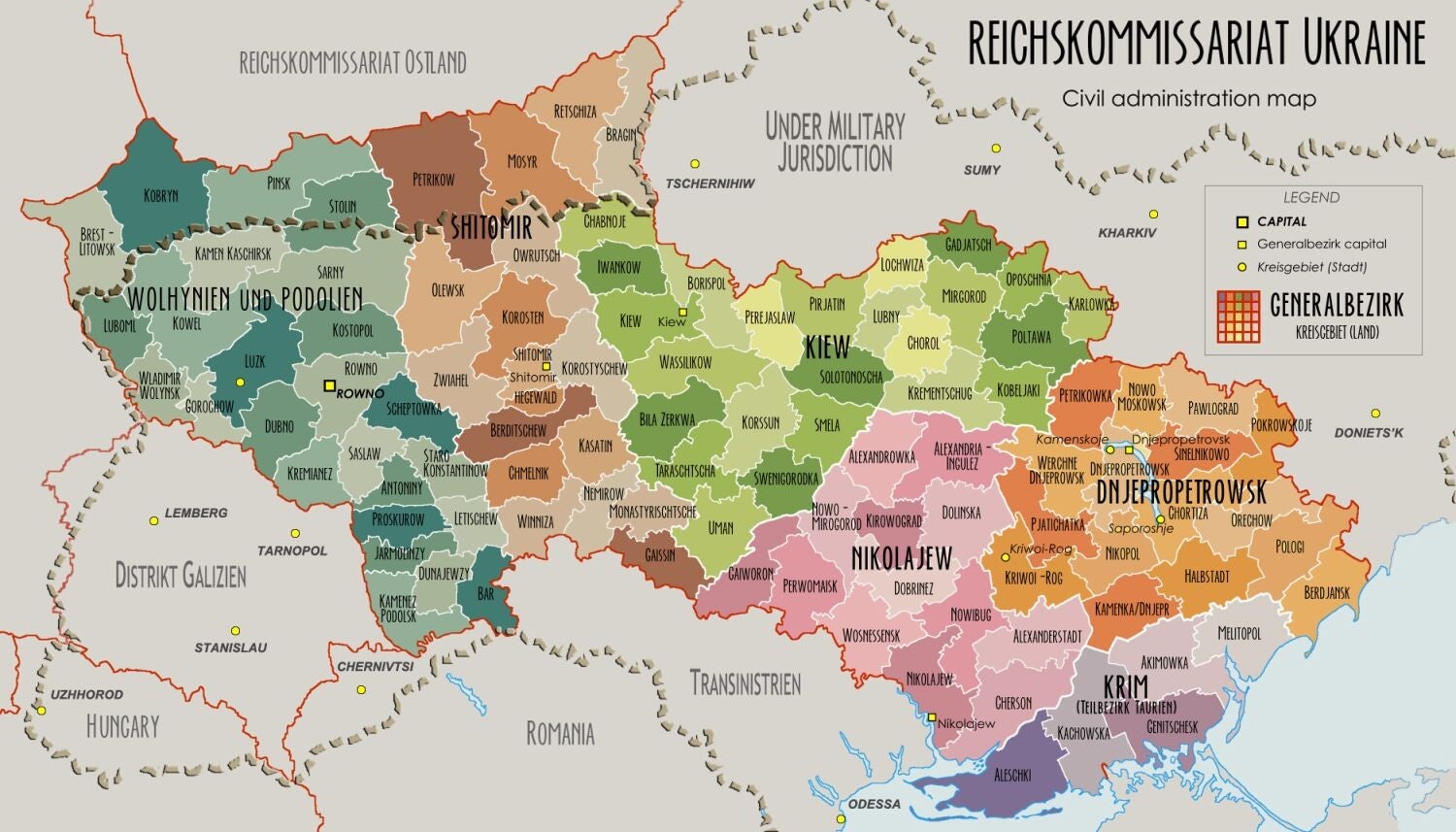
An administrative map of the Reichskommissariat Ukraine. Shows the boundaries of the Generalbezirke and Kreisgebiete as of September 1943. Distrikt Galizien added with major cities, plus outline of modern-day borders of sovereign Ukraine in order to see what part of the country constituted the actual Reichskommissariat during the Second World War.