
Overview
The Gilbert Islands campaign, conducted in November 1943, marked the first major step in the United States’ Central Pacific offensive. Following earlier defensive operations and limited raids, the campaign represented a deliberate shift toward seizing fortified Japanese positions to open a route toward the Marshall Islands, Marianas, and ultimately Japan’s inner defensive perimeter. The operation fell under Admiral Chester Nimitz’s command and formed part of the broader strategy to advance through the Central Pacific while General Douglas MacArthur moved northwest through New Guinea.
The campaign focused on two primary objectives: Tarawa Atoll and Makin Atoll. Tarawa, defended by approximately 4,500 Japanese troops of the 3rd Special Base Force, was heavily fortified with bunkers, coastal guns, and interlocking fields of fire. The assault on Betio Island began on 20 November 1943, led by the U.S. 2nd Marine Division. Difficult tides, coral reefs, and concentrated Japanese fire caused severe casualties during the initial landings. Fighting was intense and often at close range, with Marines reducing fortified positions through grenades, flamethrowers, and demolitions. After three days of combat, Tarawa was secured, but at significant cost.
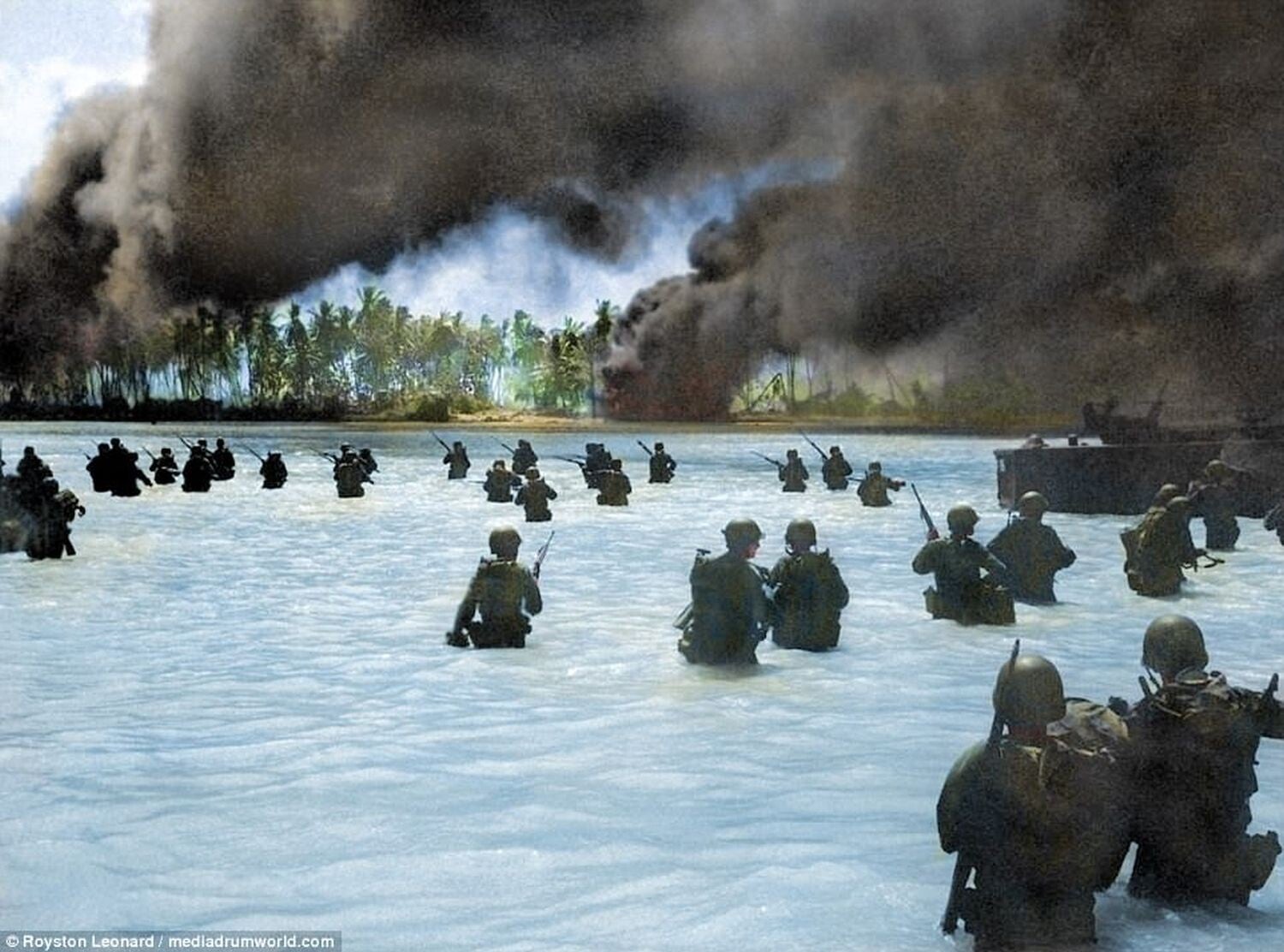
Troops of the 165th infantry on Butaritari Beach, Makin Atoll in November 1943. The American forces also seized the Gilbert Island Atoll from the Japanese.
Colourised by Royston Leonard
Makin Atoll, assaulted simultaneously by the U.S. Army’s 27th Infantry Division, encountered lighter resistance. Japanese forces numbered roughly 800, and although mines, snipers, and isolated strongpoints caused delays, the island was captured by 23 November. Makin provided a useful airfield site, though its strategic value was less than Tarawa’s.
The campaign’s significance lay in its operational and strategic consequences. It validated U.S. amphibious doctrine, exposed weaknesses in pre‑landing reconnaissance and tide prediction, and demonstrated the need for improved landing craft and close air support. More importantly, the capture of the Gilberts provided essential bases for the assault on the Marshall Islands in early 1944. The campaign marked the beginning of sustained, large‑scale U.S. offensive operations in the Central Pacific and set the pattern for subsequent island assaults.