
Overview
The New Guinea campaign in 1944 represented the decisive Allied transition from regional containment to deep penetration of Japan’s Southwest Pacific defensive system. By early 1944, Japanese forces were withdrawing westward from the Huon Peninsula, their supply lines shattered by air interdiction and naval blockade. General Douglas MacArthur’s Southwest Pacific Area command launched a series of coordinated amphibious and airborne operations designed to bypass strongpoints, seize key airfields, and isolate Japanese garrisons without direct assault.
The year opened with the Admiralty Islands operation (February–March 1944), where U.S. forces captured Los Negros and Manus, securing a major forward base for naval and air operations. In April, simultaneous landings at Hollandia and Aitape marked the beginning of Operation Reckless and Operation Persecution. These operations employed extensive air reconnaissance and carrier support, landing troops far behind Japanese lines and cutting off their main concentrations around Wewak. The rapid success of these landings demonstrated the effectiveness of Allied “leapfrogging” tactics—advancing by air and sea to seize lightly defended positions while leaving enemy strongholds to wither in isolation.
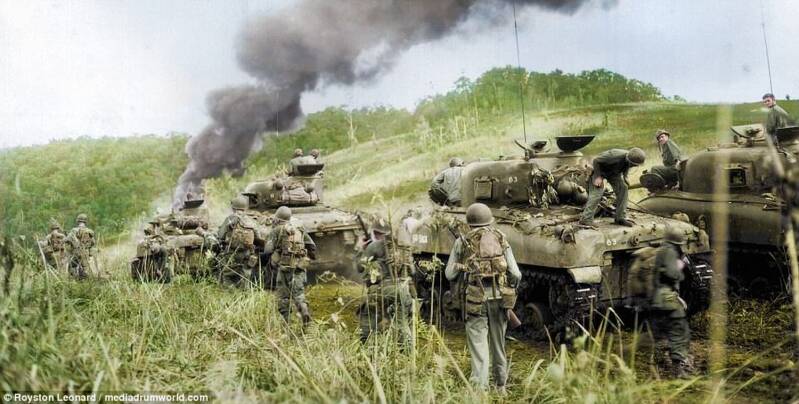
Tanks of the 603rd supporting the 162nd Infanty Regiment in Hollandia, New Guinea in April 1944.
Colourised by Royston Leonard
Subsequent operations extended the Allied perimeter westward. The capture of Biak (May–June) provided airfields for heavy bombers, while landings at Noemfoor and Sansapor (July–August) secured additional bases for the planned advance toward the Philippines. Japanese resistance was fierce but fragmented, hampered by shortages of ammunition, food, and medical supplies. Air superiority by Fifth Air Force and naval dominance by Seventh Fleet ensured uninterrupted Allied momentum.
By the end of 1944, the New Guinea campaign had achieved its strategic purpose: Japanese forces were confined to isolated pockets, Allied airfields stretched across the northern coast, and the route to the Philippines lay open. The campaign’s success demonstrated the maturity of Allied joint operations and marked the effective collapse of Japan’s position in the Southwest Pacific.