
Overview
The New Guinea campaign in 1943 marked the transition from defensive operations to sustained Allied offensive action in the Southwest Pacific. By the beginning of the year, Japanese forces still held strong positions at Buna, Gona, and Sanananda, but their perimeter was collapsing under pressure from Australian and American units. The final reduction of these beachheads in January 1943 ended Japan’s attempt to seize Port Moresby and opened the way for a broader Allied advance along the northern coast of New Guinea.
Allied strategy in 1943 centred on isolating and neutralising major Japanese bases through a combination of ground assaults, air superiority, and amphibious manoeuvre. The capture of Wau in January–February prevented a renewed Japanese thrust toward Port Moresby and secured a forward airfield essential for later operations. The subsequent Salamaua–Lae campaign formed the core of the year’s fighting. Australian and American forces advanced from multiple directions: overland from Wau, along the coast from Nassau Bay, and by air during the September airborne landing at Nadzab. These converging operations forced the Japanese to abandon Salamaua and then Lae, both of which fell in September 1943.
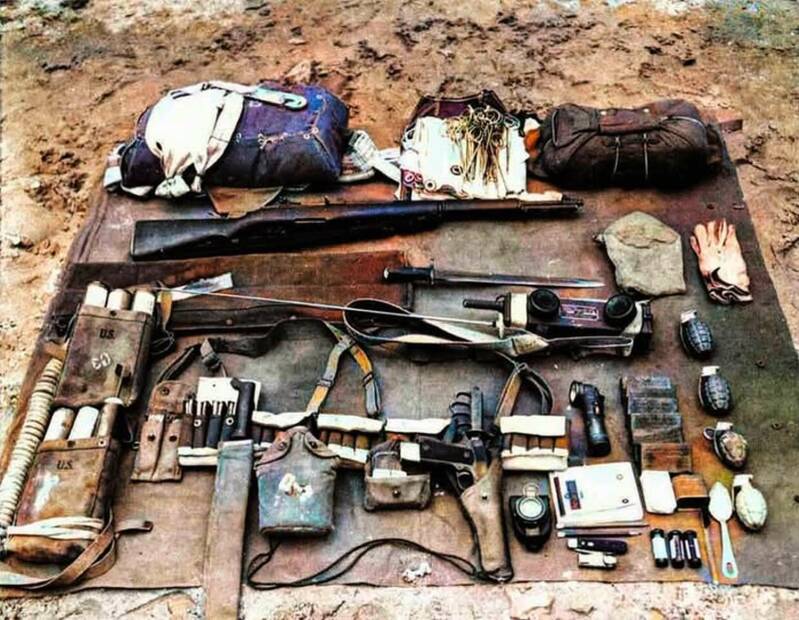
This was the equipment carried by the paratroopers of the 503rd Parachute Infantry Regiment in 1943, before jump on Nadzab, New Guinea. At the very top were the main and reserve parachutes. Directly beneath them were an M1 Garand rifle, a 16-inch M1905/M1942 bayonet, a machete in a canvas sheath, and an M1918 trench knife next to a 1911 pistol holster. In the bottom corner was a simple pocket knife.
On the left side were two packs of signal flares, an M1911 pistol with two spare magazines, and 25 eight-round en bloc clips for the M1 Garand in field-made pouches. This gave the soldier more than 250 rounds of .30-06 and 21 rounds of .45 ACP. He also carried four pineapple-type hand grenades.
One of the key pieces of equipment was the Motorola SCR-536 "Handie-Talkie" radio. Weighing about 2.3 kilograms, this device operated in AM voice mode on a frequency range of 3.5 to 6.0 MHz.
Together with the belt kit, ammo pouches, bags, gloves, flashlight, and other personal gear, this load made up a practical combat kit designed for close-quarters combat, firepower, and survival in the jungle.
With Lae secured, Allied forces moved rapidly to exploit the victory. Landings at Finschhafen in late September established another key base and triggered heavy fighting as Japanese units attempted to counterattack from Sattelberg and the Huon Peninsula. By December, the Huon Peninsula was firmly in Allied hands, and Japanese forces were withdrawing westward toward Madang and Wewak.
Throughout 1943, air power played a decisive role. Fifth Air Force interdicted Japanese shipping in the Bismarck Sea, most notably during the March 1943 destruction of a major convoy, which crippled Japan’s ability to reinforce New Guinea. By the end of the year, Japan’s position in the region was strategically untenable, and the Allies held the initiative for the 1944 advance toward Hollandia and Aitape.