


Overview
The bombing of Wieluń on 1 September 1939 is widely regarded as one of the first hostile actions of the German invasion of Poland. Beginning shortly after 04:40, Luftwaffe units of Luftflotte 4 attacked the undefended town in a series of strikes that continued for several hours. Wieluń had no military garrison, no anti‑aircraft capability, and no strategic industry. Its population consisted almost entirely of civilians, and the town held a functioning hospital clearly marked with Red Cross symbols.
The initial attack destroyed the hospital and killed many of the patients and staff. Subsequent waves targeted the town centre, marketplace, and residential districts. Estimates of casualties vary, but at least 127 civilians were killed, with some assessments placing the number higher due to incomplete records and the scale of destruction. Approximately 70 percent of the town’s buildings were damaged or destroyed, leaving the centre largely in ruins.
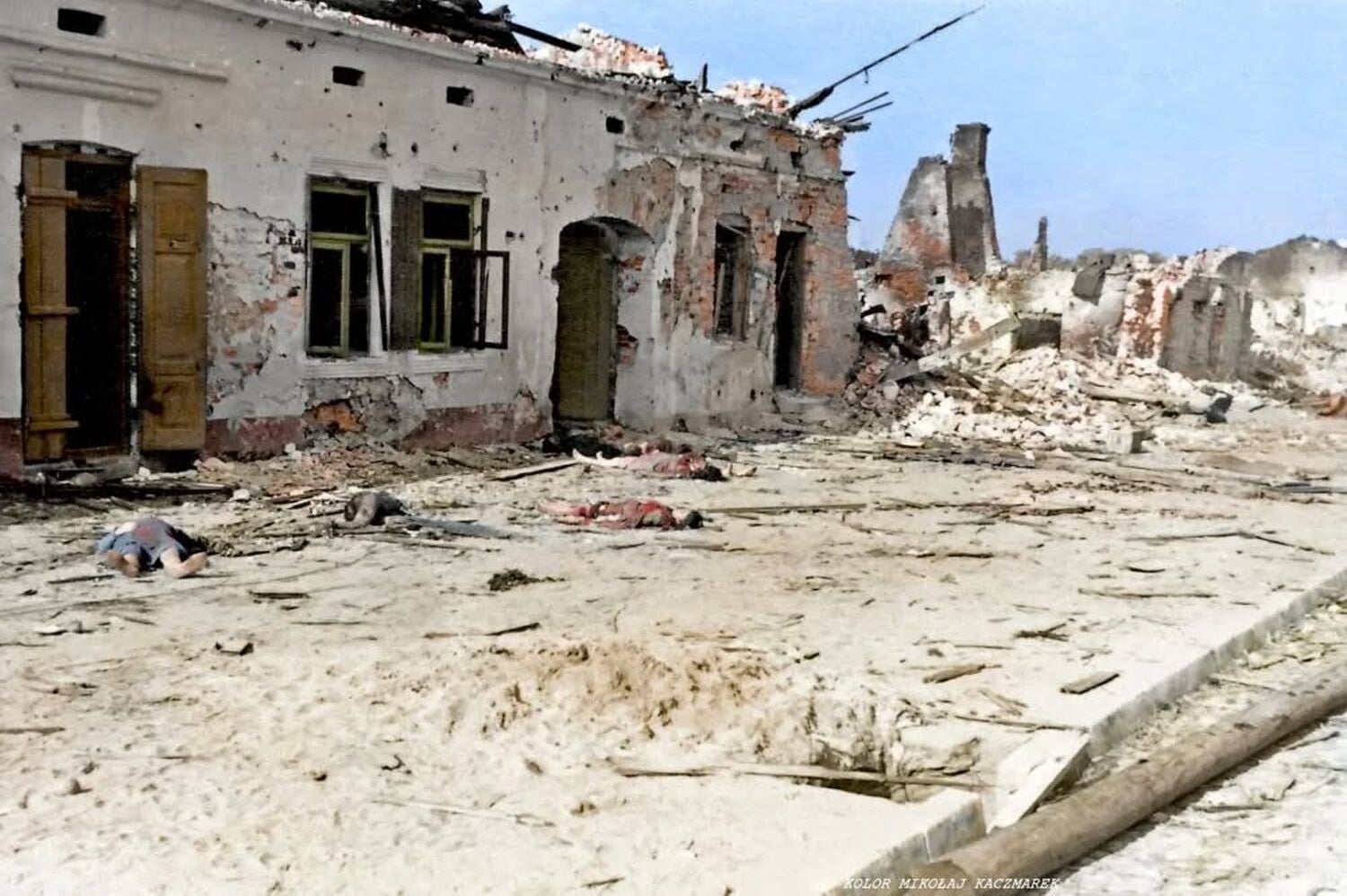
Aftermath of the bombing of Wieluń
The attack had no operational military value. Polish forces were not present in or near the town, and no defensive positions existed. The bombing is therefore frequently cited in historical analysis as an early example of deliberate terror bombing during the Second World War. It demonstrated the Luftwaffe’s willingness to employ air power against civilian targets and foreshadowed similar operations conducted later in the campaign.
Wieluń’s destruction occurred minutes before the shelling of Westerplatte, placing it among the earliest confirmed acts of aggression in the European theatre. The event remains a significant subject in Polish wartime historiography, symbolising the suddenness of the invasion and the vulnerability of civilian populations during the opening phase of the conflict.
The first target?
Wieluń is a town in south‑central Poland with a population of 21,624 as of 2021. It serves as the administrative seat of both Gmina Wieluń and Wieluń County within the Łódź Voivodeship.
Historically, it is the centre of the Wieluń Land, a distinct territorial unit with roots in the medieval Polish state.
The town’s name, first recorded in 1282 as Velun, has uncertain origins.
Historians suggest either a derivation from the Slavic term vel, meaning wetland, or from the personal name Wielisław. Jan Długosz noted the abundance of water in the area, supporting the former interpretation.
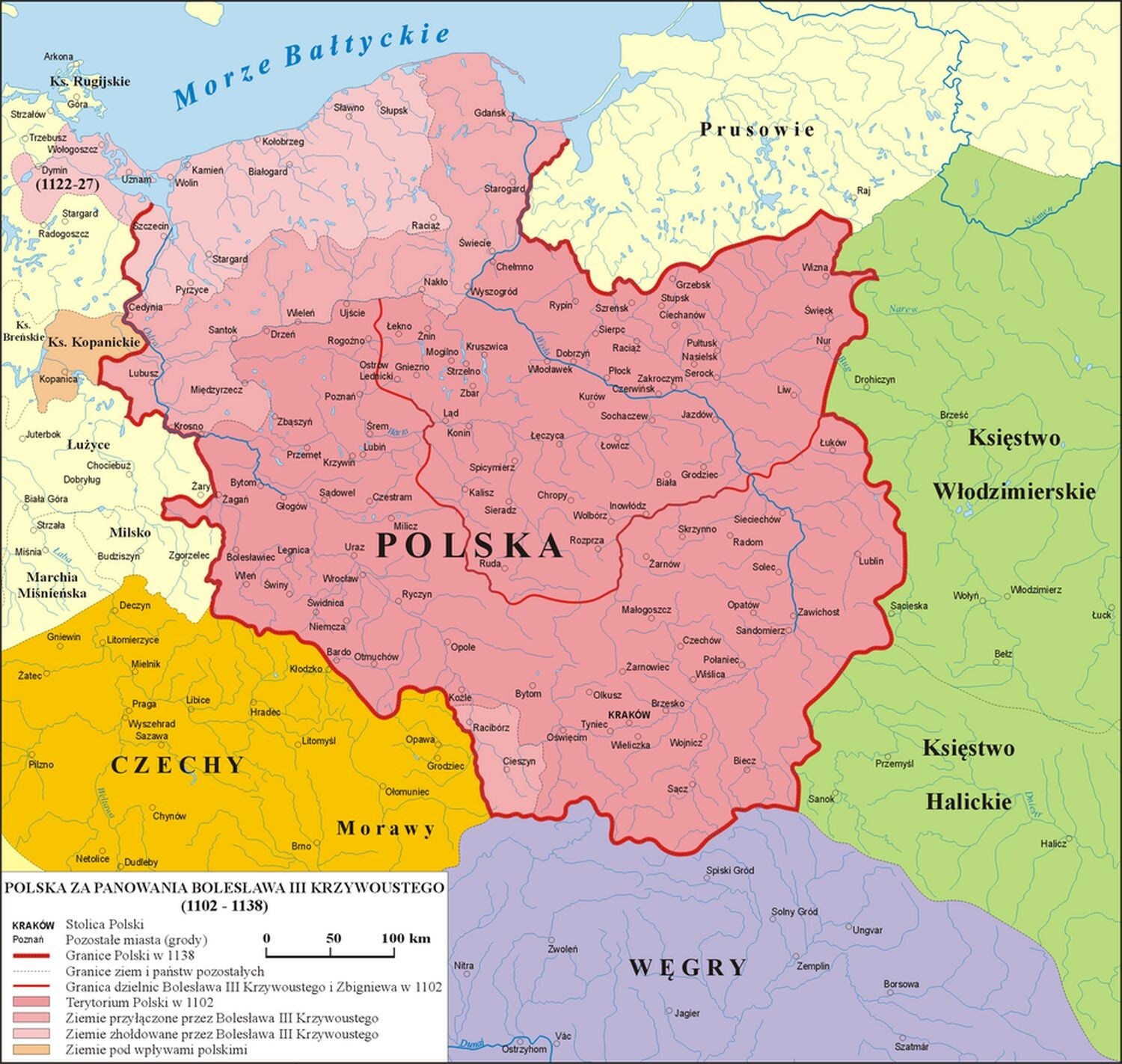
Poland during the rule of Bolesław III Wrymouth (1102–1138). During his reign, the area later known as the Land of Wieluń formed part of the Seniorate Province, centred on the early Castellany of Ruda. The castellany, first mentioned in 1136, served as a local administrative and ecclesiastical centre. Power struggles during Poland’s fragmentation shaped the region’s governance, but Wieluń itself had not yet risen to prominence; that shift occurred later, when the castellany moved from Ruda to Wieluń in 1281.
...local administrative importance...
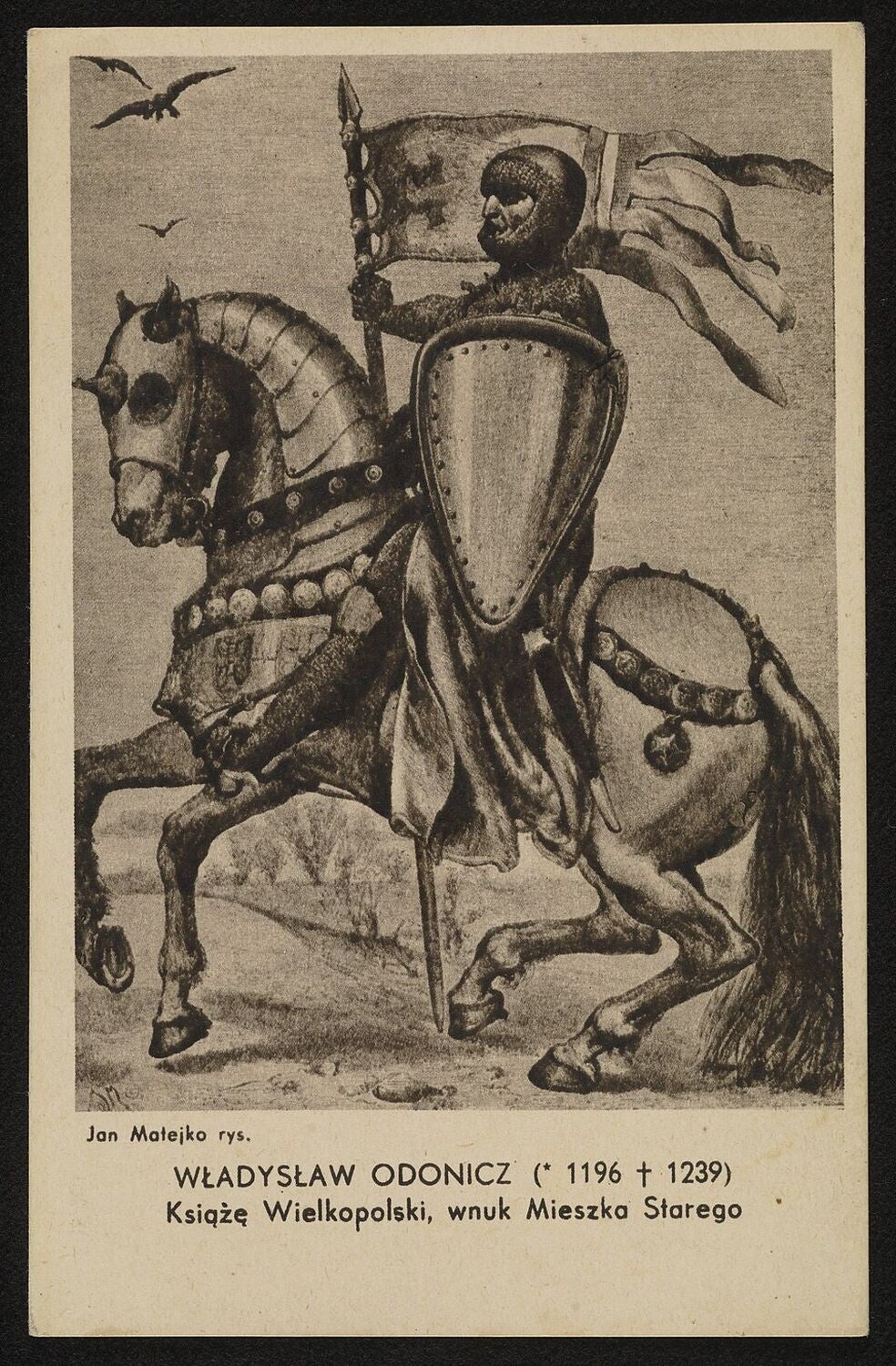
Władysław Odonic, drawing by Jan Matejko on a postcard, published in 1939.
The region’s early administrative structure was based on the Castellany of Ruda, established in the 10th or 11th century and mentioned in the 1136 Bull of Gniezno.
Ruda served as the seat of both a castellan and a Roman Catholic archdeacon, giving it local administrative importance.
During the period of Poland’s fragmentation, the castellany passed through the hands of several Piast dukes, including Mieszko III the Old, Władysław Odonic, and Władysław III Spindleshanks.
In the late 13th century, the castellany came under the control of the Dukes of Silesia from Opole, before returning to Greater Poland.
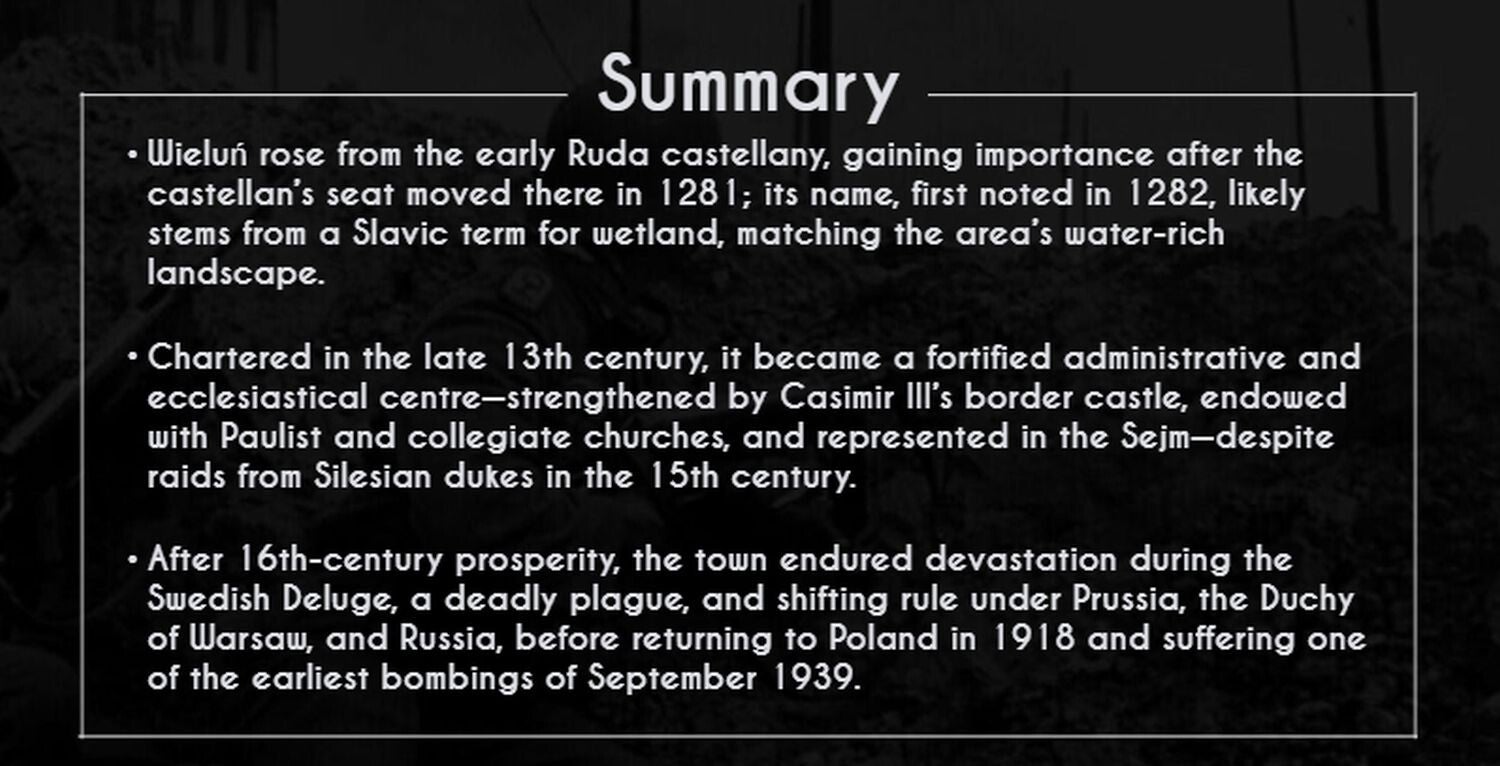
In 1281, the castellan’s office was transferred from Ruda to Wieluń, marking the rise of the latter as the regional centre.
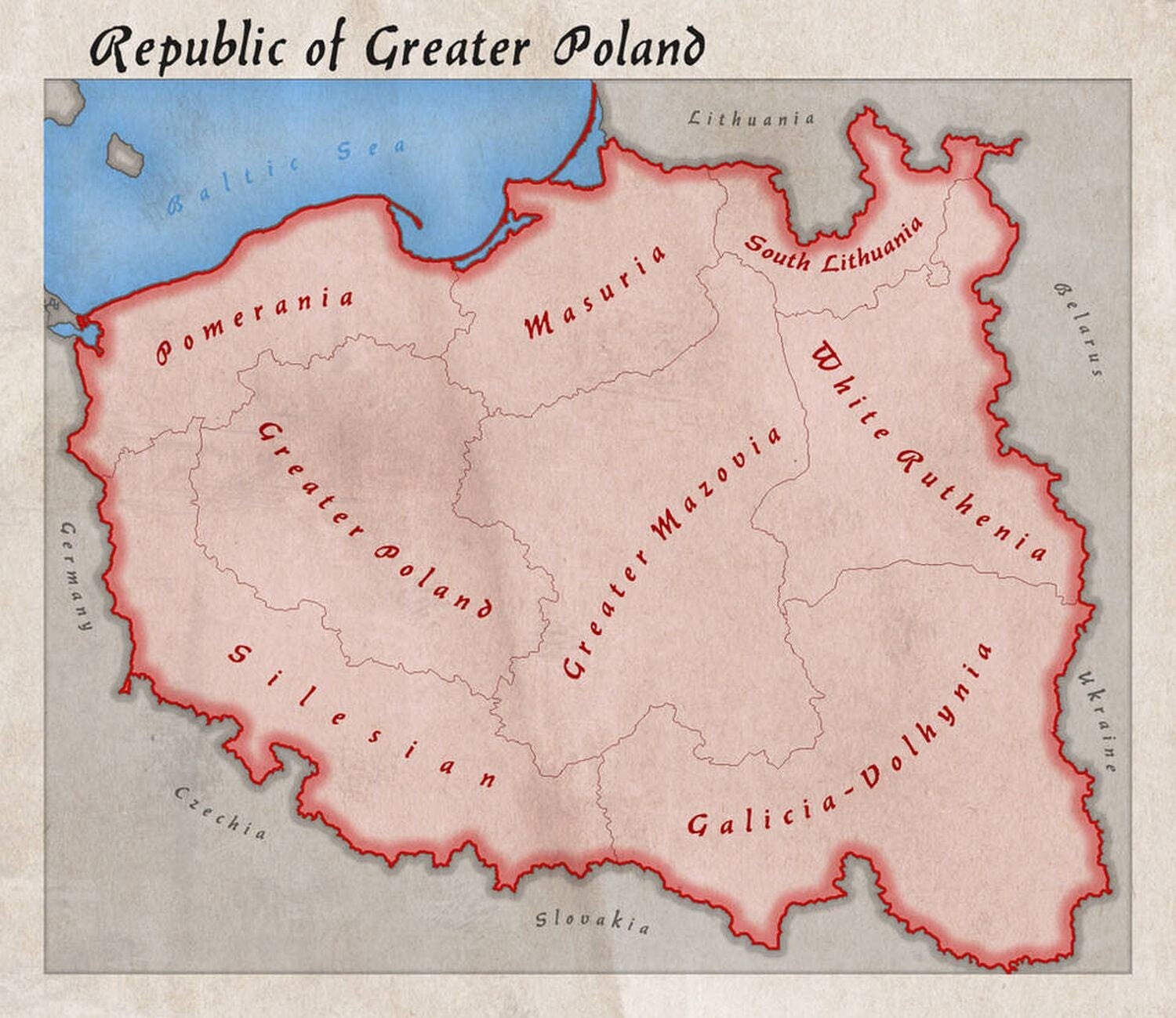
Greater Poland: During the 13th century, the Castellany of Ruda, which governed the region later centred on Wieluń, passed under the authority of the Dukes of Silesia from Opole. This shift reflected the fluid territorial control characteristic of Poland’s fragmentation. Silesian rule was temporary; by the late 13th century the castellany returned to Greater Poland, restoring Piast oversight. In 1281, the administrative seat moved from Ruda to Wieluń, marking the town’s emergence as the region’s principal centre.
https://www.deviantart.com/kristo1594/art/Greater-Poland-311738552
...fires and warfare...
Wieluń itself likely originated around 1220 under Duke Władysław Odonic.
It was first mentioned in 1282 and probably received its town charter in the same period. In the mid‑14th century, King Casimir III the Great constructed a castle as part of a defensive system along the border with Czech‑ruled Silesia.
The structure was repeatedly rebuilt due to fires and warfare; a Classicist palace now occupies its site.
As part of Sieradz Voivodeship, the Land of Wieluń maintained its own officials, courts, and representation in the Polish Sejm.
The Castellan of Wieluń held senatorial rank, and the land elected two deputies to the Sejm. Its coat of arms, created between 1410 and 1434, appears on the tomb of King Władysław II Jagiełło.
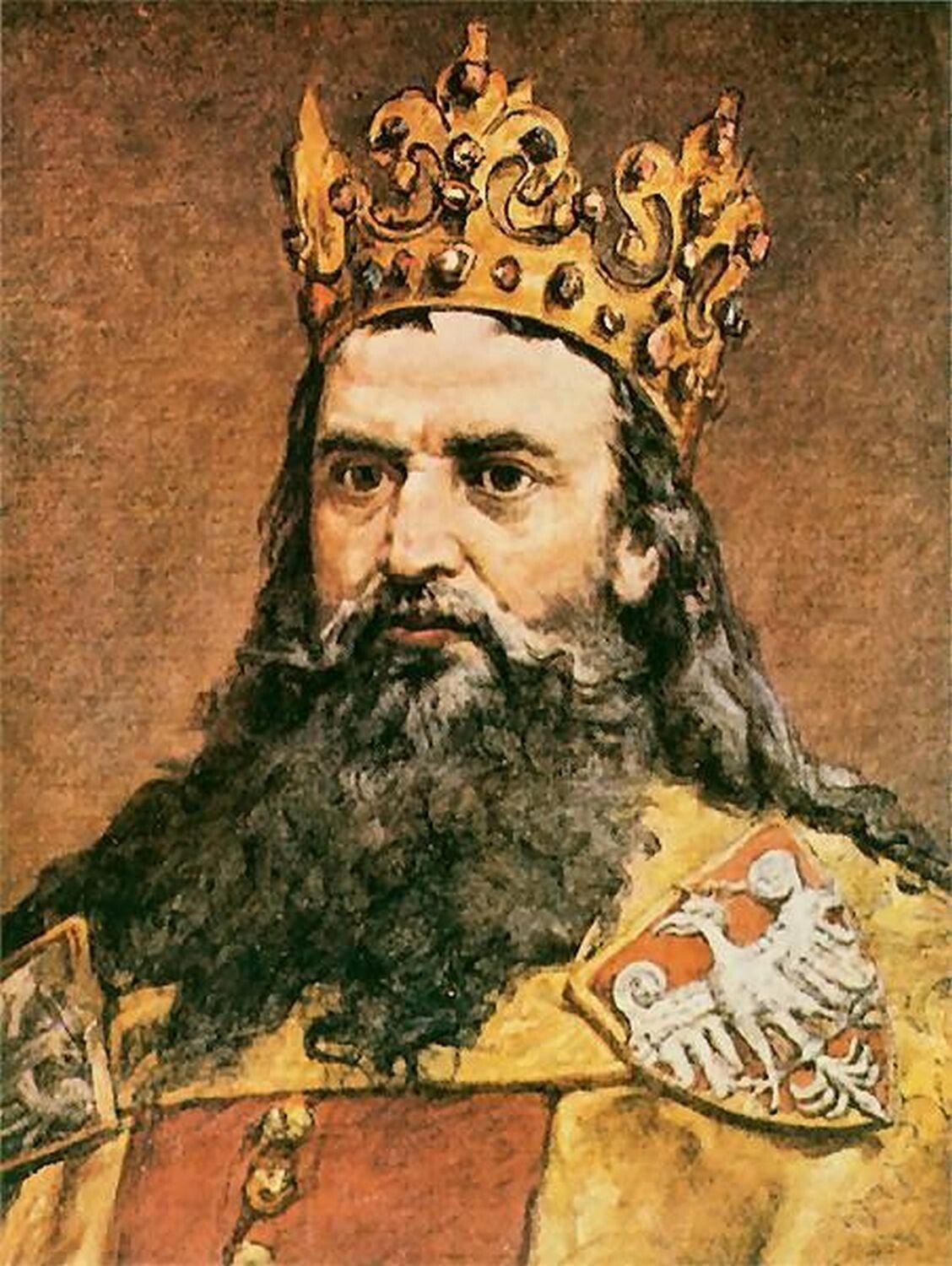
King Casimir III the Great
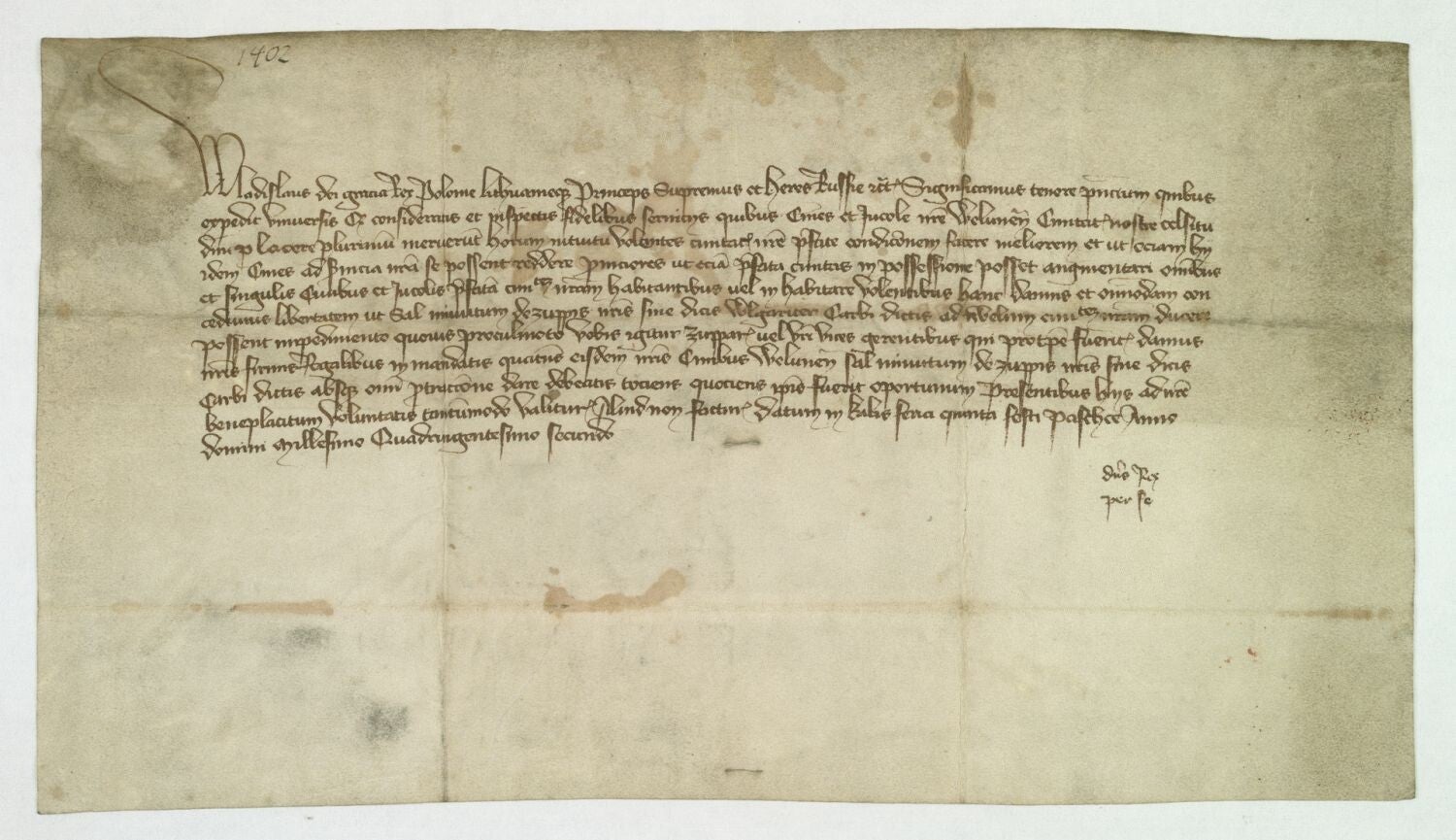
In 1402, King Władysław II Jagiełło granted Wieluń a royal privilege regulating the salt trade, confirming its rights to purchase, store, and distribute salt within the region. The charter strengthened the town’s economic position by integrating it into the royal monopoly system, ensuring stable supply and revenue. This privilege reflected Wieluń’s importance as a commercial centre in the Kingdom of Poland and its continuing role in regional administrative and trade networks.
...remained an important centre...

Louis I of Hungary
In 1370, Louis I of Hungary granted the land to Władysław Opolczyk, Duke of Opole.
After its return to Poland in 1395, Wieluń developed rapidly.
A Paulist church and abbey were built in the 1390s, and in 1413 the collegiate church was transferred from Ruda.
Despite raids by Silesian dukes in the 1440s and 1450s, the town remained an important centre of commerce and administration.
Wieluń prospered during the 16th century Polish Golden Age.
It suffered heavily during the Swedish Deluge, when both Swedish forces and Polish troops devastated the town.
A plague between 1707 and 1711 killed around 2,000 inhabitants.
After the partitions, Wieluń passed through Prussian, Duchy of Warsaw, and Russian control before returning to Poland in 1918.
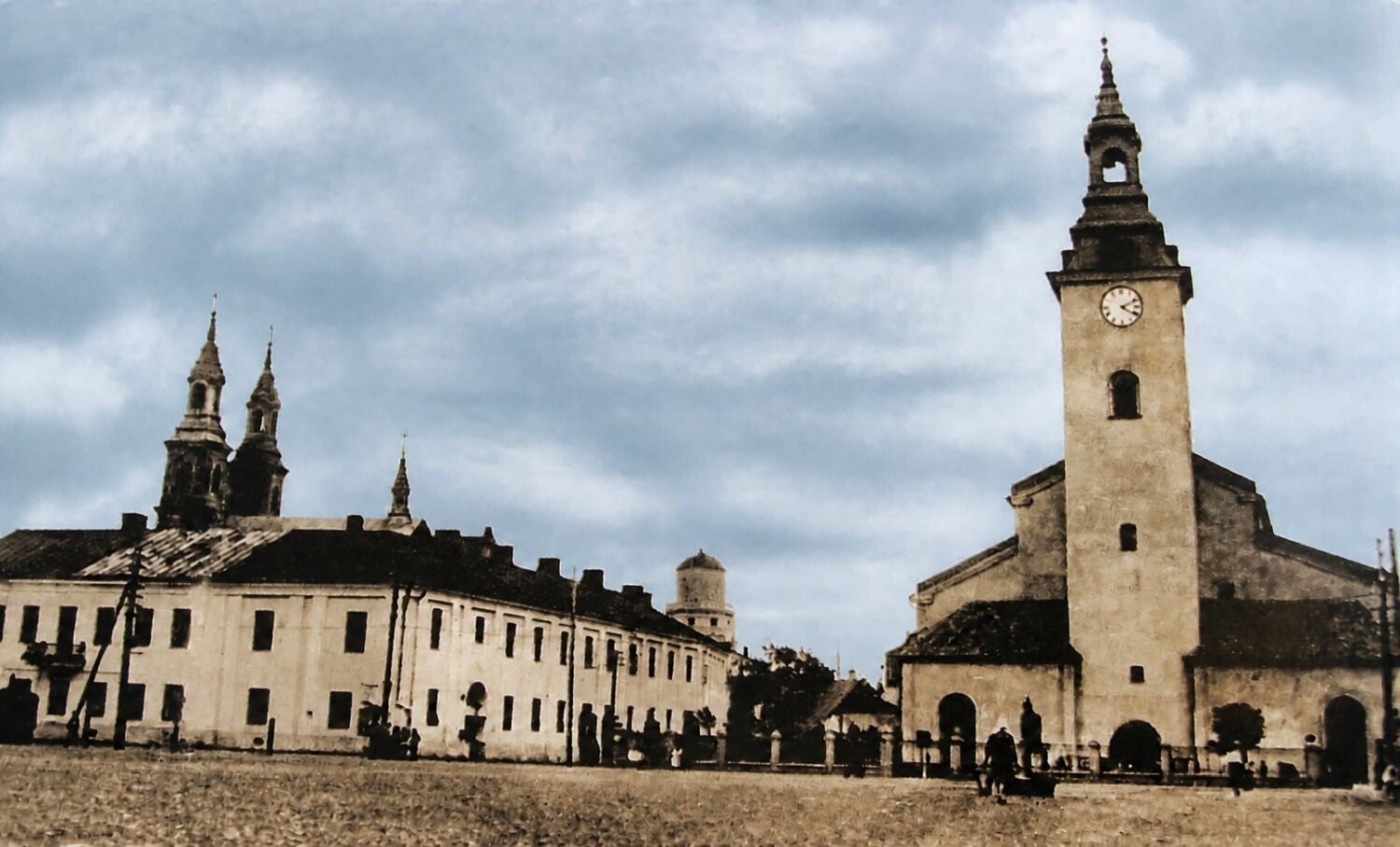
The Old Town in Wieluń in 1910.
Prelude to War
In the weeks leading up to the German invasion of Poland in September 1939, the country experienced a rapid escalation of political tension, military alertness, and civilian anxiety.
The deterioration of relations with Germany had been visible for months, particularly after the occupation of Czechoslovakia and the increasing German pressure over Danzig and the Polish Corridor.
By late summer, Polish authorities anticipated conflict, ordering partial mobilisations and strengthening defensive positions along the western frontier.

However, diplomatic uncertainty and foreign pressure caused delays in full mobilisation, leaving many units incomplete when hostilities began.
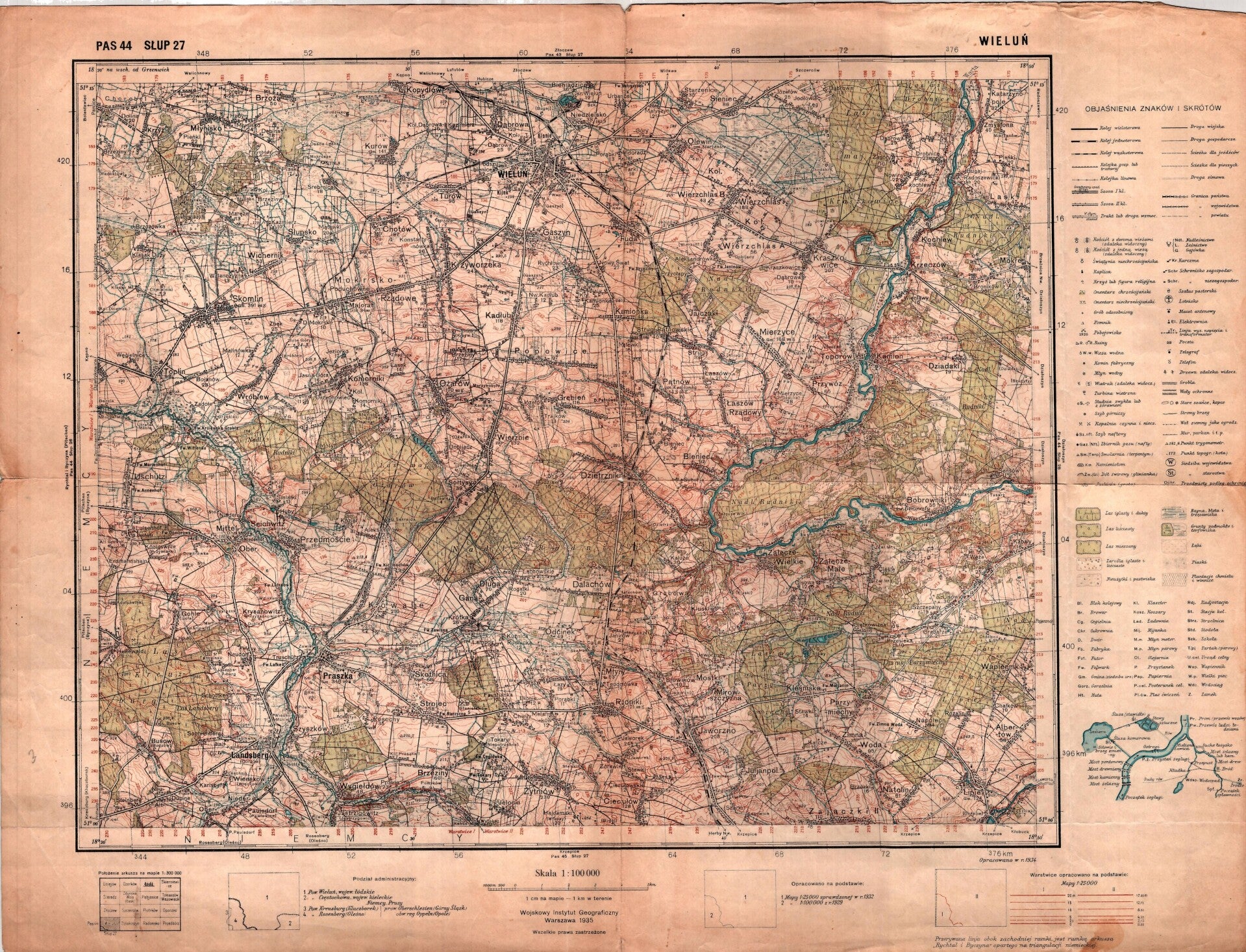
Wieluń in 1935. Wieluń in the late 1930s was a small, predominantly civilian market town in central Poland with no military industry or defensive infrastructure. Its economy centred on local trade, crafts, and agriculture. The community experienced the same political tension affecting the wider Second Polish Republic, yet remained strategically insignificant. By 1939 it was an undefended settlement, making its destruction on 1 September a stark example of civilian vulnerability during the invasion.
...determination and apprehension...
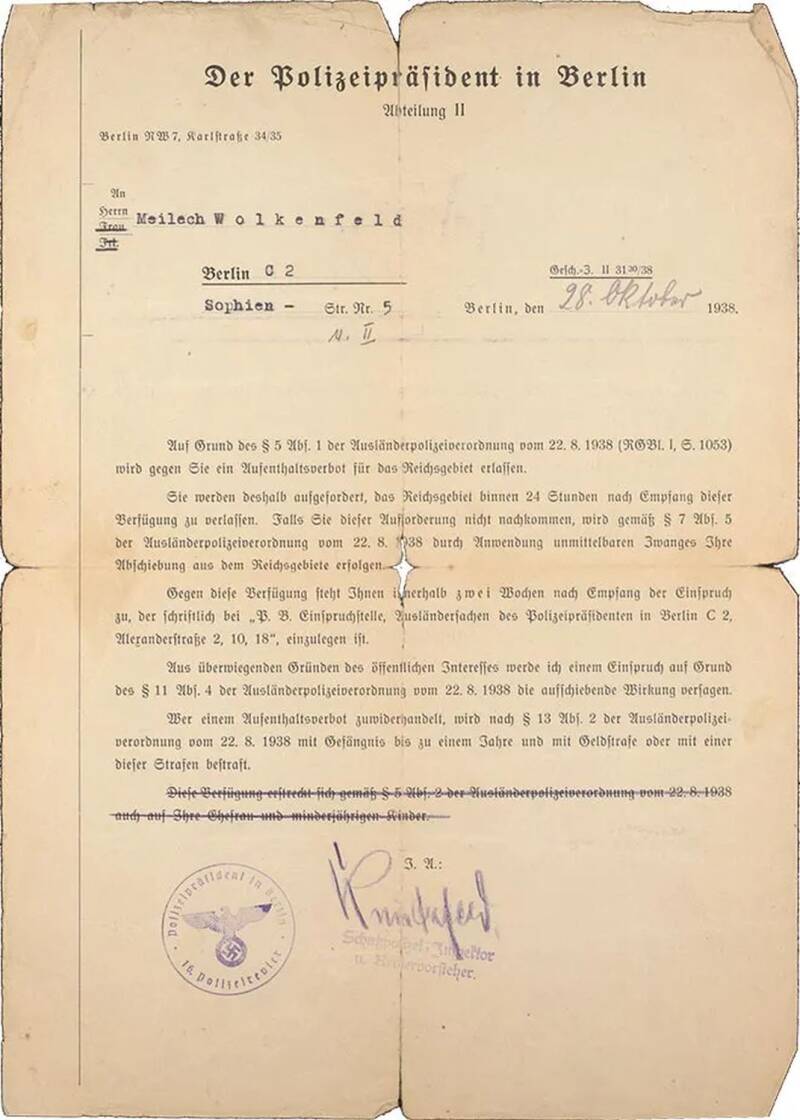
Meilech Wolkenfeld’s expulsion order on 28 October 1938 formed part of escalating prewar coercion, as the Nazi regime expelled 17,000 Polish Jews, signalling its growing radicalisation and the tightening repression that preceded the outbreak of wider conflict.
https://www.jmberlin.de/en/topic-polenaktion-1938#media-13417
Across Poland, the atmosphere was marked by a mixture of determination and apprehension.
Government communications urged calm while preparing the population for air‑raid precautions, blackout regulations, and civil defence measures.
Towns and villages organised volunteer fire brigades, first‑aid posts, and shelters, though resources were limited.
Industrial centres increased production of military supplies, while railways operated under heightened security to move troops and equipment.
Despite these preparations, many communities remained vulnerable due to shortages of modern weaponry, limited anti‑aircraft defences, and the speed of German operational planning.
Towns near the western border, including Wieluń, felt the strain acutely.
Their location made them likely targets for early strikes, and residents observed troop movements, fortification work, and the arrival of reserve units.
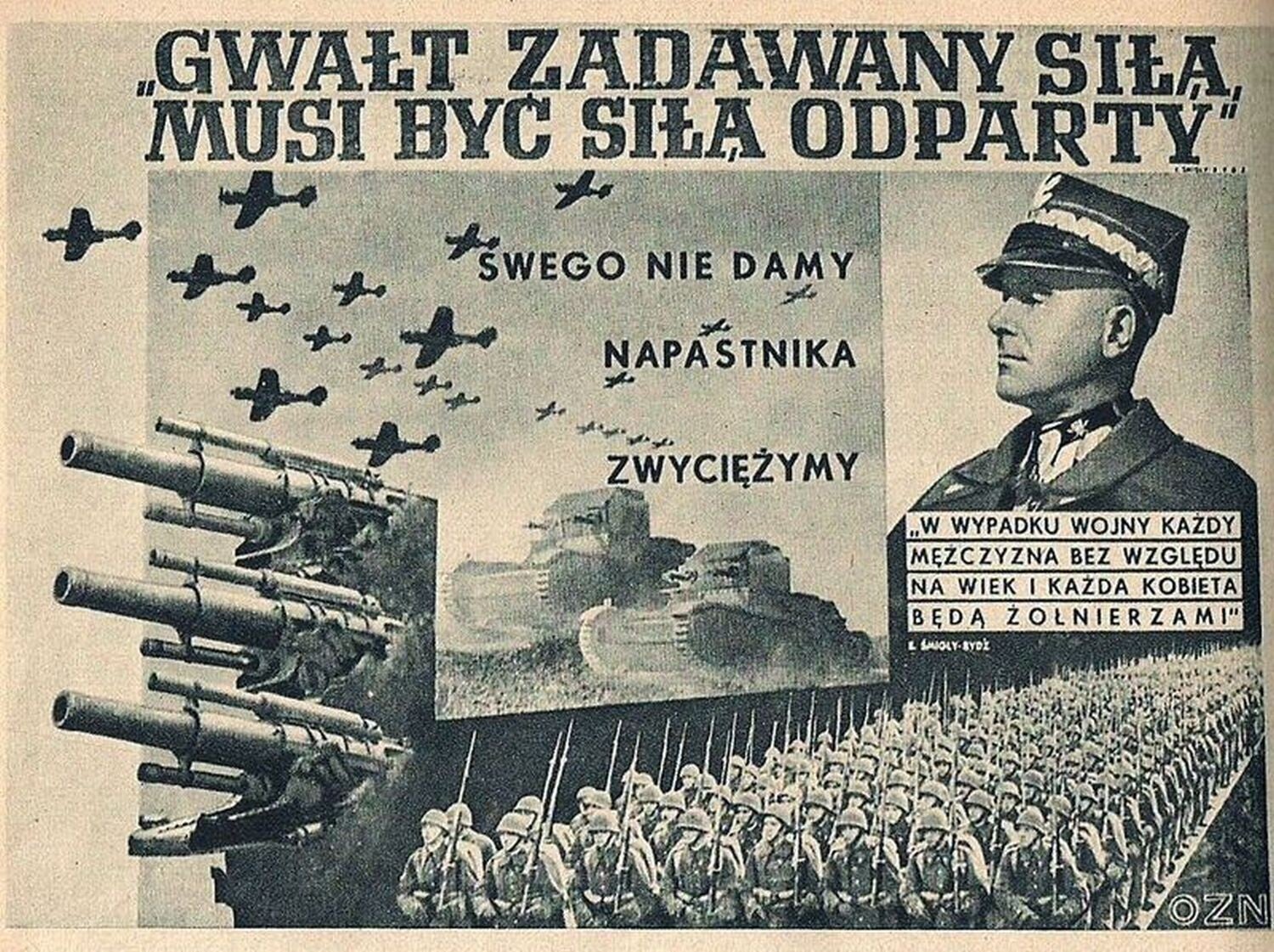
Wieluń’s ordeal on 1 September 1939 became an early symbol of the collapse of assumptions underpinning Plan West. The Polish concept relied on holding key western regions long enough for France to launch the promised offensive within fifteen days of mobilisation. Wieluń, an undefended town far from major military positions, was struck in the opening minutes of the war, demonstrating the speed and reach of German air power and the vulnerability of Poland’s rear areas. The attack illustrated that even areas outside the main defensive belt could not be secured long enough for Plan West to function.
https://eng.ipn.gov.pl/en/digital-resources/articles/7180,Plan-West-The-plan-that-never-was.html
...felt the strain acutely...
Local administrations attempted to secure essential supplies and maintain order, but uncertainty persisted.
In Wieluń, civil defence instructions were distributed, yet the town lacked substantial military presence or strategic infrastructure, leaving it exposed to air attack.
With mobilisation incomplete and resources scarce, residents depended on improvised precautions that offered little real protection against the threat of bombardment.
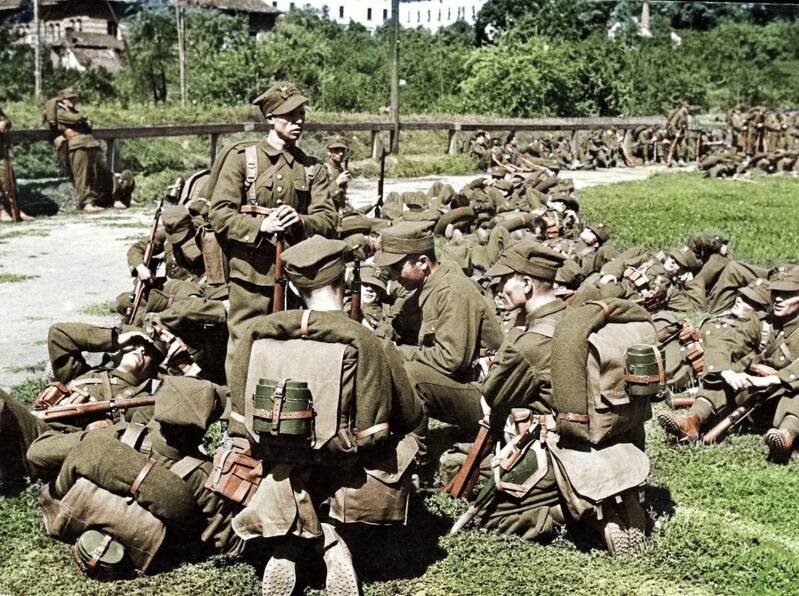
Polish soldiers training during the mobilization in early 1939.
...intensifying public concern...
By late August, rumours of imminent war circulated widely.
The signing of the Molotov–Ribbentrop Pact confirmed Poland’s isolation, intensifying public concern.
When the invasion began on 1 September, towns like Wieluń experienced the immediate consequences of modern warfare, with the Luftwaffe’s bombing demonstrating the vulnerability of civilian centres in the opening hours of the conflict.
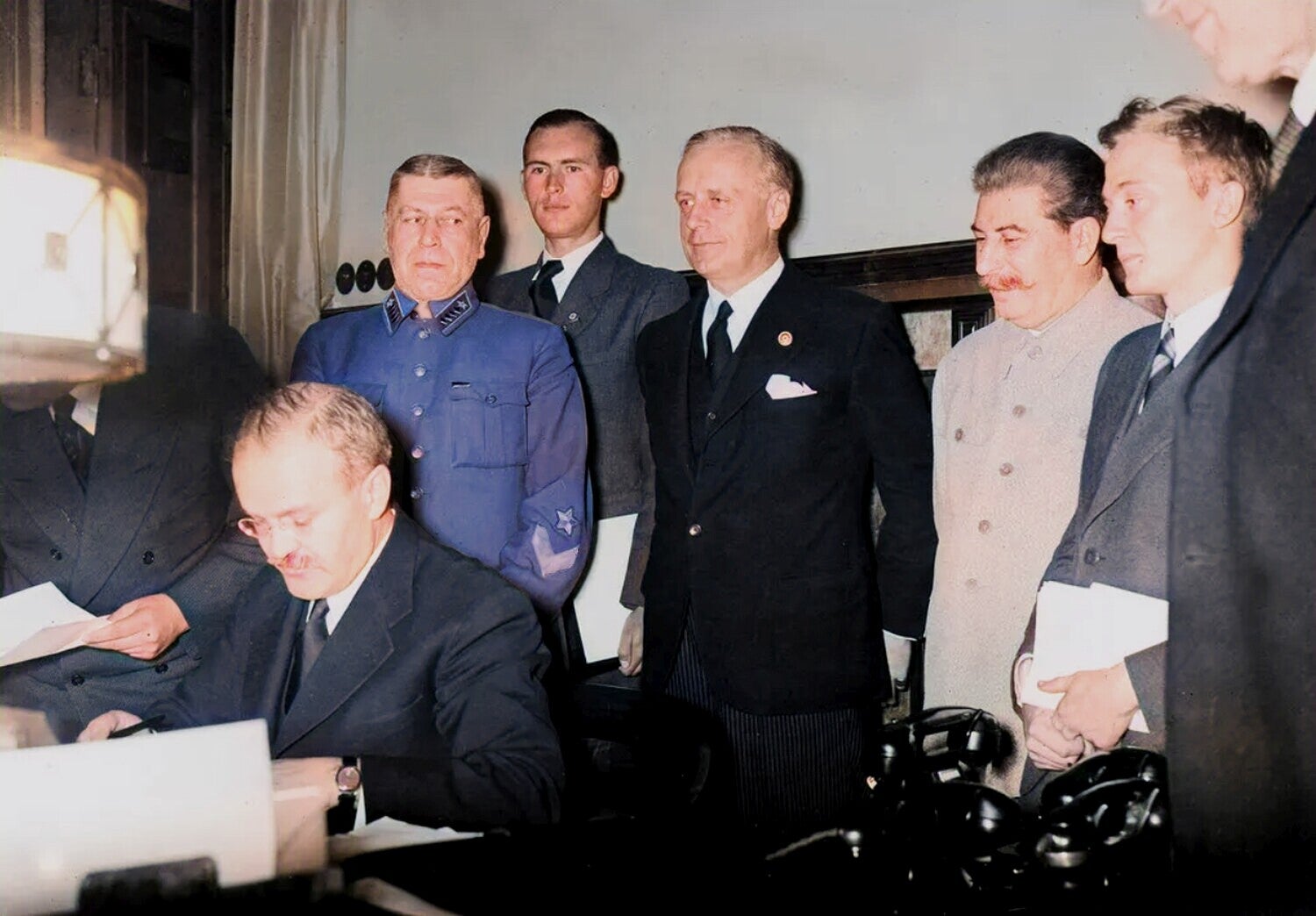
The Soviet foreign minister Vyacheslav M. Molotov signing the 1939 Molotov-Ribbentrop Pact, as the German foreign minister, Joachim von Ribbentrop, standing third from left, and Stalin, fourth from left. The signing of the pact removed any possibility of Soviet intervention against German expansion, enabling Hitler to attack Poland without fear of a second front. This strategic freedom allowed the Wehrmacht and Luftwaffe to begin the invasion with maximum force on 1 September. Wieluń, an undefended civilian town, became one of the earliest targets. Its destruction reflected Germany’s confidence that the pact guaranteed political cover for aggressive operations.
Heinrich Hoffmann/ullstein bild, via Getty Images
The Bombing
29 Junkers Ju 87B Stukas of I group Sturzkampfgeschwader 76 took out from Nieder-Ellguth airport under the leadership of Captain (Hauptmann) Walter Sigel.
They arrived at Wielu uncontested and dropped 29 500-kilogram bombs and 112 50-kilogram bombs.
The hospital, which most likely featured Red Cross symbols, was one of the first targets; 32 people were killed there.
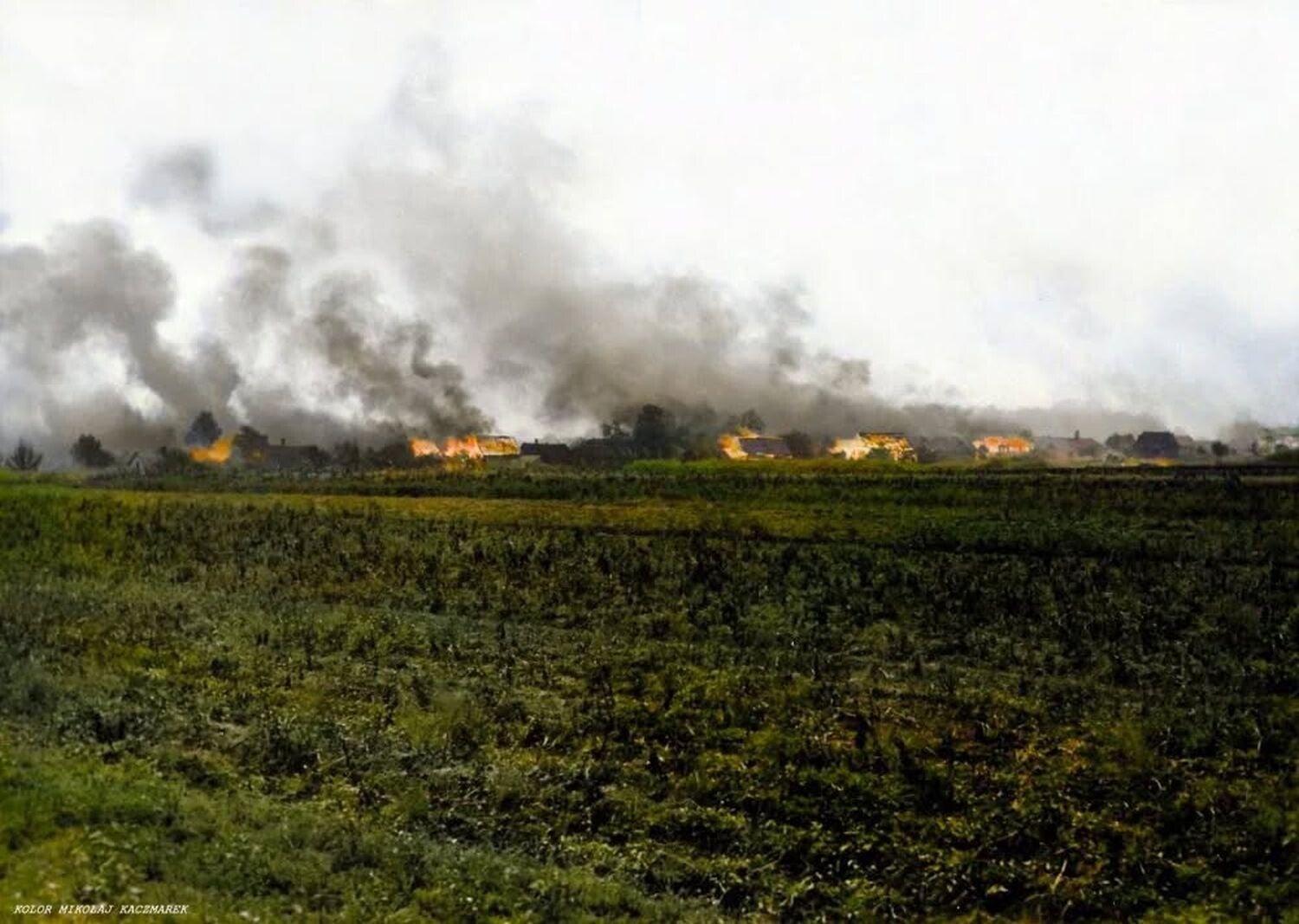
After the hospital caught fire, German planes strafed people attempting to flee.

...strafed people attempting to flee...

After the hospital caught fire, German planes strafed people attempting to flee.
Within an hour, all 29 aircraft had returned to Nieder-Ellguth, where Sigel reported "no significant enemy observation."
During the strike, German planes reported "blue sky" and detailed descriptions of the structures targeted.
German pilots reported no enemy activity in Wieluń following the initial raid.
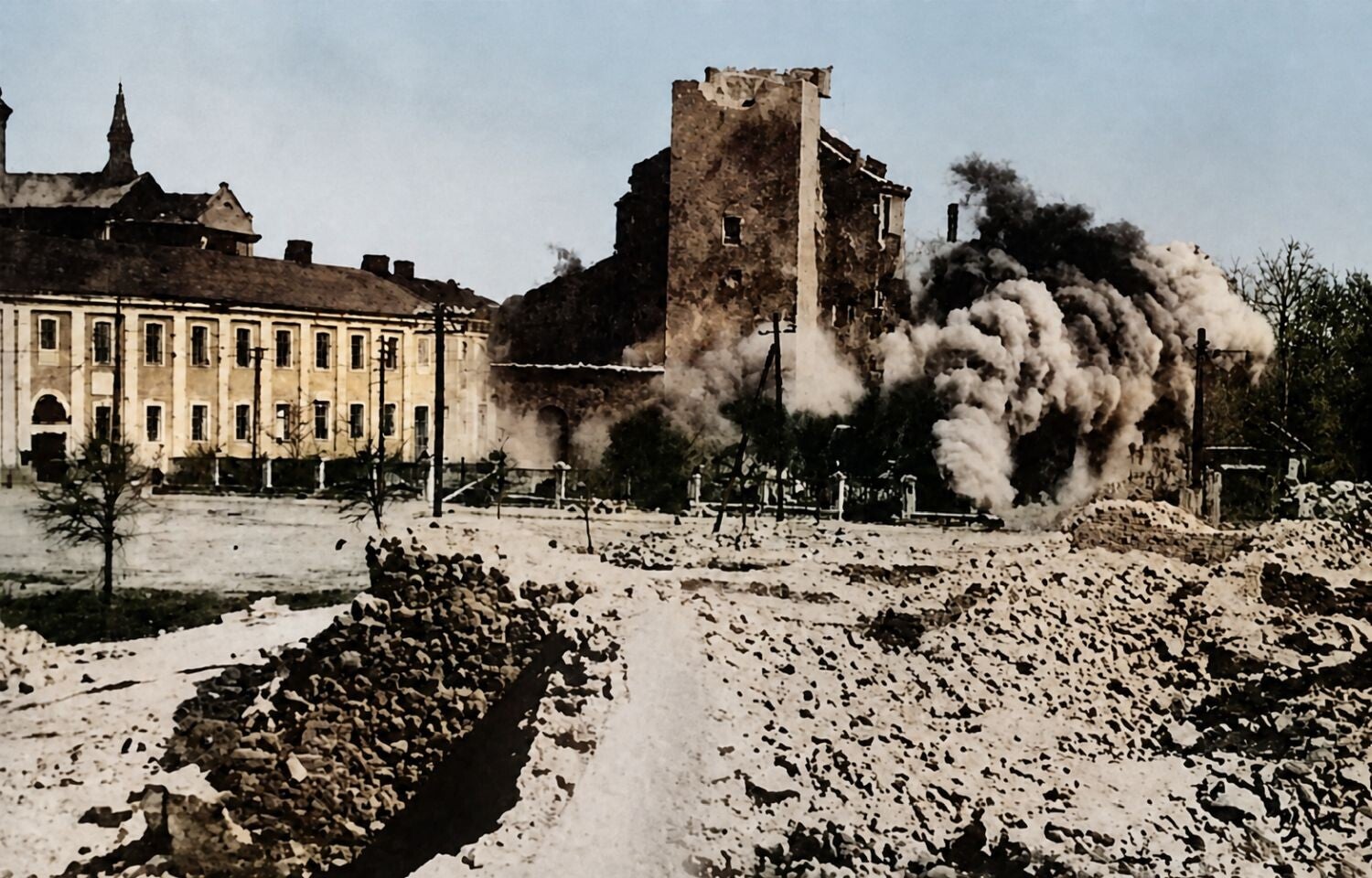
Bombing of St. Michael's Church in Wieluń, September 1, 1939.
...several more waves blasted the town...
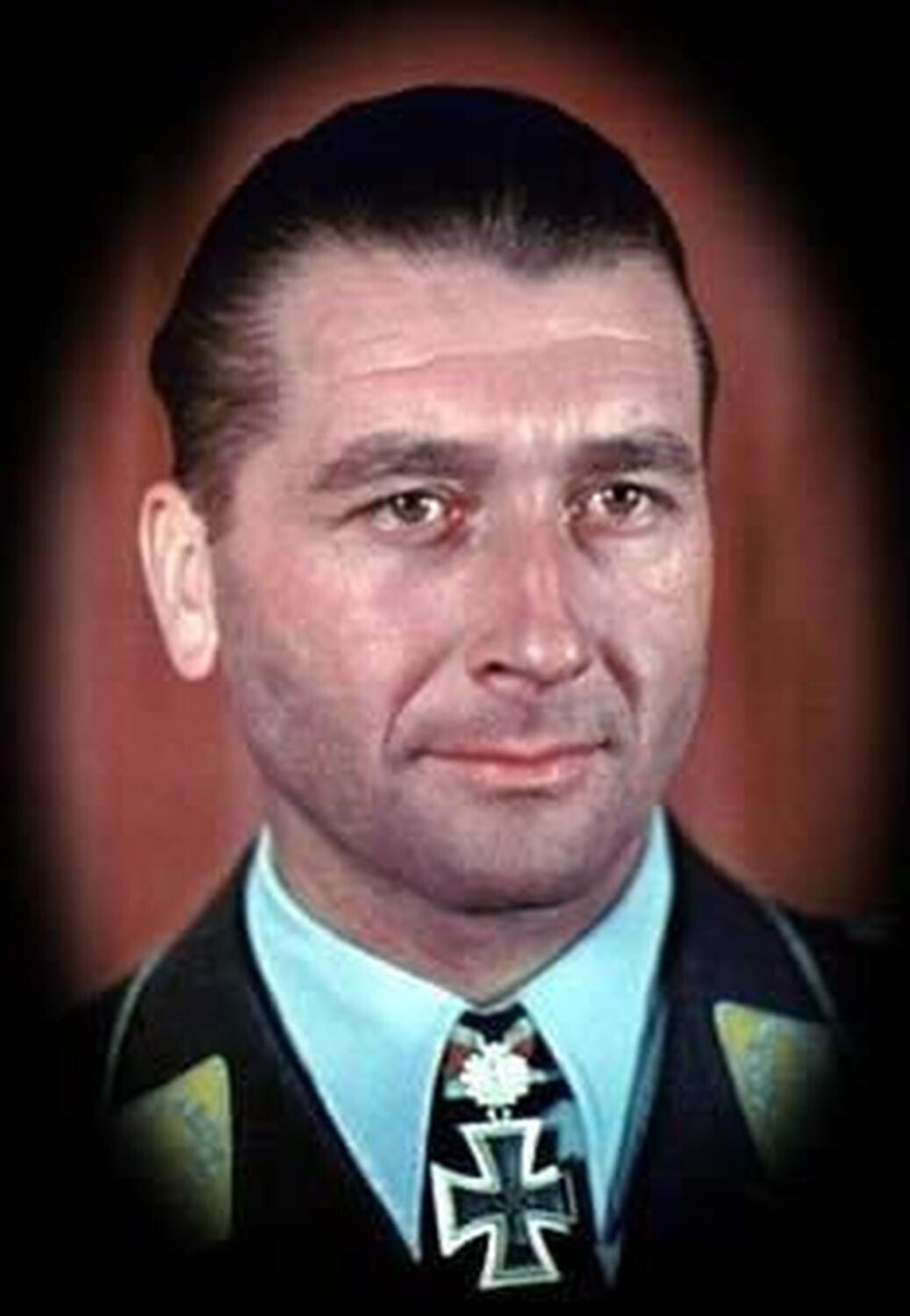
Captain (Hauptmann) Walter Sigel lead the raid on Wieluń
Two Dornier Do 17 reconnaissance planes that scouted the region for Polish military troops between 04:50 and 05:02 reported finding numerous, the closest to the town being in a forest 12 kilometres (7.5 miles) southwest of Wielu.
Several more waves blasted the town; the number varies according to accounts.
Captain Friedrich-Karl Freiherr von Dalwigk zu Lichtenfels commanded one of the latter waves, described by Pitkowski as the second, of Stuka bombers from I./Sturzkampfgeschwader 77.
The second wave, which attacked the town at 05:08 (or possibly 06:08), was commanded by Captain von Schönborn, also of Sturzkampfgeschwader 77, according to Ksiek. Hauptmann Clemens Graf von
Schönborn-Wiesentheid commanded II./Sturzkampfgeschwader 77.

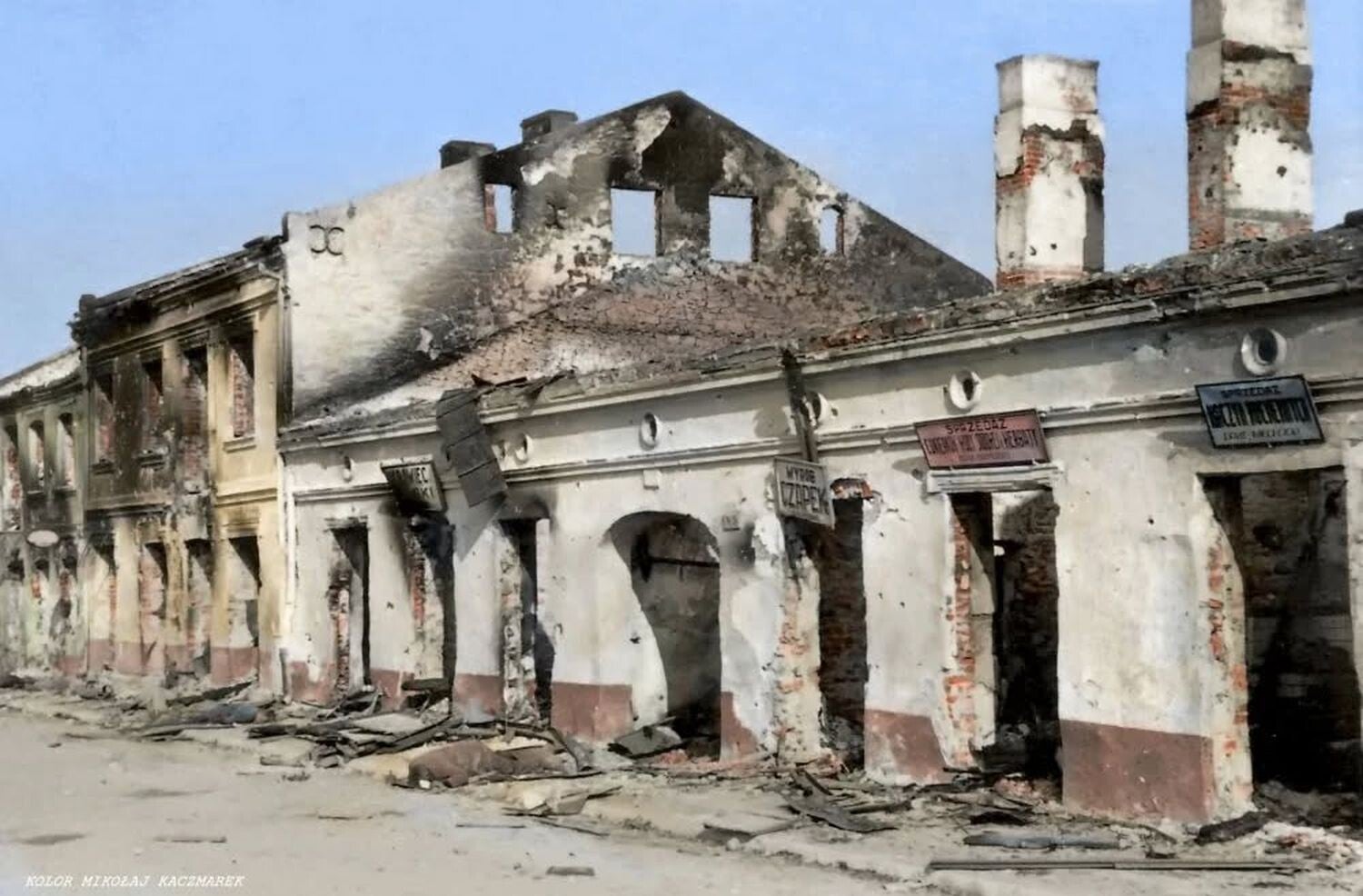
...the city was bombarded with exceptional precision...
A third wave of 29 Stukas from Sturzkampfgeschwader 2, led by Major Oskar Dinort of Nieder-Ellguth, attacked Wielu at 13:00 (or 14:00).
However, according to Bbnik, the third wave, led by Major Dinort, attacked the town between 8:00 and 9:00 a.m.
This was followed by a fourth wave of 60 Ju 87 Stukas from I./Sturzkampfgeschwader 77, commanded by Günter Schwartzkopff, around 14:00 hours.

...bombarded with exceptional precision...

Bbnik concludes that three morning waves and one milder afternoon wave of bombing can be established based on German documents.
Due to the lack of air defences, the city was bombarded with exceptional precision from a low height.
Following the attack, Germans strafed fleeing people. On the first day of the invasion, the German Army took the town.
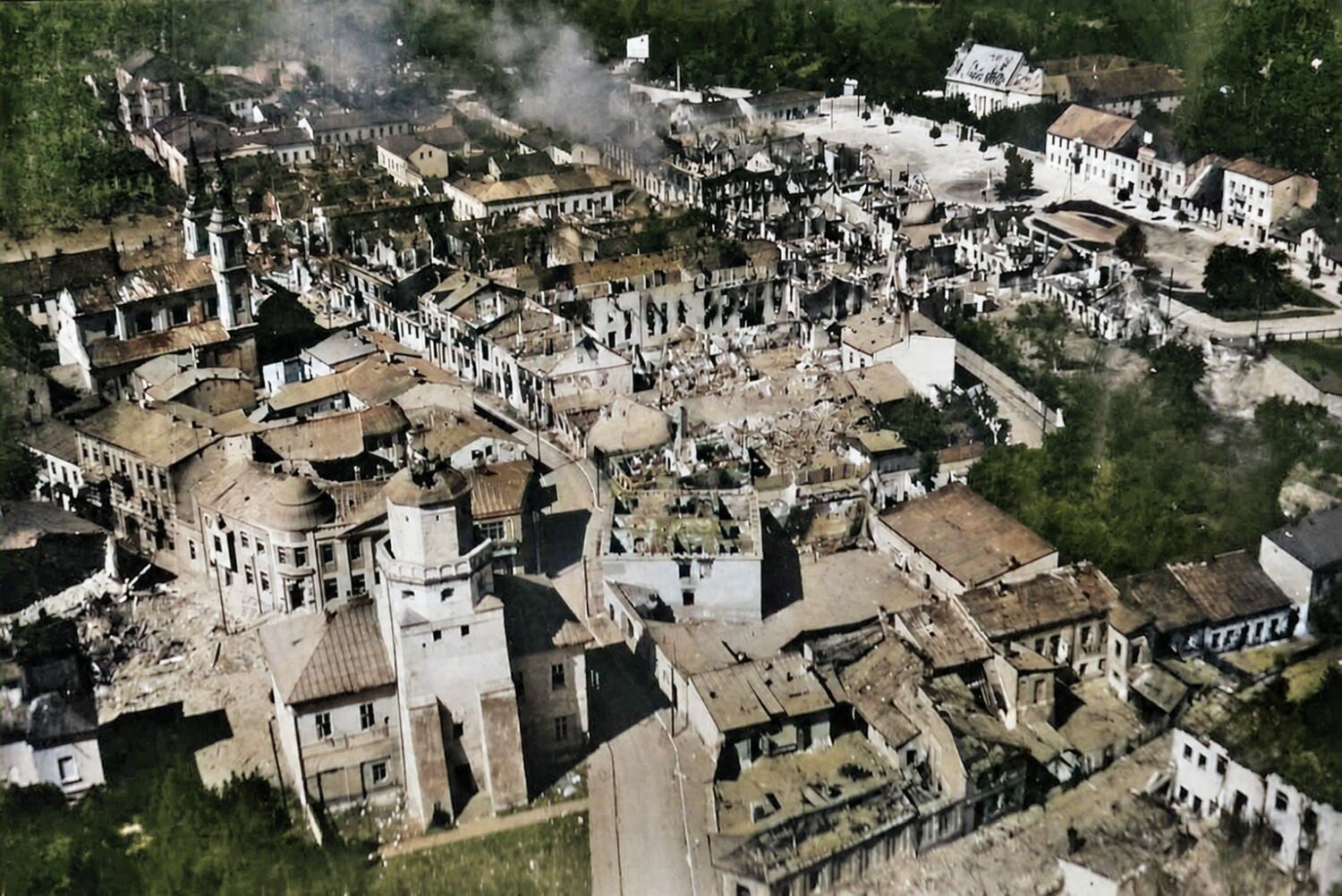
Wieluń just after Luftwaffe bombing on 1 September 1939. The extent of the damage can clearly be seen.
Aftermath
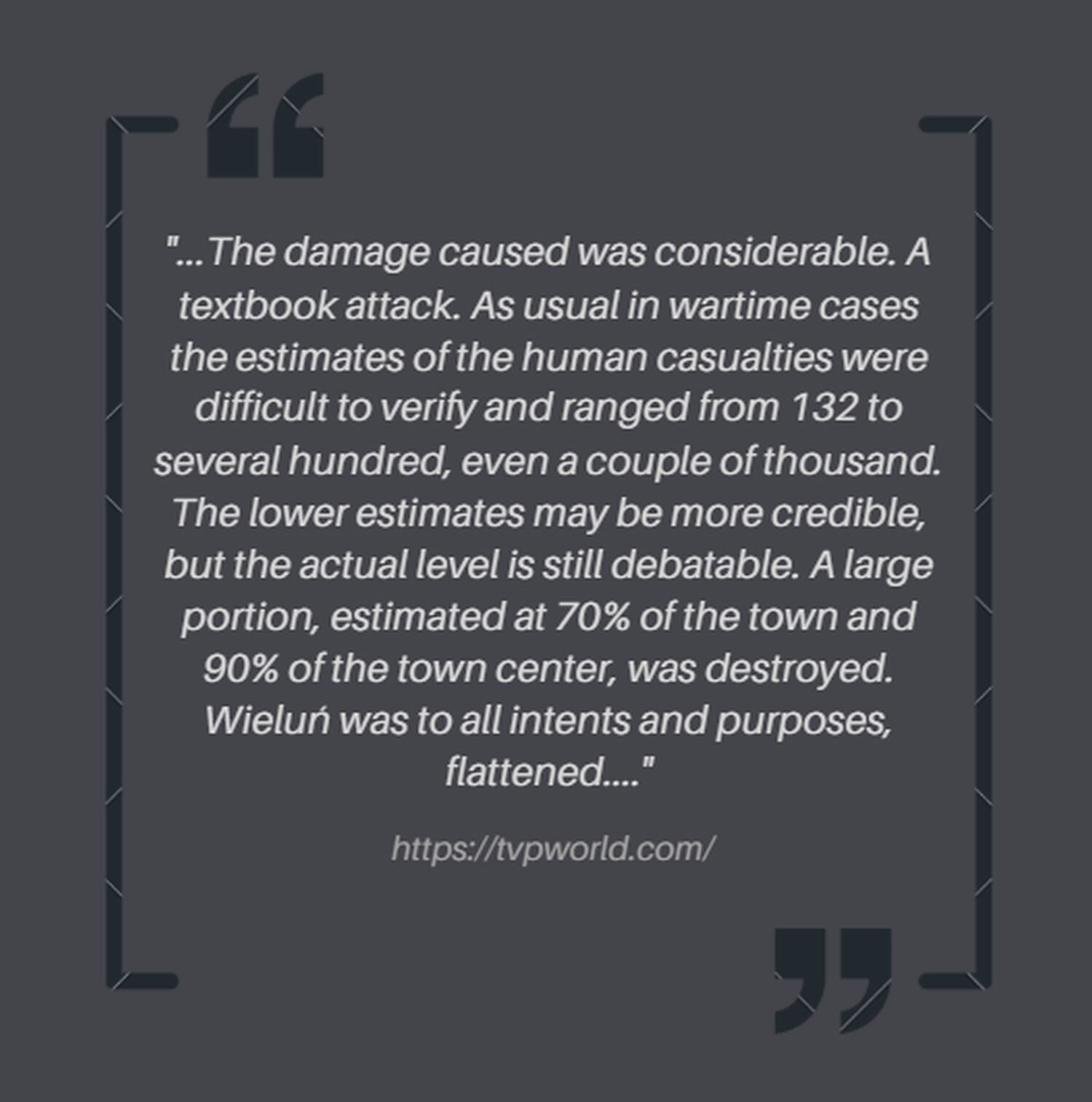
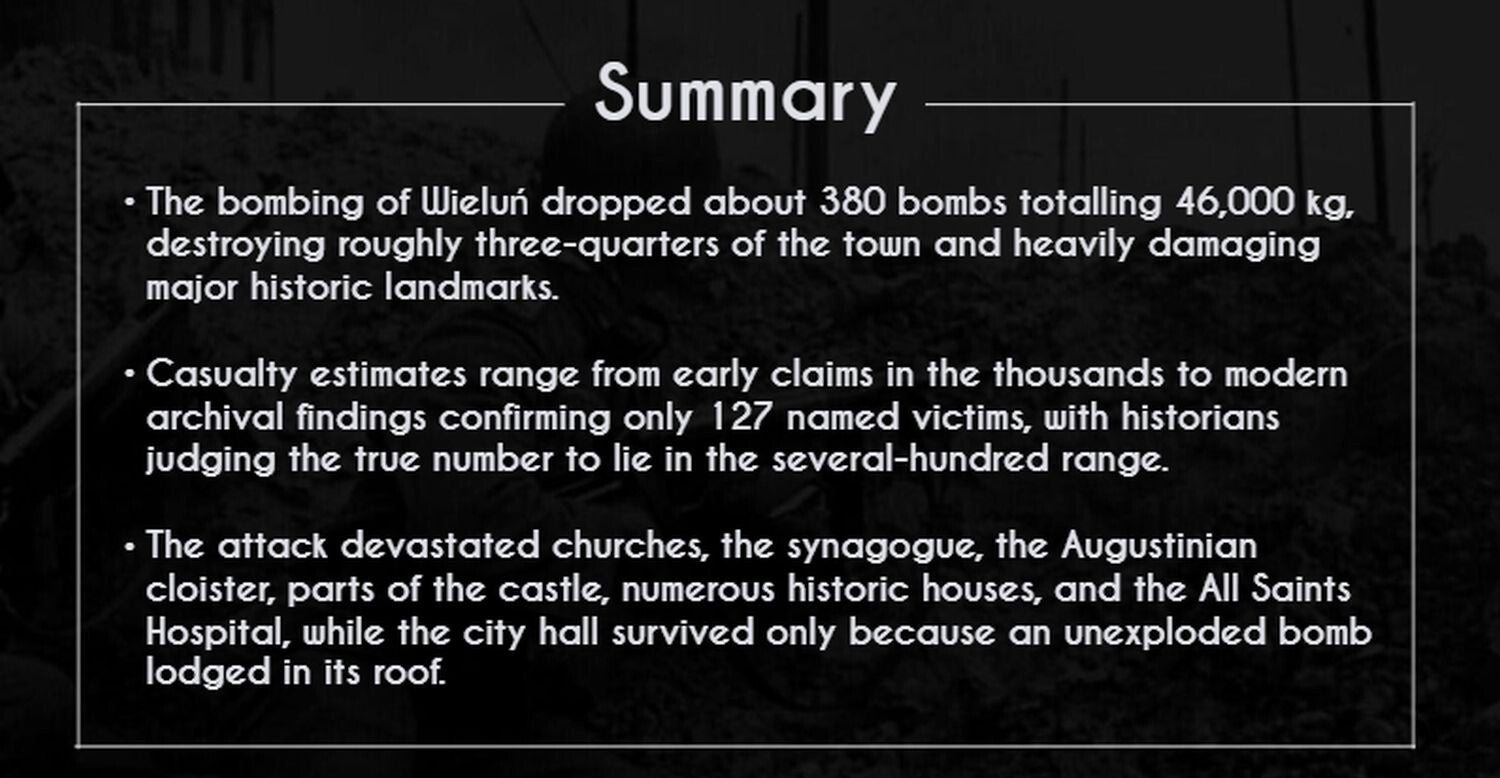
In total, 380 bombs weighing 46,000 kg were dropped on the town, destroying 70% of the town's structures, including up to 90% in the city centre.
According to some estimates, 75% of the buildings were destroyed.
Casualty estimates vary greatly because an accurate casualty count does not exist because no full damage investigation was performed until after the war.
Early estimates from the People's Republic of Poland put the death toll at 2169; however, these figures have since been updated and reduced.

...1,290 townspeople dead...

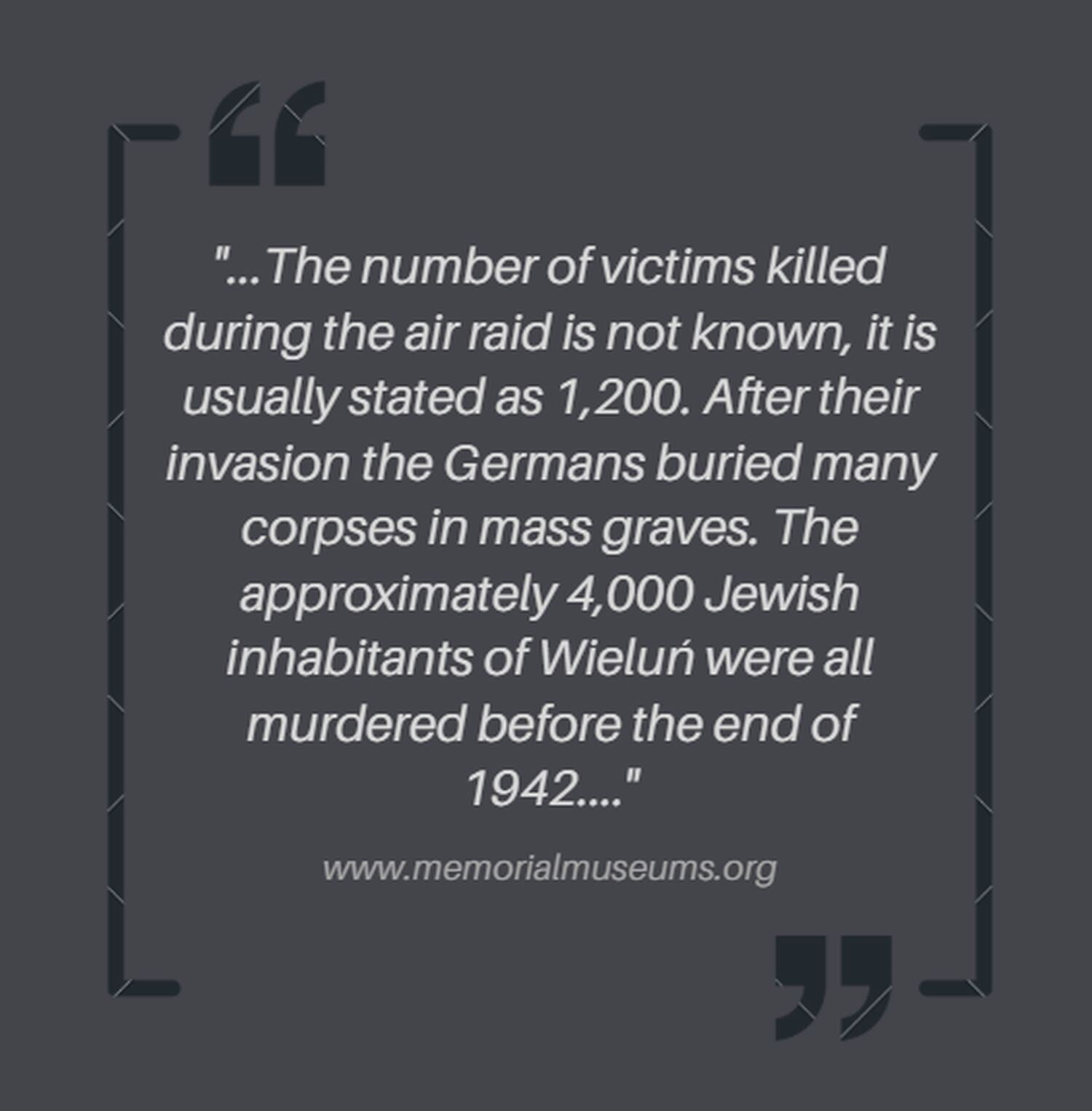
The casualty rate was "more than twice as high as Guernica's or Coventry's," according to Norman Davies, who quoted the statistic of "1,290 townspeople dead," which was popular in older research and is still quite frequently reported in modern media.
According to historian Pitkowski, the number of proven casualties is 127, and the claim of 1,200 is erroneous because it represents the total number of fatalities in Wielu County.

Aftermath of the Coventry Blitz: The British city was battered by German bombers during 'The Blitz', suffering enormous damage. However, despite the sheer scale of these raids, Wielun - a much smaller location - suffered a higher amount of casualties.
...bombing killed 32 persons, including 26 patients...
A similar conclusion was reached in a 2004 Institute of National Remembrance assessment, which noted that while the number of casualties was probable in the "several hundred" range, there were insufficient sources to arrive at a decisive number, and only 127 were named beyond all doubt.
Major landmarks, damaged or destroyed by the German bombing included:
- The Collegiate Church in Wieluń , built in the 13th–14th centuries.
- A mid-19th-century synagogue in Wieluń.
- The 14th-century Augustinian cloister in Wieluń.
- One wing of the 19th-century castle in Wieluń.
- The All Saints Hospital in Wieluń with a clear Red Cross roof sign, whose bombing killed 32 persons, including 26 patients.
- The 15th-century city walls in Wieluń severely damaged.
- Over a dozen historic 18th- and early-19th-century houses.
- The city hall, with its 14th-century Kraków Gate, survived when a bomb got stuck in the city hall's roof and failed to explode.

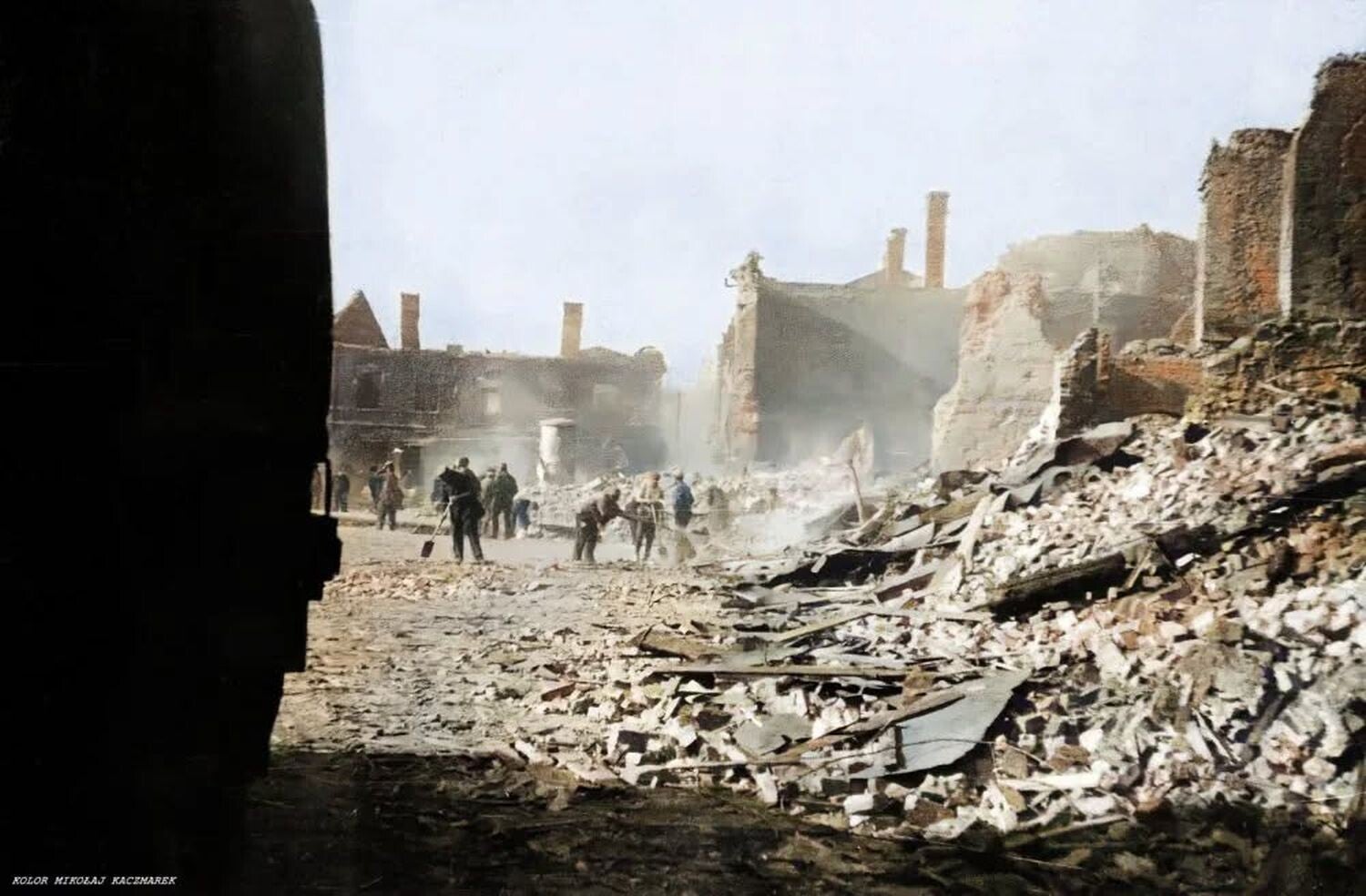
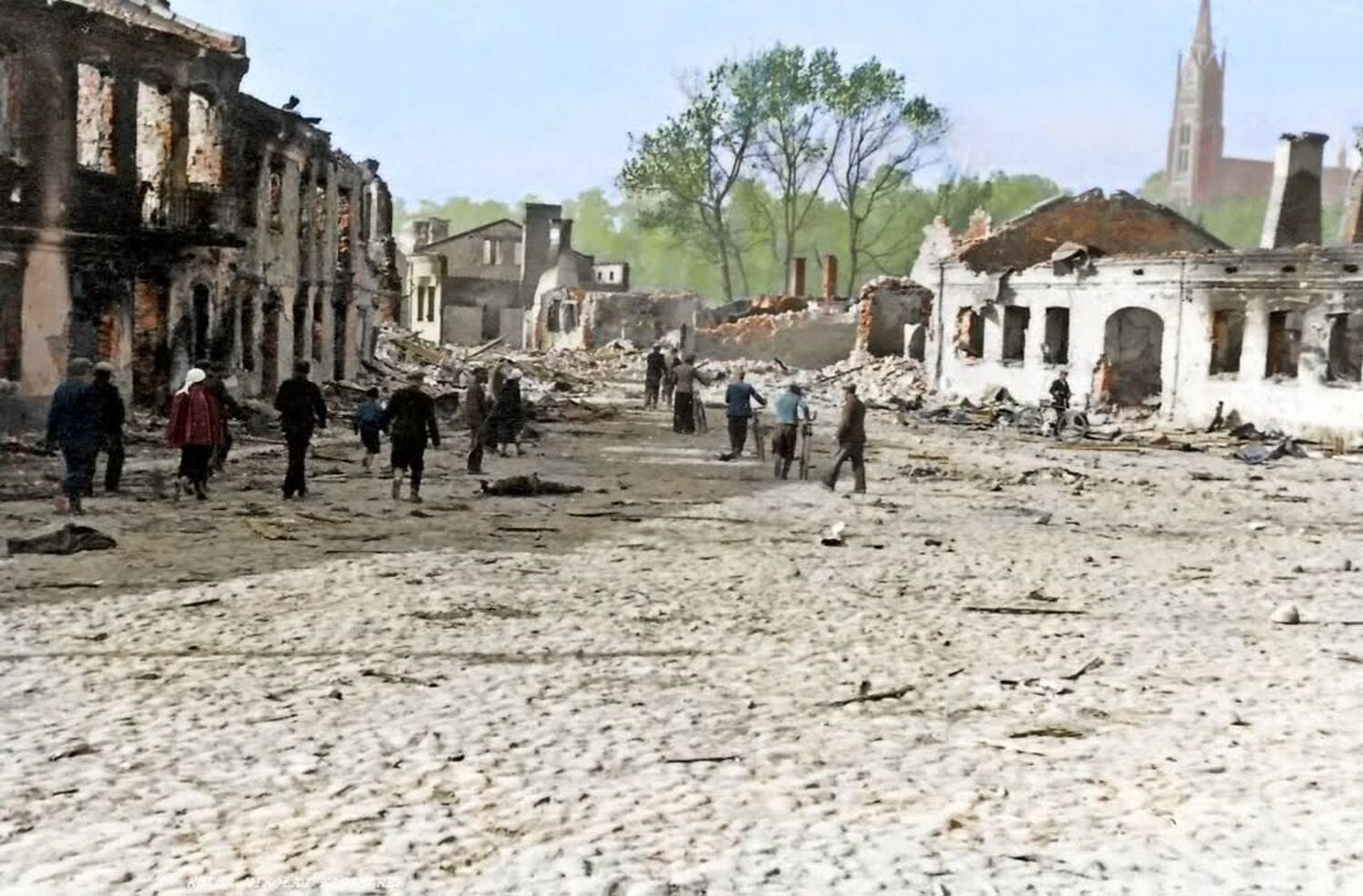
The aftermath of the raid. Residents come to terms with the immense destruction.
The bombing of Wieluń. Beginning of World War II. 80th Anniversary 1939-2019 - YouTube
A War Crime?
The attack was part of Germany’s strategy of “Blitzkrieg,” which relied on a combination of fast-moving armoured units and airpower to quickly defeat the enemy.
The Luftwaffe was tasked with destroying Poland’s air defences and creating chaos among the civilian population.
Wieluń was chosen as the first target because it was located near the German border and was believed to be an important railway hub.
However, according to reports, the Luftwaffe bombed a "well-recognised" hospital and strafed fleeing residents.


View of the bombed city centre from St. Michael's Church.
...70% of the town was completely destroyed...
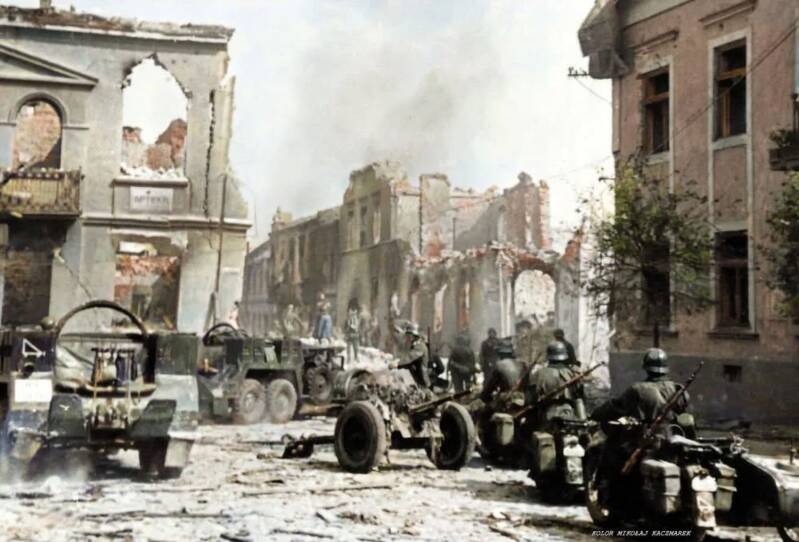
German troops move through the ruins of Wieluń.
Following the incident, 127 civilian casualties were recorded, potentially "several hundred," although the precise number is unknown.
70% of the town was completely destroyed (90 per cent in the city core).
The majority of the town's buildings were gutted, including the hospital, schools, and homes.
The bombing also caused fires that burned for several days.

Wielun residents cleaning up after the raid.
Poland marks 80 years since first bombs fell – DW – 09/01/2019
...many of the victims were women, children, and the elderly...
The death toll from the bombing of Wieluń was high and many of the victims were women, children, and the elderly.
The town's hospital was also destroyed, leaving the wounded without any medical attention.
Many of the survivors were left homeless and without food or clothing.
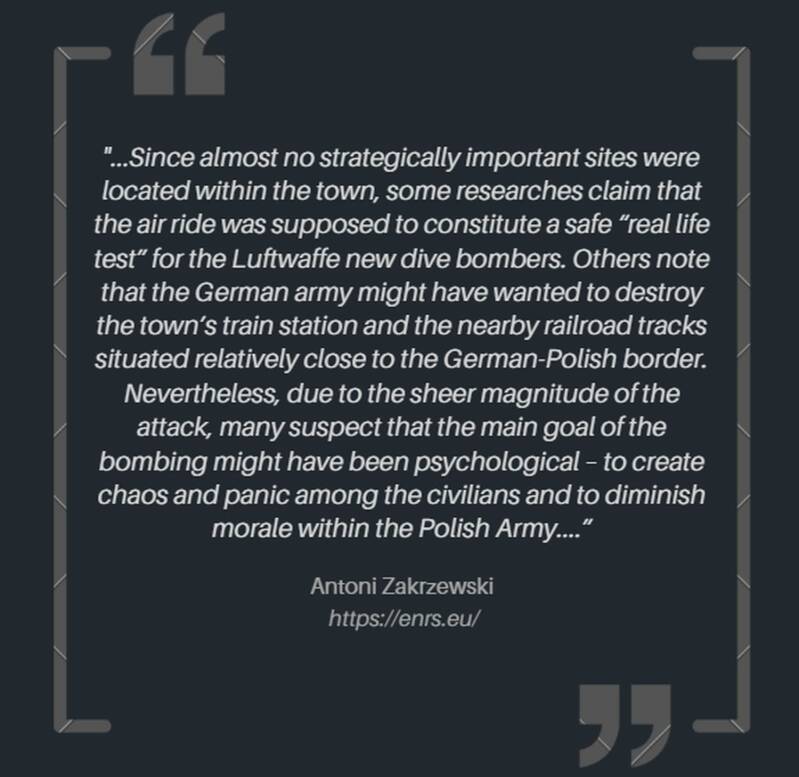
According to some historians, the raids may have been designed to test the Luftwaffe's tactics and weaponry, particularly the new Ju 87B bomber. Germany's Chief of General Staff,
Franz Halder, mentioned in his war diary a plan called "Offensive Operation Red in the Wielu area" two weeks before the war began.
The Luftwaffe launched numerous more raids in the area in the early days of the war, particularly on the tiny towns of Dziaoszyn and Kamiesk, and produced aerial images illustrating the efficacy of attacks on neighbouring towns.

Generalfeldmarschall Wolfram von Richthofen. His role in the bombing of Wieluń raised controversy, as the indiscriminate attacks on civilians led to accusations of war crimes during the Invasion of Poland..
https://ww2gravestone.com/people/richthofen-wolfram-freiherr-von/

German General, Franz Halder. The Wielun bombing may have been an opportunity for the Luftwaffe to test new tactics, a theory supported by references to 'Offensive Operation Red' in Franz Halders war diaries.
...to test the capabilities and operational efficacy of his dive bombers...
In his war diary, Halder distinguished between "terrorist attacks" and strikes on military targets.
According to German historian Hans-Erich Volkmann, Wielu would have had no operational, much alone strategic, relevance for the German 10th Army, which was the decisive military component in this area of the front.
Wolfram von Richthofen, the Luftwaffe's commander, would have personally ordered the attack.
Volkmann, like Böhler, believes that, while Richthofen may not have planned it as a "terror strike," he chose Wielu as a target close to the border to test the capabilities and operational efficacy of his dive bombers.


The infamous Luftwaffe dive-bomber, Junkers Ju-87 'Stuka'. Lightly defended urban centres like Wielun would have provided an excellent opportunities for German dive-bombers to refine their tactics.
https://worldwartwo.filminspector.com/2018/07/color-photos-of-world-war-ii-part-9.html
...it was utterly defenceless...

If feasible without incurring losses to his own force. Volkmann considers the destruction of Wielun to be a war crime because it was an attack on a non-military target.
Similarly, historian Norman Davies explains why Frampol was bombed two weeks later: "Frampol was chosen partly because it was utterly defenceless, and partly because its baroque street pattern gave an ideal geometric grid for calculations and measurements."
The bombing was also seen as a violation of the Hague Convention of 1907, which prohibited the bombing of civilian areas.
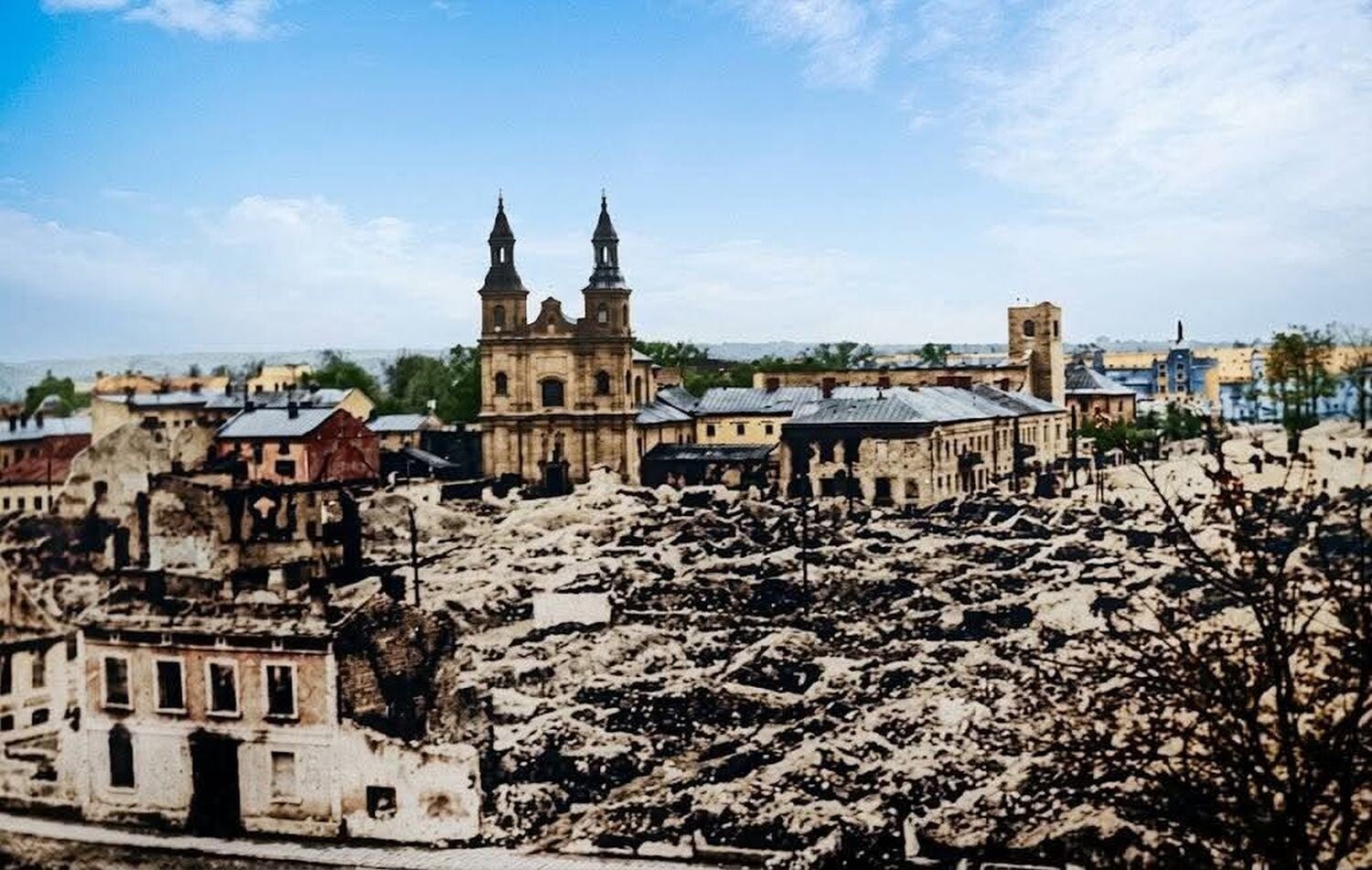
The bombing of Wieluń on 1 September 1939 is widely regarded as a probable war crime because the town had no military presence, no air defences, and no strategic value. The Luftwaffe struck hospitals, markets, and residential areas, killing civilians in the opening minutes of the invasion. Some debate persists because Germany had not yet been formally at war, but the deliberate targeting of an undefended civilian centre strongly supports the war‑crime classification.
Colourised by Gabriel Caruntu
Was it the first attack?
The precise time the first bombs fell on Wieluń on the morning of 1st September 1939 has been disputed, particularly in relation to claims that the town's bombing was the first overt act of World War II, five minutes before the shelling of Westerplatte at 04:45, which has traditionally been considered the war's start.
The Danzig skirmishes also started about the same time (04:45 h). Regardless of which event happened first, they all collectively marked the start of the well-coordinated German Invasion of Poland.
However, even if the time of 04:40 is true, several historians identify the first (aerial) action of the war as bombers from Sturzkampfgeschwader 1 attacking the vital Tczew bridge in the Pomeranian Corridor about 04:30.
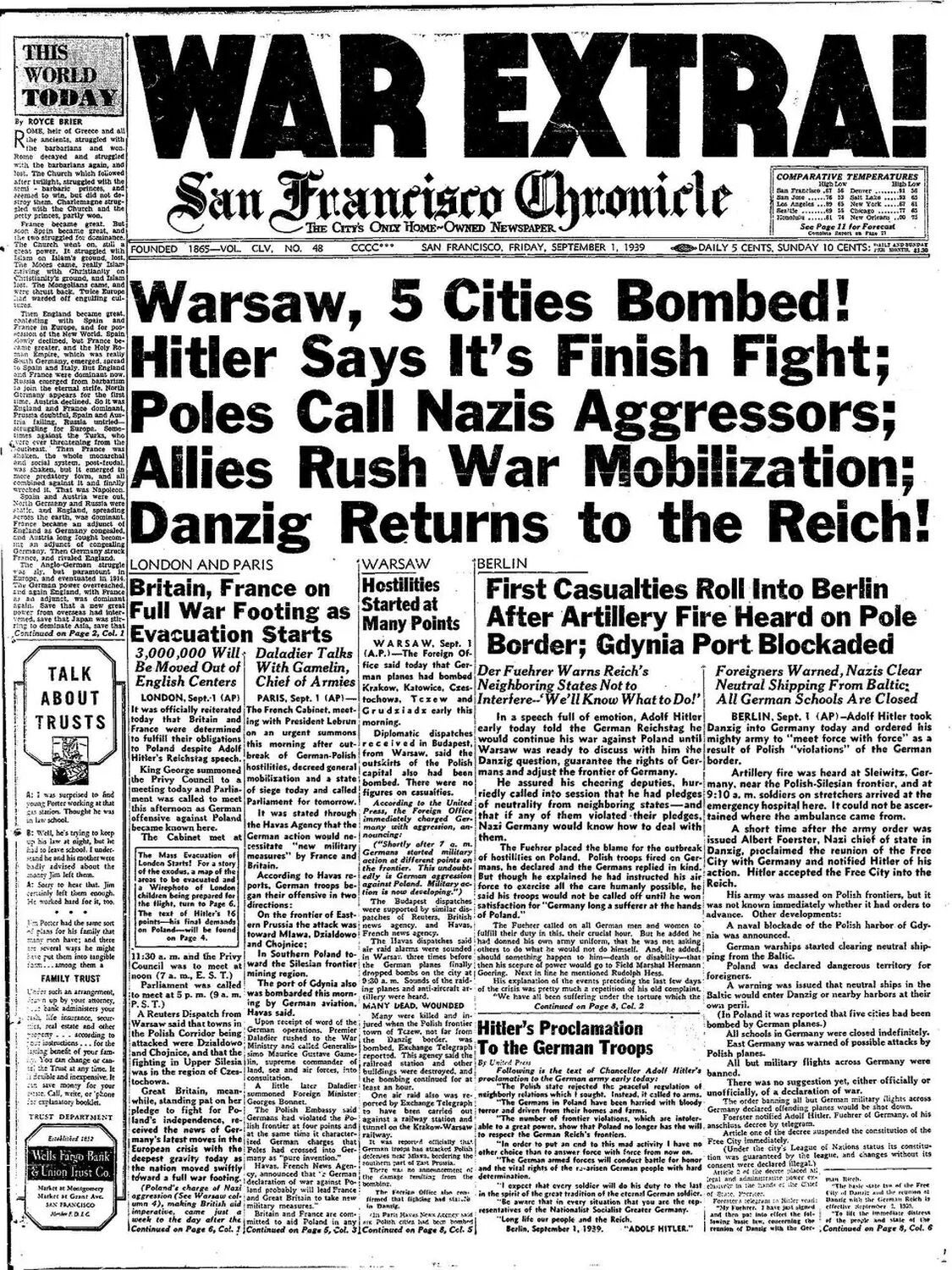
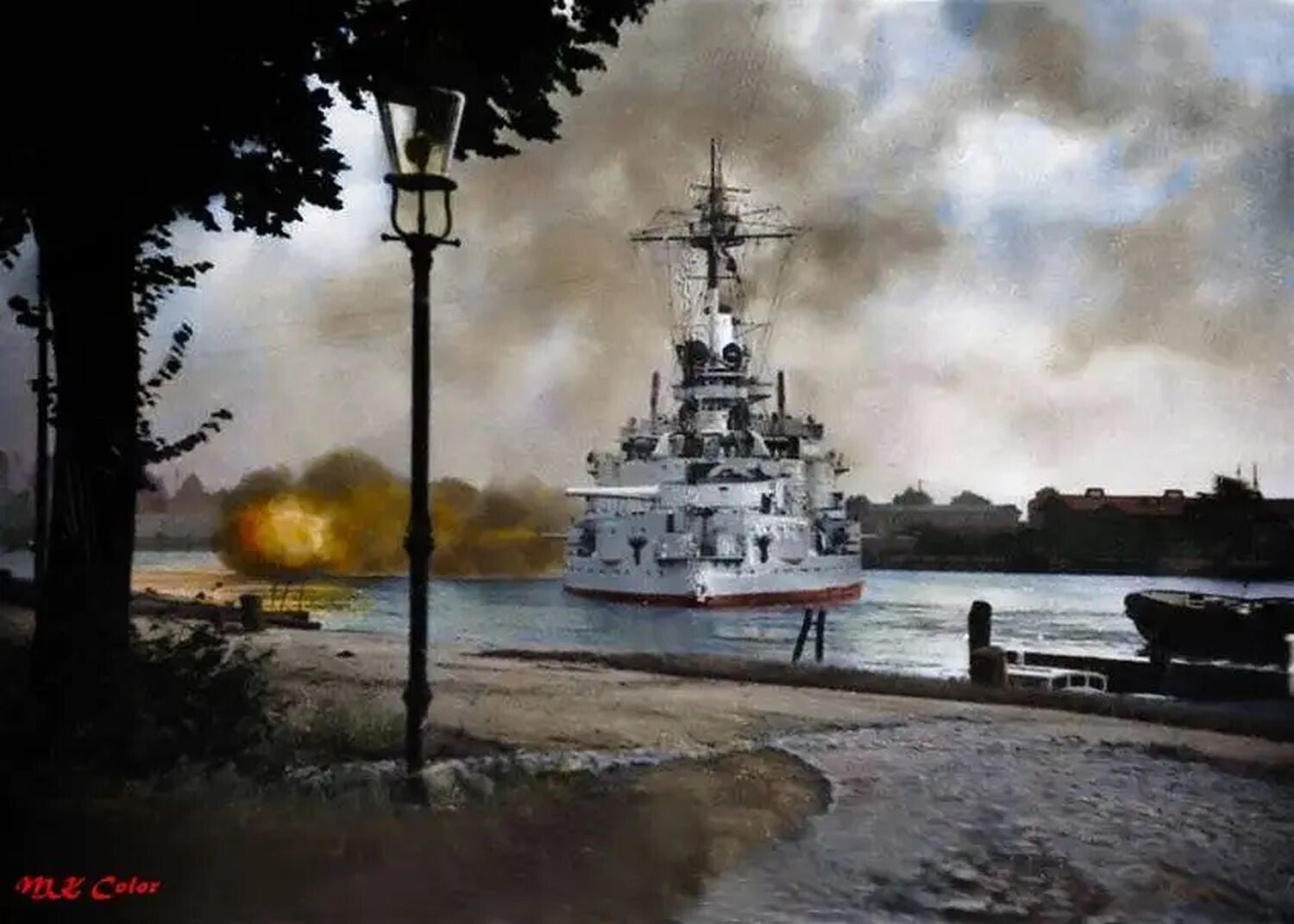
In the early morning of 1 September 1939, Schleswig‑Holstein fired on Westerplatte at 04:47, long regarded as the opening shot of the war. Yet the bombing of Wieluń, beginning around 04:40, appears to have occurred minutes earlier. Because the Luftwaffe struck an undefended civilian town before the naval bombardment, some historians argue Wieluń constitutes the war’s first hostile act, though both events marked Germany’s transition to open aggression.
Conclusion
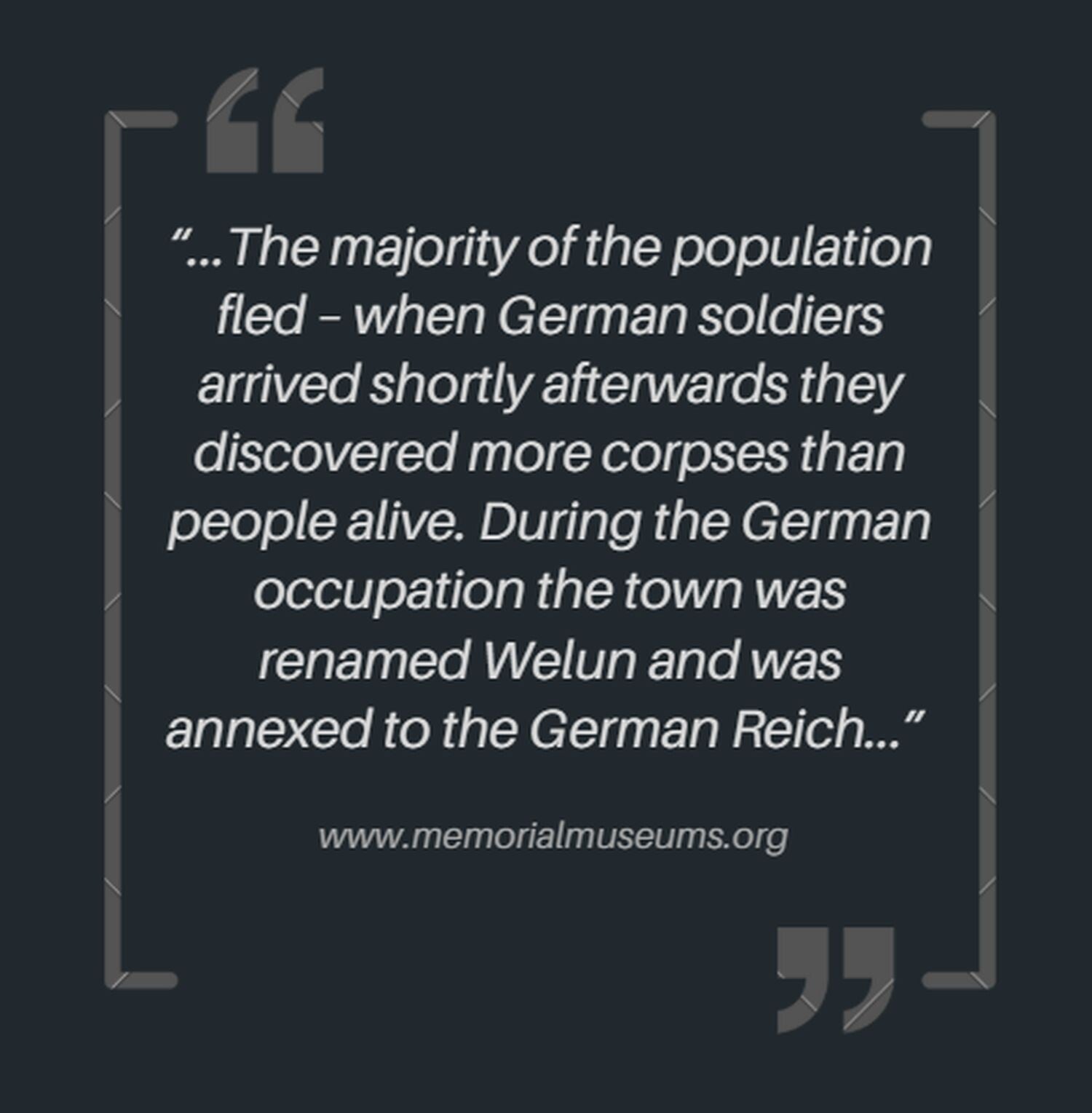
In conclusion, the bombing of Wieluń was the first bombing of World War II and one of the first acts of the war. It was conducted by the German Luftwaffe and resulted in the deaths of over 1,200 people, mostly civilians.
The bombing was likely a war crime and a violation of international law, it demonstrated the brutality of war and the devastating consequences of bombing civilian areas. The bombing of Wieluń served as a reminder of the importance of protecting civilians during armed conflicts.
Further reading




