
Overview
In the summer and autumn of 1940, the Luftwaffe entered the Battle of Britain as a large, experienced air arm shaped by rapid victories in Poland, Norway, the Low Countries, and France. Its fighter force centred on the Messerschmitt Bf 109E, a capable single‑engine fighter with strong climb performance and effective armament. The twin‑engine Bf 110 served as a long‑range escort, though its vulnerability in close combat soon became evident. Bomber units operated Heinkel He 111s, Dornier Do 17s, and Junkers Ju 88s, supported by the Ju 87 Stuka, whose effectiveness declined sharply against prepared British defences.
Luftwaffe pilots were generally well trained and combat‑experienced. Fighter leaders such as Werner Mölders and Adolf Galland refined flexible tactics, including the Rotte and Schwarm formations, which offered superior visibility and manoeuvrability compared to older, rigid patterns. However, the Luftwaffe faced structural limitations: insufficient long‑range escort capability, inadequate intelligence on RAF strength, and a bomber fleet not designed for sustained strategic assault.
Operational strategy evolved through several phases. Initial attacks targeted shipping and coastal installations, followed by attempts to destroy RAF Fighter Command’s airfields and infrastructure. These strikes inflicted damage but failed to break the defensive system built around radar, sector stations, and coordinated control. In September, the Luftwaffe shifted to bombing London, aiming to draw RAF fighters into large, decisive battles. This change relieved pressure on Fighter Command’s airfields and allowed the RAF to recover.
Successes included heavy damage to ports, factories, and some airfields, as well as tactical victories on days when German formations achieved concentration and surprise. Failures were more decisive: inability to neutralise radar, loss rates that exceeded replacement capacity, and the strategic misjudgement of RAF resilience. Leadership under Hermann Göring struggled to adapt, and coordination between fighter and bomber units remained inconsistent.
By October, the Luftwaffe had failed to achieve air superiority, ending the campaign without its strategic objectives.
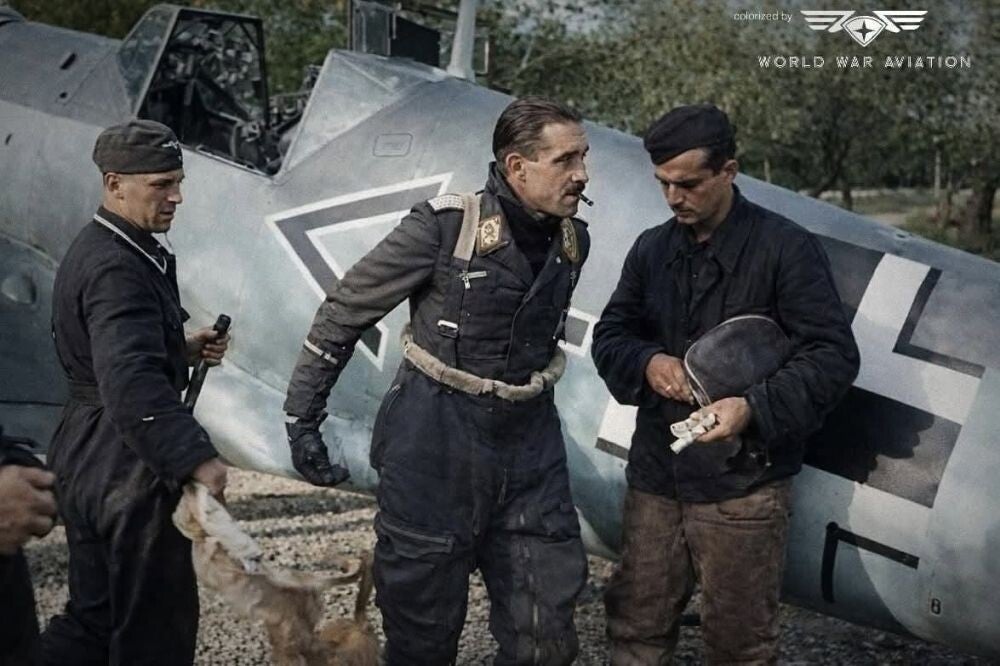
High scoring Ace Adolf Galland (104 victories) hopping out of his Bf-109E. 1940, Likely during the Battle of Britain. Galland emerged as one of the Luftwaffe’s most effective fighter commanders in the Battle of Britain. Leading Jagdgeschwader 26, he flew the Bf 109E and quickly became one of Germany’s top aces, combining tactical flexibility with strong situational awareness. Galland refined the Rotte and Schwarm formations, improving German fighter efficiency. His success, influence, and outspoken advocacy for fighter priorities made him a central figure in the Luftwaffe’s 1940 campaign.