
Overview
The Cape Gloucester operation, conducted between December 1943 and April 1944, formed a central component of the Allied campaign to isolate the major Japanese base at Rabaul. It belonged to General Douglas MacArthur’s Southwest Pacific Area strategy and was executed as part of Operation Cartwheel, the joint plan to neutralise Rabaul through encirclement rather than direct assault. Cape Gloucester, located on the western tip of New Britain, controlled the approaches to the Vitiaz Strait, a key maritime passage between New Britain and New Guinea. Securing this area was essential for protecting Allied movements along the New Guinea coast and for establishing airfields to support subsequent operations.
The assault began on 26 December 1943, when the U.S. 1st Marine Division landed on two beaches north of Cape Gloucester. The terrain—dense jungle, swamps, and heavy rainfall—proved as challenging as Japanese resistance. The primary objective was the capture of the airfields on the Gloucester peninsula, which Japanese forces had fortified but could not adequately supply or reinforce due to Allied air interdiction. After several days of fighting, the Marines secured the airfields and pushed inland toward the high ground at Target Hill and Hill 660, overcoming determined Japanese defensive positions.
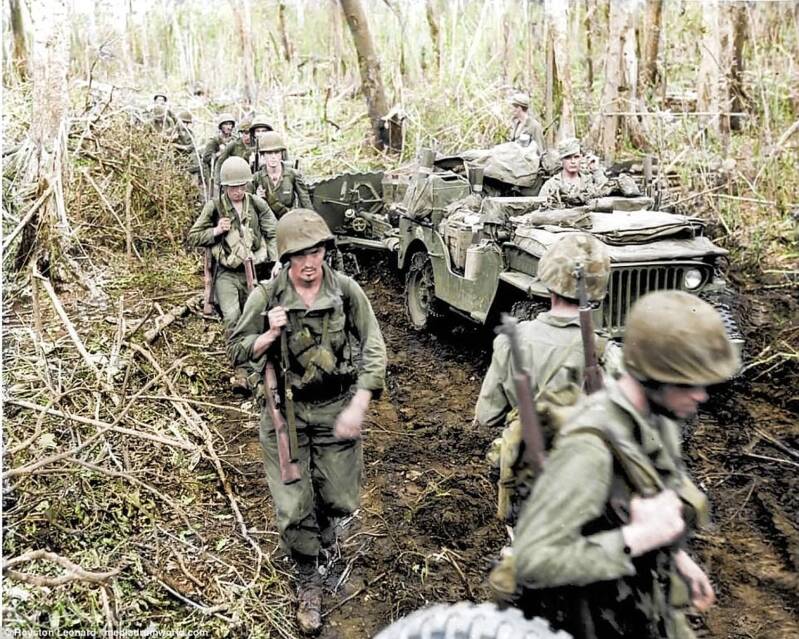
Men of the US First Marines Division at Cape Gloucester, New Britain, Bismarck Archipelago, late December 1943.
Colourised by Royston Leonard
The operation continued into early 1944 as Marines advanced along the coast toward Talasea, aiming to cut off retreating Japanese units and further restrict movement between Rabaul and western New Britain. Japanese forces, suffering from shortages of food, ammunition, and medical support, gradually withdrew into the interior. By April, organised resistance in the Cape Gloucester sector had collapsed.
Cape Gloucester’s capture contributed directly to the isolation of Rabaul, secured control of the Vitiaz Strait, and provided airfields for operations supporting the Allied advance toward Saidor, Madang, and later Hollandia. The operation demonstrated the effectiveness of bypassing major strongpoints while seizing key terrain essential for the broader Southwest Pacific offensive.