
Overview
The “Hundred-Man Killing Contest” became one of the most infamous stories associated with Japan’s invasion of China. In late 1937, Japanese newspapers reported that two Imperial Japanese Army officers, Toshiaki Mukai and Tsuyoshi Noda, were competing to determine who could be the first to kill 100 Chinese with a sword during the Japanese advance towards Nanjing.
The Tokyo Nichi Nichi Shimbun and Osaka Mainichi Shimbun presented the supposed competition almost like a sporting contest, publishing running scores as the two officers advanced with Japanese forces. By December, newspapers reported that both men had exceeded 100 killings, with Mukai supposedly reaching 106 and Noda 105. Unable to determine who had reached the target first, the reports claimed that the officers agreed to continue towards 150.
The literal accuracy of these sensational newspaper stories has subsequently been disputed. The descriptions of repeated sword fights appear highly implausible, and historians have questioned whether the competition occurred exactly as reported. Noda himself reportedly later acknowledged that only a small number of his sword killings had occurred during actual combat. This raised the disturbing possibility that some victims described by the newspapers were prisoners rather than enemy soldiers actively fighting Japanese forces.
The episode acquired greater significance because it occurred during the Japanese advance upon Nanjing, where widespread atrocities followed the city’s capture in December 1937. After the Second World War, Mukai and Noda were arrested, extradited to China and prosecuted before the Nanjing War Crimes Tribunal.
Both were convicted in connection with wartime atrocities and executed by firing squad in January 1948.
Rediscovery of the original newspaper reports during the 1970s generated renewed controversy in Japan over their accuracy. The “contest” subsequently became part of a wider historical debate concerning Japanese wartime conduct, propaganda, responsibility and the interpretation of the Nanjing Massacre.
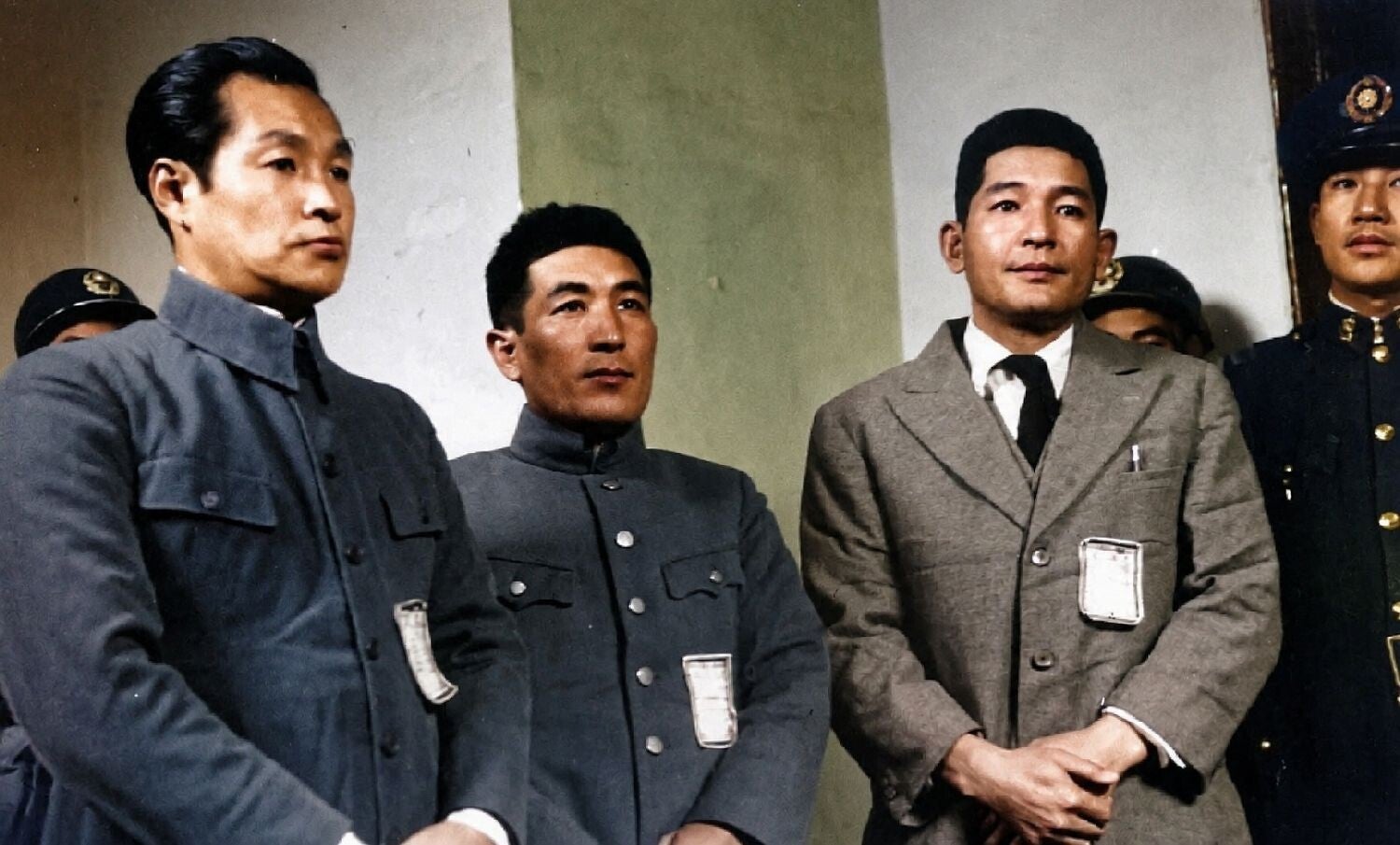
Toshiaki Mukai (right), Tsuyoshi Noda (centre) and Gunkichi Tanaka (left) became notorious for atrocities committed during Japan’s invasion of China. Mukai and Noda were associated with the infamous “Hundred-Man Killing Contest,” reported by Japanese newspapers during the advance towards Nanjing in 1937, although the accuracy of the competition remains disputed. Tanaka was accused of personally killing numerous Chinese prisoners and civilians with his sword. After Japan’s defeat, all three were prosecuted by the Nanjing War Crimes Tribunal for atrocities connected with the capture and occupation of Nanjing. They were convicted, sentenced to death and executed by firing squad in January 1948.