
Overview
The surrender of Japan on 2 September 1945 aboard USS Missouri in Tokyo Bay marked the formal conclusion of the Second World War in the Pacific. The ceremony brought together representatives of the Empire of Japan and senior Allied commanders to enact the Instrument of Surrender, a document that ended hostilities after years of devastating conflict. The Japanese delegation was led by Foreign Minister Mamoru Shigemitsu, who signed on behalf of the Emperor and the civilian government. Standing beside him was General Yoshijirō Umezu, Chief of the Army General Staff, who signed for the Imperial General Headquarters. Their presence symbolised the unified acceptance of defeat by both Japan’s political and military leadership.
Behind Shigemitsu and Umezu stood additional representatives from the Foreign Ministry, Army, and Navy, reflecting the breadth of institutions involved in Japan’s wartime administration. Their attendance underscored the collective responsibility for acknowledging the terms imposed by the Allies. The ceremony itself was brief and carefully structured. General Douglas MacArthur, Supreme Commander for the Allied Powers, presided over the proceedings, followed by signatures from representatives of the United States, China, the United Kingdom, the Soviet Union, Australia, Canada, France, the Netherlands, and New Zealand.
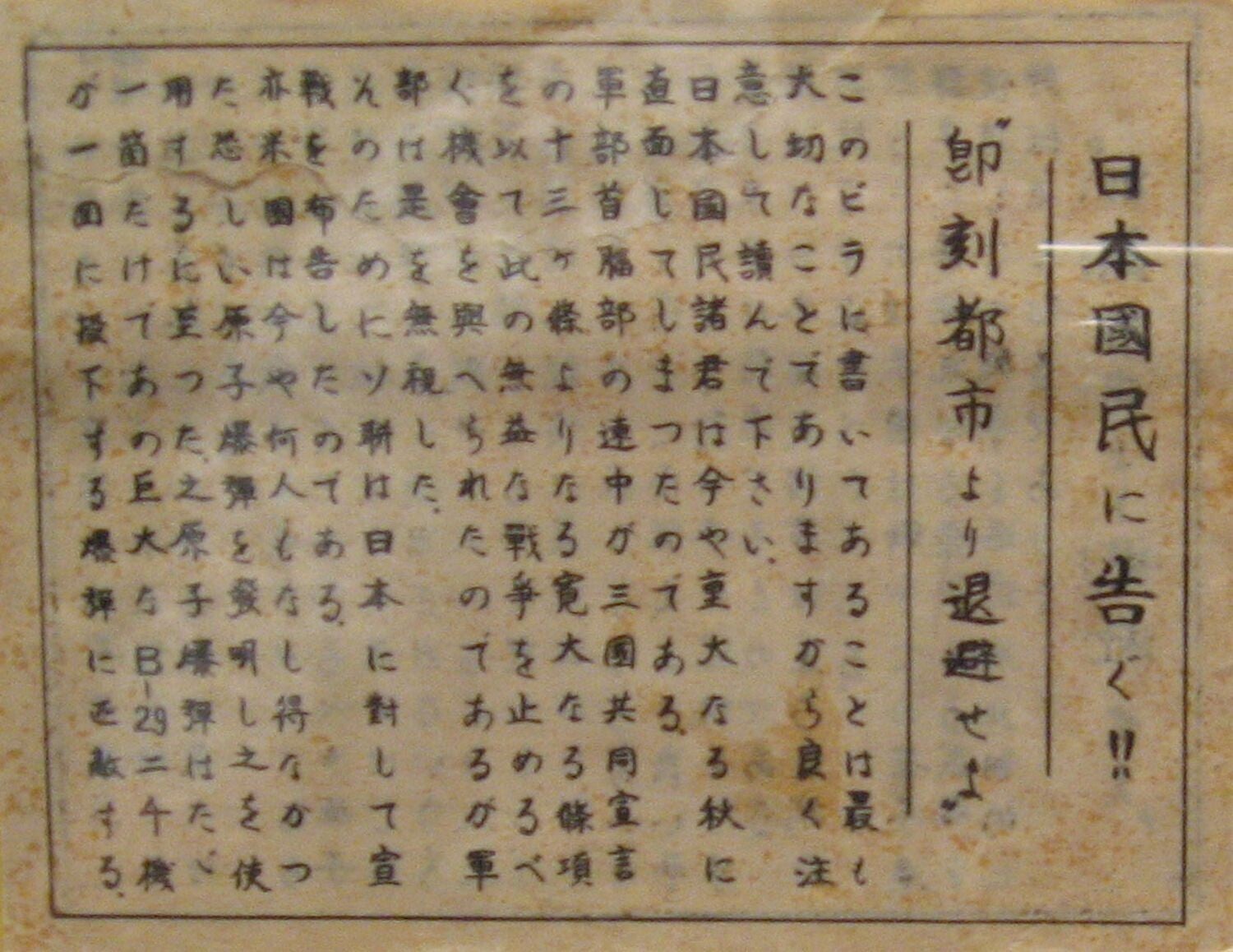
A leaflet dropped on Japan after the bombing of Hiroshima. The leaflet says, in part: "The Japanese people are facing an extremely important autumn. Your military leaders were presented with thirteen articles for surrender by our three-country alliance to put an end to this unprofitable war. This proposal was ignored by your army leaders ... The United States has developed an atom bomb, which had not been done by any nation before. It has been determined to employ this frightening bomb. One atom bomb has the destructive power of 2000 B-29s."
The surrender aboard the Missouri initiated the Allied occupation of Japan, a period that would reshape the nation’s political, social, and economic systems. Demilitarization, constitutional reform, and economic restructuring formed the core of the occupation’s objectives, laying the foundation for Japan’s post‑war recovery and eventual emergence as a stable and influential state within the international order.
The scene in Tokyo Bay remains one of the most recognisable images of the war’s end. It captures both the solemnity of Japan’s capitulation and the beginning of a new era defined by reconstruction, reform, and the long process of rebuilding relations between former adversaries.
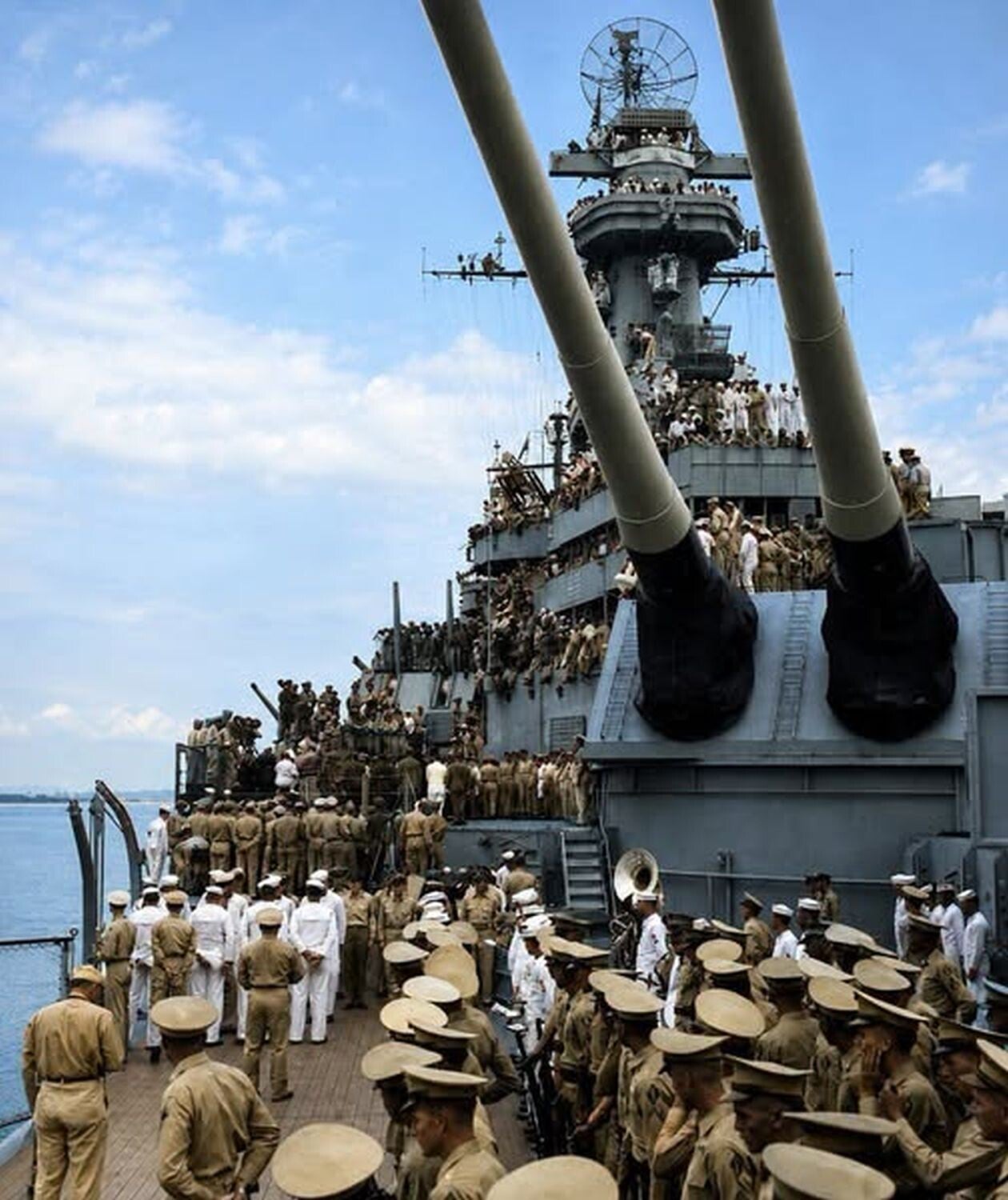
On September 2, 1945, the Second World War formally ended on the deck of USS Missouri in Tokyo Bay.
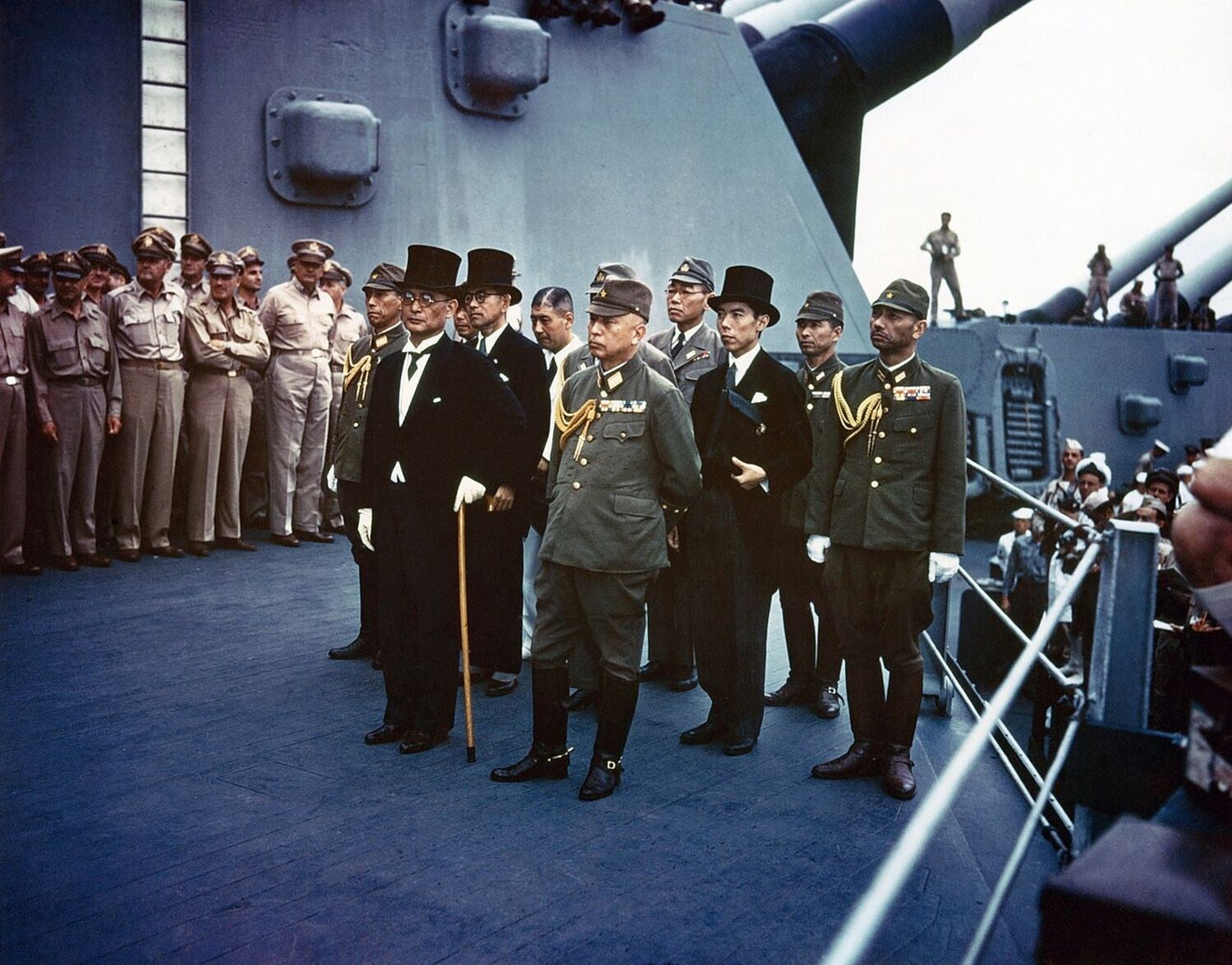
Surrender of Japan, Tokyo Bay, 2 September 1945: Representatives of the Empire of Japan on board USS Missouri (BB-63) during the surrender ceremonies. Standing in front are: Foreign Minister Mamoru Shigemitsu (wearing top hat) and General Yoshijirō Umezu, Chief of the Army General Staff. Behind them are three representatives each of the Foreign Ministry, the Army and the Navy. They include, in middle row, left to right: Lieutenant General Shūichi Miyakazi, Army; Katsuo Okazaki, Foreign Ministry; Rear Admiral Tadatoshi Tomioka, Navy; Toshikazu Kase, Foreign Ministry, and Major General Yatsuji Nagai, Army. In the back row, left to right (not all are visible): Rear Admiral Ichirō Yokoyama, Navy; Saburo Ōta, Foreign Ministry; Katsuo Shiba, Navy, and Kazushi Sugita, Army.
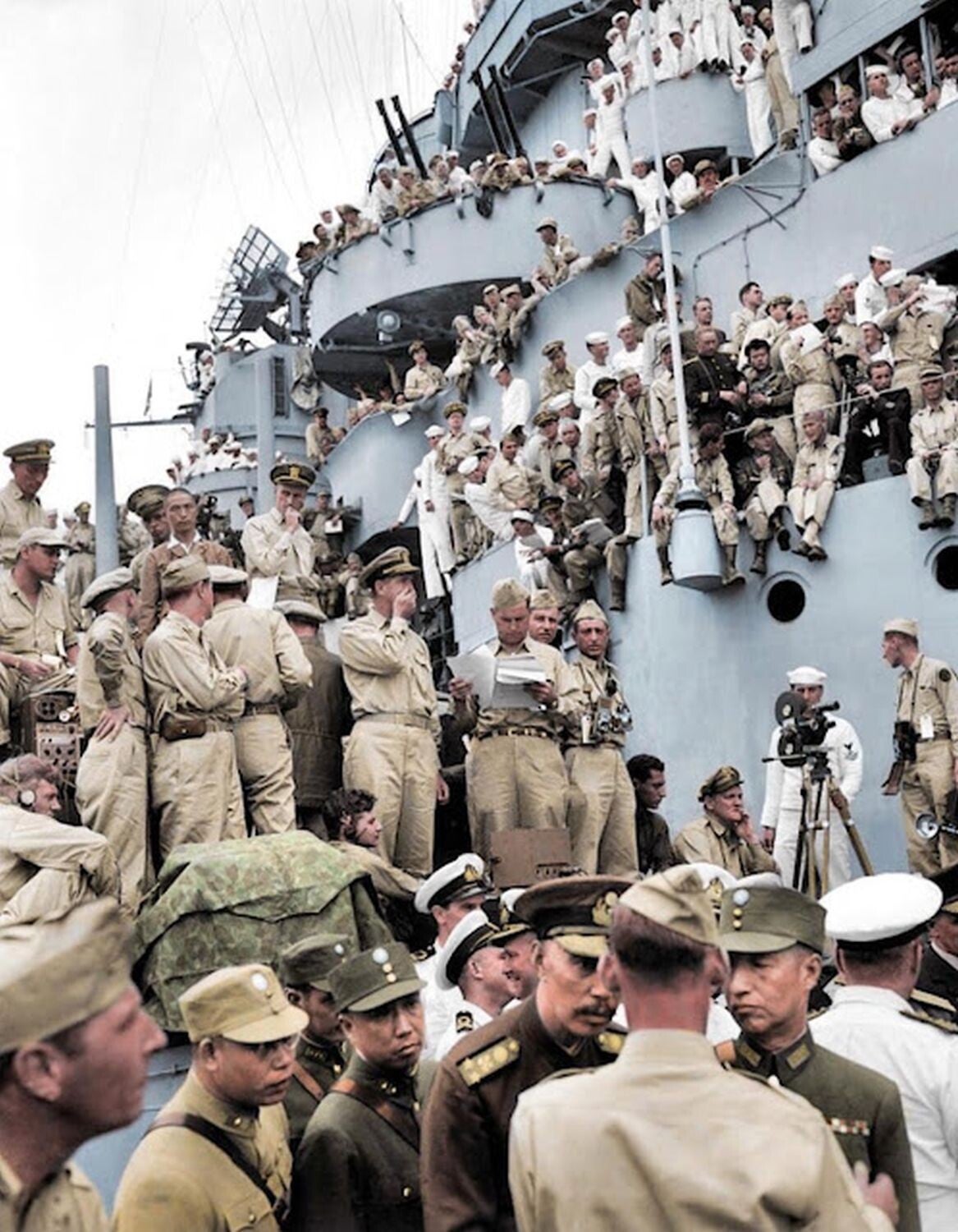
Spectators from all over the world pick vantage positions on the deck of the USS Missouri, in Tokyo Bay in September 1945, to watch the Japanese surrender ceremony marking the end of World War II. USS Missouri was chosen for Japan’s surrender because it was a modern, powerful battleship available in Tokyo Bay and symbolically tied to the United States. It carried President Truman’s home‑state name, underscoring national authority, and provided a secure, spacious platform for a multinational ceremony. Its selection reinforced the formality and legitimacy of Japan’s capitulation.
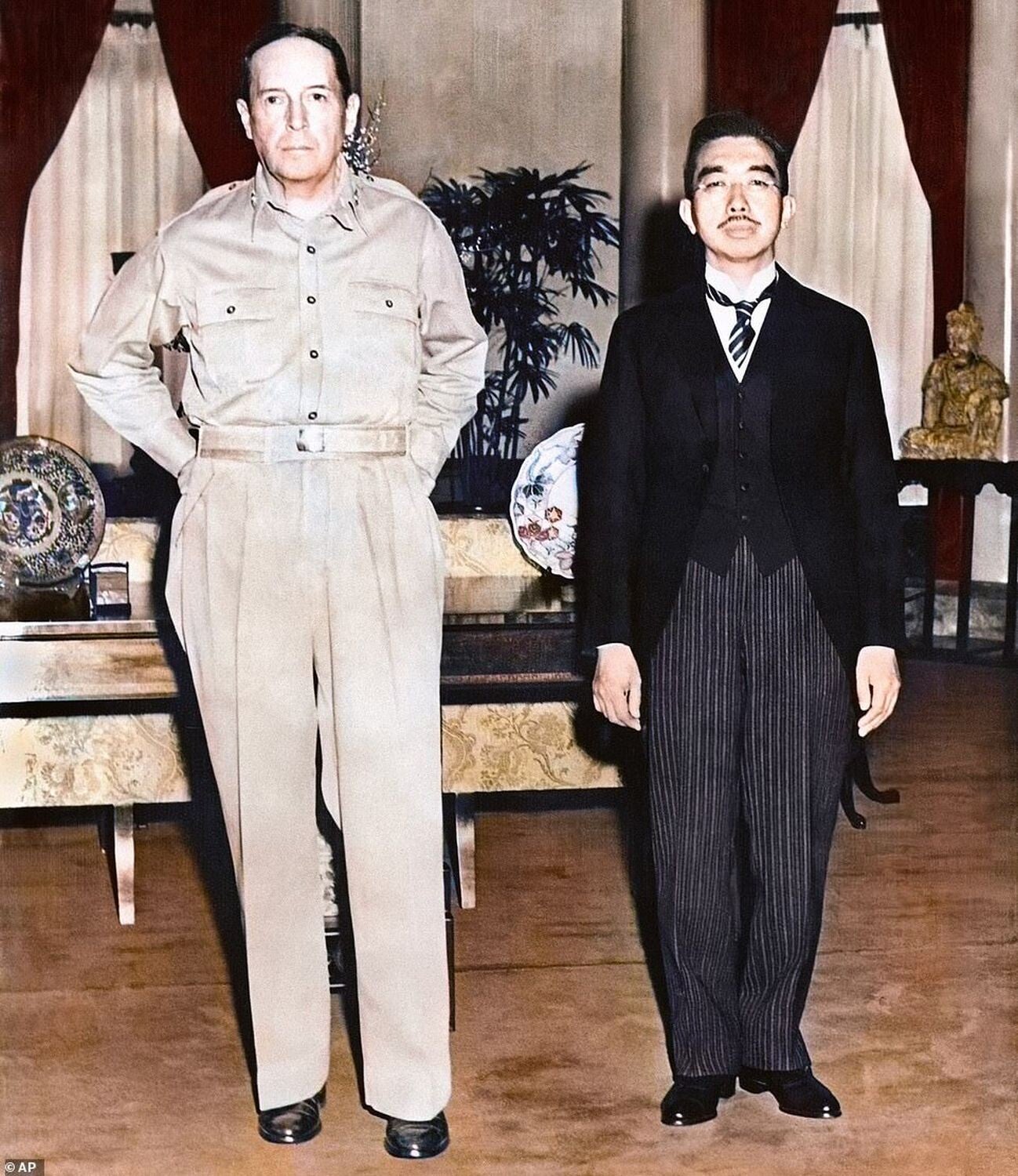
Japanese Emperor Hirohito (right), meets General Douglas MacArthur (left) at the US Embassy in Tokyo on September 27, 1945. General of the Army Douglas MacArthur was an American five-star general and Field Marshal of the Philippine Army. He was Chief of Staff of the United States Army during the 1930s and played a prominent role in the Pacific theater.
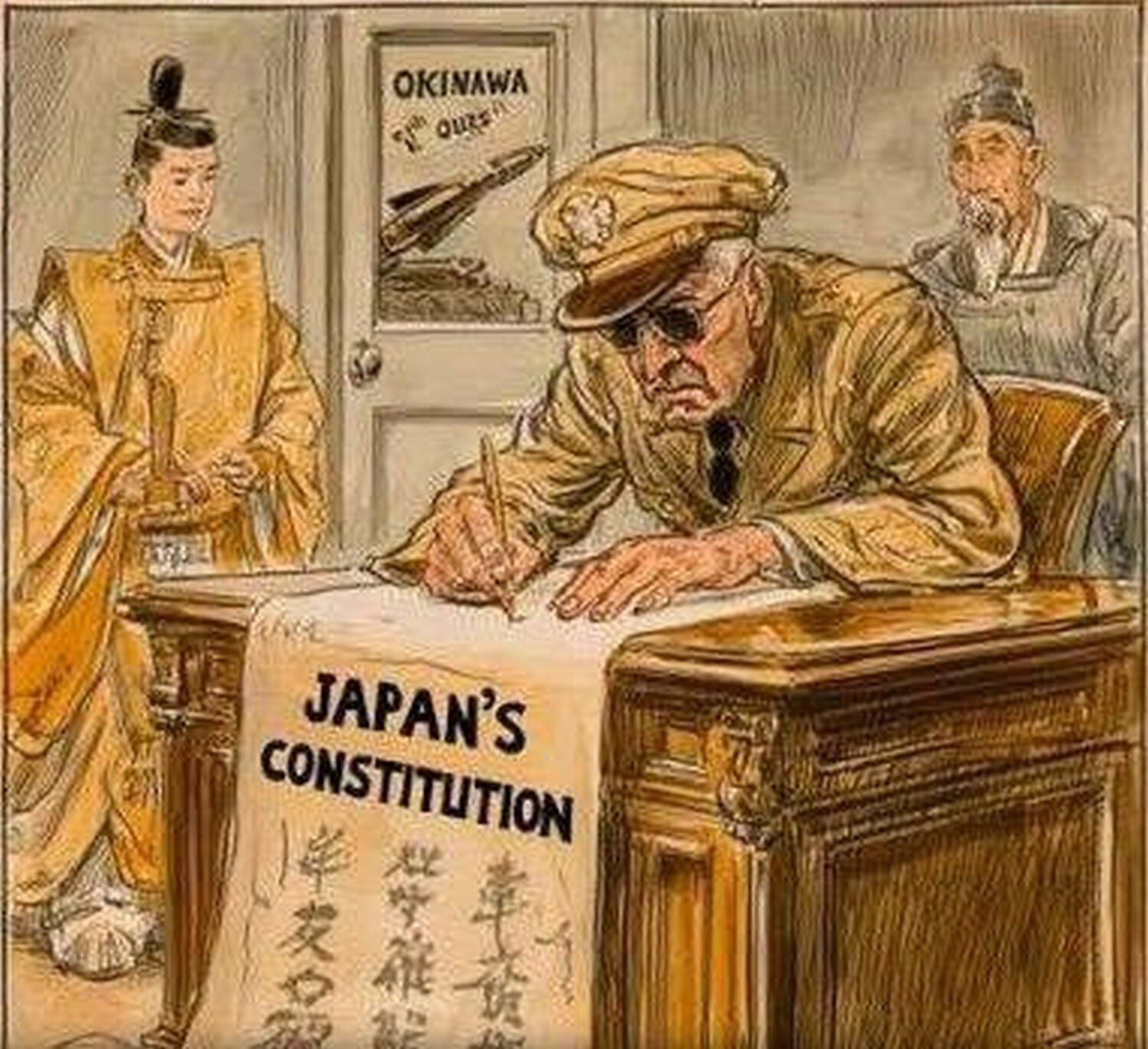
This political cartoon illustrates the creation of Japan’s postwar constitution during the Allied occupation. After Japan’s 1945 surrender, General Douglas MacArthur ordered his Government Section to draft a new constitution when Japanese proposals proved inadequate. Working in secrecy at the Dai Ichi building, a team of American officers and civilian staff—led by Colonel Charles Kades—produced the English draft in eight days. Beate Sirota Gordon, then twenty‑two, authored key civil rights and women’s equality provisions. Translated and revised, the constitution took effect on May 3, 1947, transforming Emperor Hirohito into a symbolic monarch within a parliamentary democracy.