
Overview
The Mariana and Palau Islands campaign, conducted between June and November 1944, marked the decisive breach of Japan’s Central Pacific defensive perimeter. Under Admiral Chester Nimitz’s command, U.S. forces advanced through the Marianas—Saipan, Tinian, and Guam—and then westward to the Palau group, including Peleliu and Angaur. The campaign’s strategic purpose was to secure bases for long‑range air operations against the Japanese home islands and to support the forthcoming liberation of the Philippines.
The opening phase began with the assault on Saipan on 15 June 1944. After intense fighting, the island was secured on 9 July. Its capture triggered political shock in Tokyo, leading to the resignation of Prime Minister Hideki Tojo’s cabinet. Operations continued with the seizure of Guam (21 July–10 August) and Tinian (24 July–1 August). These islands provided airfields for the B‑29 Superfortress, enabling direct strategic bombing of Japan, including the later atomic missions launched from Tinian.
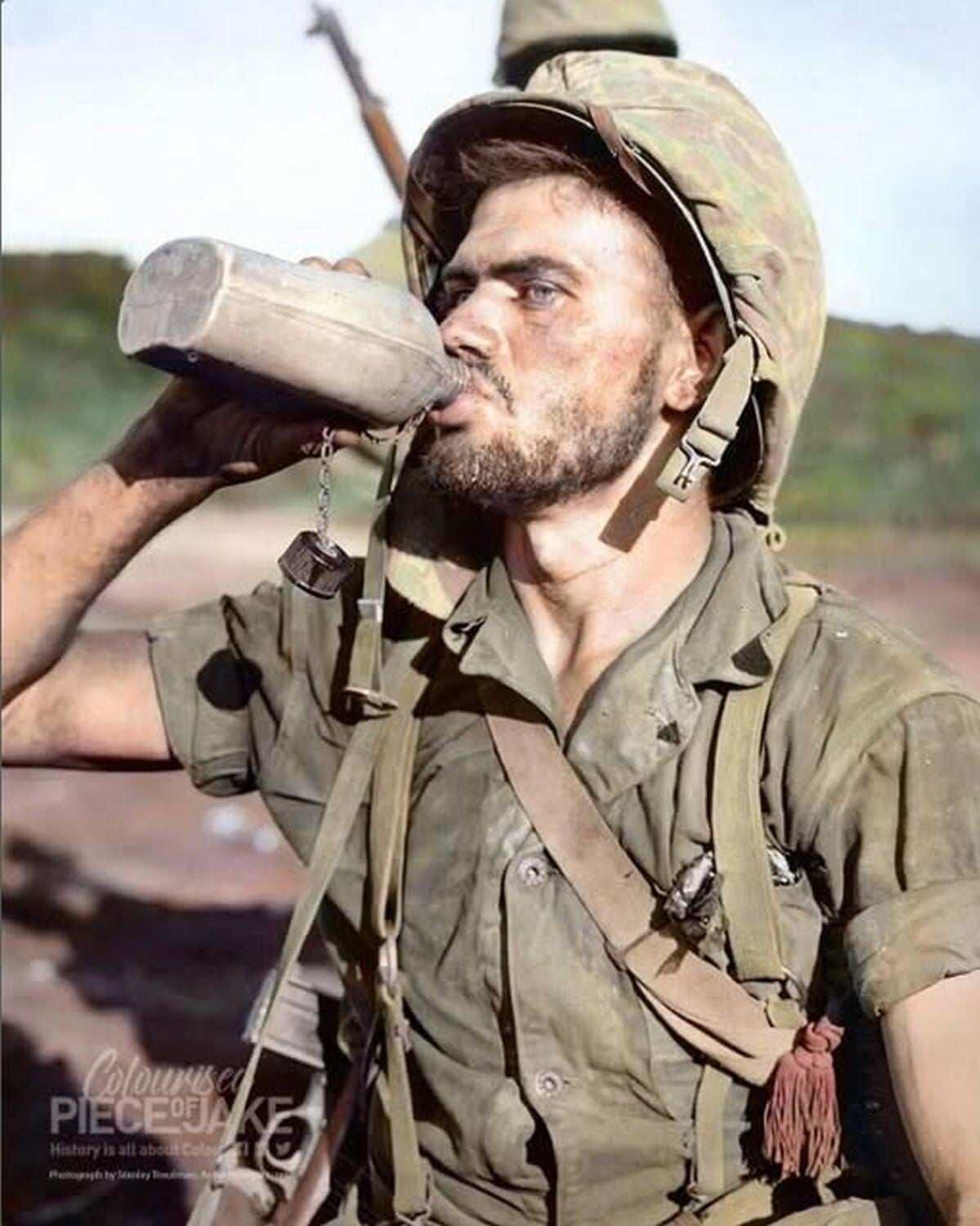
PFC Thomas Ellis Underwood pauses to drink from his canteen after fighting on the western beaches of Saipan, Mariana Islands, on 8 July 1944, during the opening phase of the Mariana and Palau Islands Campaign. The photograph records a brief moment of recovery amid the intense combat that defined the Saipan landings. Underwood later continued service in the Pacific War and was killed in action on 4 March 1945 during the Battle of Iwo Jima. His experience reflects the heavy attrition endured by U.S. Marine and Army units throughout the Central Pacific advance.
The second phase focused on the Palau Islands, intended to protect the right flank of General Douglas MacArthur’s advance toward the Philippines. The assault on Peleliu began on 15 September 1944 and developed into one of the most brutal battles of the Pacific War. Japanese defenders employed a dense network of fortified caves and mutually supporting positions, turning the island into a prolonged attritional struggle. Although captured by November, the high casualties raised questions about its strategic value. Nearby Angaur was taken more quickly and provided additional airfield sites.
The campaign’s outcome was strategically decisive. It placed Japan within sustained bomber range, isolated major Japanese bases in the Carolines, and secured the operational corridor for the Philippines invasion. By breaking through the Marianas–Palau defensive line, U.S. forces transitioned from regional island‑hopping to direct pressure on Japan’s core territory.