
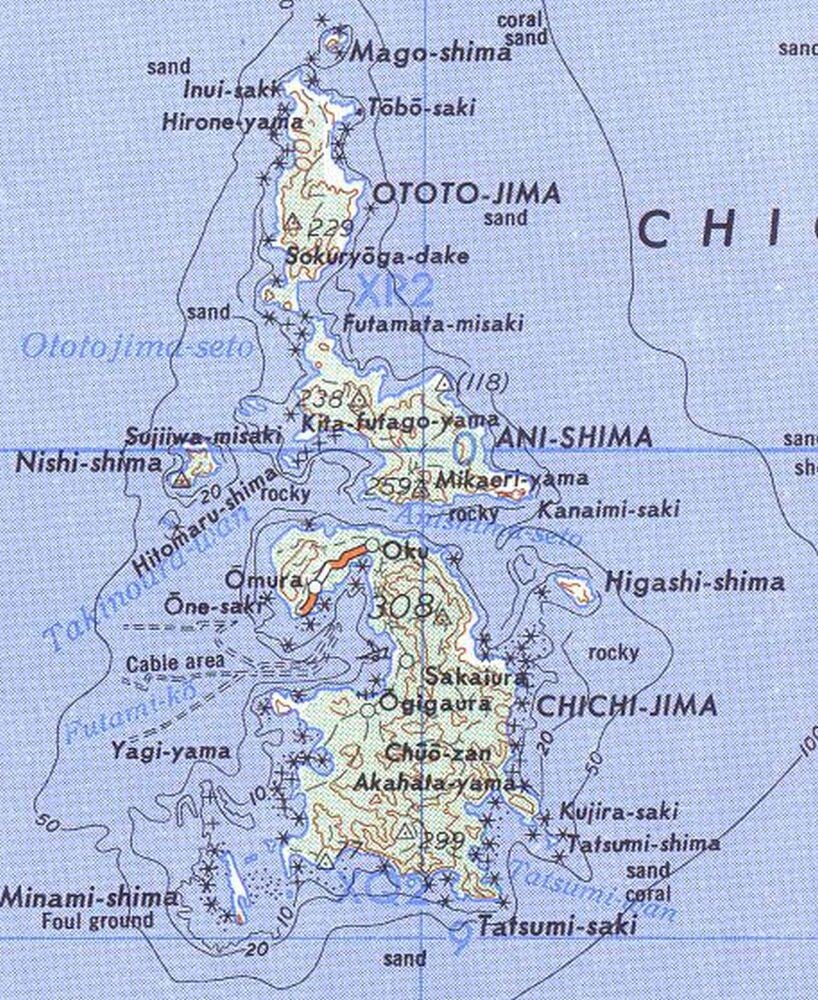
Chichijima, the largest island in the Ogasawara (Bonin) group, held significant strategic value for the Imperial Japanese military during the Second World War.
Its location, roughly midway between Japan and the central Pacific, made it a natural relay point for long‑range communications, weather reporting, and naval coordination.
By the late 1930s, the island had become the primary site for Japan’s long‑range radio stations in the Nanpō Shotō, forming a critical link between the Home Islands and the scattered outposts of the central Pacific.
As tensions in the Pacific increased, Chichijima’s importance grew, and it developed into the heaviest‑garrisoned island in the chain.
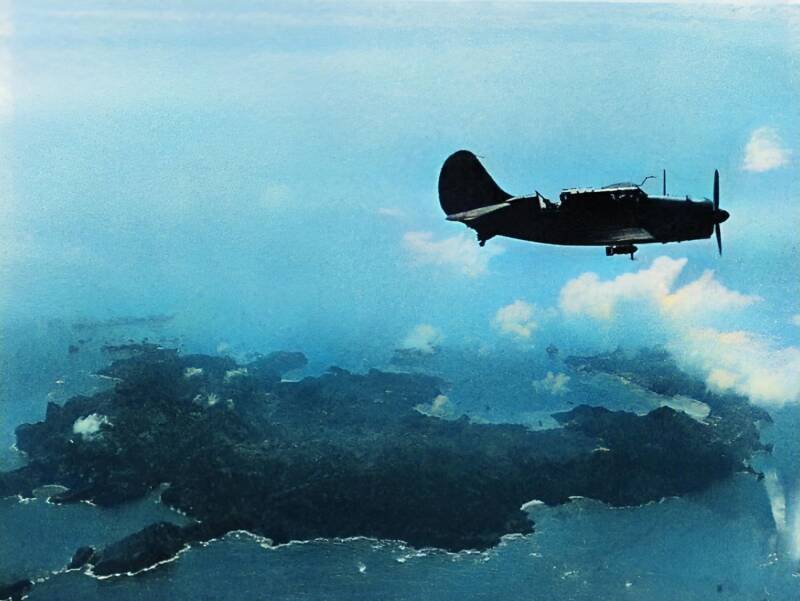
An American warplane flies over the Japanese island of Chichijima during the Second World War.
https://allthatsinteresting.com/george-bush-cannibalized-chichijima-incident
The Pacific War
By 1944 the Pacific War had entered a phase defined by sustained Allied offensives and the progressive isolation of Japanese strongholds.
In the Central Pacific, U.S. forces advanced through the Marshall and Mariana Islands, capturing Saipan, Tinian, and Guam between June and August.
These operations provided airfields for B‑29 bombers, enabling direct strikes against the Japanese Home Islands.
The loss of the Marianas also contributed to the destruction of Japan’s carrier aviation during the Battle of the Philippine Sea in June 1944.
...garrisons became isolated, and air and naval strength declined...
In the southwest, Allied forces under General Douglas MacArthur moved through New Guinea and into the Philippines.
The Leyte campaign began in October 1944, followed by the Battle of Leyte Gulf, one of the largest naval engagements of the war.
By early 1945, U.S. forces had secured Luzon and were advancing toward Manila, where urban combat caused extensive destruction. Japan’s defensive perimeter contracted sharply.
Supply lines deteriorated, garrisons became isolated, and air and naval strength declined. In February 1945, the assault on Iwo Jima commenced, driven by the need for emergency landing fields for B‑29 operations.
The battle lasted until March, marked by high casualties on both sides.By early 1945, Japan faced mounting strategic pressure, with Allied forces preparing for further operations toward Okinawa and the Home Islands.
The Garrison
At the time of the attack on Pearl Harbor in December 1941, Chichijima hosted a substantial military presence.
Contemporary accounts indicate that an Imperial Japanese Army force of approximately 3,700 to 3,800 men formed the core of the garrison.
Alongside them were roughly 1,200 naval personnel responsible for operating the island’s naval base, seaplane facilities, radio and meteorological stations, and small craft units including gunboats, submarine chasers, and minesweepers.
The island’s defensive strength was further reinforced by a heavy artillery fortress regiment, which provided coastal defence and contributed to the broader defensive network intended to protect Japan’s eastern approaches.
Occupation
The island’s civilian population, including the Oubeikei - descendants of Western settlers who had lived on the Bonin Islands since the nineteenth century - experienced increasing scrutiny as wartime controls tightened.
Japanese authorities viewed the Oubeikei with suspicion, concerned that their foreign ancestry and linguistic background might make them vulnerable to espionage or foreign influence.
Reports indicate that they were compelled to adopt Japanese names and conform to stricter cultural expectations.
...the Japanese government ordered the evacuation...
Despite these pressures, the community remained on the island until 1944, when the Japanese government ordered the evacuation of all 6,886 civilian inhabitants of the Ogasawara Islands to the Home Islands.
This evacuation included the Oubeikei and other long‑established families.
Notably, at least two American citizens of Japanese descent served in the Japanese military on Chichijima during the war, including Nobuaki “Warren” Iwatake, a Japanese‑American from Hawaii who had been drafted into the Imperial Army while living with relatives in Hiroshima.
Targeting Communications
Throughout the Pacific War, Chichijima was a frequent target of United States Navy air operations.
Its radio stations, positioned atop the island’s two prominent mountains, were central to Japanese communications and therefore priority objectives for American forces.
Bombing raids sought to disrupt the island’s ability to relay messages, coordinate naval movements, and provide meteorological data essential for Japanese operations.
These attacks intensified as the war progressed, particularly during the campaigns in the Marianas and the Volcano Islands.
During one such raid, the future American president George H. W. Bush was shot down while flying a torpedo bomber mission against the island.
He was rescued at sea by a US submarine, an event that later became widely known.
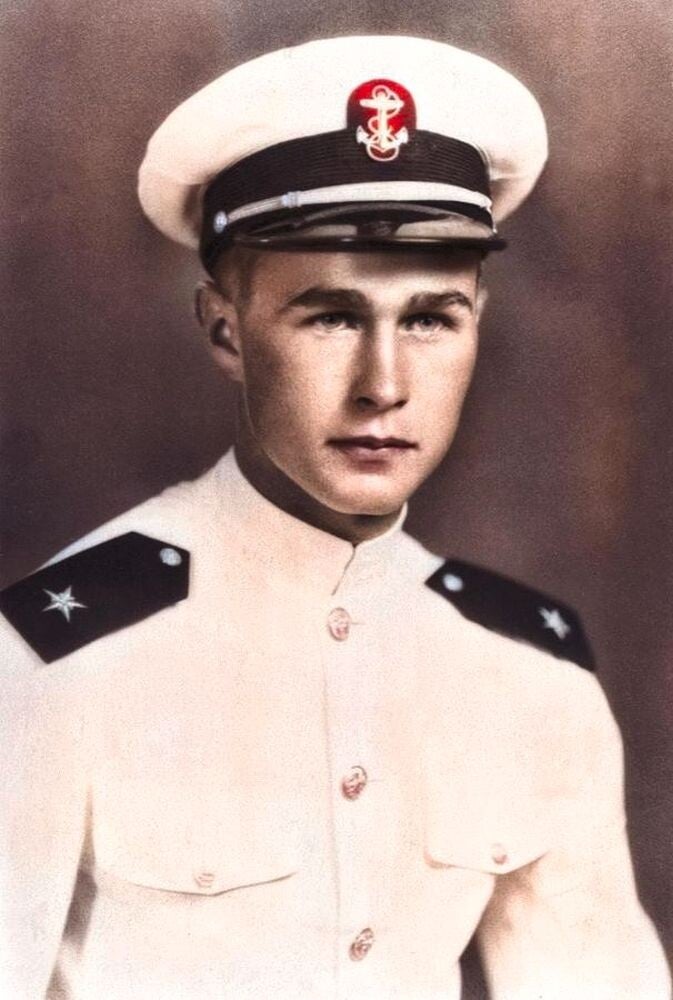
George Bush, future US President and US Navy pilot was shot down while on a raid on Chichijima, fortunately being rescued shortly after.
...contributed to the formidable resistance...
Chichijima’s military resources played a role in reinforcing Iwo Jima, located roughly 150 miles to the south.
As American forces prepared to assault Iwo Jima in early 1945, Japanese commanders drew personnel, supplies, and equipment from Chichijima and other islands in the Nanpō Shotō to strengthen the island’s defences.
These reinforcements contributed to the formidable resistance encountered by US Marines during the battle from 19 February to 24 March 1945.
Despite these efforts, Iwo Jima fell after intense fighting, but Chichijima itself remained under Japanese control until the end of the war.
...even as Japan’s overall position deteriorated...
The island’s strategic value ensured that it remained heavily defended even as Japan’s overall position deteriorated.
Its radio facilities continued to operate, providing surveillance and communication support for Japanese forces across the central Pacific.
The rugged terrain and fortified positions made an American landing costly, and US planners chose to isolate the island rather than capture it.
As a result, Chichijima never experienced a direct amphibious assault.
Instead, it endured repeated air attacks and naval bombardments while remaining cut off from resupply as Japan’s maritime capabilities collapsed.
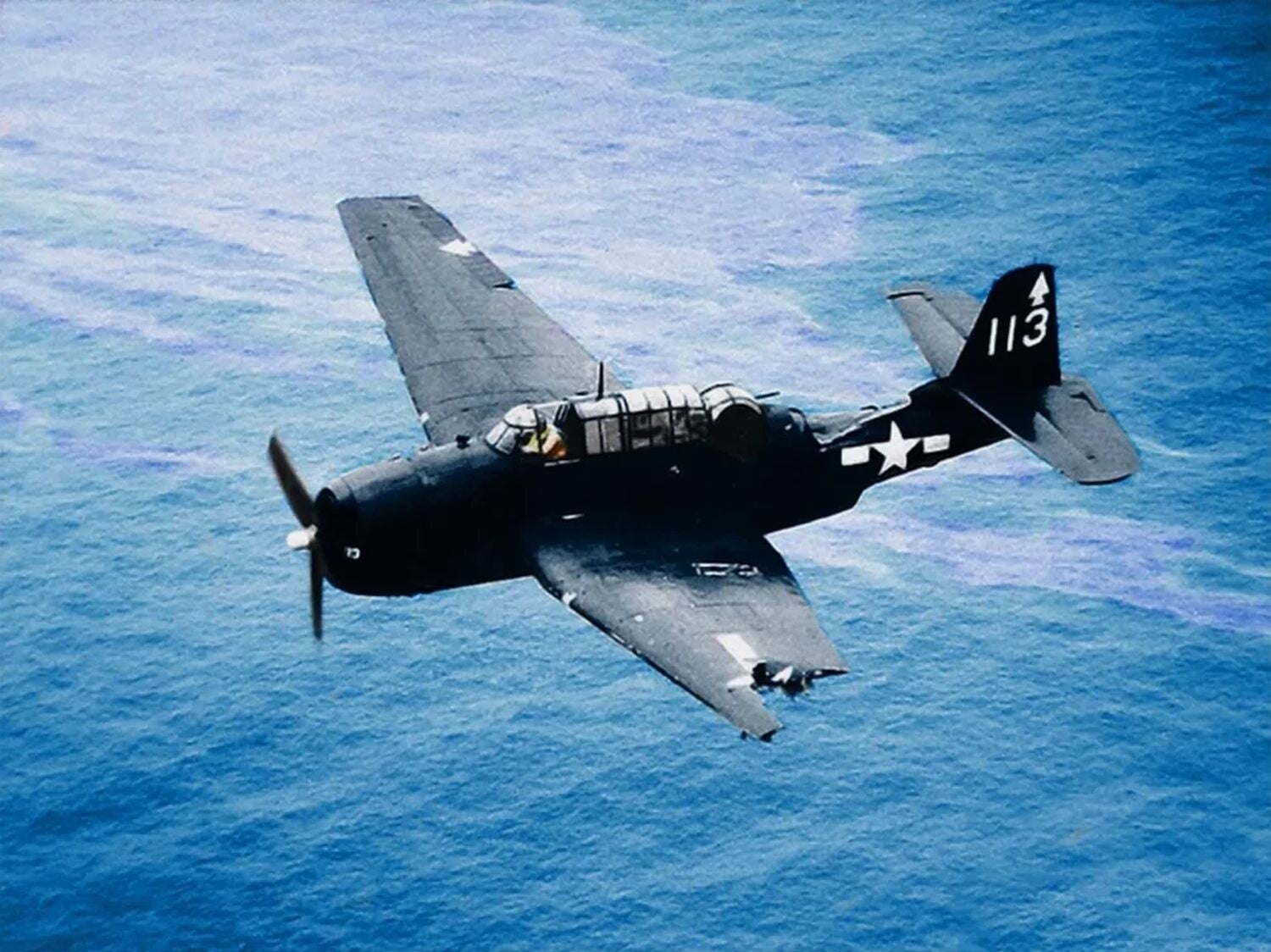
On the eve of the Iwo Jima landings, Chichijima’s starving garrison came under attack from carrier‑based U.S. Navy aircraft. The island’s two long‑range radio stations were the primary targets, struck by Avengers despite heavy anti‑aircraft fire. Lieutenant Robert King’s Avenger from USS Bennington was damaged when another Avenger, its wing blown off by flak, rolled into King’s aircraft, crumpling his rear fuselage and shearing half the port wing. King ordered his crew to bail out before unexpectedly regaining control. His two crewmen were captured and later executed. King ditched safely but carried deep survivor’s guilt.
War Crimes
The island also became associated with the Chichijima incident of February 1945, in which several captured American aviators were tortured and executed by members of the Japanese garrison. In some cases, portions of the victims were consumed.
These acts, later documented in war crimes investigations, formed part of the basis for postwar prosecutions.
The incident gained broader public attention decades later through James Bradley’s book Flyboys, which examined the experiences of American airmen operating in the region and the circumstances surrounding their capture.
Surrender
When Japan announced its surrender in August 1945, the garrisons across the Ogasawara Islands capitulated without further resistance.
Approximately 25,000 Japanese troops in the island chain surrendered to Allied forces, including the substantial contingent on Chichijima.
The subsequent occupation brought investigations into wartime conduct, particularly concerning the treatment of prisoners.
Thirty Japanese soldiers were court‑martialled for class “B” war crimes, most of them connected to the Chichijima incident.
Four officers - Major Matoba, General Tachibana, Admiral Mori, and Captain Yoshii - were convicted and executed by hanging.
Enlisted personnel and Probationary Medical Officer Tadashi Teraki received prison sentences but were released within eight years.
...subjects of historical study and public interest...
In the postwar period, Chichijima’s military infrastructure was dismantled, and the island transitioned to American administration as part of the broader occupation of the Ogasawara Islands.
The civilian population did not immediately return; instead, the islands remained under US control until 1968, when they were formally restored to Japan.
The wartime experiences of Chichijima, including its role as a communications hub, its heavy garrison, and the events associated with the Chichijima incident, became subjects of historical study and public interest, reflecting the island’s complex position within the Pacific War.
...the broader social and political consequences...
Today, Chichijima’s wartime history remains a significant component of its identity.
The remnants of fortifications, radio sites, and military structures serve as physical reminders of its strategic importance.
The island’s role in communications, its connection to major Pacific campaigns, and the postwar legal proceedings that followed the surrender contribute to a detailed understanding of how remote outposts functioned within Japan’s wartime system.
The evacuation of civilians, the suspicion directed toward the Oubeikei, and the later reintegration of the island into Japanese administration illustrate the broader social and political consequences of the conflict for isolated communities in the Pacific.
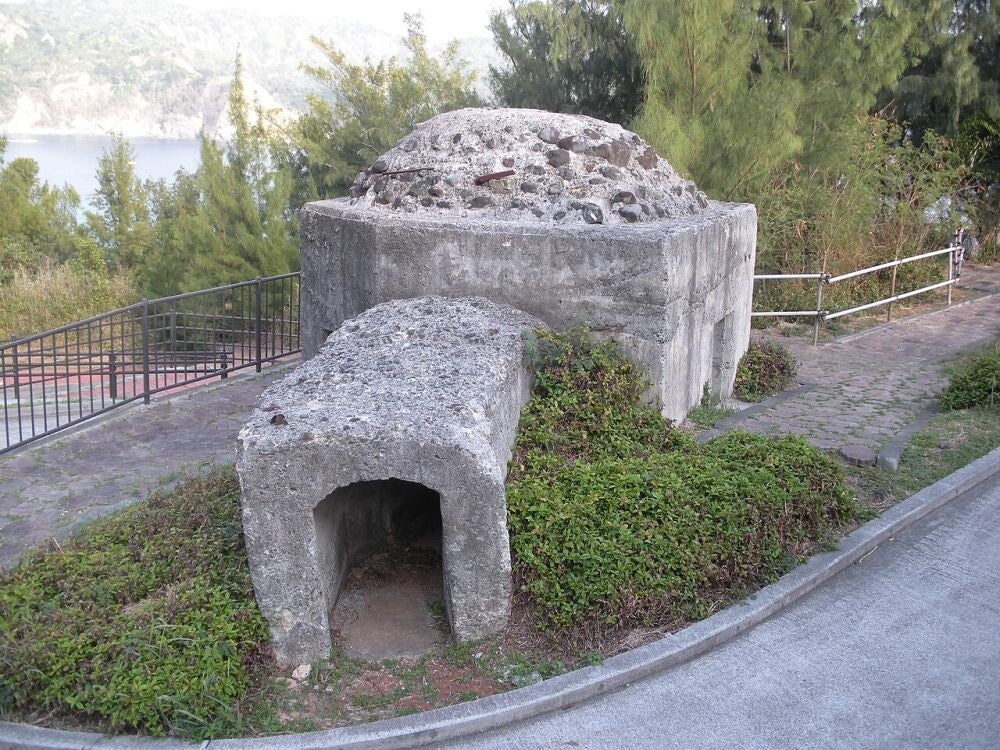
An old bunker on Chichijima.
https://en.wikipedia.org/wiki/Chichijima#/media/File:Bunker_in_Japan_Bonin_Islands.jpg