Overview
Michael Robert Mudie’s story sits at the intersection of personal duty, the escalating Kanalkampf, and the mounting sacrifices that shaped the early Battle of Britain. Born in Singapore in 1916 to a senior Malayan Civil Service family, Mudie was educated in London and joined the RAF on a short‑service commission in 1939. He trained at Cambridge, moved through 11 Group Pool and 2 Ferry Pilot Pool, and in January 1940 joined No. 615 Squadron in France, flying Gladiators and later Hurricanes through the collapse of the Western Front. A brief disciplinary incident while on leave in March did little to hinder his career; by May he was back in combat, force‑landing at Bapaume after engaging Dornier bombers. With the BEF withdrawing, 615 Squadron returned to Kenley, briefly forming “G” Flight for operations from Manston before regrouping for the defence of southern England.
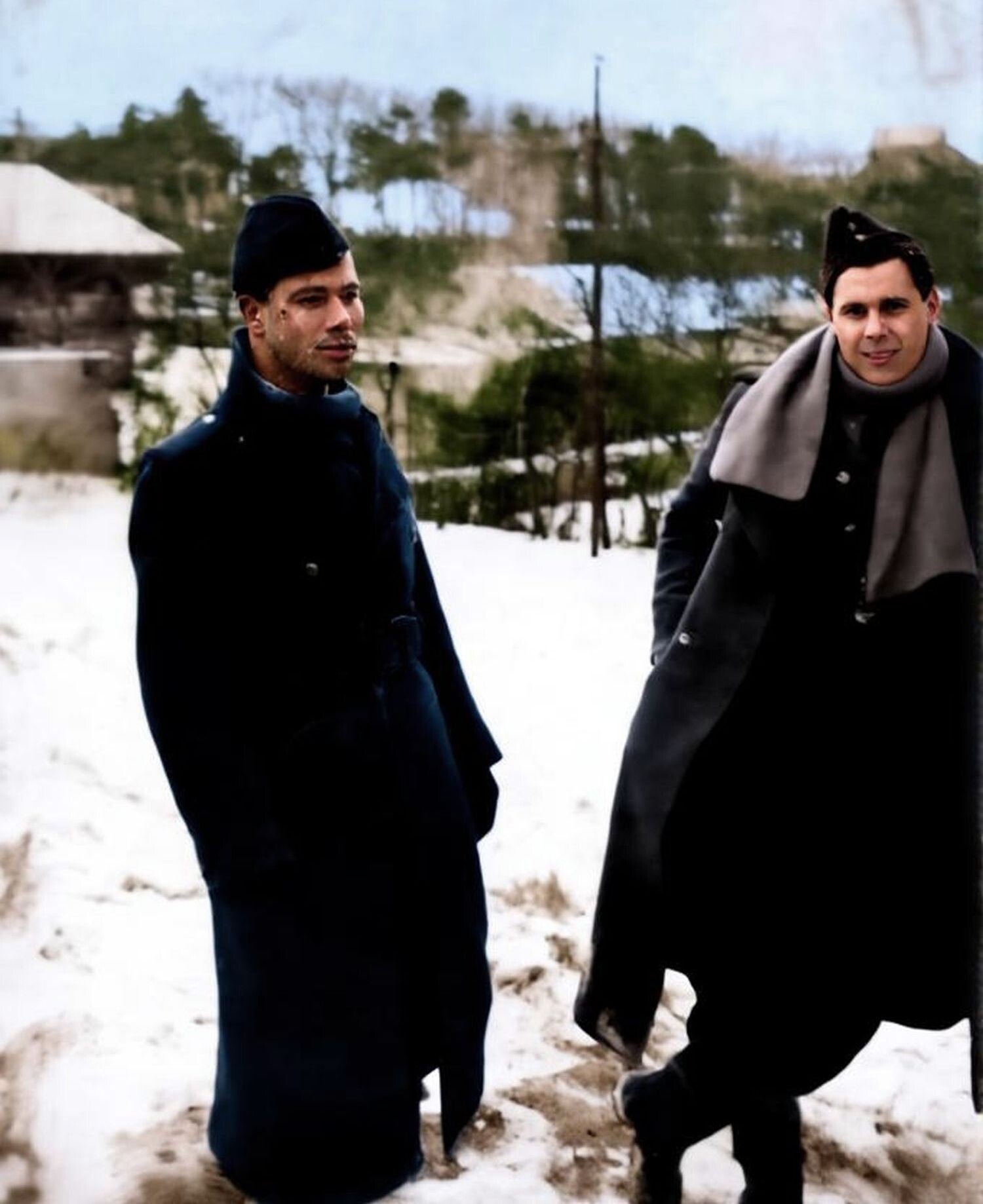
Mudie (left ) with F/Lt. HE Horne (Canadian) in France.
By June and July, the Kanalkampf was fully underway. The Luftwaffe sought to break Britain’s coastal convoys and draw Fighter Command into attritional combat. The RAF, stretched but resolute, met every raid. Radar, short transit times, and the ability to recover downed pilots gave Britain a crucial edge, while German bombers and their Bf 109 escorts struggled with range and mounting losses. By mid‑July the fighting intensified, culminating in the heavy assault on Convoy CW 6 on 14 July.
Mudie was among those scrambled to defend it. Flying Hurricane L1584, he was overwhelmed by multiple Bf 109s—claims later shared by Trebing, Krieger, Priller, and Tietzen. Shot down and badly wounded, he baled out into the Channel. BBC commentator Charles Gardner, watching from the cliffs, misidentified his falling aircraft as a German machine, remarking, “It’s impossible to tell which are our machines and which are the Germans!” Mudie was rescued but died the next day, aged twenty‑four.
His death, like so many in that hard summer, bought time—time that ensured Fighter Command survived the coming onslaught and that Britain endured.
Death of Michael Mudie
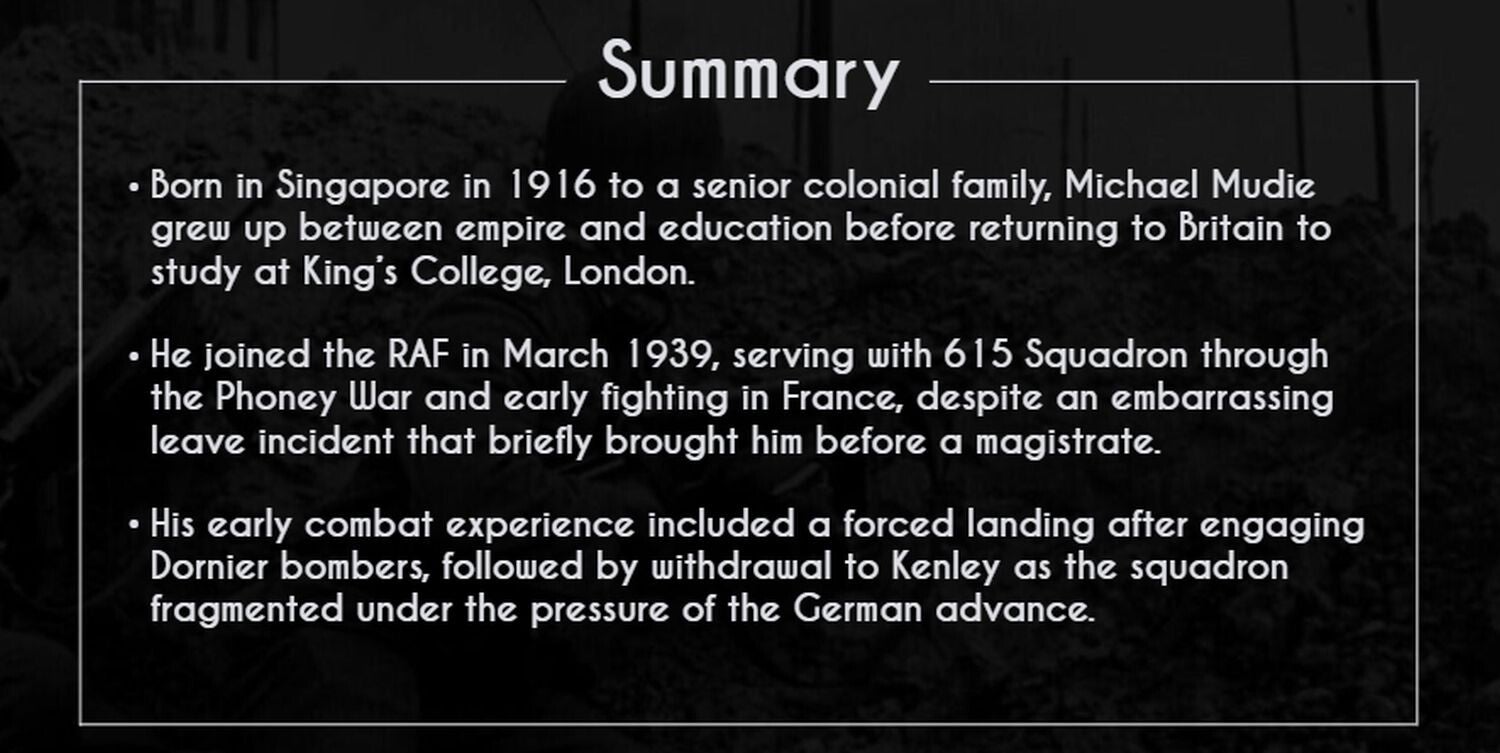
Michael Robert Mudie’s life traced a path shaped by empire, education, and the sudden demands of war.
Born in Singapore on 26 February 1916, he was the third of four sons of Norman David Mudie, a Scot from Angus who had joined the Malayan Civil Service in 1907 and eventually rose to the Supreme Court bench.
His mother, Katharine Eleanor Pugh, had followed her husband to the Far East, raising their family across the shifting landscapes of colonial service.
Michael’s early years were therefore marked by movement and distance, but also by the expectations of a family accustomed to duty.
He later returned to Britain to study at King’s College, London, a conventional path for the son of a senior colonial official.
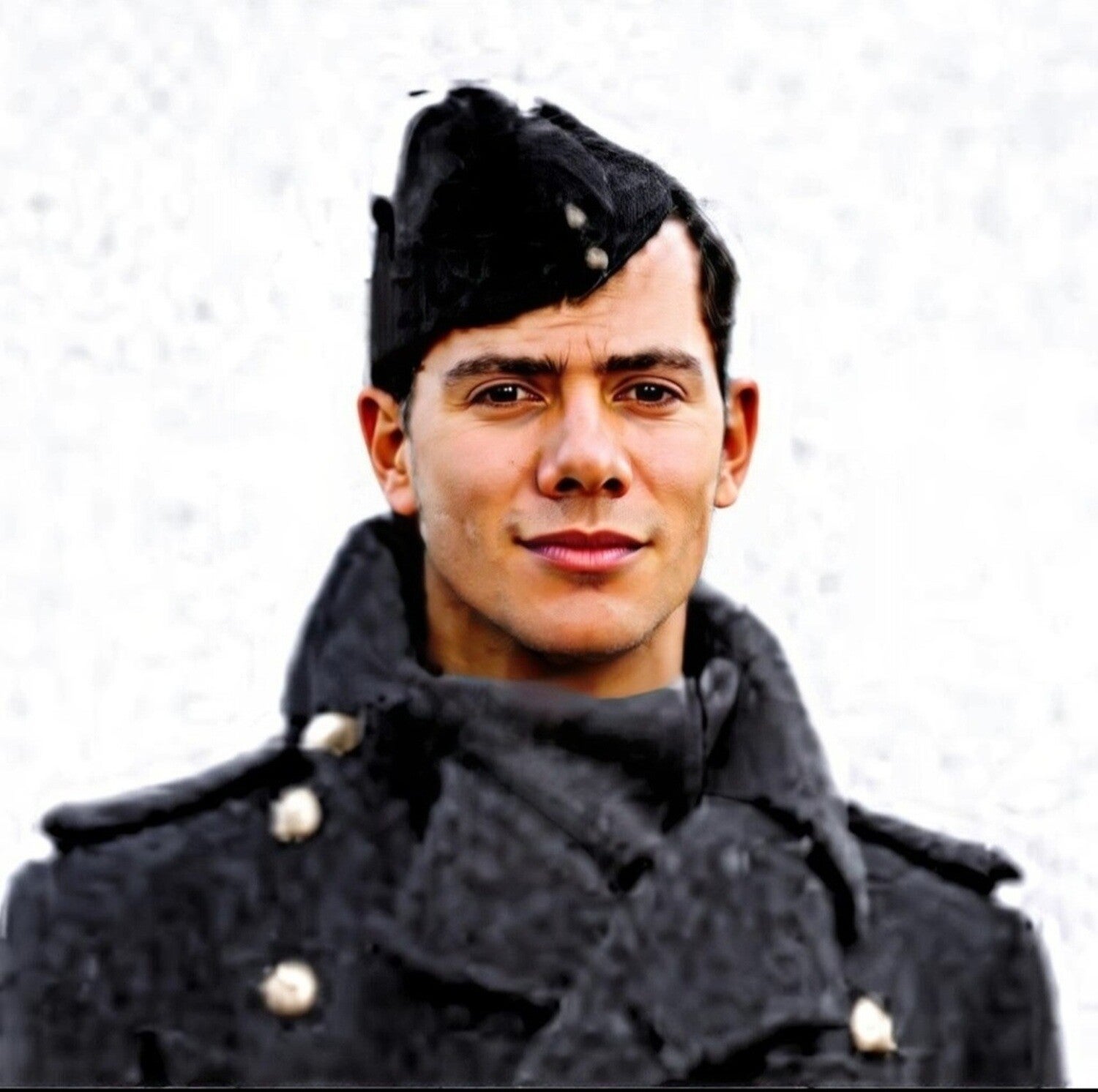
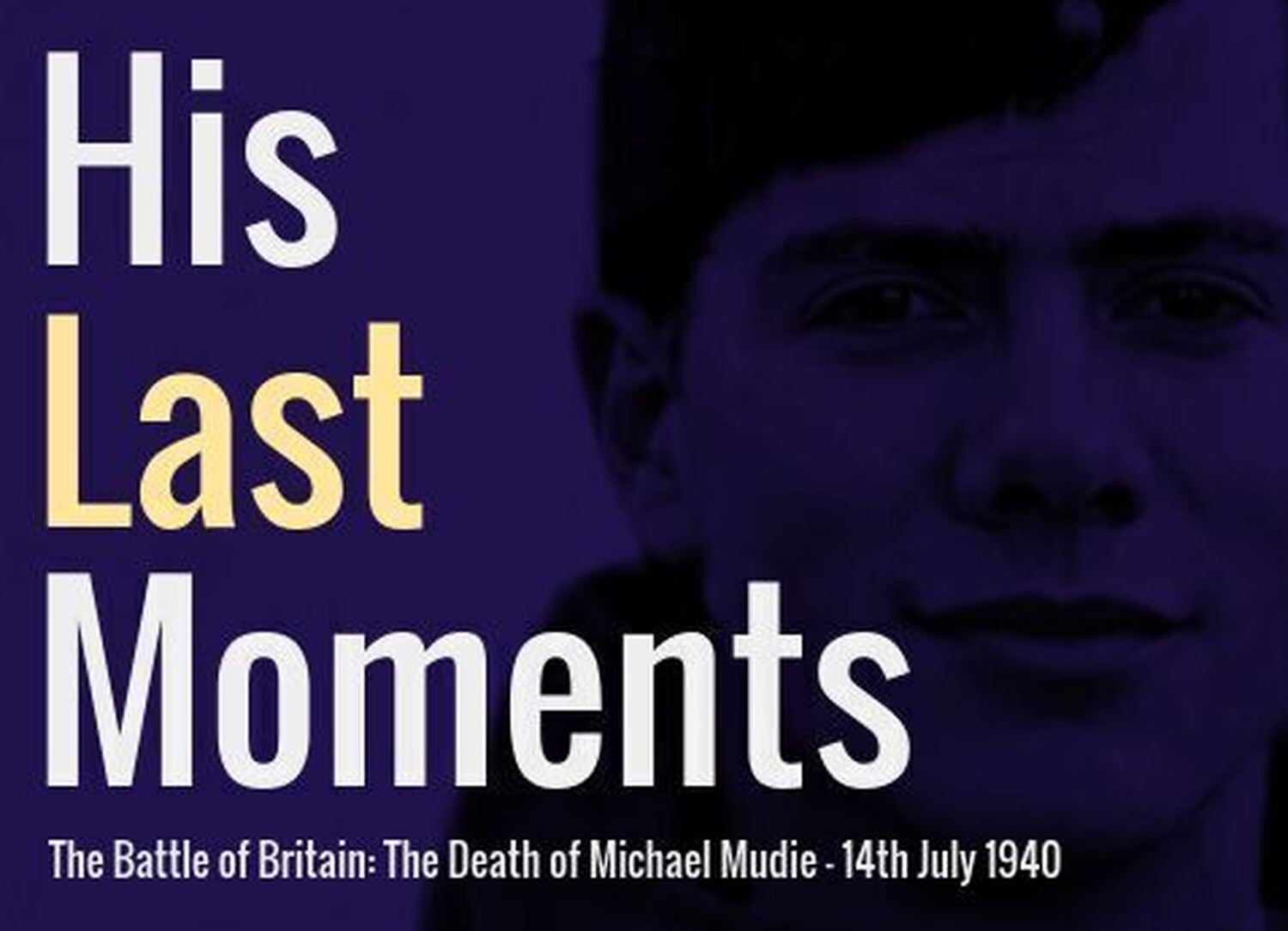
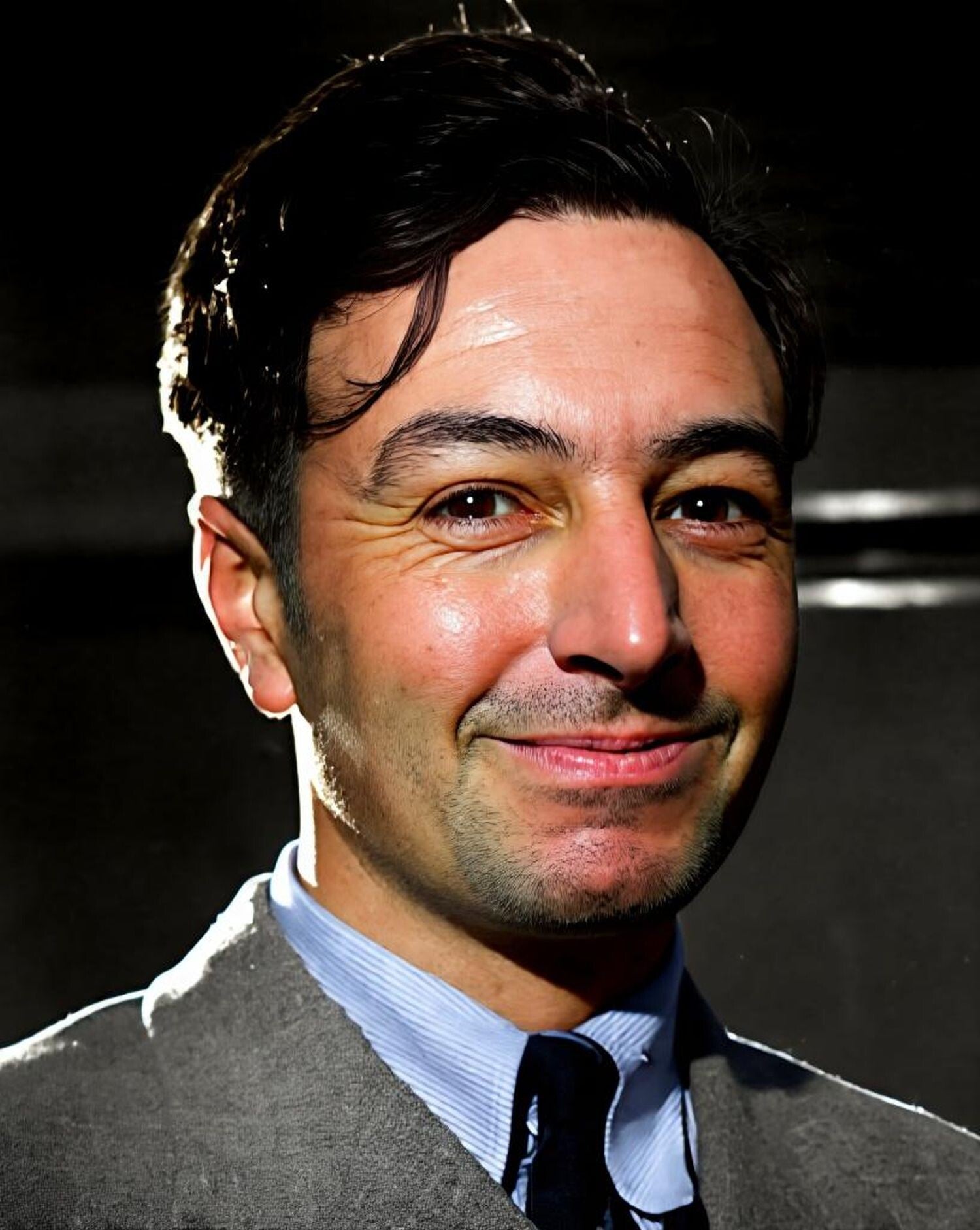
Michael Mudie, an RAF fighter pilot whose tragic last flight would be broadcast by the BBC.
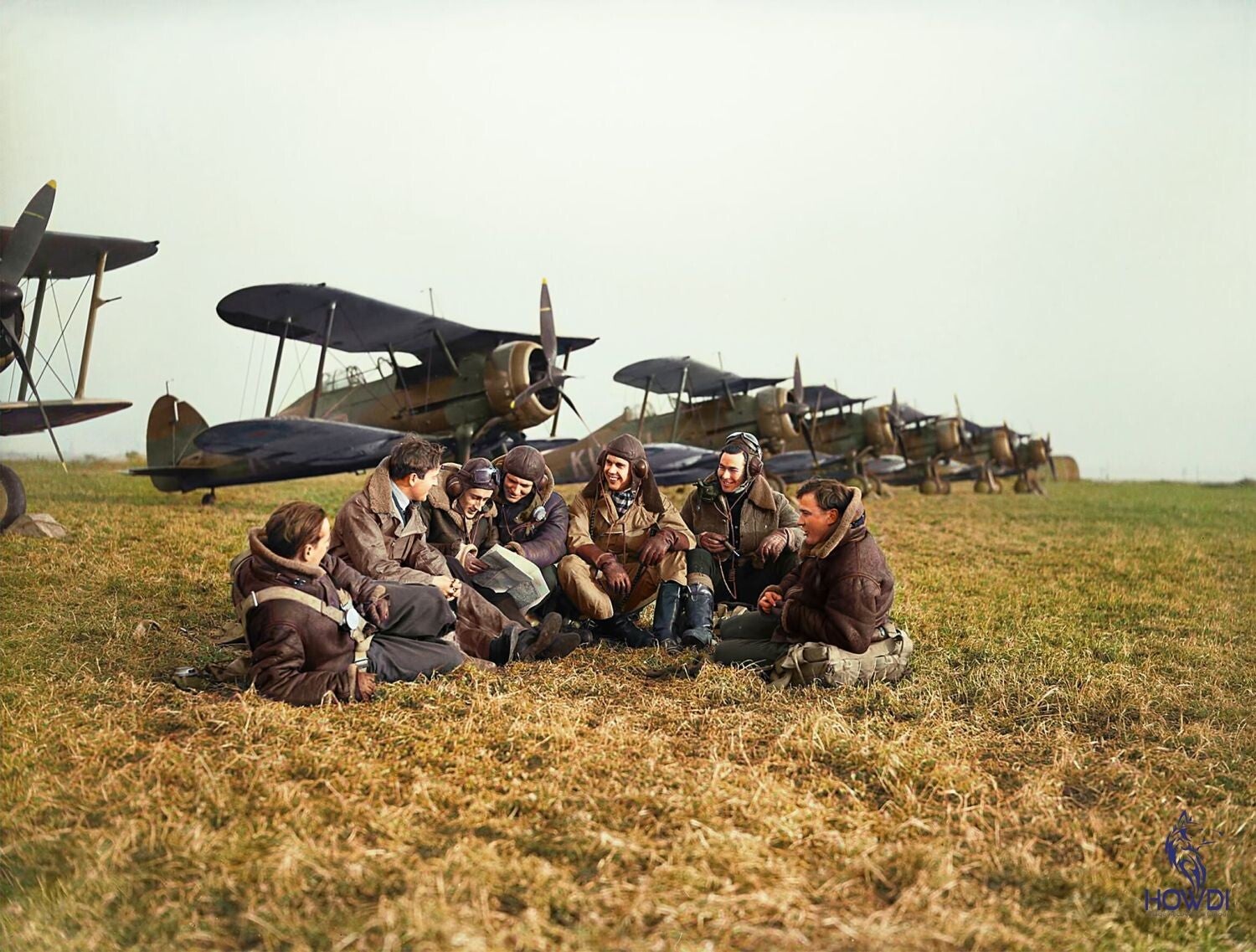
Pilots of No. 615 Squadron RAF gathered together in front of their Gloster Gladiator Mark IIs at Vitry-en-Artois. March/April 1940. The squadron was formed in Kenley in 1937, and evolved rapidly from Audax and Hector army‑co‑operation aircraft to Gauntlet and then Gladiator fighters before deploying to France with the BEF in November 1939. Operating from Vitry‑en‑Artois, with B Flight at Saint‑Inglevert, the squadron struggled through the harsh winter and the growing pressure of German air activity. Among its pilots was Michael Robert Mudie, newly trained and thrown into a theatre sliding toward disaster. Conversion to Hurricanes began just as the German offensive opened, but the speed of the collapse forced 615 back to Kenley by 20 May 1940, depleted and battle‑worn.
Photographer: H. Hensser. Photo: WikiCommons Ref CN511. Colourisation - Nathan Howland
...the rapidly deteriorating situation in France...
Mudie was posted to the RAF 11 group pool in November 1939.
Mudie entered the RAF on a short‑service commission in March 1939, just months before Europe collapsed into war.
His training began at 22 E&RFTS Cambridge, where he learned the fundamentals of flight before progressing to 11 Group Pool in November.
A further posting to 2 Ferry Pilot Pool followed in December, placing him among those held ready to reinforce the rapidly deteriorating situation in France.
On 26 January 1940 he joined No. 615 Squadron at Vitry‑en‑Artois, flying Gloster Gladiators and later Hurricanes during the bitter, chaotic months of the Phoney War and the German offensive.
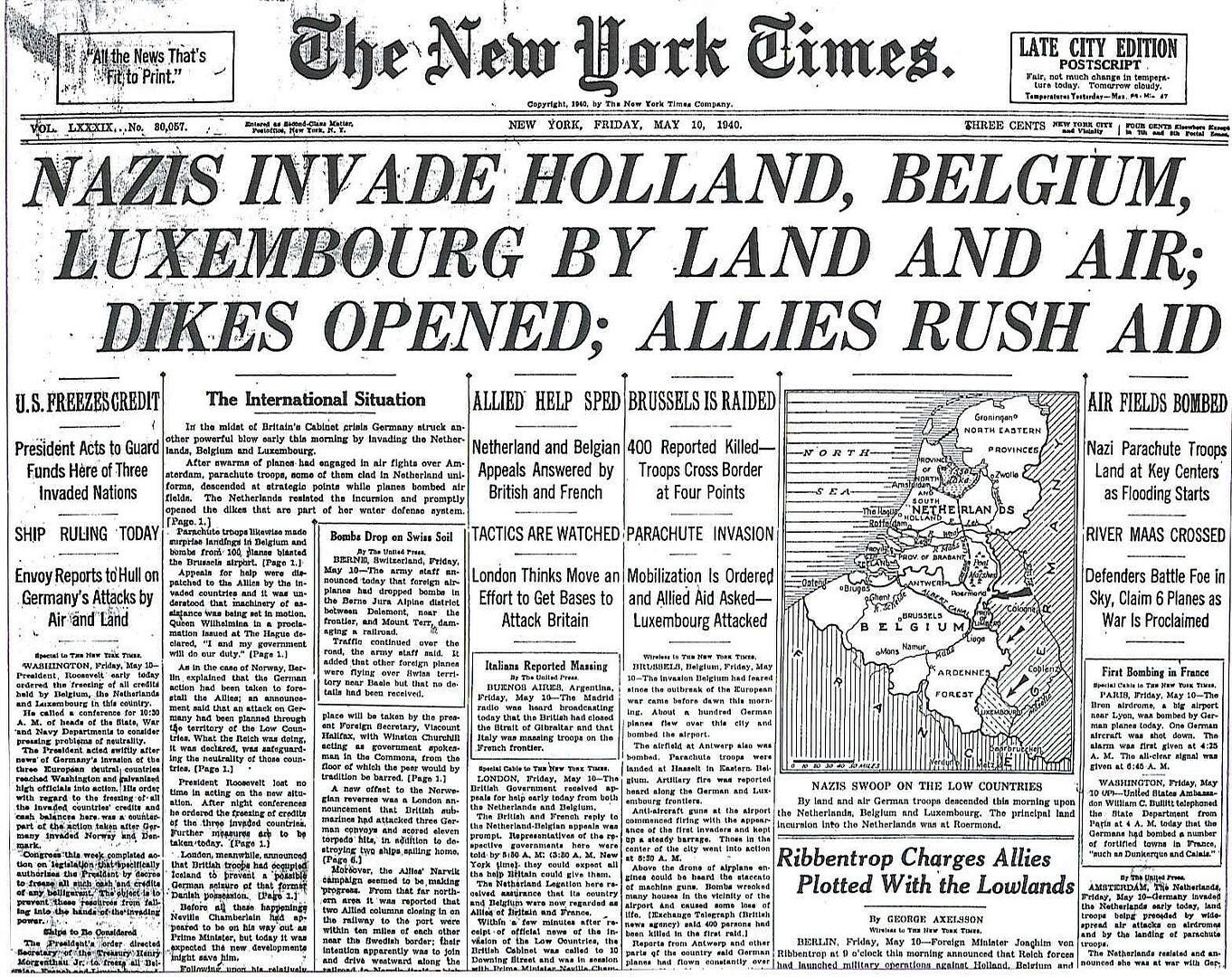
The New York Times reporting on the German invasion. Europe in 1940 was collapsing at terrifying speed. Hitler’s armies had overrun Poland, Denmark, and Norway, and by May they were driving through the Low Countries with unprecedented force. France, long considered a military giant, was reeling under the shock of Blitzkrieg. Belgium and the Netherlands were falling, civilians were fleeing in their millions, and Britain stood increasingly isolated. It was into this continent of fear, uncertainty, and rapid German domination that Mudie would find himself.
...unfortunate incident...
A brief and unfortunate incident interrupted his service in March.
While home on leave, Mudie attended a dance in Kingston, Surrey, wearing French Air Force buttons he had exchanged with comrades.
Accused of impersonating an officer, he reacted angrily, drew his revolver, and fired into the floor.
A second accidental discharge struck his own leg.
Though declared sober, he was fined in court and his weapon confiscated.
The episode, while embarrassing, did not impede his return to duty.
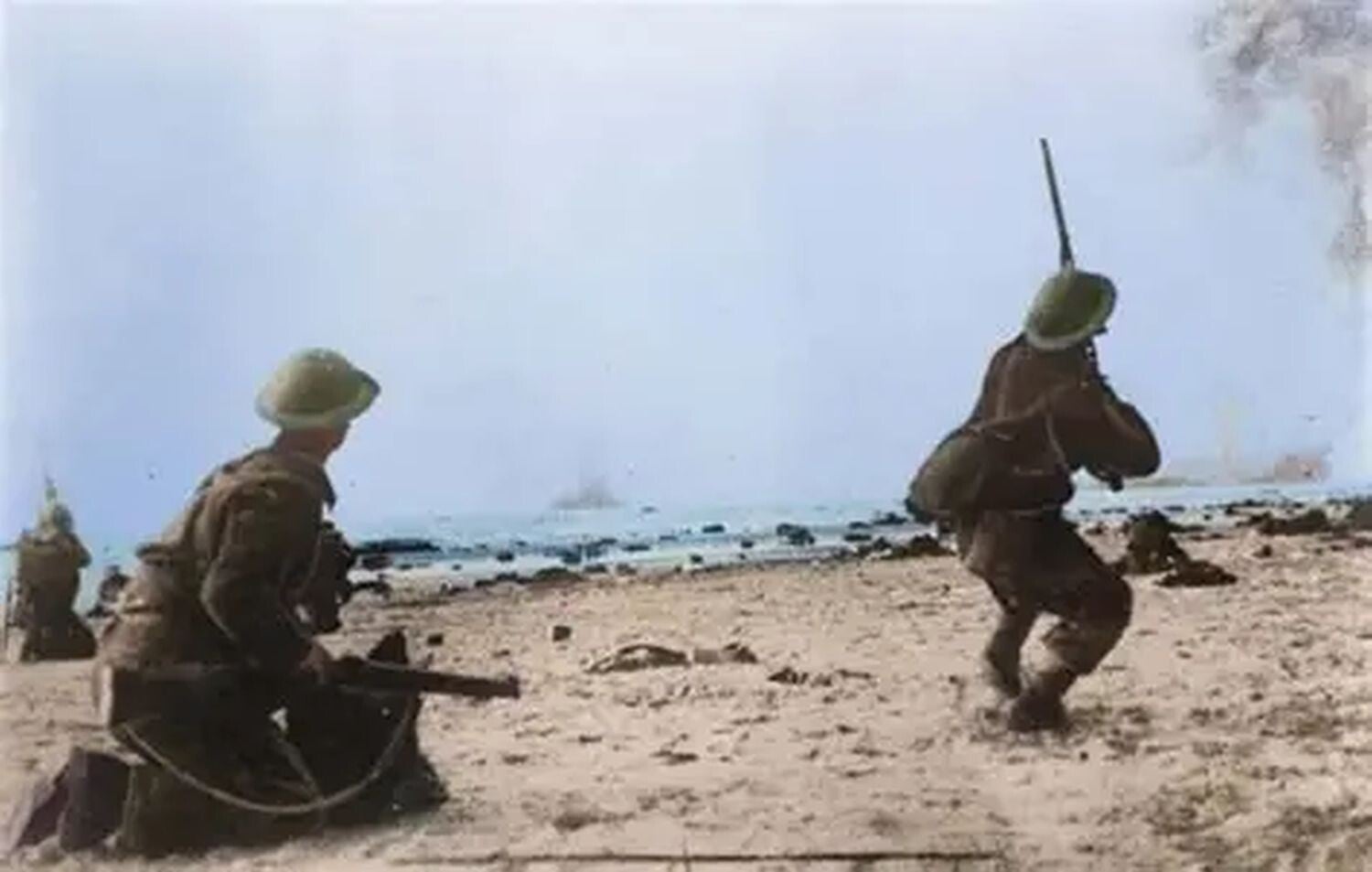
British soldiers take pot shots at Luftwaffe aircraft overhead as they await evacuation on the beaches of Dunkirk. Mudie and the rest of No. 615 Squadron entered the Battle for France as an under‑strength auxiliary unit flying Gloster Gladiators, soon replaced by Hurricanes, and was thrown into a collapsing front it could do little to slow. Operating from Vitry‑en‑Artois, the squadron flew patrols and scrambles against fast‑moving German bomber formations protected by Bf 109s. The speed and coordination of the Luftwaffe’s advance, combined with the destruction of French airfields and the rapid loss of ground support, left 615 constantly relocating and often outnumbered. By mid‑May 1940 the squadron was exhausted, its aircraft depleted, and it withdrew to England as German success became overwhelming.
...reeled toward the Channel...
Combat soon overshadowed everything.
On 15 May he force‑landed at Bapaume after an engagement with Dornier bombers.
Days later, as the British Expeditionary Force reeled back toward the Channel, 615 Squadron withdrew to Kenley.
A small detachment, “G” Flight, was formed and sent to Manston to operate Gladiators alongside 604 Squadron, but by the end of May it was dissolved and the pilots reabsorbed.
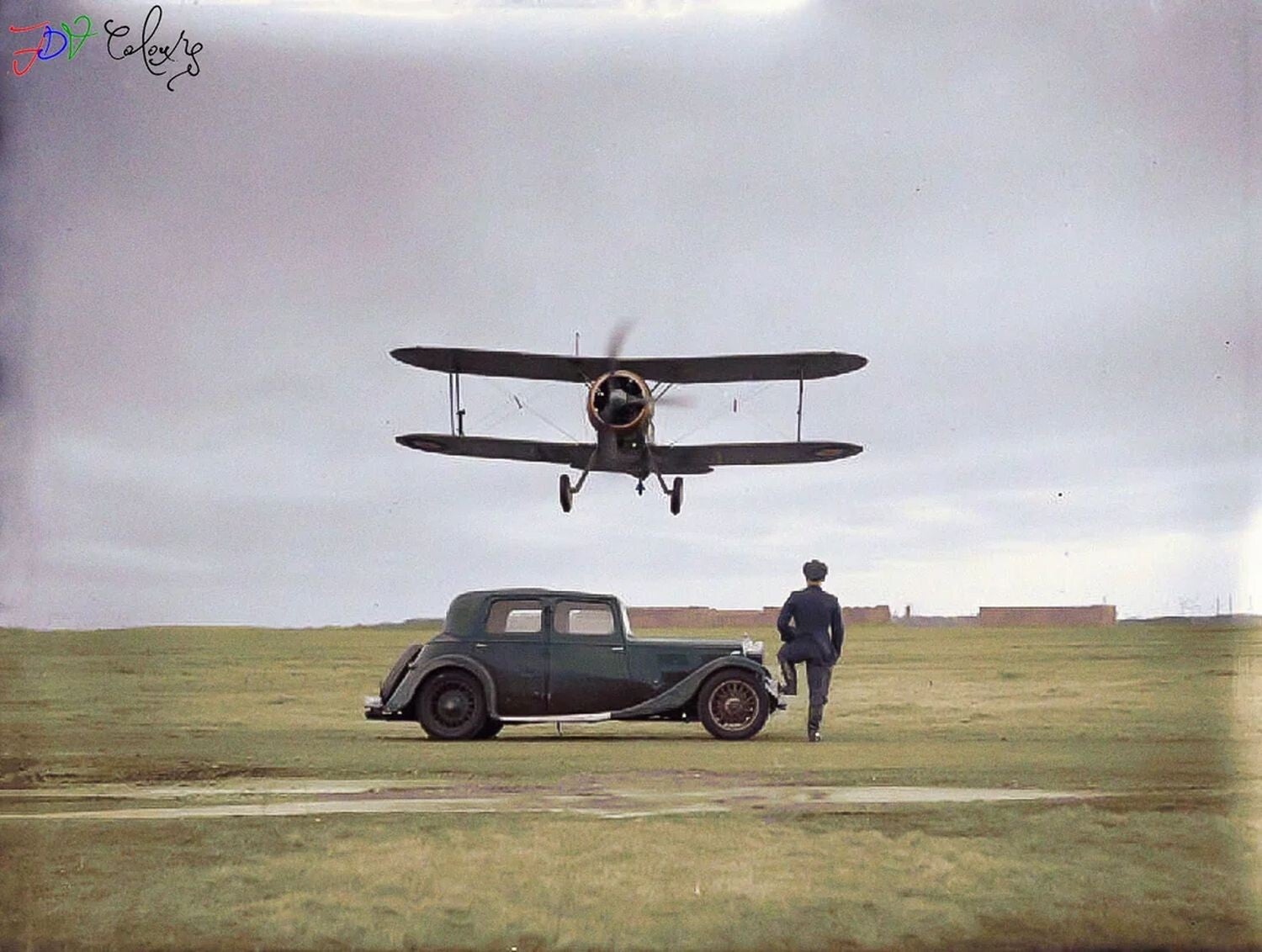
A Gloster Gladiator from No. 521 (met) Squadron RAF takes off over a Triumph Gloria and a pilot at RAF Bircham Newton. Gloster Gladiators were effectively obsolete by 1940, their biplane design and modest speed leaving them outmatched by modern German fighters. Yet a few remained in secondary roles, flying local defence and training duties. Their continued presence highlighted the RAF’s early‑war shortages and the urgency of replacing outdated aircraft as the air battle intensified.
Kanalkampf
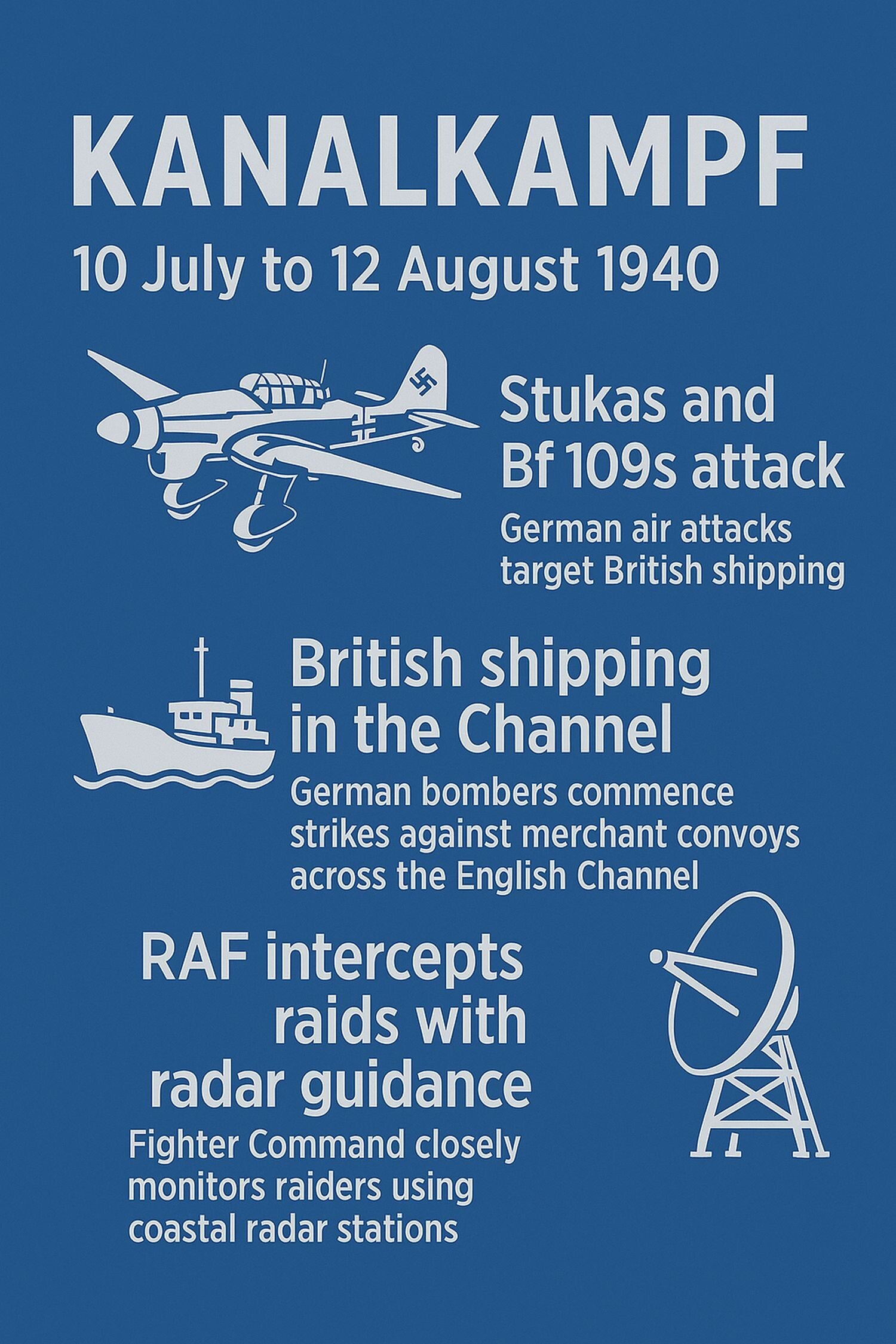
The Battle of Britain did not begin with the great set‑piece raids of August, but with the grinding, attritional struggle that unfolded across the Channel in June and July 1940.
This opening phase, later termed the Kanalkampf, grew from German attempts to disrupt Britain’s coastal convoys—small, slow merchant ships that threaded daily through the narrow waters between Dover and the French coast.
For the Luftwaffe, these convoys offered both targets and bait: a way to draw RAF Fighter Command into combat, test its strength, and wear down its pilots before the main assault on Britain began.
For the RAF, the convoys were a lifeline that had to be protected, even at the cost of constant, exhausting engagements.
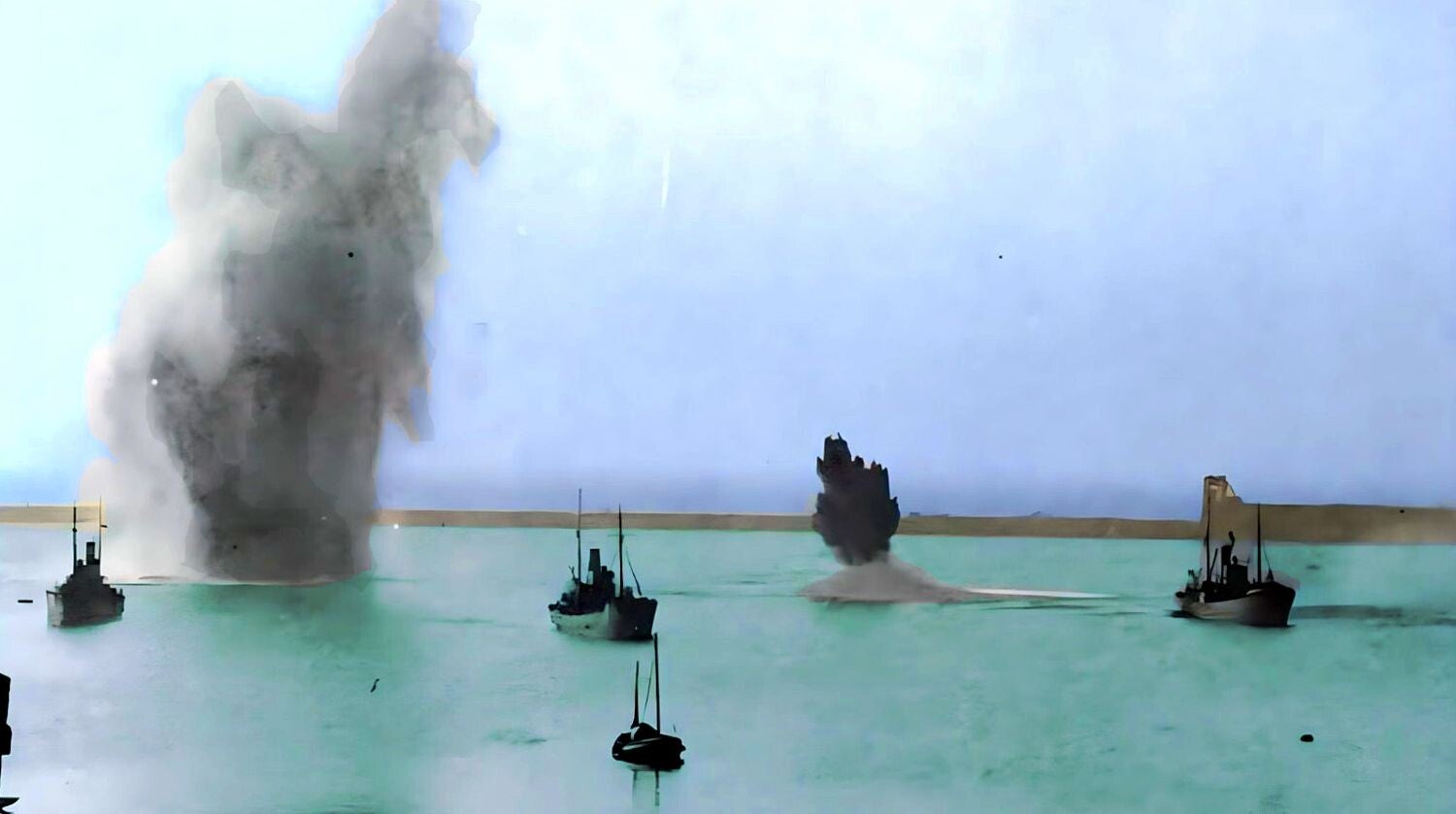
A convoy under Luftwaffe attack near Dover, July 1940. During Kanalkampf, the Luftwaffe launched frequent attacks on British Channel convoys and the port of Dover. These raids aimed to lure RAF fighters into combat and test British defences. Dover, Folkestone, and surrounding areas suffered repeated bombings, damaging docks, merchant ships, and coastal infrastructure. Although militarily limited, these attacks caused disruption and casualties, intensifying public fear and preparing the Luftwaffe for larger-scale operations inland.
...struck at shipping whenever conditions allowed...
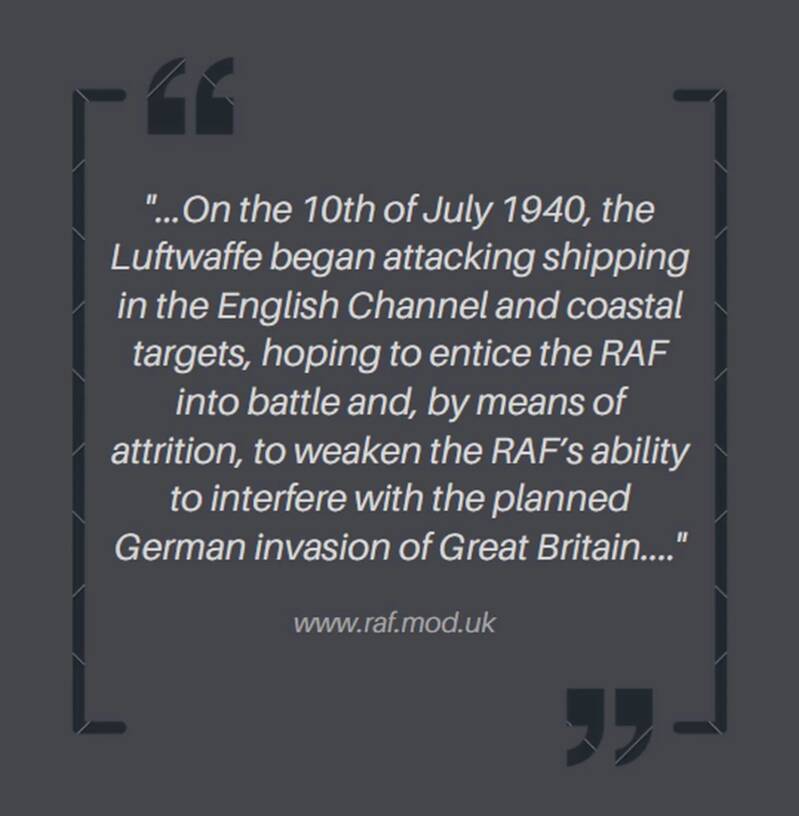
By early July the pattern was set. German reconnaissance aircraft probed the Channel, often escorted by Bf 109s sweeping ahead to clear the air.
Stukas and Dorniers struck at shipping whenever conditions allowed, while British radar stations tracked the incoming raids and scrambled Hurricanes and Spitfires to intercept.
The fighting was fierce but fragmented—sharp clashes over the water, brief dogfights at altitude, and sudden dives into cloud as pilots sought advantage or escape.
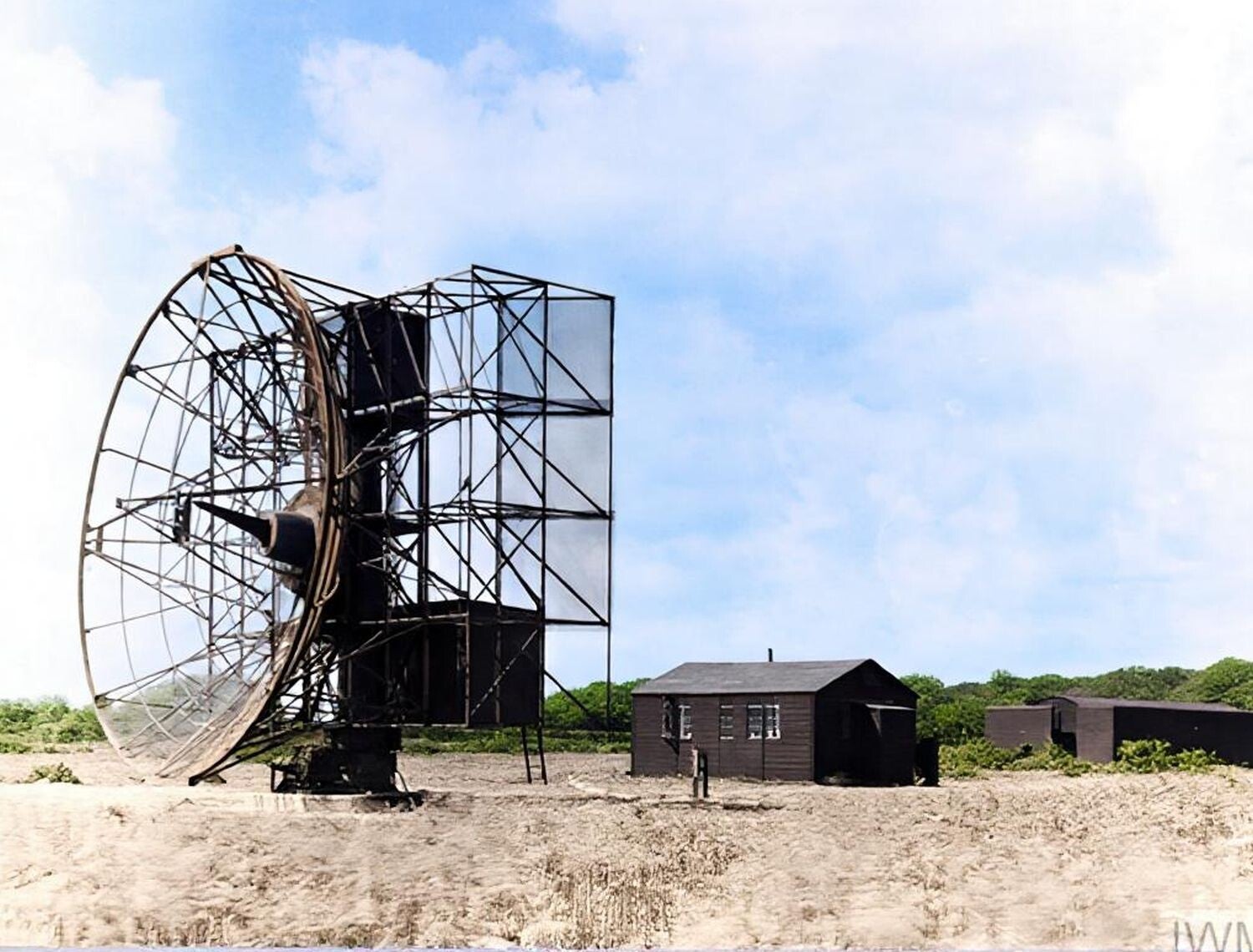
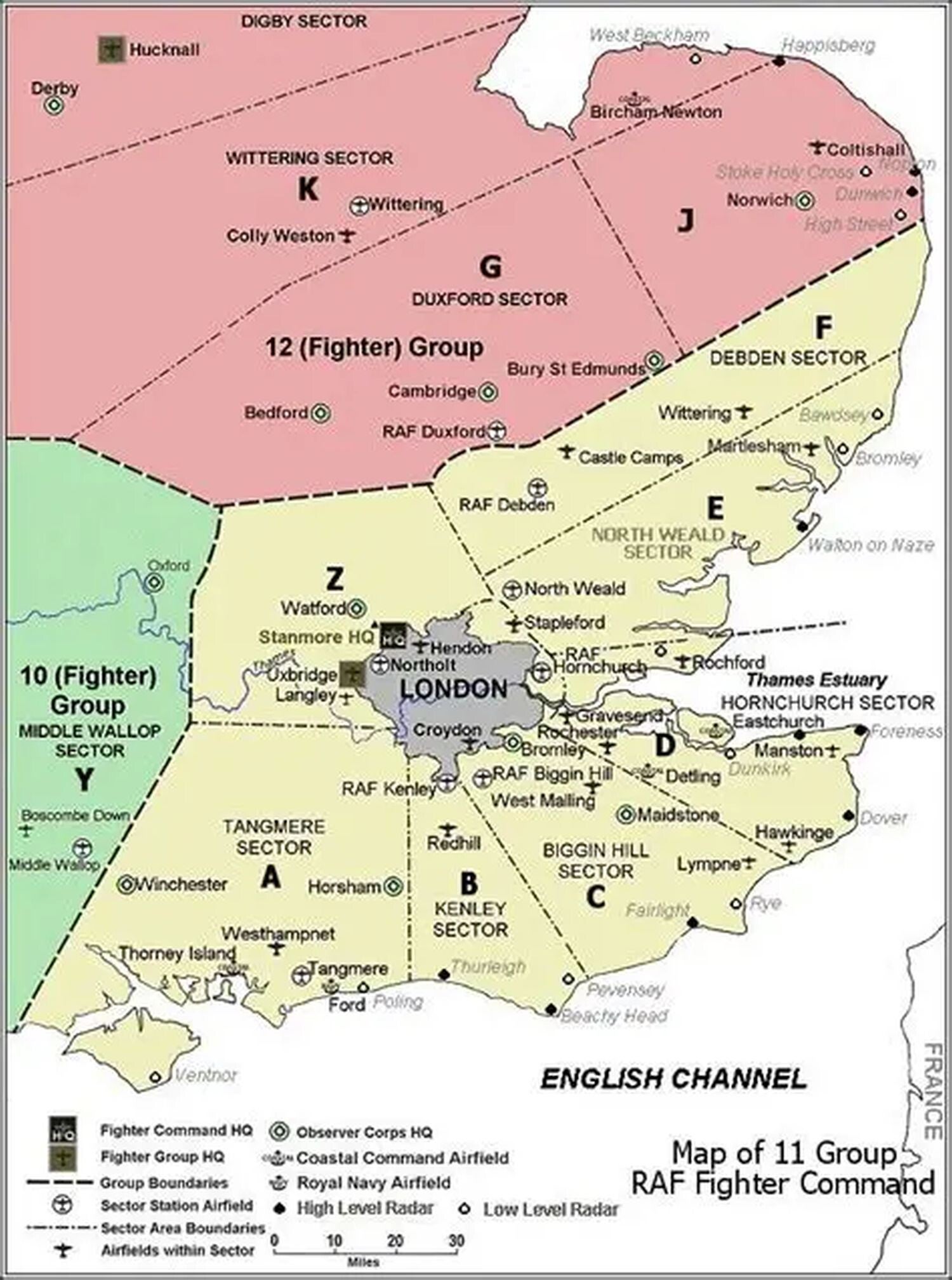
The coastal Chain Home radar network shaped Kanalkampf by giving Fighter Command early warning of most incoming raids, but its weakness at low‑altitude detection meant German aircraft skimming the Channel often appeared with minimal notice. This limitation let the Luftwaffe strike convoys quickly and withdraw before interception, sharpening the Channel battles and exposing the system’s early vulnerabilities.
Imperial War Museum
...attacked with growing determination...
Losses mounted on both sides, yet neither gained decisive ground.
What mattered most was the cumulative strain: pilots flying multiple sorties a day, ground crews working without pause, and commanders trying to read an enemy whose intentions were still unclear.
By 14 July the tempo had quickened. Convoys were attacked with growing determination, and the Luftwaffe began coordinating larger formations of fighters and bombers.
The RAF, though stretched, responded with equal resolve.
The day’s battles—culminating in the heavy assault on Convoy CW 6—marked a turning point.
The Kanalkampf was no longer a prelude but the opening movement of the Battle of Britain itself, a contest of endurance that would soon escalate into a full‑scale struggle for control of the skies.
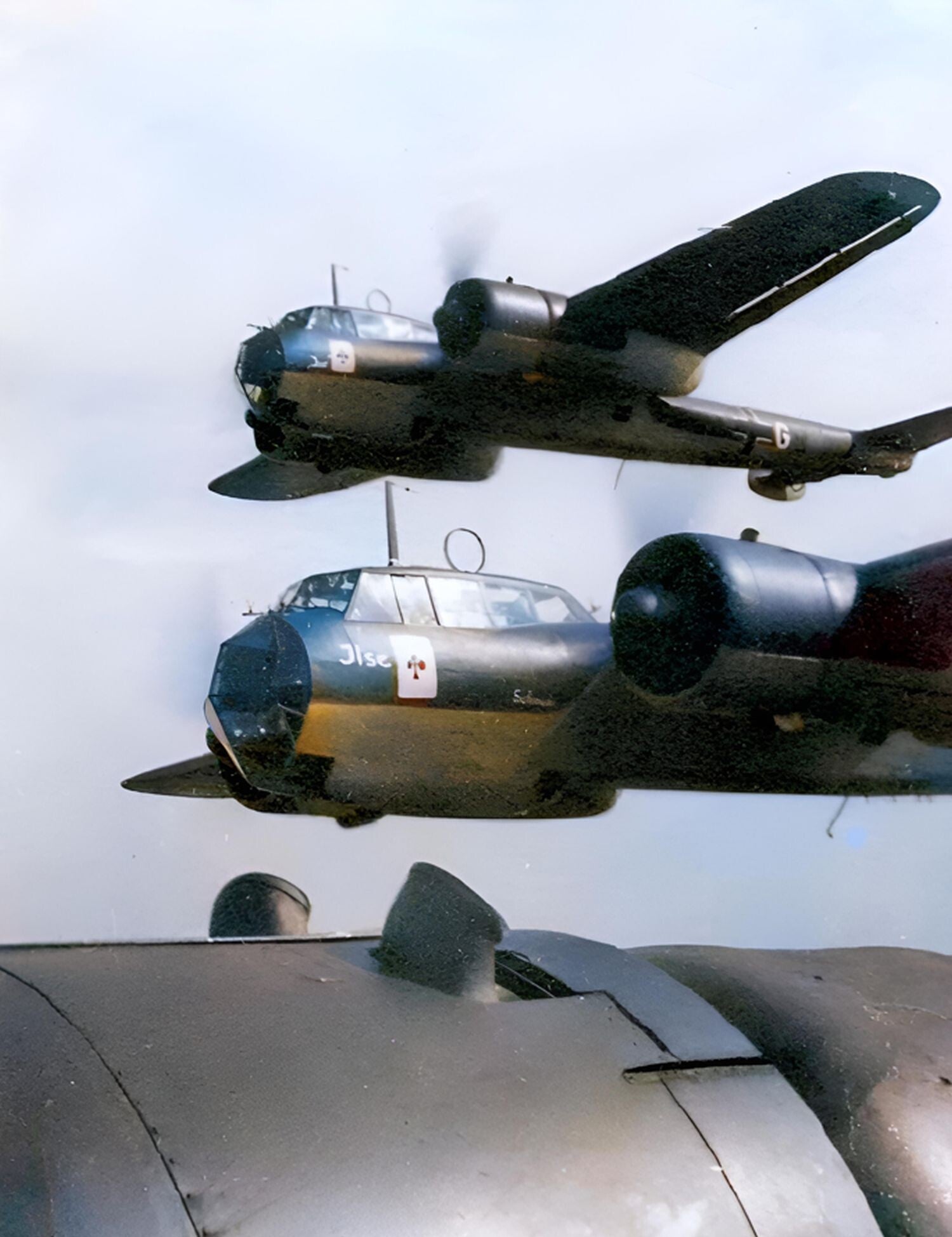
Dornier Do 17Zs 7.KG3 flying in formation Battle of Britain. The Dornier Do 17, nicknamed the “Flying Pencil,” played a major role in Kanalkampf, conducting low-level raids on shipping.
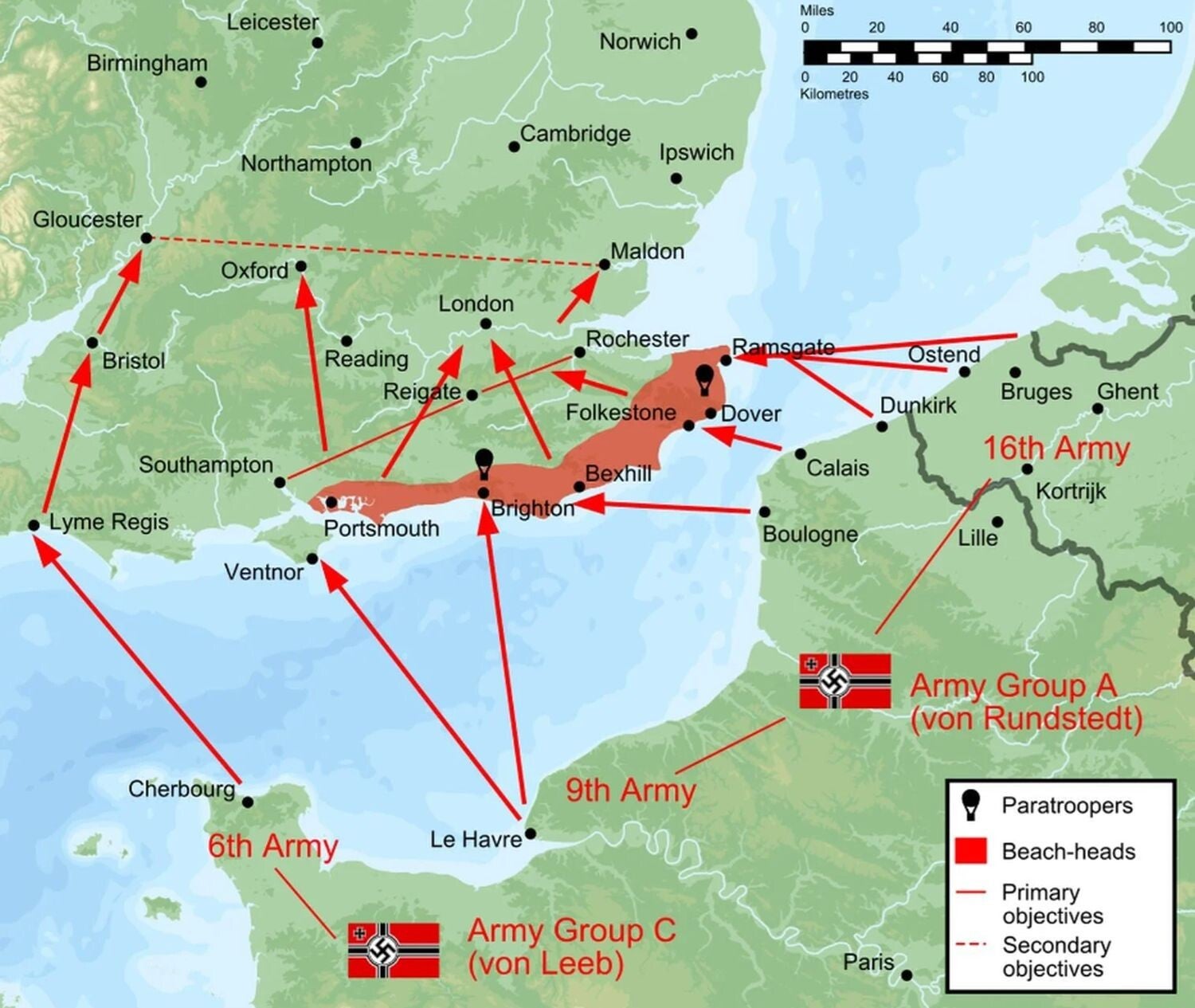
The German plans for Operation Sealion - the invasion of England. initial Army proposals of 25th July 1940 envisaging landings from Kent to Dorset, Isle of Wight and parts of Devon; subsequently refined to a confined group of four landing sites in East Sussex and western Kent. Kanalkampf marked the Luftwaffe’s opening effort to dominate the Channel, testing RAF reactions and weakening coastal convoys. Its outcome shaped the feasibility of Sealion, since German planners required air superiority before risking an invasion fleet. The failure to break Fighter Command during Kanalkampf ultimately undermined any realistic chance of launching Sealion.
The Final Day
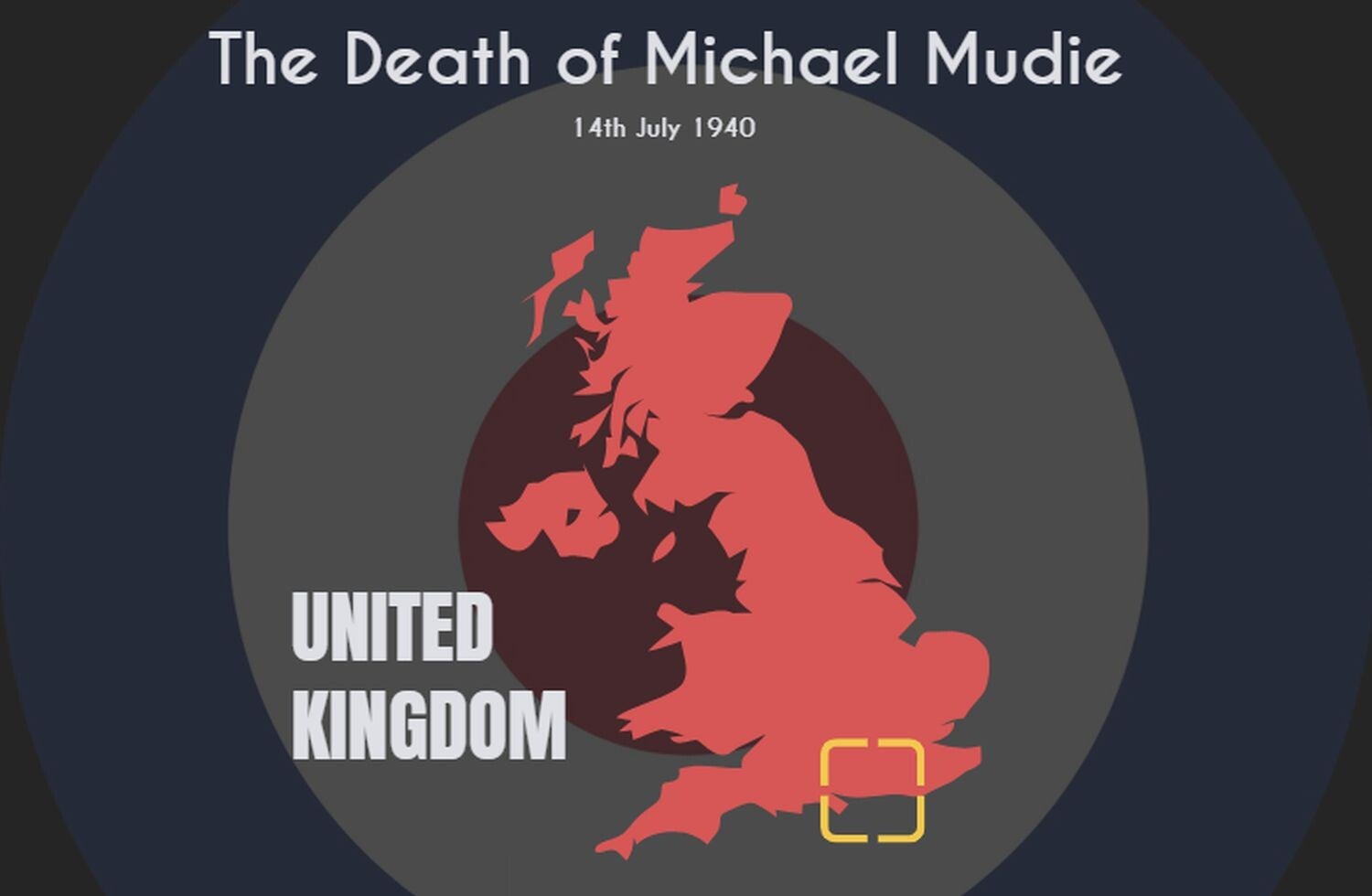
Mudie’s final battle came on 14 July 1940, during the escalating air war over the Channel.
Flying Hurricane L1584, he joined the defence of Convoy CW 6 off Dover as large formations of Stukas, Dorniers, and Messerschmitts suddenly swept in.
For Mudie, there was little hope of escaping the Schwarms of Bf 109s that closed in behind him.
No fewer than four German fighter pilots claimed a share in the destruction of his Hurricane L1584 (KW‑G).
Among them were Oberfeldwebel Trebing of JG 3 and Walter Krieger of JG 51, alongside two far better‑known aces: Oberleutnant Josef Priller and Hauptmann Horst Tietzen.
Against such concentrated, veteran opposition, Mudie’s fate was sealed within seconds.
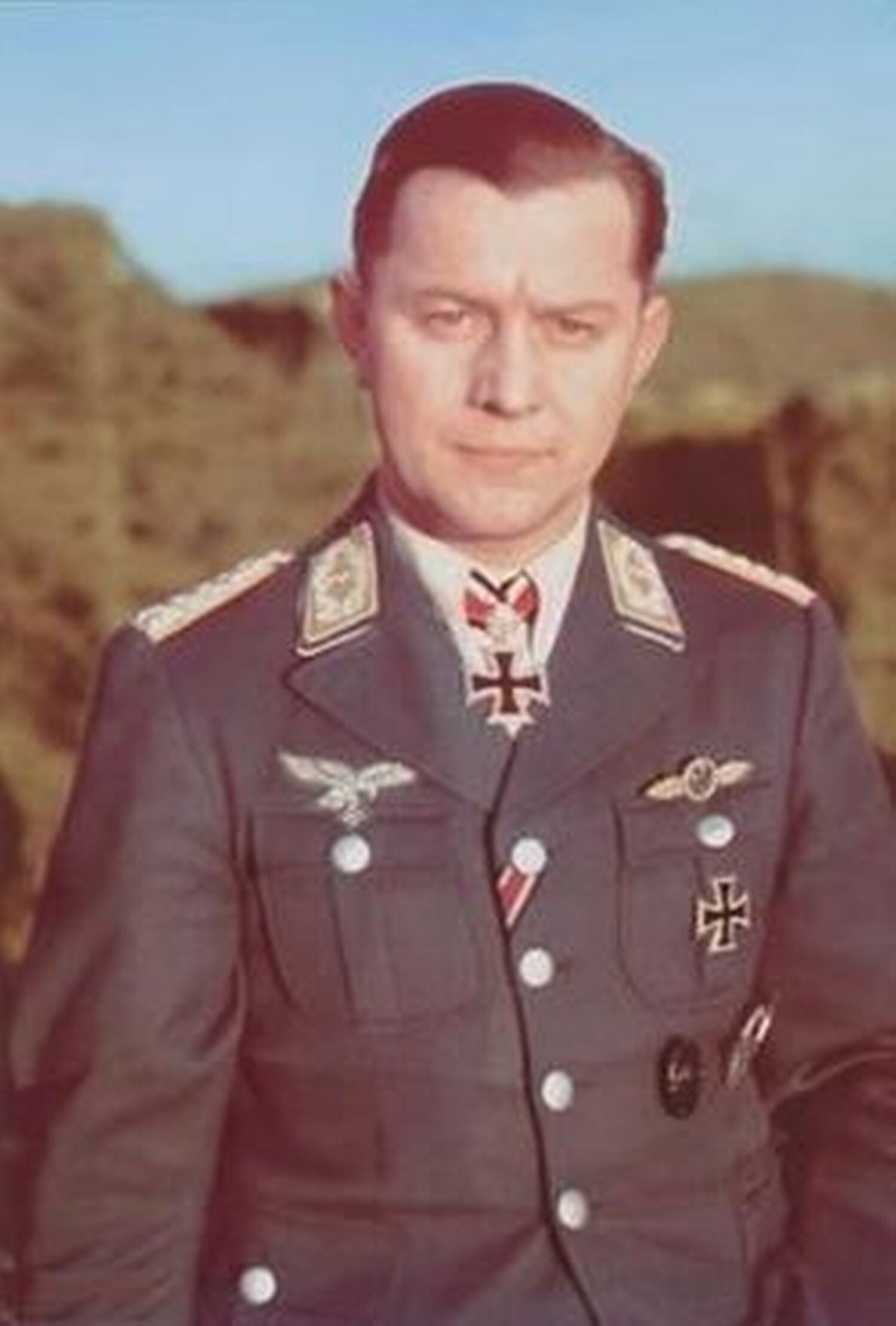
Oberleutnant Josef Priller, one of the Luftwaffe pilots responsible for shooting down Mudie.
Oberst Josef “Pips” Priller (1915-1961) - Find a Grave Memorial
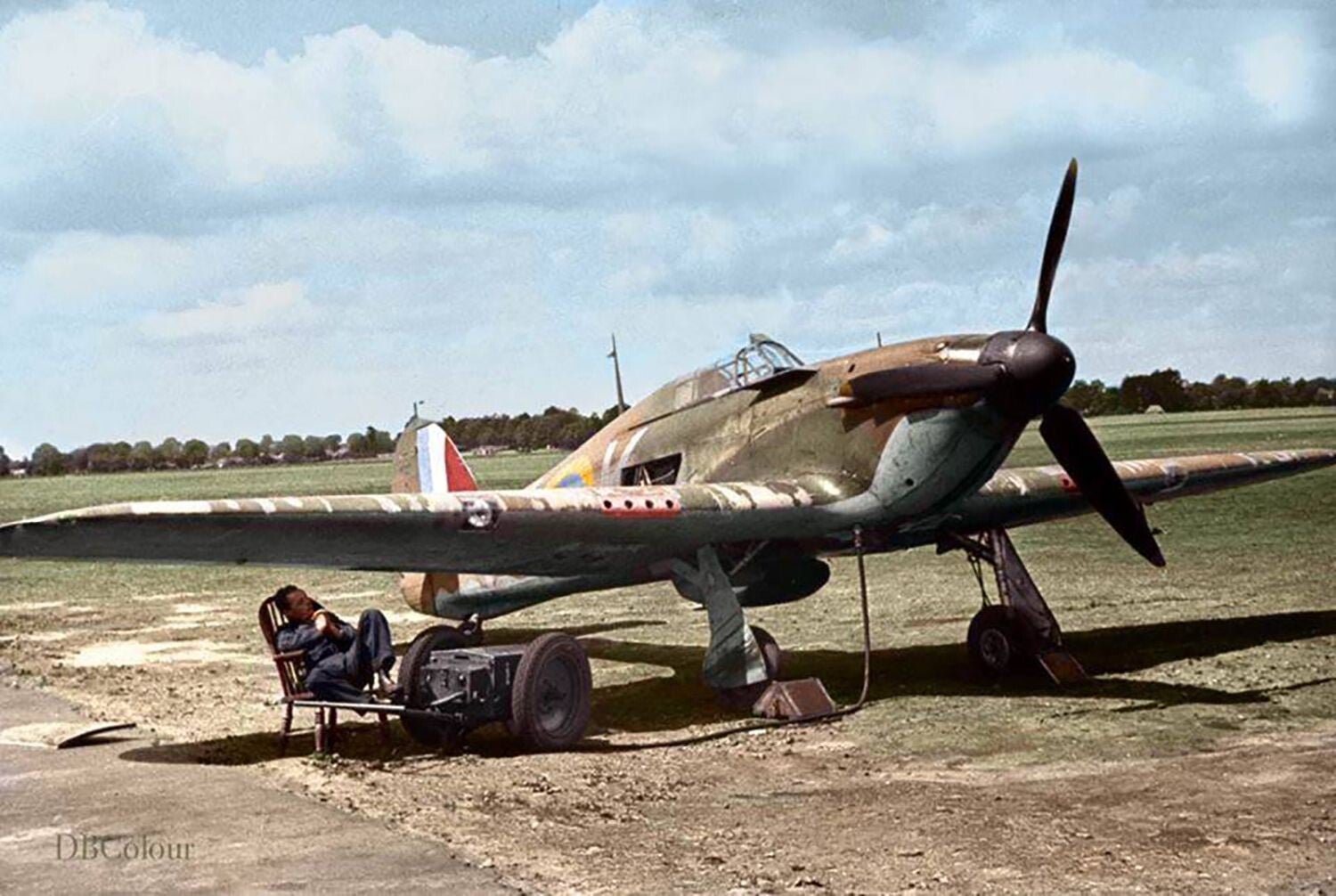
A Mark I Hawker Hurricane - the type flown by Mudie on the 14th July 1940.
Asisbiz Hawker Hurricane I RAF 85Sqn VYK Geoffrey Sammy Allard P3408 England July 1940-01
...the confusion and immediacy of the moment:..
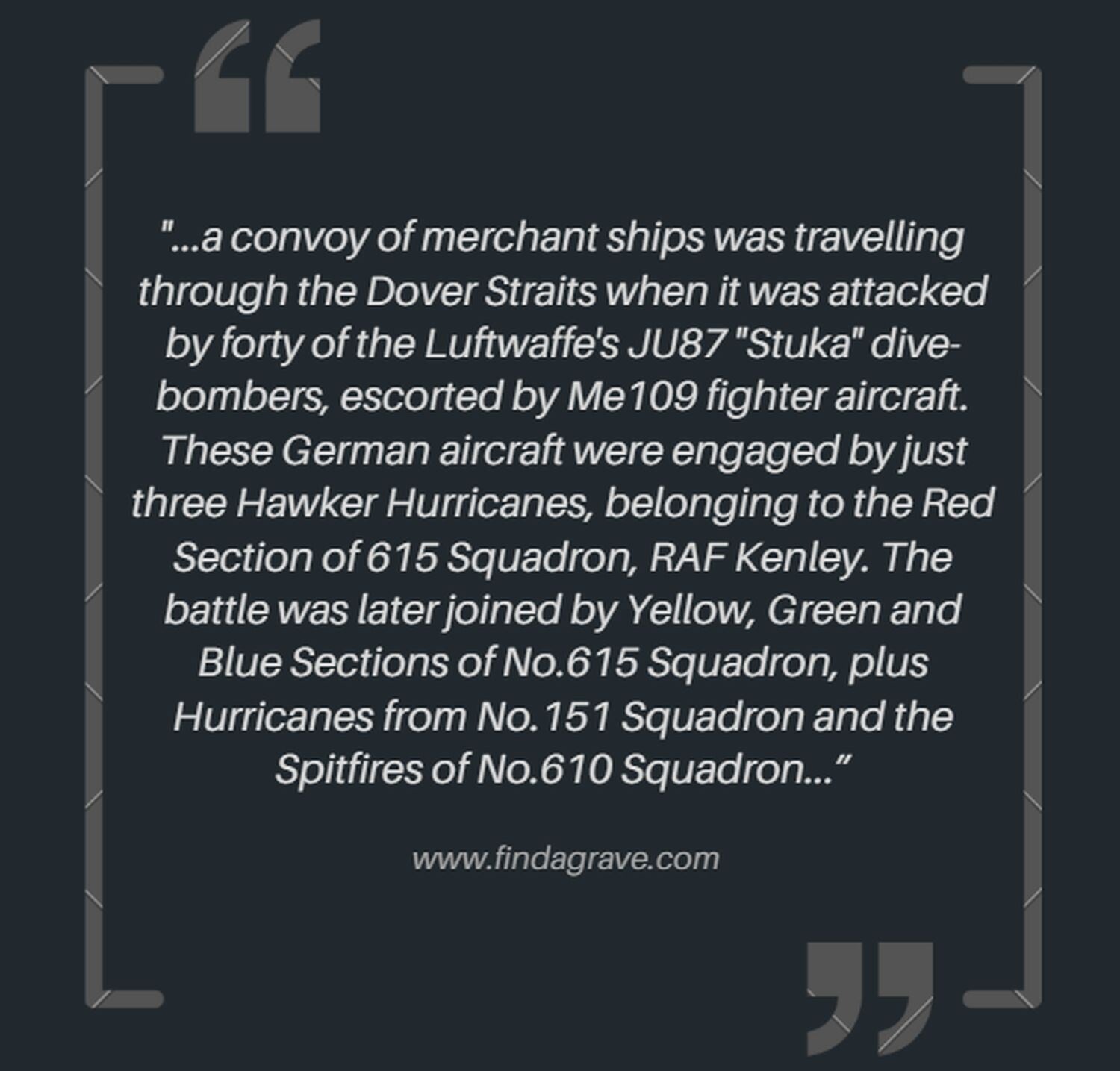
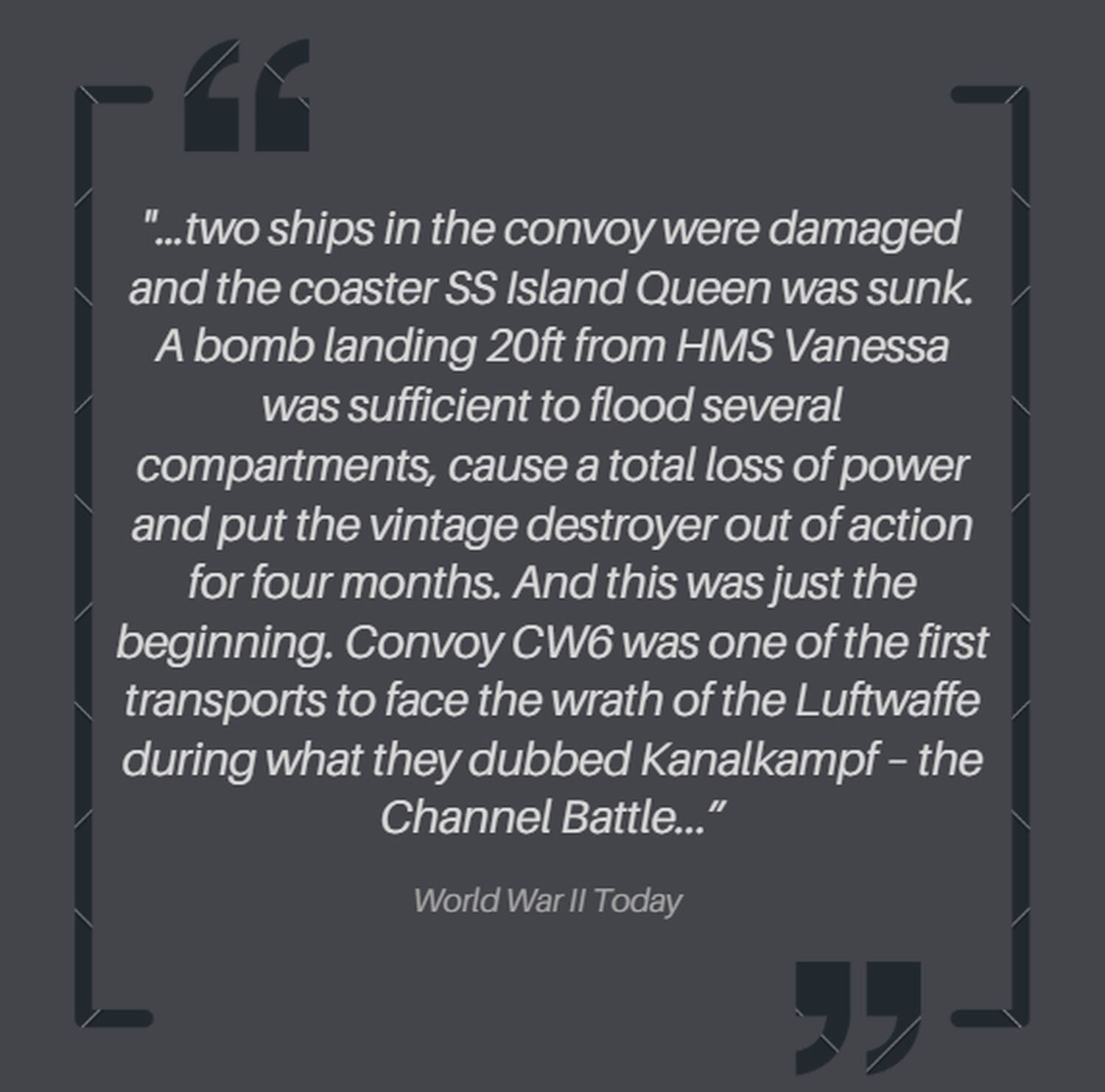
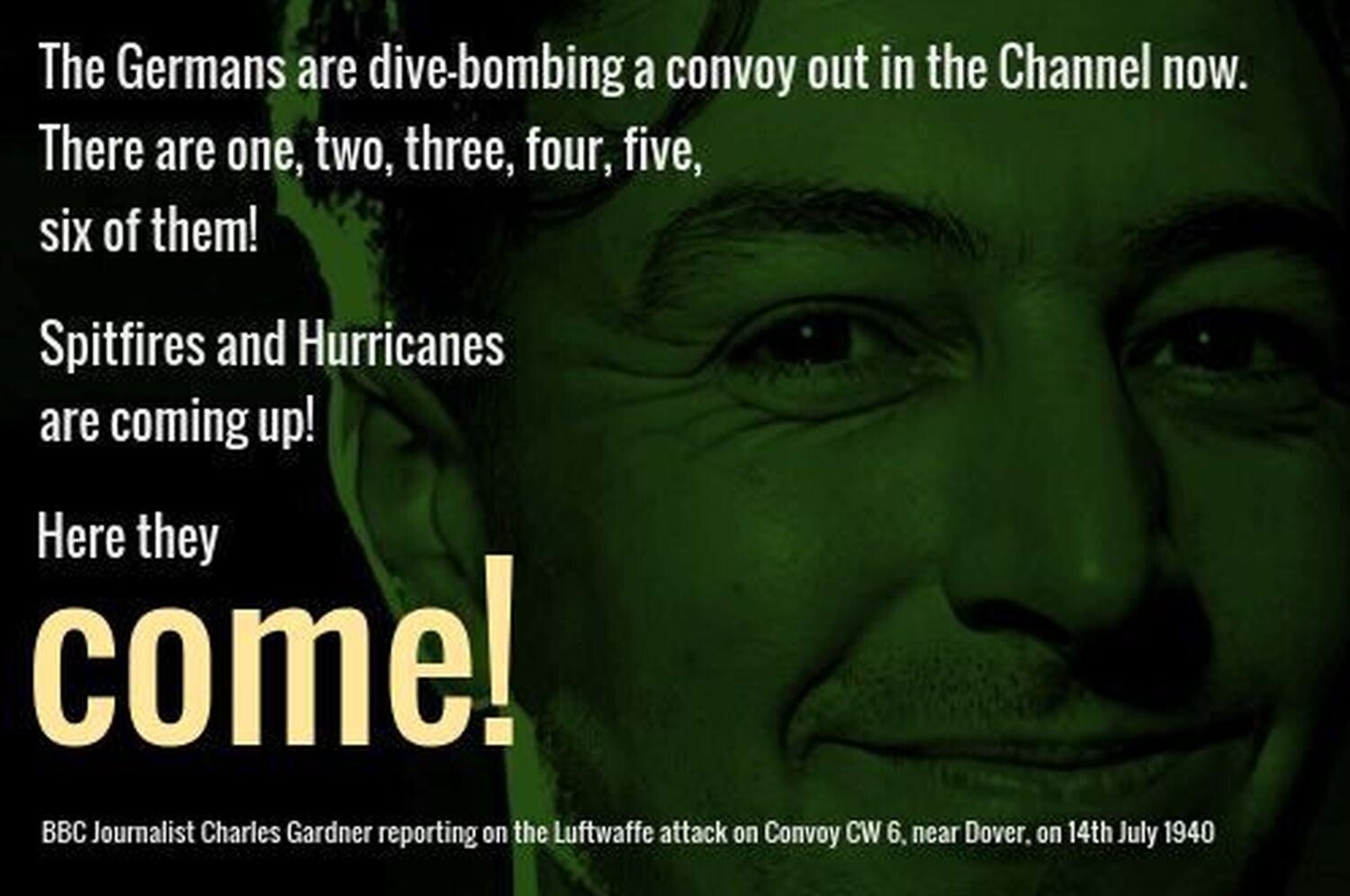
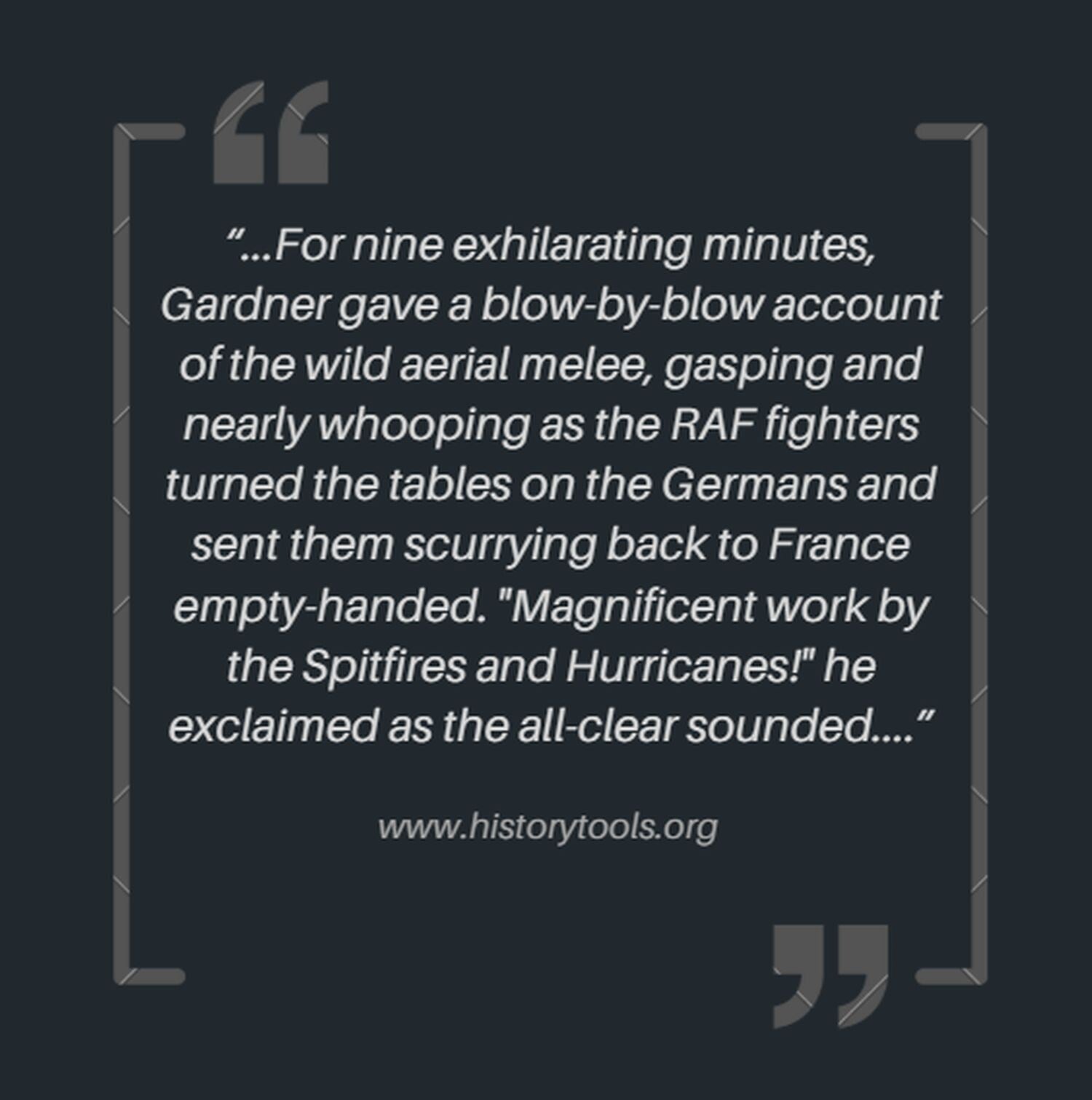
On the cliffs above Dover, BBC commentator Charles Gardner was recording the battle live, unaware that he had misidentified the stricken aircraft.
His own words captured both the confusion and immediacy of the moment: “It’s impossible to tell which are our machines and which are the Germans!”
Watching the fight unfold, he continued, “I am looking out to sea now. I can see the little white dot of a parachute as the German pilot is floating down towards the spot where his machine crashed with such a big fountain of water about two minutes ago!”
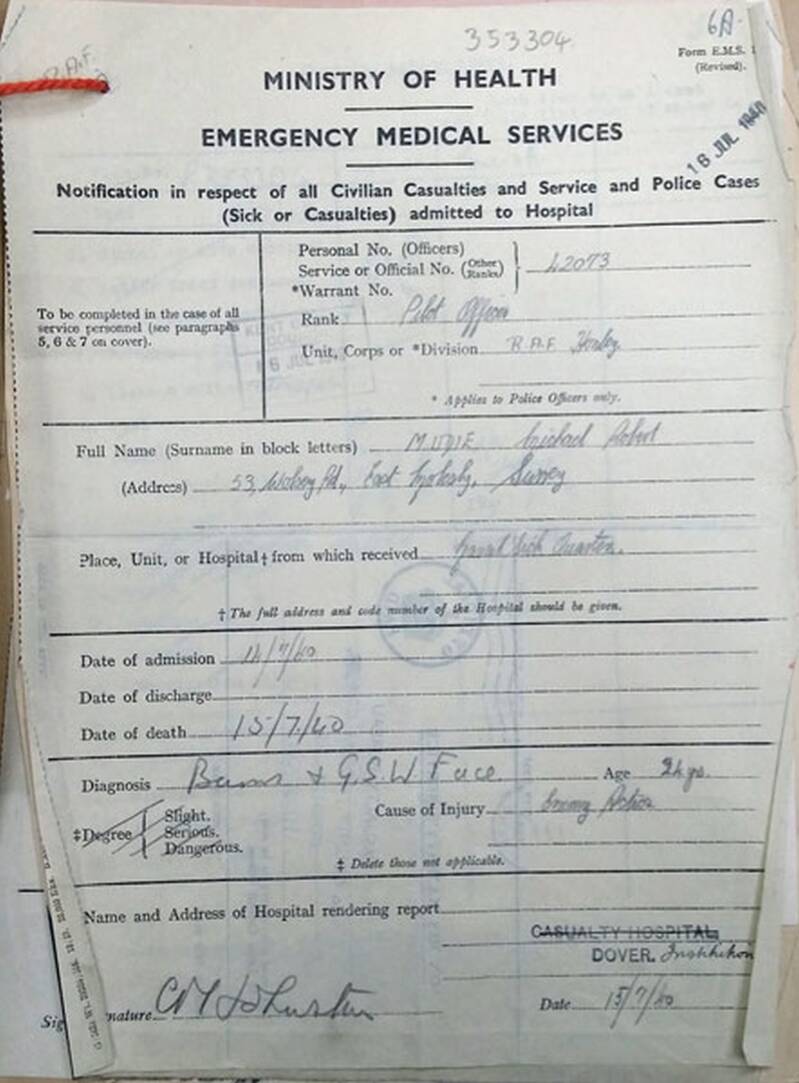
Mudie's casualty report, GSW means Gun Shot Wound.
Charles Gardner became one of the defining BBC voices of the early war, known for vivid frontline reporting and an instinctive feel for the drama of air combat.
A young journalist with a passion for aviation, he was sent to France in 1939–40, where his dispatches captured the collapse of Allied resistance and the RAF’s desperate efforts to slow the German advance.
His most famous moment came on 14 July 1940, when he delivered a breathless live commentary from Dover as Stukas attacked a Channel convoy and RAF fighters intercepted them.
The broadcast electrified listeners after the disasters of Dunkirk and France, offering rare proof that the Luftwaffe could be fought and beaten.
Though some critics accused him of treating battle like sport, most listeners embraced his authenticity. Gardner’s voice became part of the soundscape of 1940, preserving the tension, fear, and exhilaration of Britain’s fight for survival.
BBC Journalist Charles Gardner
BBC - History of the BBC, Charles Gardener - Battle over Channel 1940
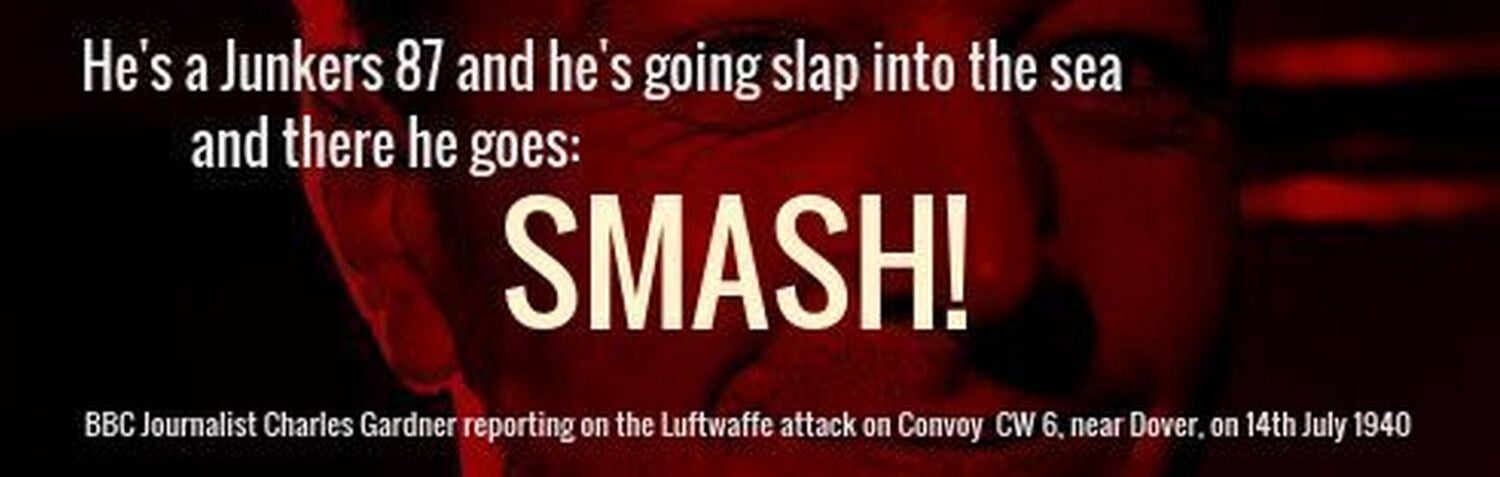
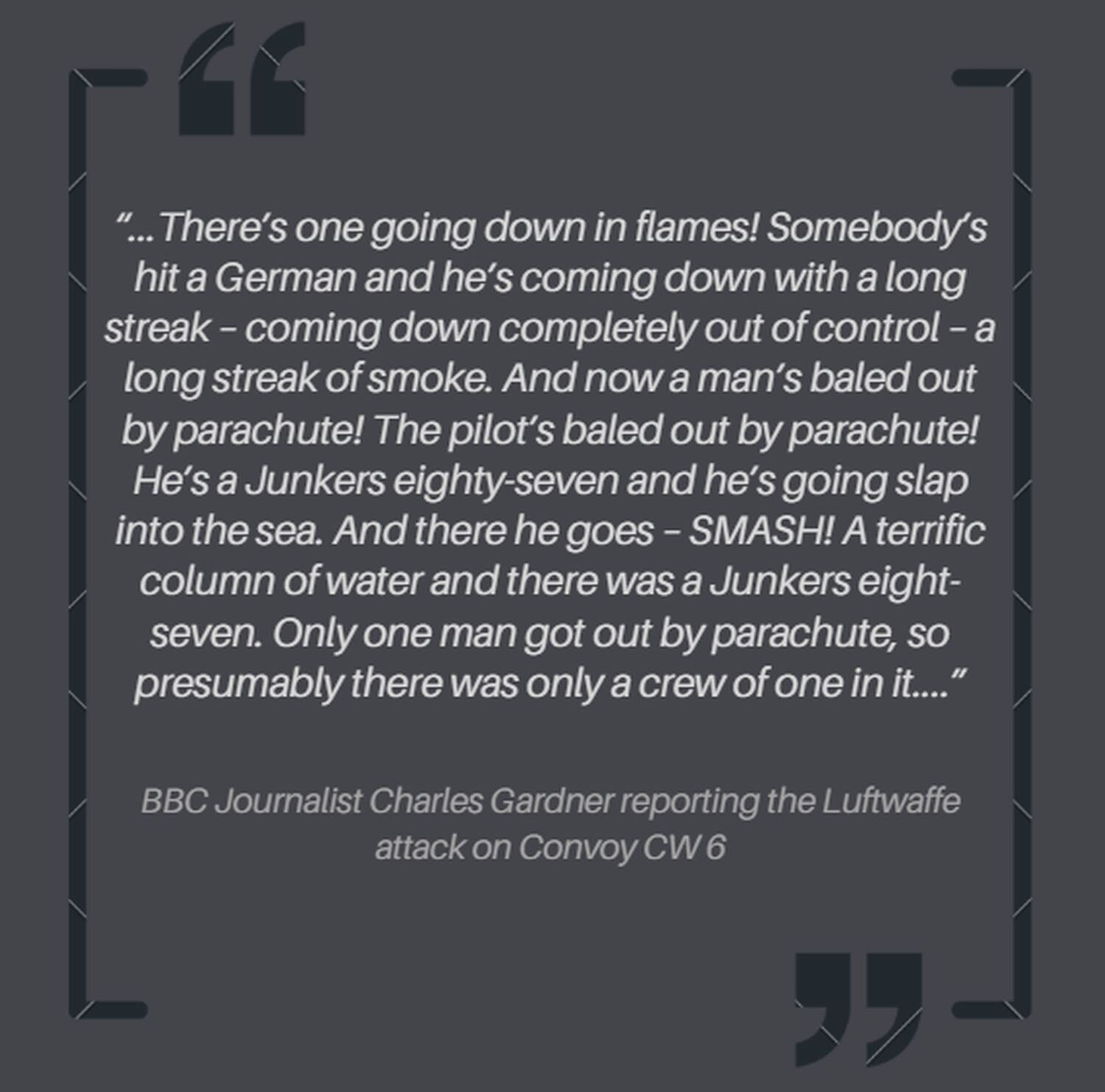
The “German” descending beneath the parachute was, in truth, the gravely wounded Pilot Officer Mudie.
Gardner, still following the wider battle, returned to the scene moments later:
“No damage done, except to the Germans, who lost one machine and the German pilot, who is still on the end of his parachute. I can see no boat going out to pick him up, so he’ll probably have a long swim ashore!”.
Forced to bale out into the sea. Mudie was badly wounded.
He was rescued by the Royal Navy and taken to Dover Hospital, where his injuries were recorded as burns and a gunshot wound to the face.
He died the following day, aged twenty‑four.
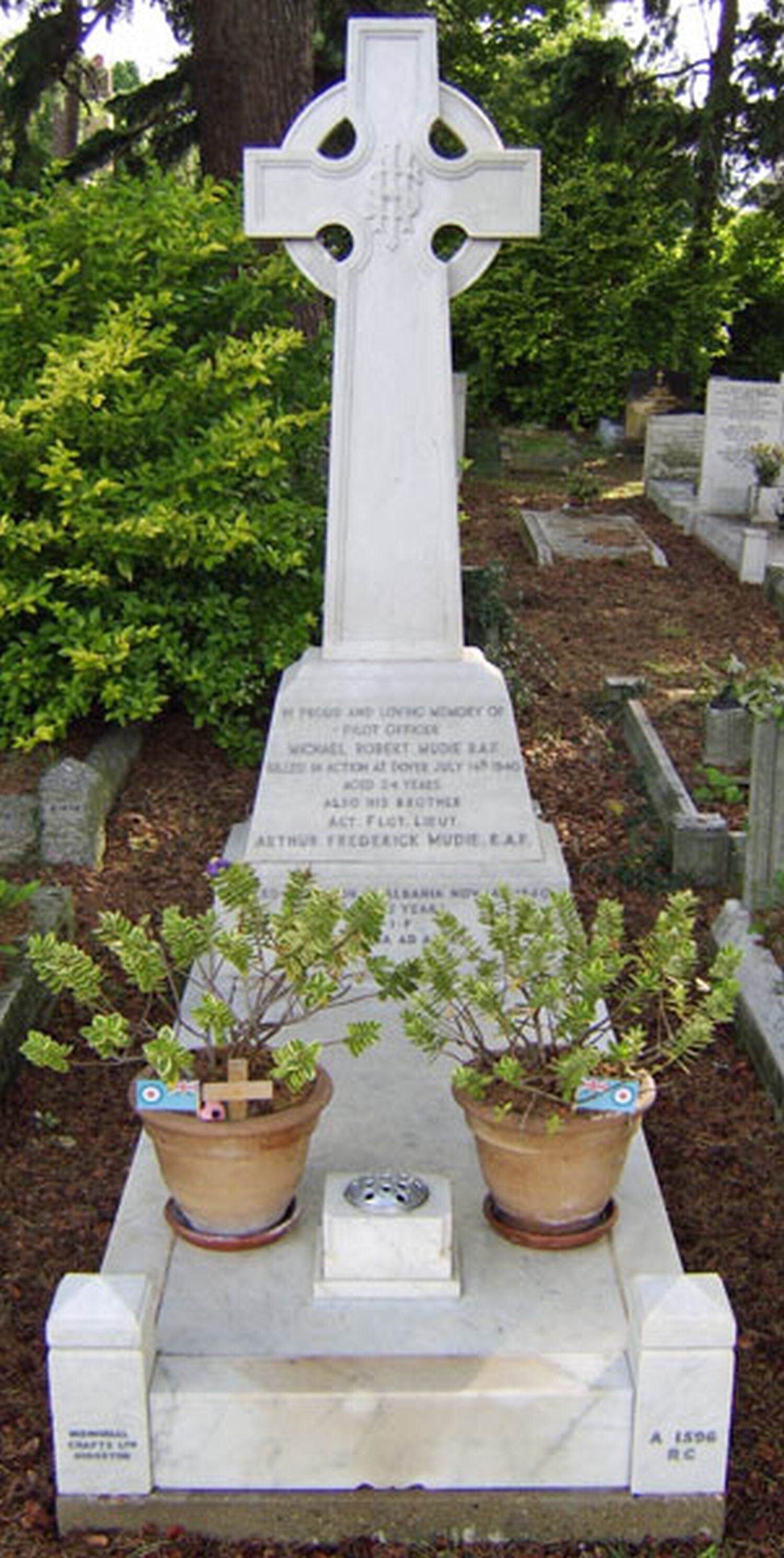
The grave of Michael Mudie.
...the first desperate year of the war...

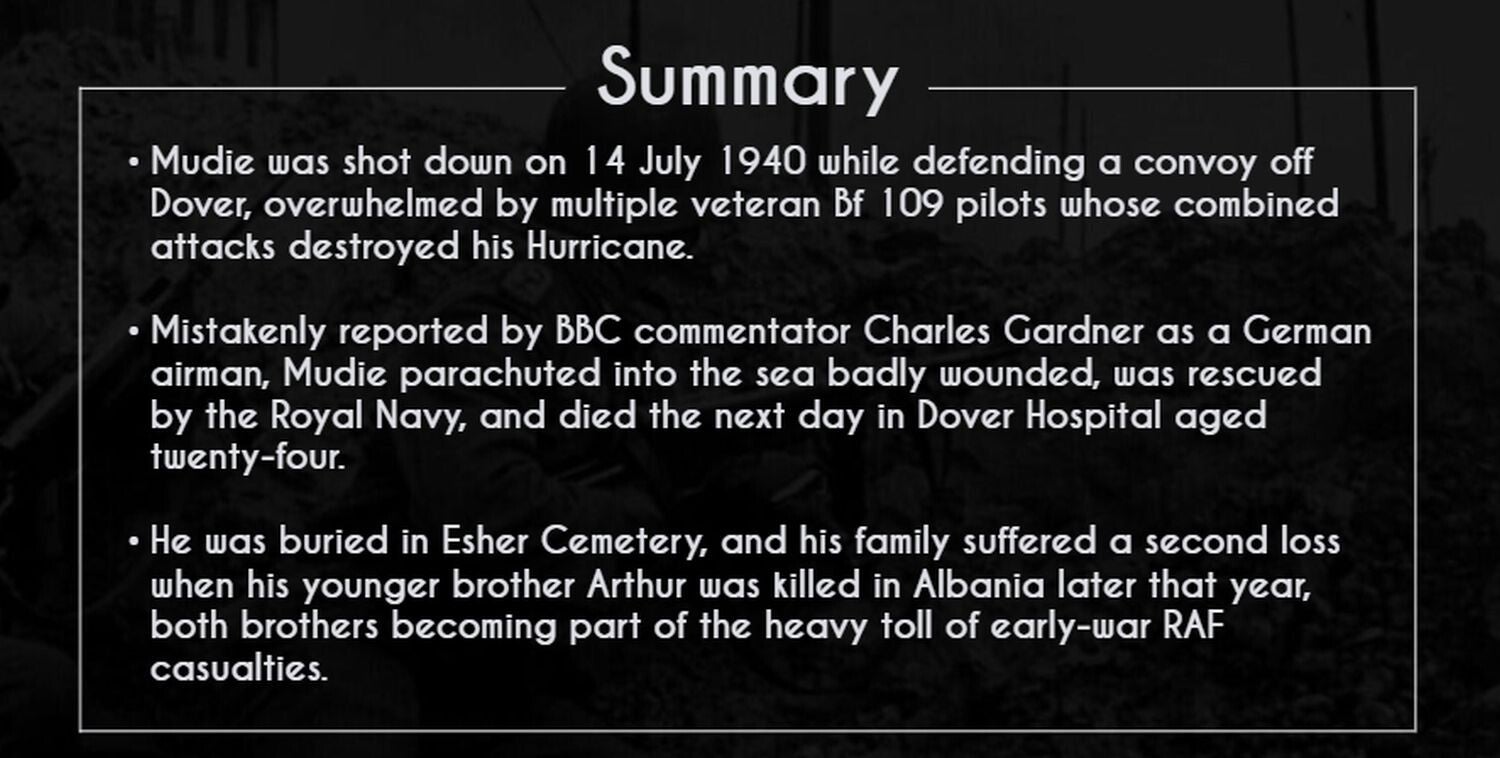
Mudie was buried in Esher Cemetery, Surrey. His family’s losses did not end there.
His younger brother, Flight Lieutenant Arthur Frederick Mudie of No. 84 Squadron, was killed on 15 November 1940 when Blenheim L1389 struck a mountainside during operations against Italian forces in Albania.
He was twenty‑two. Both brothers are remembered among the many young airmen whose lives were claimed in the first desperate year of the war.
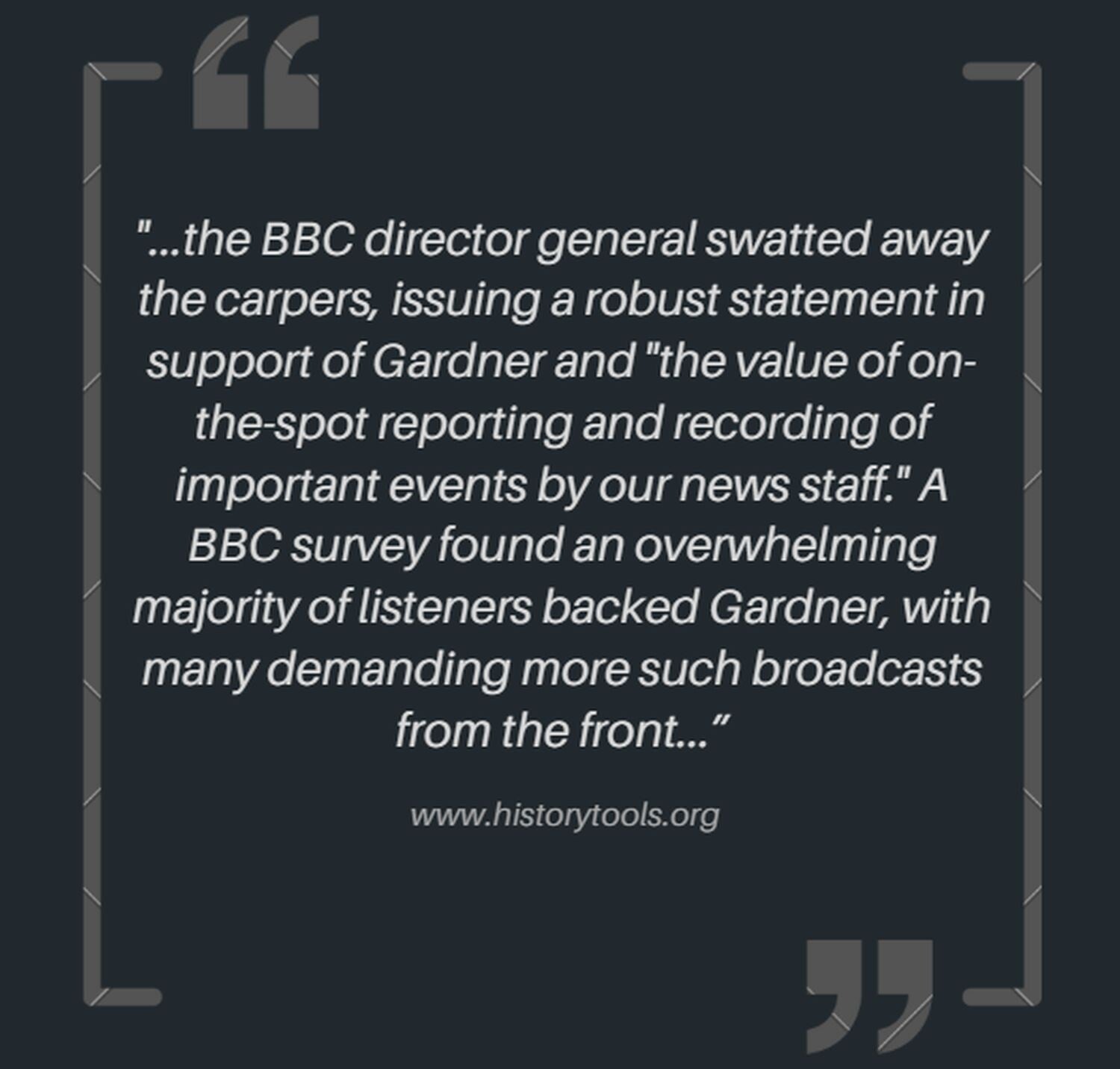
Although Gardner would be later criticised for its excitement whilst reporting on the air battle taking place above him, it was also recognised as one of the earliest real‑time accounts of aerial combat.
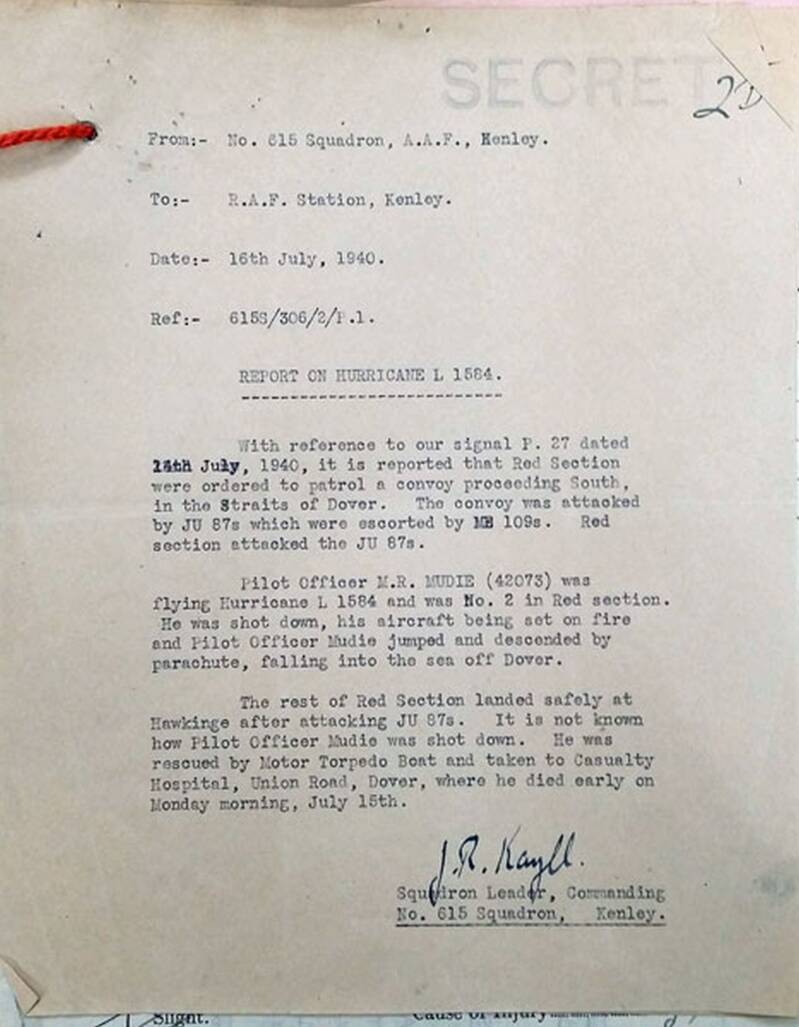
Report by the squadron CO.
Ultimate Sacrifice
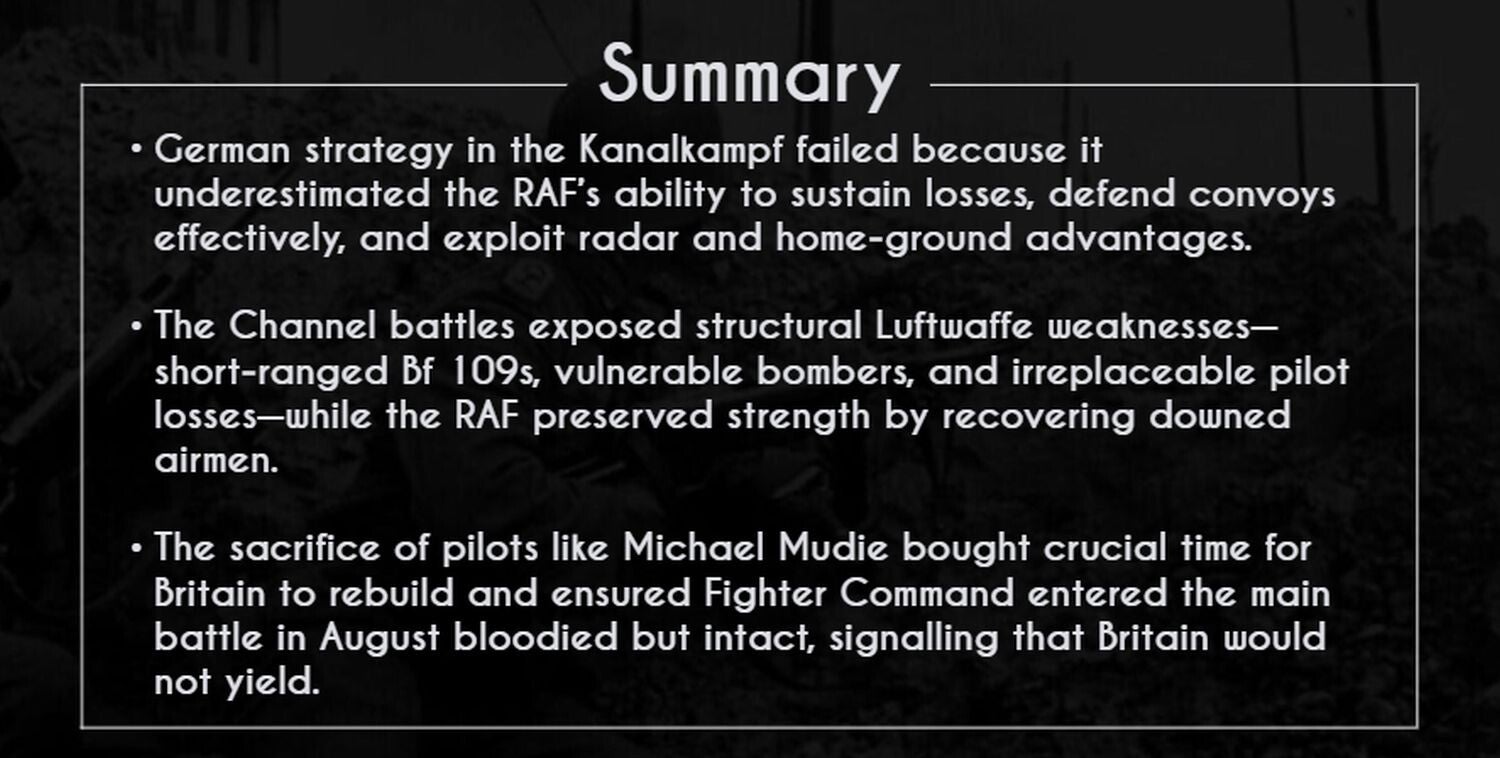
German failure in the Kanalkampf and ultimately in the Battle of Britain grew from a fundamental misreading of what Fighter Command could endure, how Britain would fight, and what sacrifices its young pilots were prepared to make.
The Channel battles of June and July 1940 were intended as a softening‑up phase: by attacking coastal convoys, the Luftwaffe hoped to draw the RAF into constant combat, wear down its squadrons, and clear the way for a decisive air offensive.
Yet the plan faltered almost from the outset.
The convoys were small, but they mattered; the RAF defended them with determination, and radar ensured that German raids rarely arrived unopposed.
Instead of bleeding Fighter Command dry, the Luftwaffe found itself locked in a series of short, sharp engagements that cost aircraft and experienced pilots it could not easily replace.
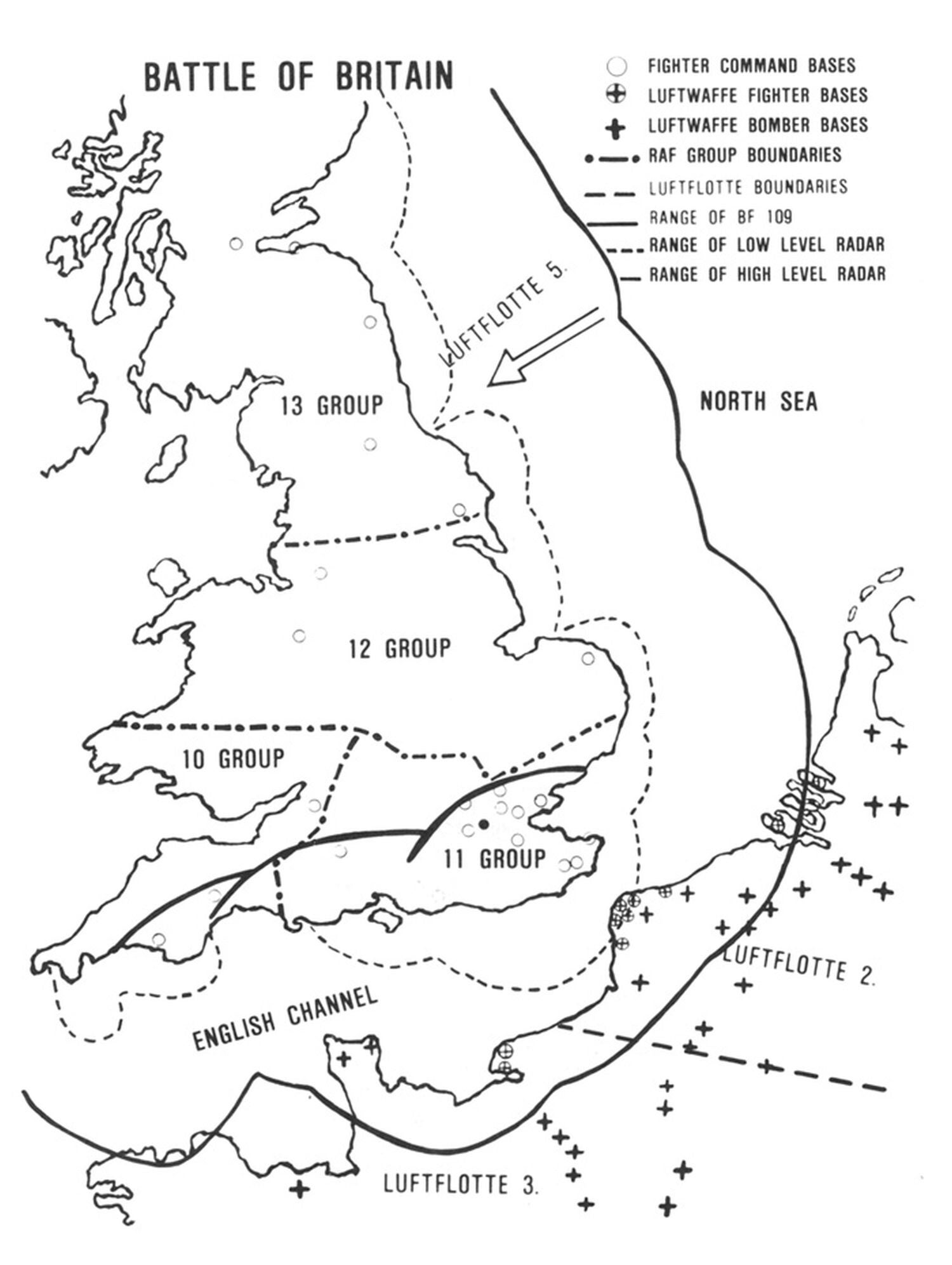
UK Radar coverage 1939–1940. The Luftwaffe entered the Kanalkampf unready for Britain’s radar system, wrongly assuming they could slip past or destroy it. Chain Home repeatedly exposed their raids, enabling rapid RAF interception and turning Channel attacks costly.
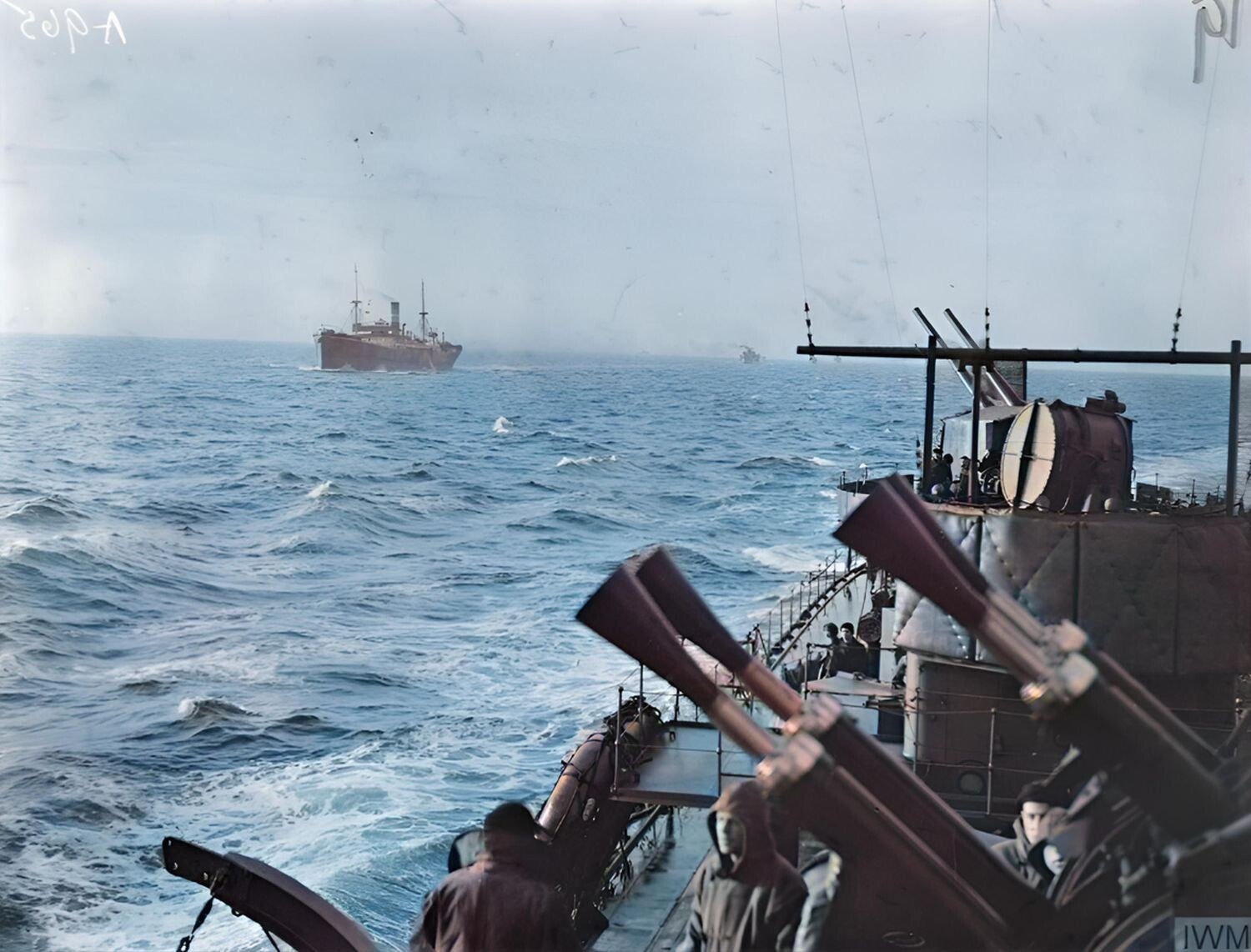
Onboard an escorting destroyer in the Straits of Dover, September 1940. During the Kanalkampf (Channel Battle) phase of the Battle of Britain in July–August 1940, British coastal convoys became prime targets for the Luftwaffe. By maintaining escorted shipping through the English Channel, Britain forced German aircraft to attack defended, moving targets close to RAF Fighter Command bases. These raids drew German bombers and fighters into repeated engagements, allowing RAF squadrons to intercept under favourable conditions. Although convoy losses occurred, the system prevented maritime paralysis and preserved vital supply routes. Crucially, the fighting over convoys gave Fighter Command combat experience and intelligence that proved invaluable in the larger air battles that followed.
...revealed deeper structural weaknesses...
The Channel fighting also revealed deeper structural weaknesses. German bombers were vulnerable without close escort, and the Bf 109s that protected them had limited endurance over southern England.
The RAF, by contrast, fought over home territory, with the advantage of radar control, shorter transit times, and the ability to recover downed pilots.
Every British airman who survived to fly again strengthened the defence; every German pilot lost weakened the offensive.
By mid‑July, as attacks intensified against convoys like CW 6, the Luftwaffe was learning that the Channel was not a proving ground but a warning.
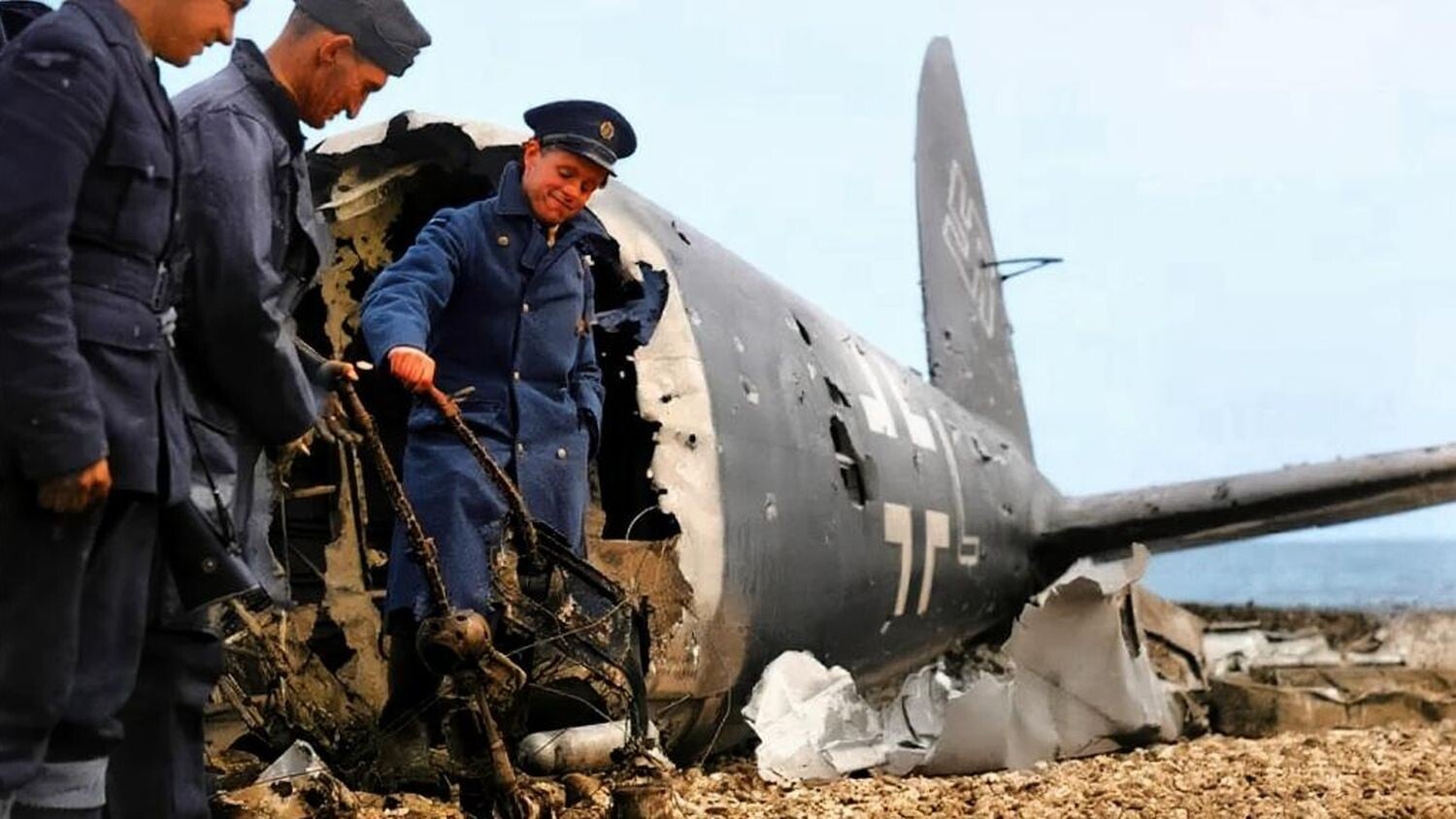
RAF personnel examine the wreck of Heinkel He 111H (G1+LK) of 2./KG 55 on East Beach, Selsey in Sussex, shot down by P/O Wakeham and P/O Lord Shuttleworth of No. 145 Squadron on 11th July 1940 during a sortie to attack Portsmouth dockyards. Oblt. Schweinhagen, Ofw. Slotosch and Fw. Steiner were all captured wounded. Uffz. Mueller died on his way to hospital and Ofw. Schlueter died of his wounds the same day. During the Kanalkampf (Channel Battle) phase of the Battle of Britain in July–August 1940, British coastal convoys became prime targets for the Luftwaffe. By maintaining escorted shipping through the English Channel, Britain forced German aircraft to attack defended, moving targets close to RAF Fighter Command bases. These raids drew German bombers and fighters into repeated engagements, allowing RAF squadrons to intercept under favourable conditions. Although convoy losses occurred, the system prevented maritime paralysis and preserved vital supply routes. Crucially, the fighting over convoys gave Fighter Command combat experience and intelligence that proved invaluable in the larger air battles that followed.
https://battleofbritain1940.com/entry/thursday-11-july-1940/ © IWM (HU 72441)
...each loss carried weight...
The RAF’s resilience rested on the skill and sacrifice of men like Pilot Officer Michael Robert Mudie.
His death on 14 July, during the defence of a convoy off Dover, was one among many, but each loss carried weight.
These pilots bought time—time for squadrons to regroup, for aircraft production to accelerate, and for Britain to harden its resolve.
Their endurance ensured that when the Luftwaffe shifted to full‑scale assault in August, Fighter Command was bloodied but unbroken.
The German failure in the Kanalkampf was not merely tactical; it was the first clear sign that Britain would not yield, and that the courage of its young airmen would shape the outcome of the battle to come.
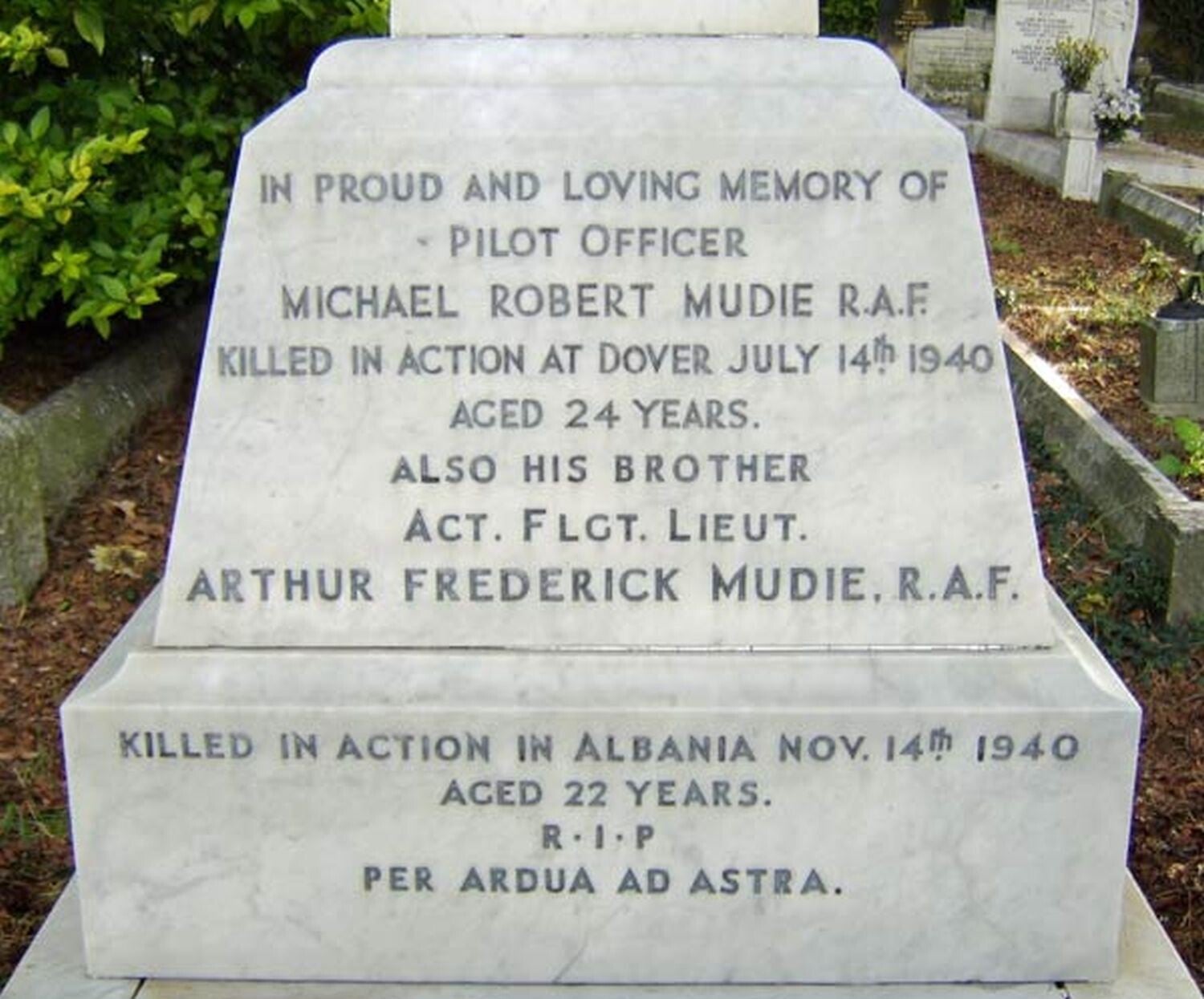
The grave of Michael Mudie. Mudie’s loss embodied the harsh price of defending Britain in 1940. His sacrifice showed how fragile the nation’s security was, resting on the courage of individuals barely out of training. His death became part of the collective recognition that survival depended on countless such acts of unrecorded bravery.