
Overview
The Battle of Manila (3 February–3 March 1945) was the climactic urban engagement of the Philippine campaign and one of the most destructive battles fought in the Pacific War. After U.S. forces landed at Lingayen Gulf in January, they advanced rapidly toward the capital. General Tomoyuki Yamashita intended to withdraw the bulk of his army to the mountains of northern Luzon, avoiding a major fight inside Manila. However, Rear Admiral Sanji Iwabuchi, commanding roughly 17,000 naval troops, refused to abandon the city and prepared for a final defence.
American units entered Manila on 3 February, liberating the University of Santo Tomas internment camp and pushing south toward the government districts. Once U.S. forces crossed the Pasig River, Japanese resistance intensified. Iwabuchi’s troops fortified concrete buildings, warehouses, and administrative centres, creating interlocking defensive positions that forced U.S. infantry, engineers, and armour into systematic block‑by‑block clearing operations.
The battle’s defining feature was the scale of destruction. Japanese forces carried out widespread atrocities and demolished infrastructure as they retreated. U.S. forces, facing entrenched defenders in dense urban terrain, relied heavily on artillery, tanks, flamethrowers, and demolitions to break resistance. This combination produced catastrophic damage: Manila’s historic districts, including Intramuros, were devastated, and civilian casualties exceeded 100,000.
By late February, American forces had isolated the remaining Japanese pockets. The final assault on Intramuros on 23 February used concentrated artillery to breach the walls, followed by infantry and armour clearing the interior. Organised Japanese resistance ended on 3 March, though scattered fighting continued briefly.
The battle eliminated Japan’s last major urban stronghold in the Philippines and restored the capital to the Commonwealth government. It also left Manila almost entirely ruined, shaping post‑war reconstruction and marking the city as one of the most heavily damaged Allied capitals of the Second World War.
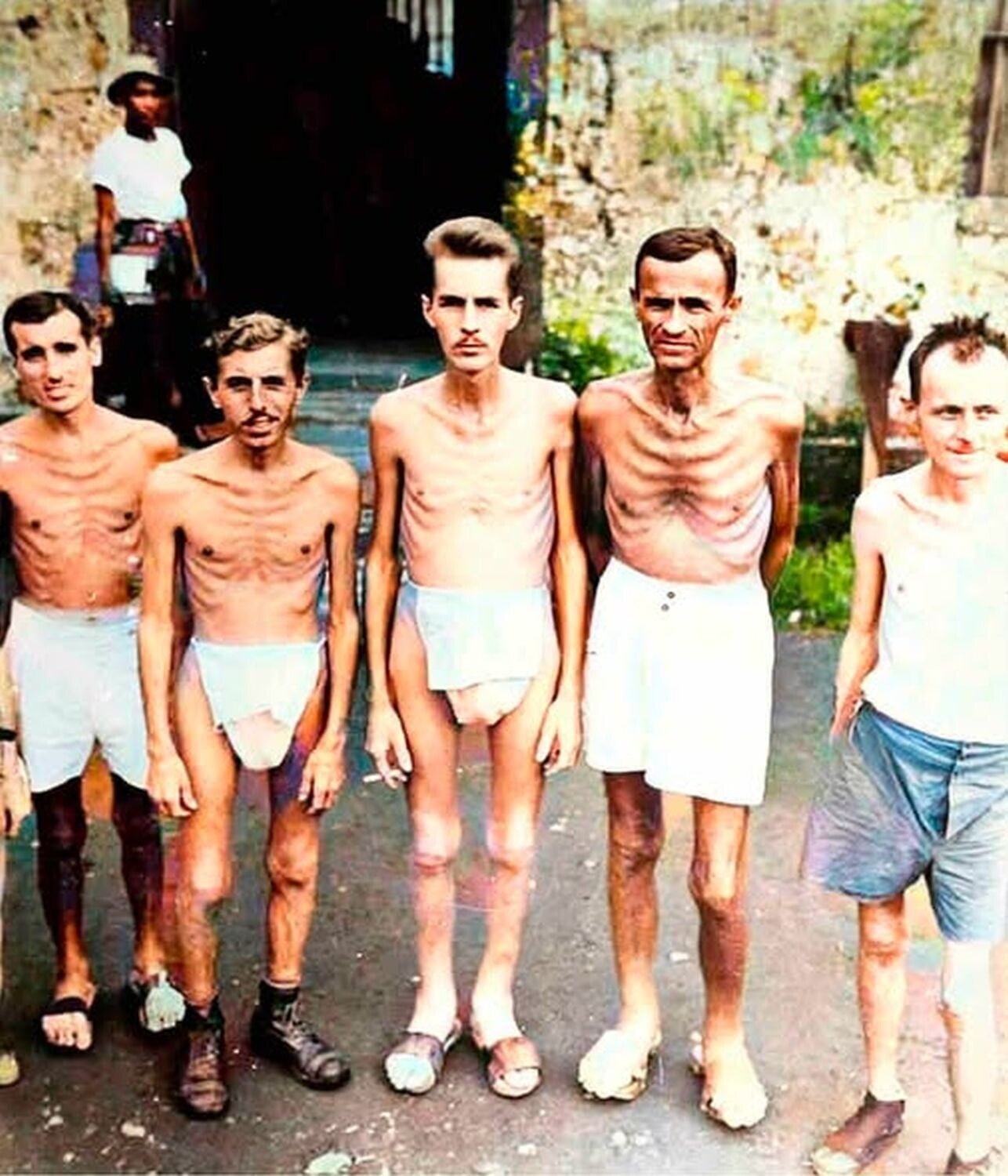
five emaciated American prisoners of war who were liberated by Allied forces at the height of the Battle of Manila in February 1945. They are standing outside a building at the Old Bilibid Prison in Manila, Philippines. During the Japanese occupation, Bilibid served as a central POW transit hub and hospital camp. The severe, extreme malnutrition visible on their bodies testifies to the near-starvation rations and complete lack of proper medical attention they endured during their three years of brutal confinement following the surrender of US forces in the Philippines in 1942.