
Overview
Operation Cartwheel was the Allied strategic campaign conducted in the Southwest Pacific between June 1943 and early 1944, designed to neutralise the major Japanese base at Rabaul without requiring a costly direct assault. It formed a central component of the broader Allied advance through New Guinea and the Solomon Islands, reflecting the shift toward coordinated, multi‑axis operations under General Douglas MacArthur and Admiral William F. Halsey.
The plan divided responsibilities between two commands. MacArthur’s forces advanced along the northern coast of New Guinea, while Halsey’s South Pacific forces pushed northwest through the Solomon Islands. This dual approach aimed to isolate Rabaul by capturing or bypassing key Japanese positions, severing supply lines, and establishing airfields from which Allied air power could dominate the region. The strategy relied heavily on “leapfrogging” or “island‑hopping,” selecting objectives that offered operational advantage while avoiding strongpoints that would require disproportionate effort to capture.
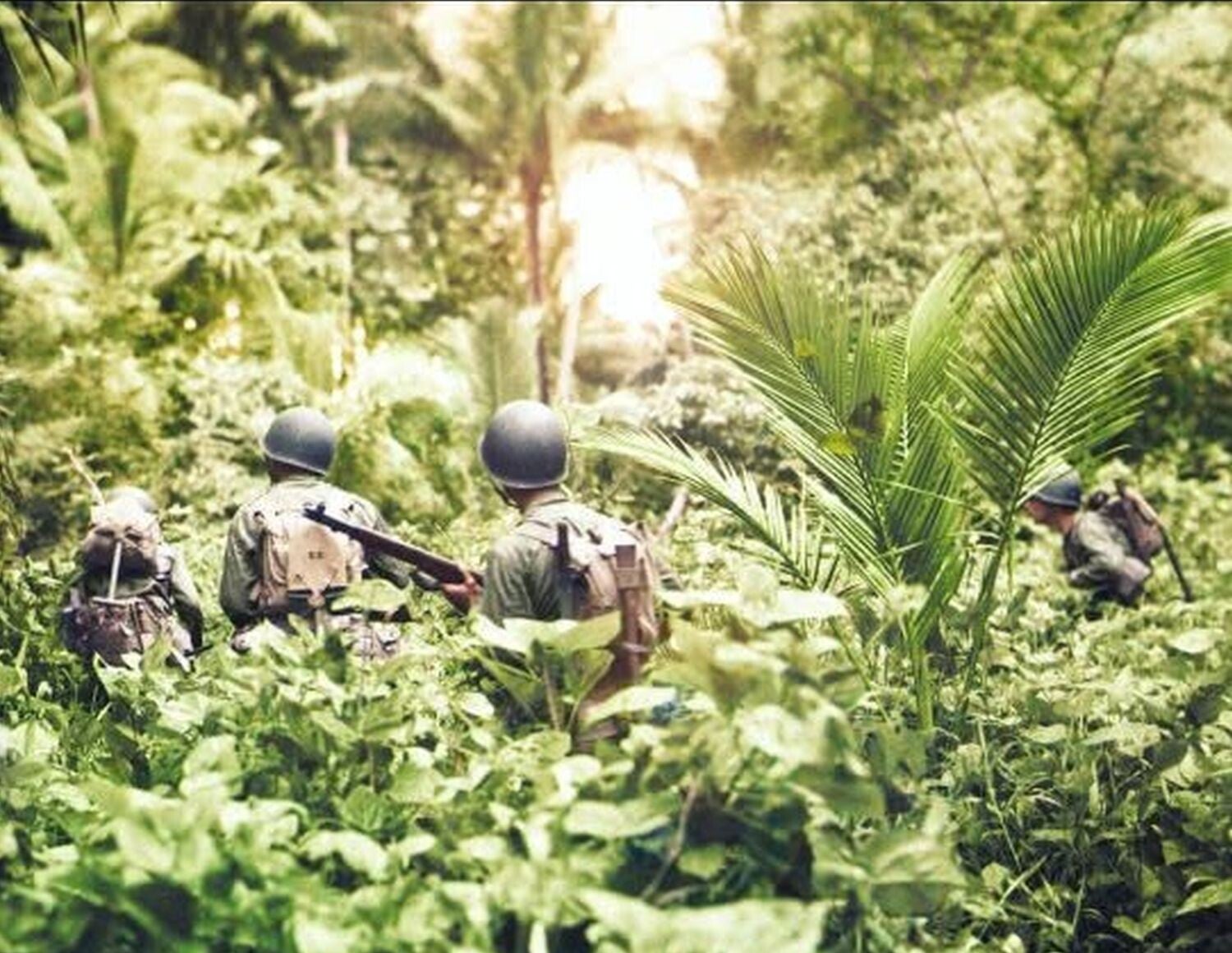
Marine patrol moves through the jungle on Emirau island, March 1944. The Landing on Emirau was the last of the series of operations that made up Operation Cartwheel, General Douglas MacArthur's strategy for the encirclement of the major Japanese base at Rabaul. A force of nearly 4,000 United States Marines landed on the island of Emirau on 20 March 1944. The island was not occupied by the Japanese and there was no fighting. It was developed into an airbase which formed the final link in the chain of bases surrounding Rabaul. The isolation of Rabaul permitted MacArthur to turn his attention westward and commence his drive along the north coast of New Guinea toward the Philippines.
Sorin Alexandru Milea
Major actions within Cartwheel included the Allied landings at Woodlark and Kiriwina Islands, the advance on Lae and Salamaua, and the capture of Bougainville and New Georgia. Each step tightened the encirclement of Rabaul, reducing its ability to function as a forward base. As Allied airfields multiplied, sustained air attacks gradually rendered Rabaul ineffective, forcing the Japanese to withdraw aircraft and limiting the garrison to a defensive posture.
By early 1944, Rabaul was effectively isolated. Although its large garrison remained in place, it no longer posed a strategic threat. Operation Cartwheel succeeded without the heavy casualties expected from a direct assault, demonstrating the effectiveness of coordinated, incremental operations supported by air superiority and naval mobility.
The campaign marked a decisive shift in the Pacific War, enabling further Allied advances toward the Philippines and contributing significantly to the eventual collapse of Japanese defensive networks in the region.