Overview
The Pacific Theatre was central to the wider outcome of the Second World War, shaping Allied strategy and the post‑war balance of power across Asia and the Pacific. Japan’s expansionist aims had been developing since the early 1930s, driven by resource shortages, strategic ambition, and a desire to dominate East Asia. These aims collided with the interests of the United States and European colonial powers, who maintained long‑standing influence throughout the region.
As Japan advanced into Manchuria, China, and Southeast Asia, Western governments responded with diplomatic pressure, sanctions, and ultimately embargoes. Tokyo interpreted these measures as direct threats to its national survival, contributing to the decision to launch the attack on Pearl Harbor in December 1941 and bringing the United States fully into the war.
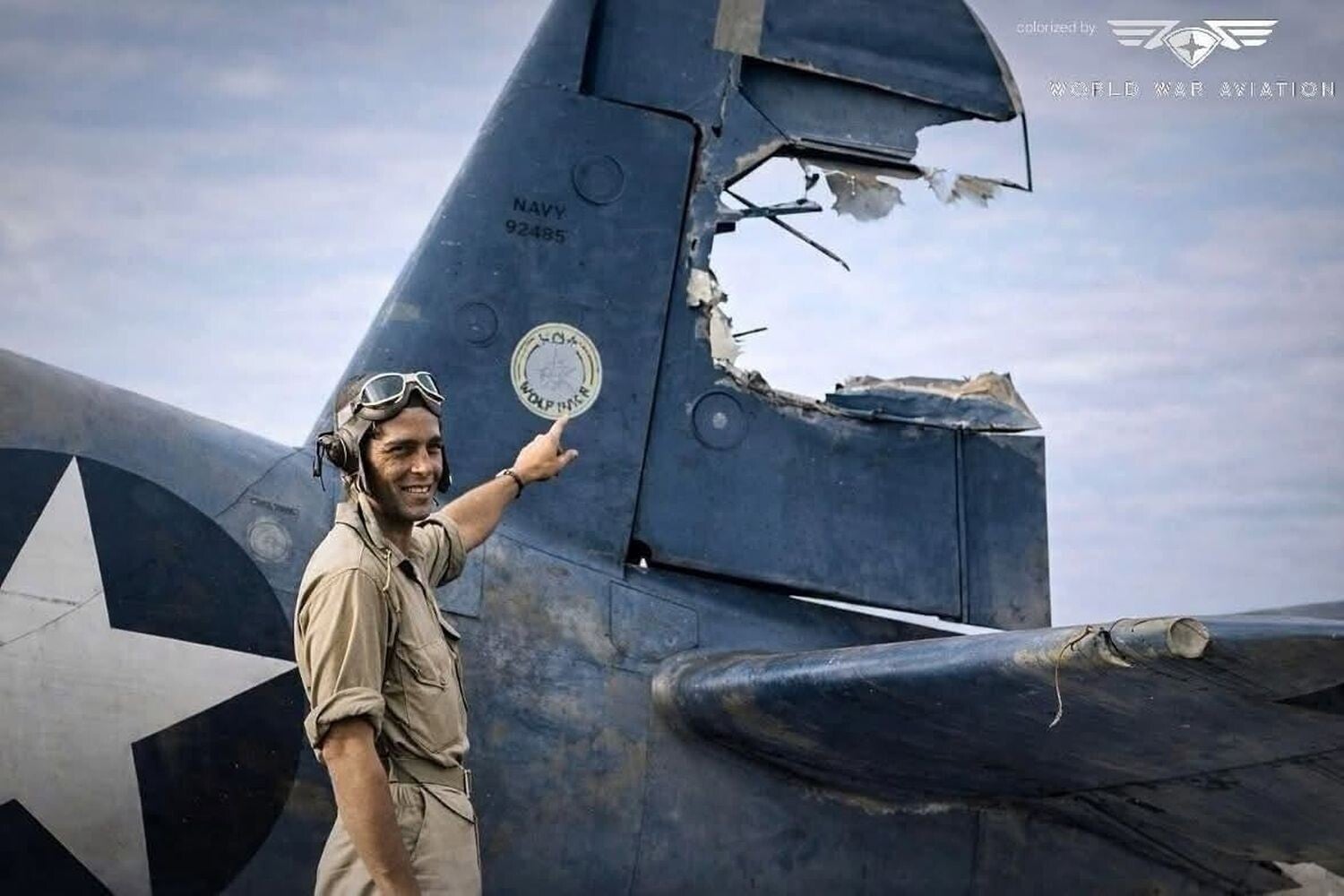
USMC Fighter Pilot JimmyJohnson shows us the battle damage to his Corsair's rudder. Guadalcanal, 1943. Guadalcanal marked the first major Allied offensive in the Pacific War and proved Japan could be pushed back. Its six‑month struggle broke Japanese momentum, secured vital sea lanes, and shifted strategic initiative to the Allies. Guadalcanal became the foundation for the wider island‑hopping campaign that ultimately carried the war toward Japan’s home islands.
The Pacific conflict unfolded across an immense geographical area, stretching from the jungles of New Guinea to the central Pacific and the waters surrounding Japan. This vast environment imposed logistical and operational challenges unmatched in other theatres. Japan secured early victories, establishing a defensive perimeter across the Pacific islands and Southeast Asia.
In response, the Allies - led primarily by the United States - developed the strategy of “island hopping,” bypassing heavily fortified positions while capturing key islands needed for airfields, supply routes, and forward bases. Each step brought Allied forces closer to Japan, but the fighting was intense, often characterised by attritional battles, harsh terrain, and high casualties among both military personnel and civilians.
Major turning points such as the Battle of Midway and the Guadalcanal Campaign shifted the momentum decisively. As Japan’s defensive capacity weakened, the Allies advanced toward the home islands, facing increasingly desperate resistance, including widespread use of kamikaze attacks.
The final phase culminated in the atomic bombings of Hiroshima and Nagasaki and Japan’s subsequent surrender. The Pacific War reshaped regional geopolitics, ended Japanese imperial expansion, and set the foundations for the post‑war order in Asia.
The origins of the Pacific conflict in the Second World War stemmed from Japan’s sustained imperial ambitions, deteriorating relations with Western powers, and a sequence of geopolitical confrontations that preceded open warfare.
During the early twentieth century, Japan pursued dominance in East Asia and the Pacific, driven by economic pressures, military expansionism, and a nationalist worldview that framed regional control as essential to national strength.
This trajectory inevitably collided with the strategic interests of Western nations, particularly the United States, whose commercial and political presence in Asia was threatened by Japan’s advances.
...willingness to use force...
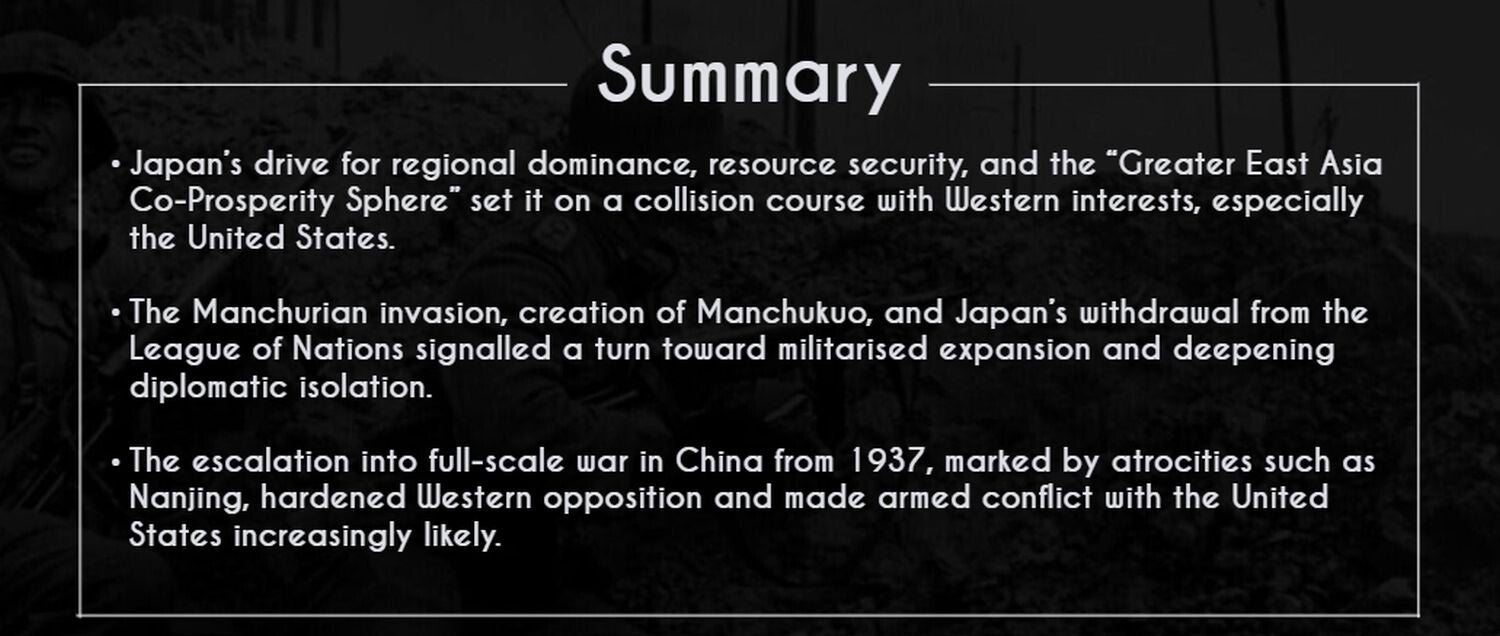
Japan’s imperial programme centred on establishing regional hegemony and promoting the concept of the “Greater East Asia Co‑Prosperity Sphere,” a bloc of Asian territories under Japanese leadership and insulated from Western influence.
Securing raw materials was a central objective. Japan’s limited domestic resources and expanding industrial base created a dependency on external supplies of oil, rubber, and metals.
The 1931 seizure of Manchuria demonstrated Japan’s willingness to use force to obtain these resources and marked a decisive break with international norms.
The military’s increasing influence over government policy ensured that expansion became both an economic strategy and a security doctrine.
...intensified Western opposition...
Japan’s actions in Manchuria and the creation of Manchukuo provoked condemnation from Western powers and the League of Nations, prompting Japan’s withdrawal from the League in 1933 and deepening diplomatic isolation.
Tensions escalated further with the outbreak of the Second Sino‑Japanese War in 1937, following the Marco Polo Bridge Incident.
The invasion of China, accompanied by atrocities such as the Nanjing Massacre, intensified Western opposition and increased American support for China.
By the late 1930s, Japan had become a militarised state committed to territorial expansion, making confrontation with the United States increasingly likely.
Importance of the Pacific Theatre
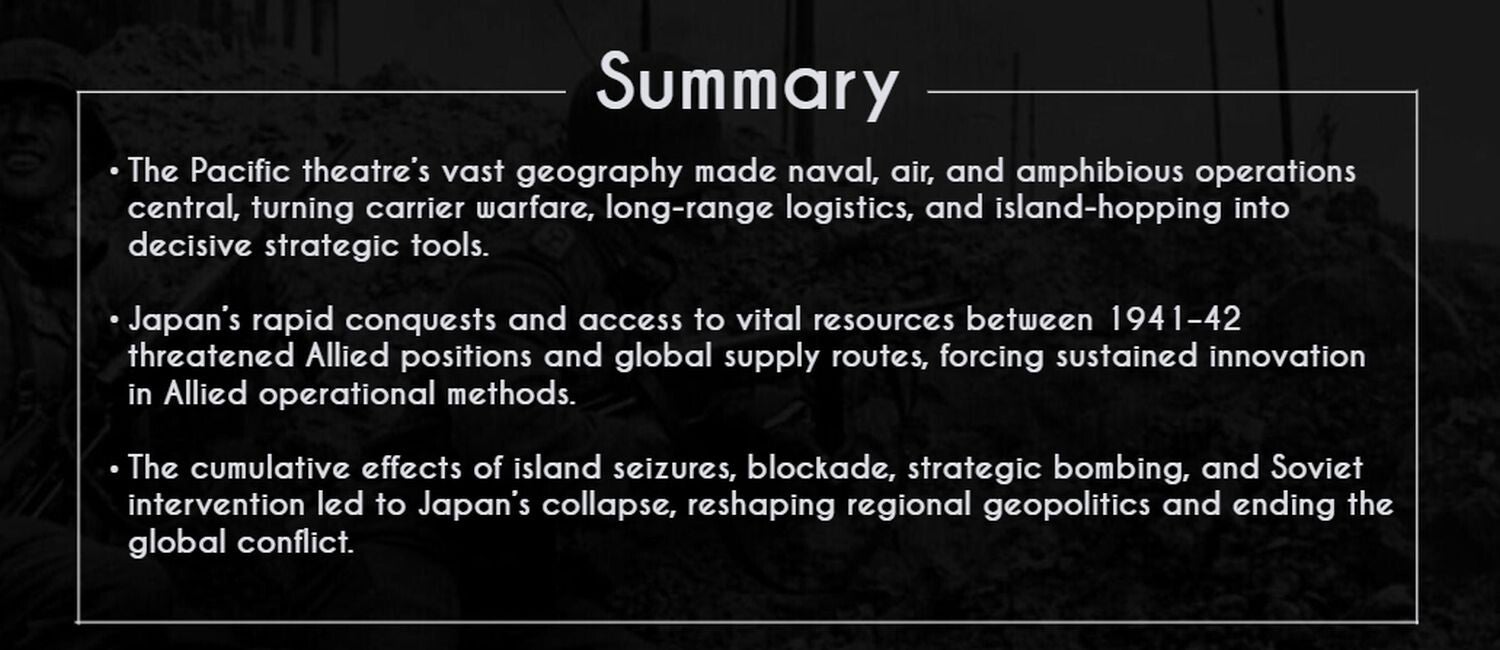
The Pacific theatre was strategically significant because it encompassed an immense geographic area, requiring sustained naval, air, and amphibious operations across thousands of miles.
Unlike the predominantly land‑based campaigns in Europe, the Pacific War demanded control of sea lanes, island chains, and maritime supply routes.
This made naval power the decisive instrument of warfare, and the theatre became the proving ground for carrier aviation, long‑range naval logistics, and modern amphibious assault doctrine.
...threatened Allied strategic positions...
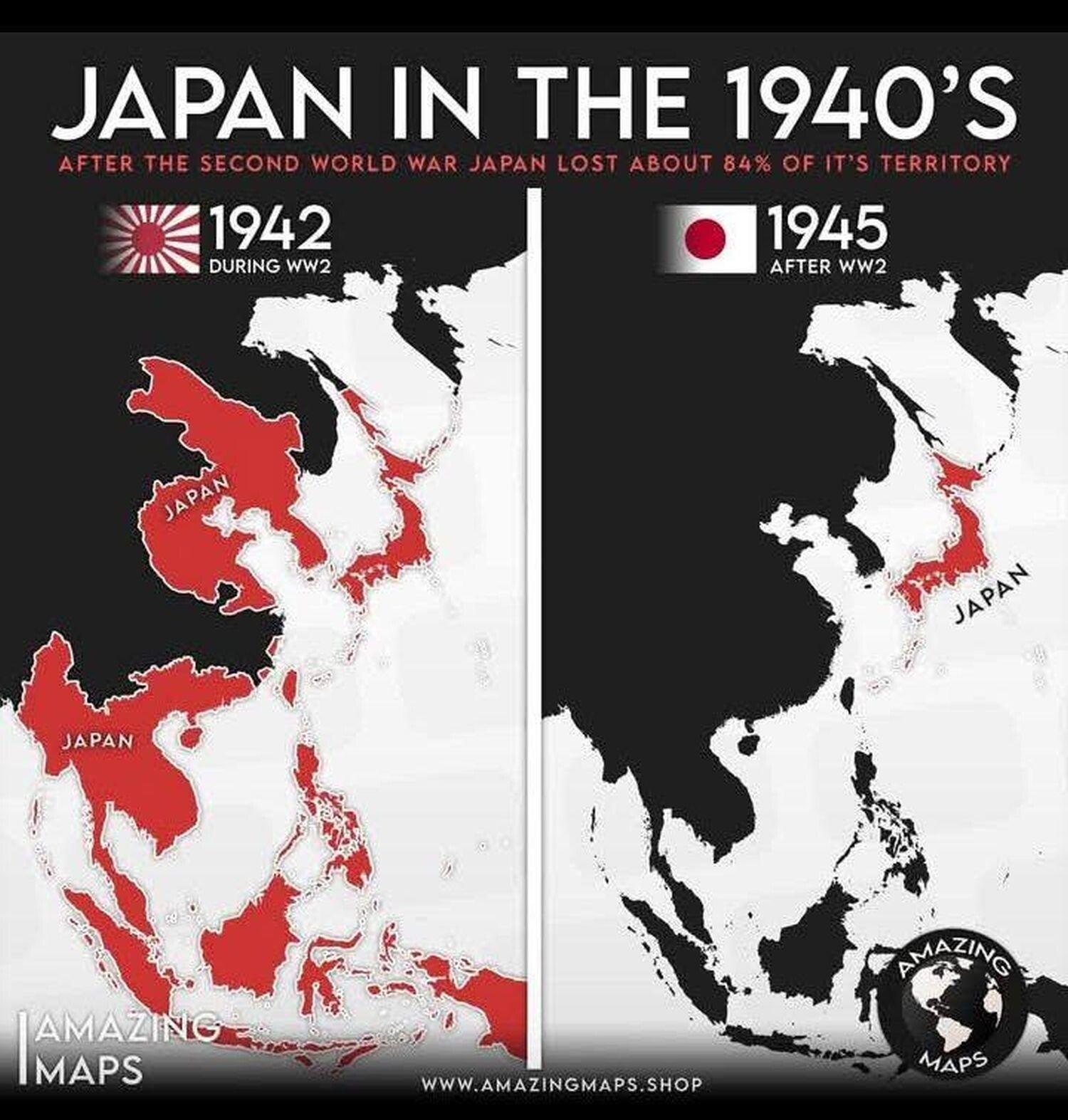
The theatre’s importance also stemmed from Japan’s rapid expansion between 1941 and 1942.
By seizing the Philippines, Malaya, Singapore, Hong Kong, the Dutch East Indies, and numerous Pacific islands, Japan gained access to vital oil, rubber, and mineral resources.
These conquests threatened Allied strategic positions, endangered Australia and India, and disrupted global supply networks.
Securing the Pacific was therefore essential to preventing Japan from consolidating a self‑sufficient empire capable of sustaining prolonged conflict.
...severing its logistical lifelines...
Operationally, the Pacific theatre forced the Allies to innovate.
The island‑hopping strategy - bypassing heavily fortified Japanese positions in favour of capturing key bases - demonstrated the value of mobility, air superiority, and selective engagement.
Carrier task forces became mobile strike platforms capable of projecting power across vast distances, while submarines systematically dismantled Japan’s merchant fleet, severing its logistical lifelines.
These developments reshaped naval warfare and established principles that would define post‑war military strategy.
...the decline of European colonial influence...
The theatre also had major geopolitical consequences. Japan’s defeat ended its imperial presence in East Asia and the Pacific, leading to the liberation of occupied territories and the post‑war occupation of Japan.
The conflict accelerated nationalist movements in Southeast Asia, contributed to the decline of European colonial influence, and reshaped regional power dynamics.
Finally, the Pacific theatre was decisive in ending the global conflict.
The capture of strategic islands, the naval blockade, the strategic bombing campaign, and the Soviet entry into the war culminated in Japan’s surrender, bringing the Second World War to a close.
Japanese Forces
Japanese conduct of the Pacific War was shaped by a leadership structure divided between the Imperial Japanese Army (IJA) and Imperial Japanese Navy (IJN).
Emperor Hirohito served as head of state, while strategic authority rested with the Imperial General Headquarters.
Senior naval figures such as Admiral Isoroku Yamamoto directed early-war carrier operations, including the planning of Pearl Harbor and subsequent attempts to destroy American naval power through decisive engagements.
Army leadership oversaw operations across China, Southeast Asia, and the Pacific islands, coordinating large infantry formations and managing Japan’s expanding defensive perimeter.
...an advantage in the opening months...
Japanese forces were extensive and widely deployed.
The IJA relied primarily on infantry divisions supported by limited armour and artillery, while the IJN fielded a powerful carrier fleet early in the war.
The Kido Butai, Japan’s main carrier striking force, was central to early successes in 1941–42. Aircraft such as the A6M Zero provided long-range, manoeuvrable air power, giving Japan an advantage in the opening months of the conflict.
Battleships like Yamato and Musashi represented Japan’s commitment to maintaining surface superiority, though their strategic impact was limited by fuel shortages and Allied air dominance.
...simultaneous strikes across multiple theatres...
Japanese tactics emphasised surprise, speed, and coordinated air‑sea operations. Early offensives relied on simultaneous strikes across multiple theatres, enabling rapid territorial expansion.
Naval forces demonstrated proficiency in night combat, particularly during the Solomon Islands campaign, where Japanese destroyers and cruisers frequently outperformed Allied units in close‑range engagements.
On land, Japanese forces employed infiltration tactics, fortified defensive positions, and attritional strategies designed to delay Allied advances and inflict maximum casualties.
US Forces
U.S. forces in the Pacific War were organised around the U.S. Navy, Marine Corps, and Army, each playing distinct operational roles across the theatre.
The Navy provided strategic mobility, sea control, and carrier‑based air power; the Marine Corps specialised in amphibious assaults and securing forward bases; and the Army conducted large‑scale ground operations in the Philippines, New Guinea, and later Okinawa.
Command was divided between Admiral Chester Nimitz in the Central Pacific and General Douglas MacArthur in the Southwest Pacific, creating two complementary axes of advance.
...substantial industrial capacity...
American equipment reflected substantial industrial capacity.
The Navy’s carrier fleet -Enterprise, Saratoga, Yorktown, Hornet, and later the Essex‑class - formed the core of U.S. offensive power. Aircraft such as the F4F Wildcat, F6F Hellcat, SBD Dauntless, and TBF Avenger provided air superiority, dive‑bombing, and torpedo capabilities.
The Marine Corps and Army employed amphibious tractors (LVTs), landing craft (LCVPs), and medium tanks such as the M4 Sherman.
The B‑24 Liberator and B‑25 Mitchell supported long‑range bombing and interdiction, while the B‑29 Superfortress later enabled strategic bombing of Japan.
...projecting power across vast distances...
U.S. tactics emphasised combined arms coordination, carrier aviation, and amphibious warfare.
Early in the war, American forces relied on attritional engagements, but by 1943–44 they had refined amphibious assault doctrine, integrating naval gunfire, air strikes, and rapid beachhead consolidation.
Carrier task forces operated as fast, mobile strike groups capable of projecting power across vast distances.
Submarines played a decisive role by targeting Japanese merchant shipping, gradually severing Japan’s logistical lifelines.
...sustained naval dominance...
Strategically, the United States adopted a dual‑advance approach.
Nimitz’s Central Pacific thrust captured key islands - Tarawa, the Marshalls, the Marianas, and Iwo Jima - providing airfields and naval bases for further operations.
MacArthur’s Southwest Pacific campaign advanced through New Guinea and the Philippines, bypassing heavily fortified Japanese positions to isolate them.
By 1945, sustained naval dominance, air superiority, and industrial output enabled the United States to penetrate Japan’s inner defensive perimeter and prepare for the final phase of the war.
Allied Contingent
The Allied contingent in the Pacific War consisted of a diverse coalition of national forces, each contributing manpower, equipment, and operational expertise across multiple theatres.
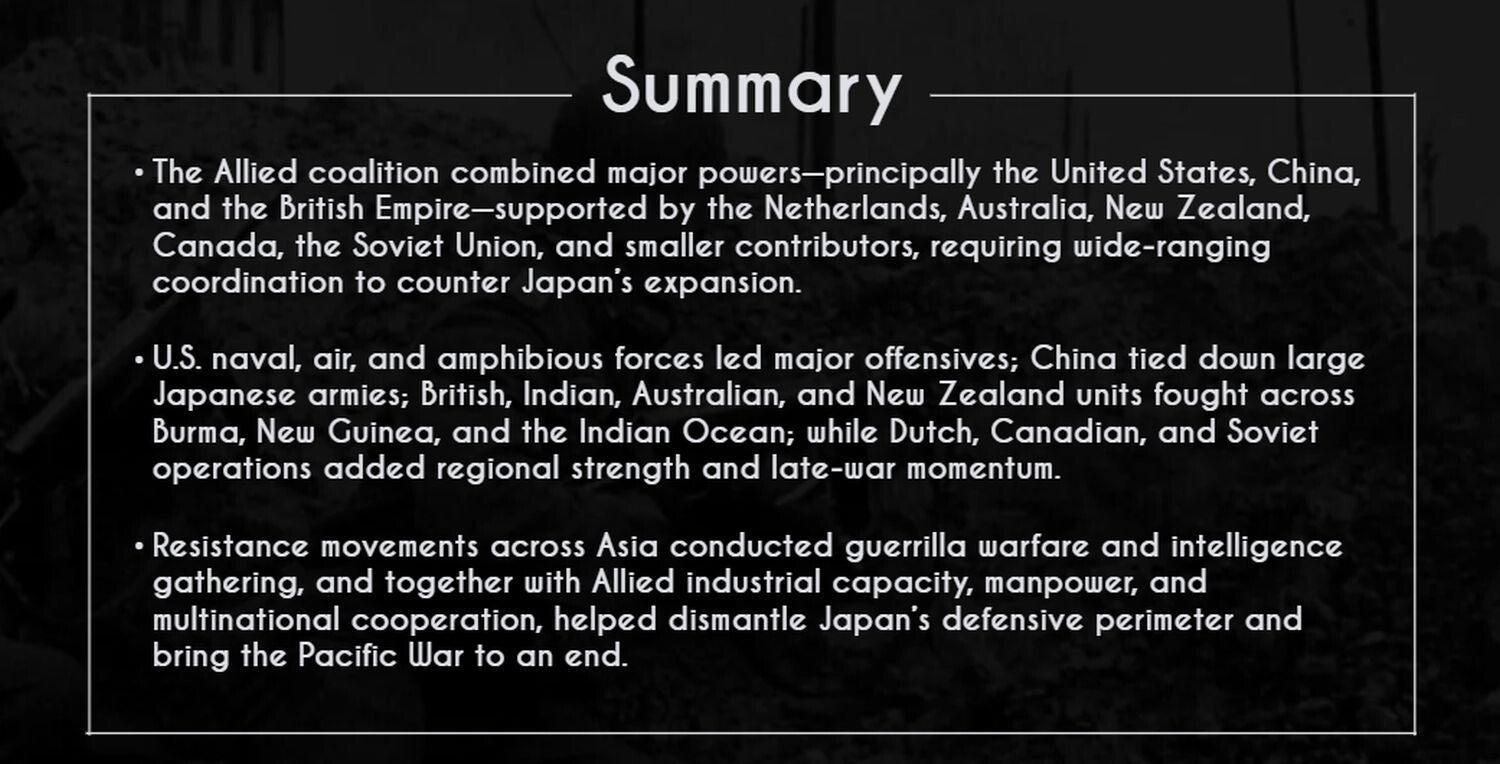
The principal participants were the United States, China, and the British Empire, supported by the Netherlands, Australia, New Zealand, Canada, and later the Soviet Union.
Additional contributions came from Mexico, Free France, and various Asian resistance movements.
This multinational structure required coordination across vast distances and differing command systems, but collectively provided the resources necessary to counter Japan’s expansion.
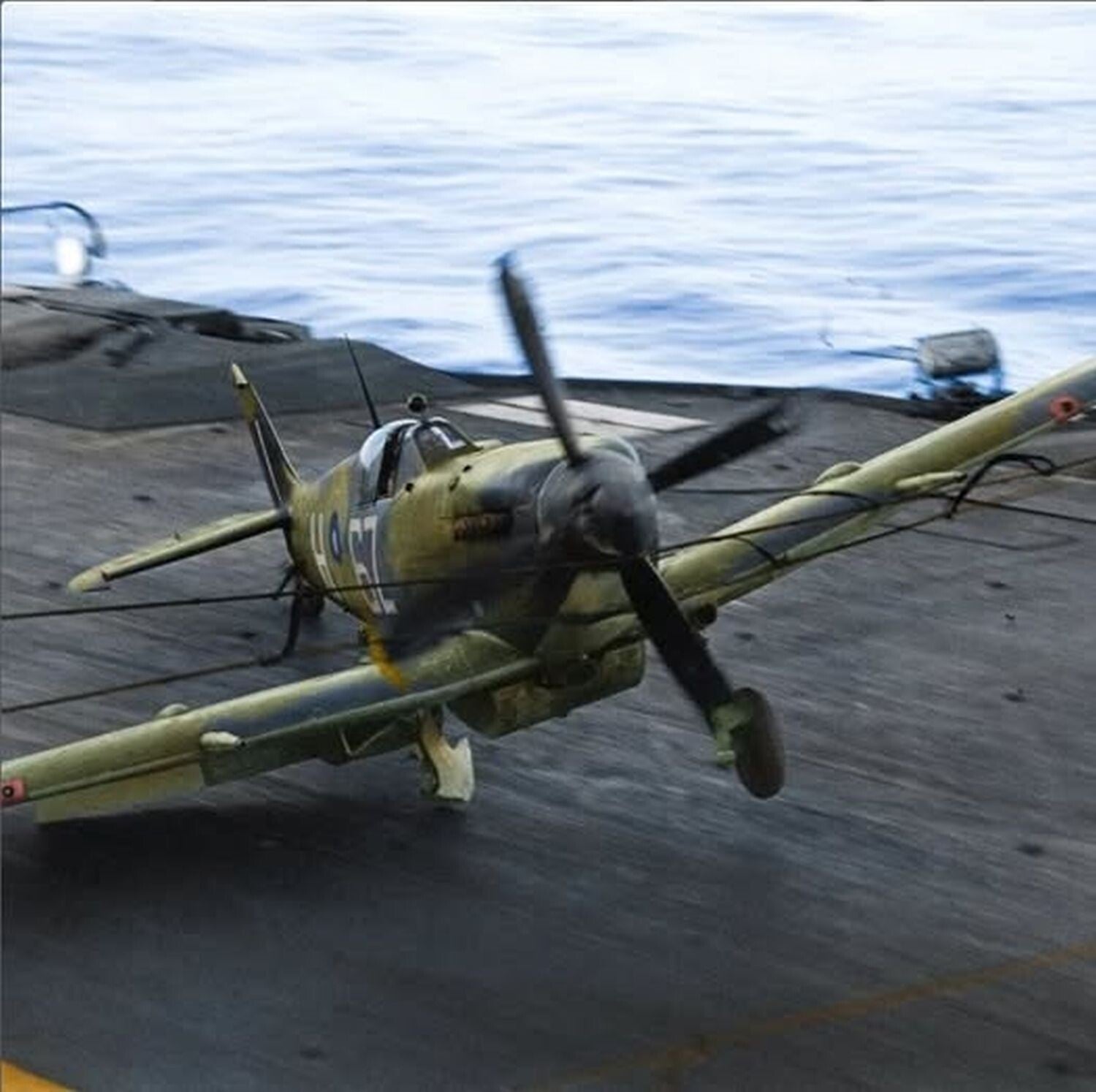
A Supermarine Seafire aircraft hitting the barrier on the HMS Indefatigable ship after returning from a strike on the Japanese oil refinery at Pangkalan Brandan, Sumatra, 1 April 1945. Seafires saw limited Pacific service from 1944, mainly in fleet air defence and spotting roles. Their short range and fragile undercarriage restricted operations, but they proved valuable during the Okinawa campaign, flying CAP, intercepting raids, and supporting naval forces. Losses were high, yet their contribution remained operationally useful.
...absorbing heavy casualties...
The United States supplied the majority of naval, air, and amphibious forces. Its carrier groups, Marine divisions, and Army formations conducted major offensives from Guadalcanal to Okinawa.
China, already engaged in full‑scale war with Japan since 1937, tied down large numbers of Japanese troops on the mainland, absorbing heavy casualties while maintaining continuous resistance.
The British Empire contributed forces from India, Australia, New Zealand, and the United Kingdom. Australian units fought in New Guinea, the Solomons, and Borneo, while Indian divisions played a central role in the Burma campaign.
British naval forces operated in the Indian Ocean, though their strength was limited by commitments in Europe and North Africa.
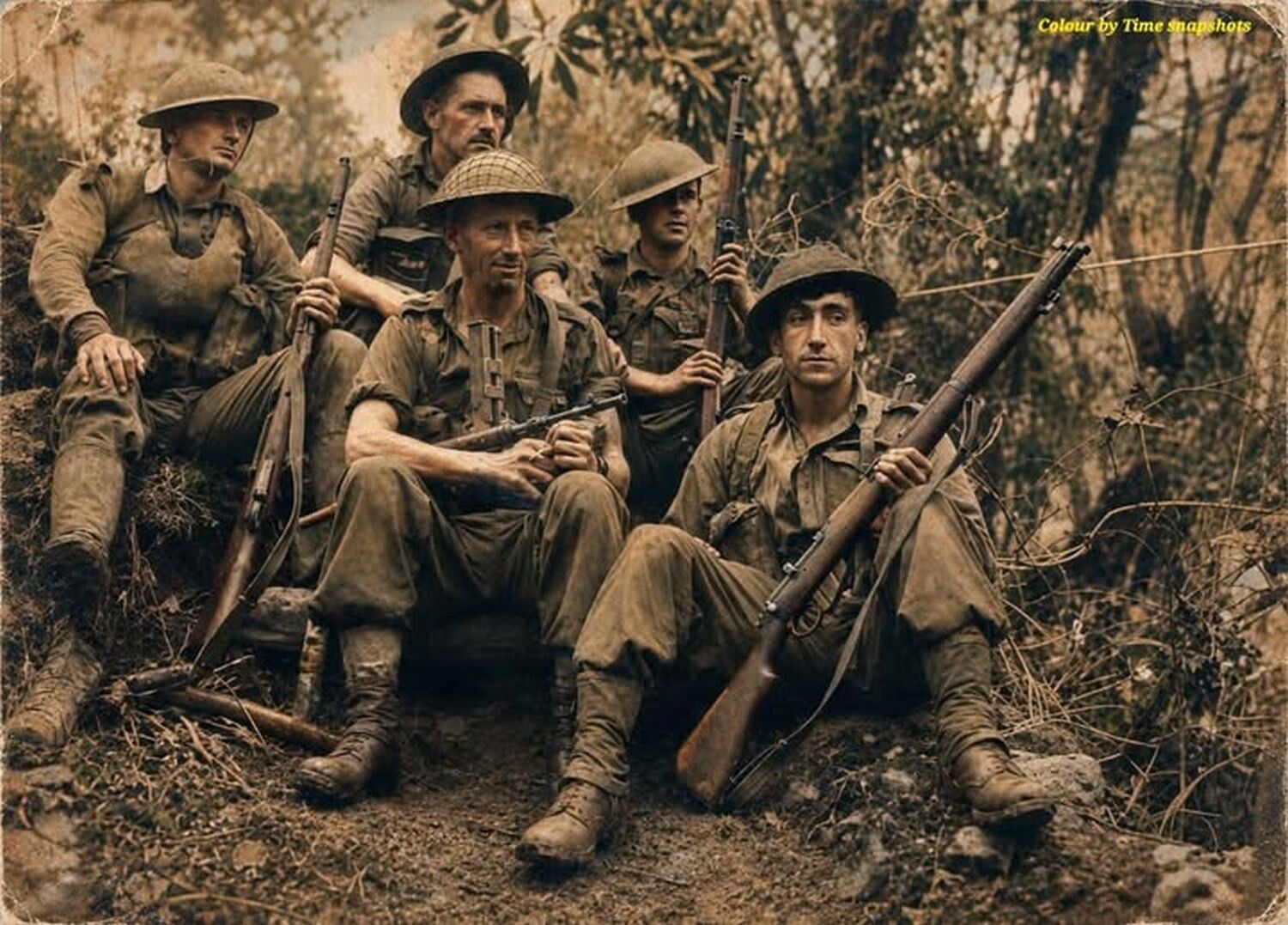
Australian 2/9th Battalion soldiers rest before entering the battle at Shaggy Ridge, Papua New Guinea, January 1944. Australian soldiers in the Pacific War fought across New Guinea, the Solomons, Borneo, and other island campaigns, operating in harsh terrain and extreme climate. They formed the core of Australia’s forward defence, engaging Japanese forces in protracted jungle operations that demanded endurance, small‑unit initiative, and close‑quarters combat. Their contribution was central to halting Japan’s southward advance and supporting wider Allied strategy, with infantry, airmen, and naval personnel sustaining continuous operations from 1942 to 1945.
Colour by Time Snapshots
...launched a major offensive...
The Netherlands deployed air, naval, and ground units in defence of the Dutch East Indies, while Canadian and New Zealand forces provided air and naval support.
The Soviet Union remained neutral until August 1945, when it launched a major offensive into Manchuria, Korea, and Sakhalin, accelerating Japan’s collapse.
Smaller contingents, such as Mexico’s 201st Fighter Squadron and Free French naval units, added specialised capabilities.
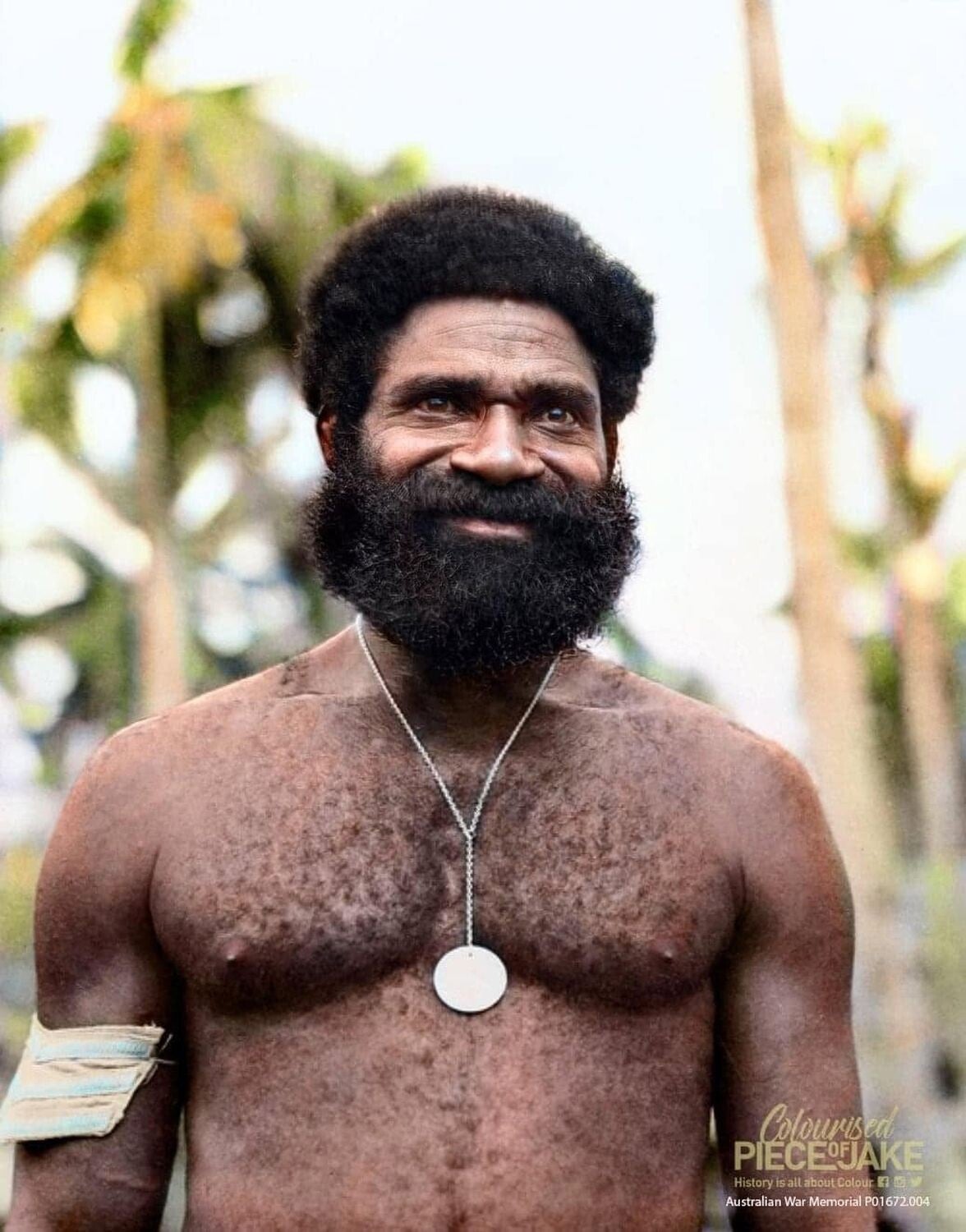
Sergeant Yauwika of the New Guinea Constabulary, a Sepik River chief, received the Loyal Services Medal for his assistance to coastwatchers in the Solomon Islands. His rank chevrons were worn on his right arm. Yauwika later suffered a grenade wound that cost him the sight of one eye. From the early stages of the war, Papuans volunteered to support Allied forces, especially Australians. Around 45,000 served as stretcher‑bearers, labourers, guides, and messengers. Australians nicknamed them “Fuzzy Wuzzies” for their frizzy hair. A small number joined Australian military units and fought in uniform, providing vital intelligence and logistical support.
...disrupted Japanese logistics...
Local resistance movements - including the Hukbalahap in the Philippines, the Free Thai Movement, the Korean Liberation Army, and the Việt Minh - conducted guerrilla warfare, sabotage, and intelligence gathering.
Their operations disrupted Japanese logistics and supported Allied advances.
Collectively, the Allied contingent combined industrial strength, manpower, and regional cooperation to overcome Japan’s defensive perimeter and bring the Pacific War to a close.
Japanese Expansion
Japan’s actions in 1940 reflected a deliberate acceleration of its expansionist strategy and a tightening alignment with Axis powers, driven by economic pressures, strategic calculations, and the desire to consolidate dominance in East Asia.
By this stage, Japan had already established control over Manchuria and large areas of China, but the ongoing conflict required additional resources and secure supply routes.
The year therefore marked a shift toward broader regional intervention and deeper diplomatic commitments.
Information
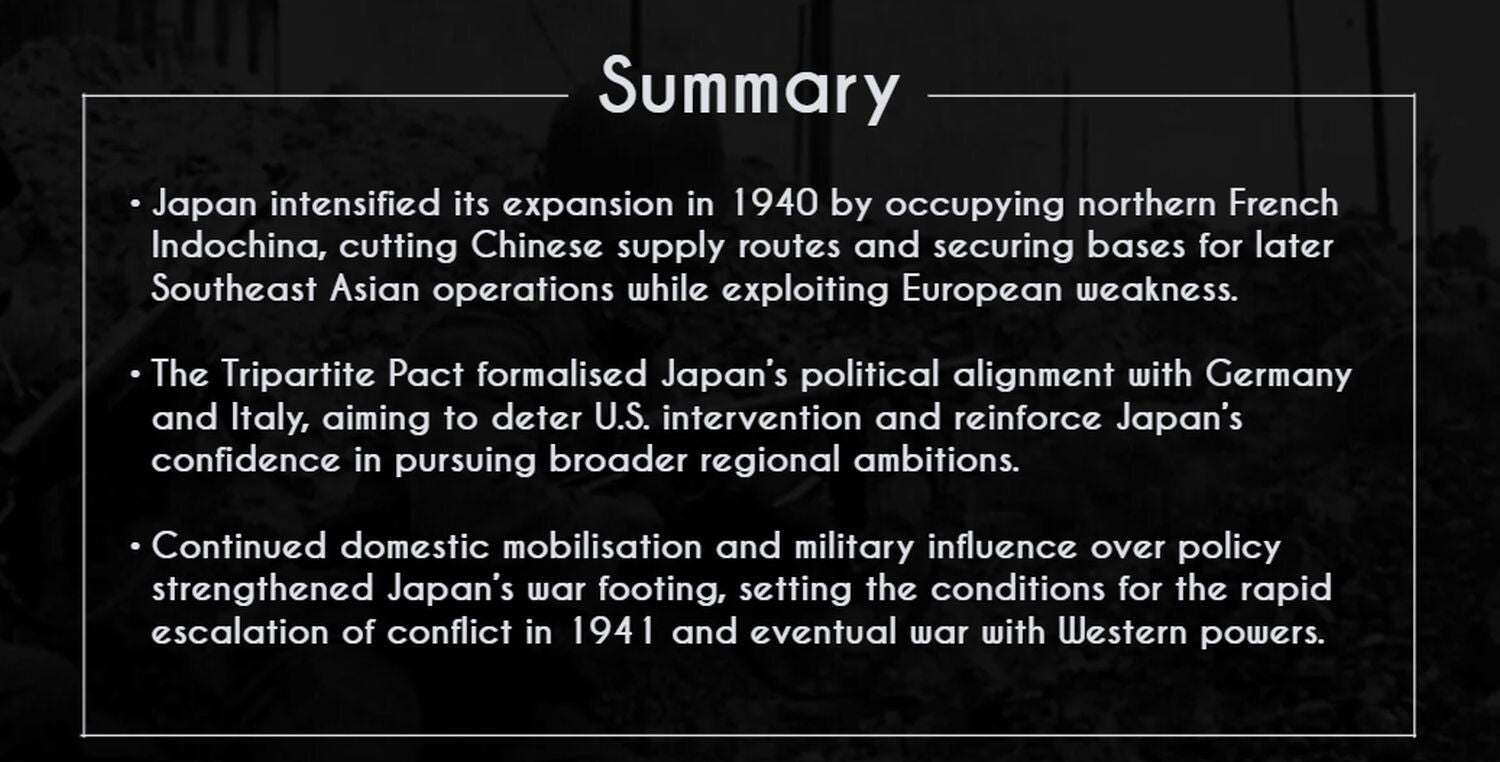
One of the most significant developments was Japan’s decision to occupy northern French Indochina in September 1940.
France, weakened by German occupation, was unable to resist Japanese demands.
The move allowed Japan to cut supply lines to Chinese Nationalist forces and establish airfields and logistical bases for future operations in Southeast Asia.
The occupation also signalled Japan’s willingness to exploit European vulnerabilities created by the wider war, expanding its strategic reach without immediate large‑scale conflict.
Information
Diplomatically, Japan formalised its alignment with Germany and Italy through the Tripartite Pact, signed on 27 September 1940.
The pact established a political and military bloc aimed at deterring the United States from intervening in Asia or Europe.
For Japan, the agreement provided reassurance that its expansion would be supported by major European powers, while also strengthening its negotiating position against Western nations.
Although the pact did not require coordinated military operations, it marked Japan’s full integration into the Axis framework.
Information
Domestically, Japan continued to mobilise its economy and society for prolonged conflict. Industrial output was increasingly directed toward military production, and the government tightened control over political life.
The Imperial Japanese Army and Navy maintained significant influence over national policy, ensuring that strategic decisions aligned with expansionist objectives.
By the end of 1940, Japan had strengthened its strategic position in East Asia, secured new bases for future operations, and formalised its alliance with the Axis powers.
These actions set the conditions for the rapid escalation of conflict in 1941 and the eventual outbreak of full‑scale war with Western nations.
American preparations
From the late 1930s to 1941, the United States undertook a series of military, industrial, and diplomatic preparations in response to Japan’s expansion across East Asia and the Pacific.
Although the U.S. did not expect the precise timing or location of Japan’s opening blow, senior planners increasingly regarded conflict as likely.
American measures during this period focused on strengthening naval power, reinforcing Pacific positions, expanding industrial capacity, and applying economic pressure to deter further Japanese aggression.
...a major maritime conflict...
The U.S. Navy was the centrepiece of American strategy.
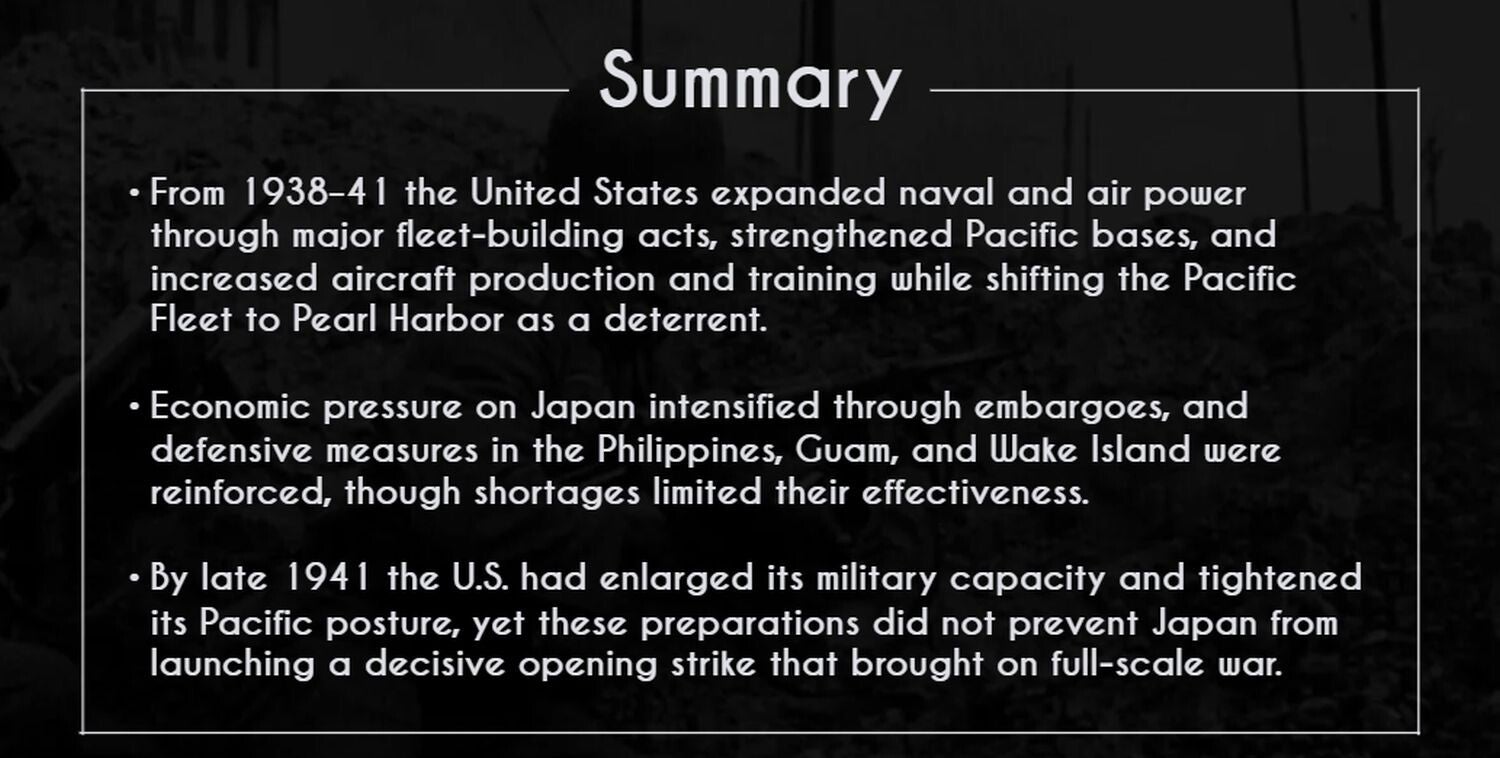
Recognising Japan’s growing naval strength, Congress authorised major fleet expansions through the Naval Act of 1938 and the Two‑Ocean Navy Act of 1940.
These measures funded new battleships, aircraft carriers, cruisers, destroyers, and submarines, significantly increasing American shipbuilding output.
Although many vessels would not be completed until after 1941, the legislation reflected a clear shift toward long‑term preparation for a major maritime conflict.
The decision in 1940 to base the Pacific Fleet at Pearl Harbor, rather than San Diego, was intended to deter Japanese advances but also placed American forces closer to potential operational theatres.
...a policy of economic pressure...
Air power development also accelerated. The U.S. Army Air Corps expanded training programmes, increased aircraft procurement, and improved Pacific airfields.
Long‑range bombers and modern fighters were prioritised, reflecting concerns about Japan’s ability to project air power from its newly acquired bases in China and Indochina.
Diplomatically, the United States adopted a policy of economic pressure which aimed to limit Japan’s operational freedom and force a withdrawal from China, though they also increased the likelihood of Japanese military action to secure alternative resources.
...though both remained vulnerable...
Defensive preparations in the Philippines intensified. General Douglas MacArthur oversaw efforts to strengthen coastal defences, expand the Philippine Army, and modernise air units.
However, shortages in equipment and training limited the effectiveness of these measures. Guam and Wake Island received modest reinforcements, though both remained vulnerable.
By late 1941, the United States had expanded its military capacity, strengthened Pacific positions, and applied sustained economic pressure on Japan.
Although these preparations improved American readiness, they did not prevent Japan from seeking a decisive opening strike, leading directly to the outbreak of war
Economic Pressure
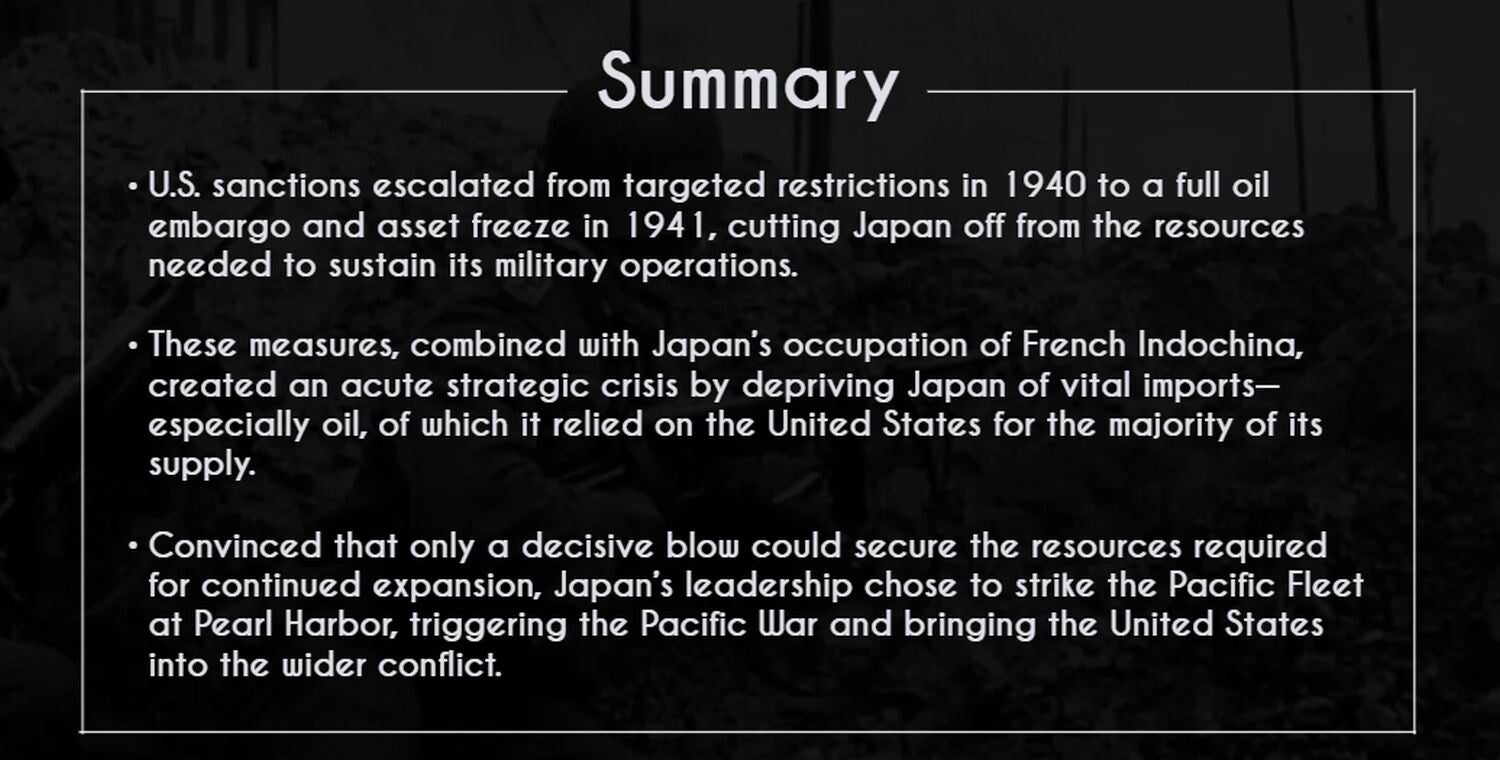
As Japan’s military actions continued to disrupt the region, Western nations—particularly the United States—began to implement economic sanctions to limit Japan’s ability to sustain its war effort.
In 1940, the United States imposed an embargo on the export of aviation fuel, steel, and iron to Japan, aiming to curb its military expansion.
This action coincided with Japan’s occupation of French Indochina (Vietnam, Laos, and Cambodia) following France’s defeat in Europe, which gave Japan control over vital resources and a strategic foothold in Southeast Asia.
The embargo deepened Japan’s dependence on imported resources and forced it to consider more drastic measures to secure oil and other critical supplies.
...essential for its military operations...
The turning point in economic sanctions came in 1941, when the U.S. placed a complete embargo on oil exports to Japan. Japan relied on the United States for approximately 80% of its oil, which was essential for its military operations.
This embargo, along with freezing Japanese assets in the United States and barring access to American financial institutions, crippled Japan’s economy and restricted its ability to wage war.
Faced with the prospect of depleting resources, Japan’s leadership faced a stark choice: abandon its expansionist goals or secure access to new resources through further military conquest.
...need to strike decisively...
This economic pressure made war with the United States almost inevitable. Japanese leaders, including Prime Minister Hideki Tojo, concluded that they would need to strike decisively to secure the resources and territory needed to sustain Japan’s empire.
Japan’s strategy centered on launching a surprise attack on the U.S. Pacific Fleet at Pearl Harbor, Hawaii, with the goal of disabling American naval power long enough to allow Japan to solidify its position in Asia.
This attack, carried out on December 7, 1941, marked the beginning of the Pacific War and brought the United States into The Second World War as a direct combatant.
Attack on Pearl Harbor
The attack on Pearl Harbor on December 7, 1941, marked the United States' entry into The Second World War and set the stage for an intense struggle across the Pacific Theatre.
This audacious and meticulously planned assault not only struck a critical blow to U.S. naval power but also emboldened Japan to initiate a rapid succession of offensives across Southeast Asia and the Pacific Islands.
Japan’s early victories secured strategic resources and strengthened its territorial control, forcing the Allies to confront a formidable and deeply entrenched opponent.
...meticulously planned the assault...
On the morning of December 7, 1941, Japanese forces launched a surprise attack on the U.S. Pacific Fleet anchored at Pearl Harbor, Hawaii.
The Japanese had meticulously planned the assault to maximize the element of surprise and to disable the U.S. naval presence in the Pacific, thereby preventing immediate American retaliation.
The attack was led by Admiral Isoroku Yamamoto, who sought to cripple U.S. military capabilities and allow Japan a clear path to pursue its territorial expansion without interference.
...a devastating toll...
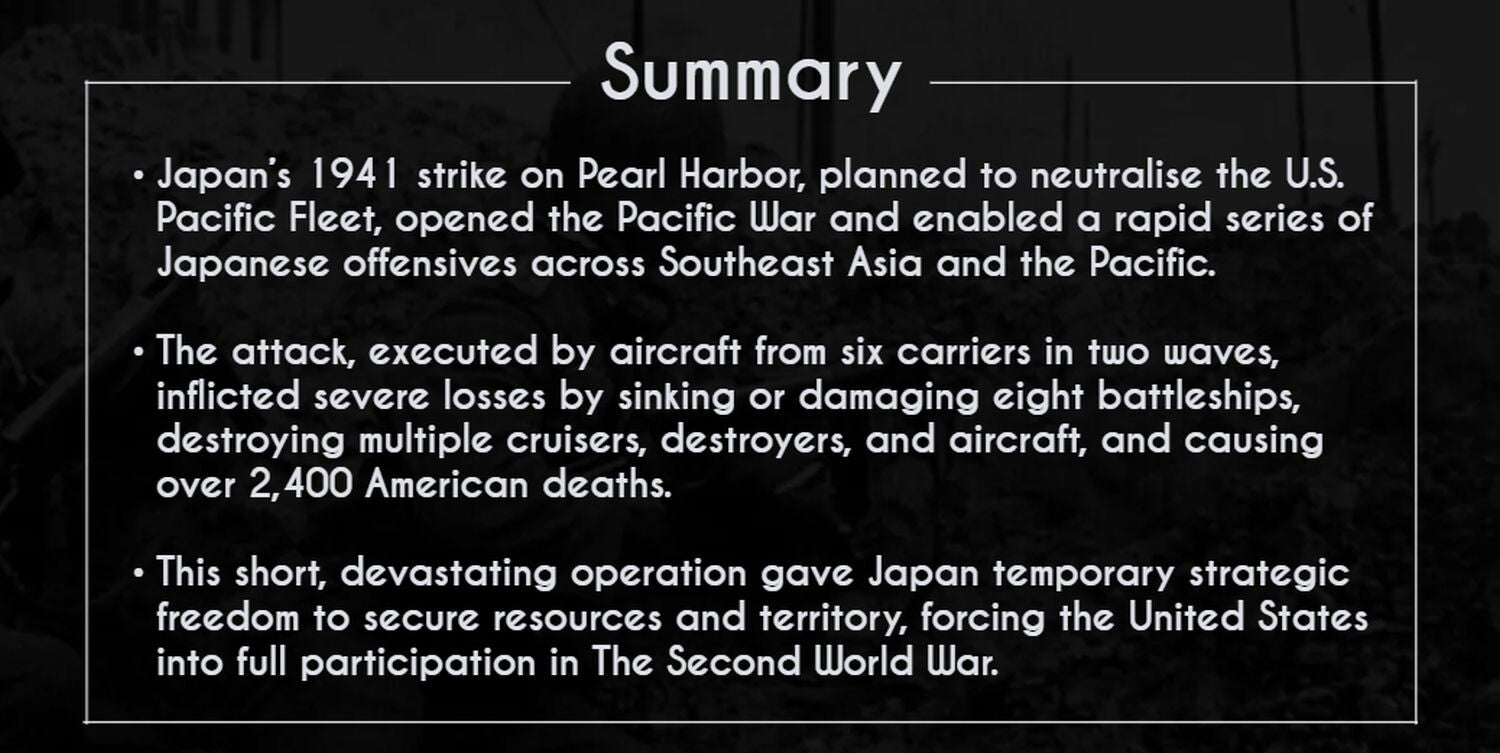
The attack involved over 350 aircraft launched from six Japanese carriers, which struck in two waves.
The assault lasted less than two hours but left a devastating toll: eight U.S. battleships were damaged or sunk, including the USS Arizona, which suffered a catastrophic explosion that killed over 1,000 sailors.
Additionally, three cruisers, three destroyers, and numerous aircraft were destroyed or severely damaged.
Over 2,400 American personnel were killed, with thousands more wounded.
1942 - Early Japanese Successes
The year 1942 marked a decisive turning point in the Pacific War, defined by Japan’s rapid expansion, the limits of its operational reach, and the emergence of coordinated Allied counteroffensives.
At the start of the year, Japan appeared ascendant. Its forces had seized territory across East Asia and the Pacific, exploiting surprise, mobility, and air‑sea coordination to overwhelm Allied positions.
However, by the end of 1942, Japan’s strategic momentum had stalled, and the Allies had begun a sustained campaign that would gradually reverse Japanese gains.
...conduct complex operations...
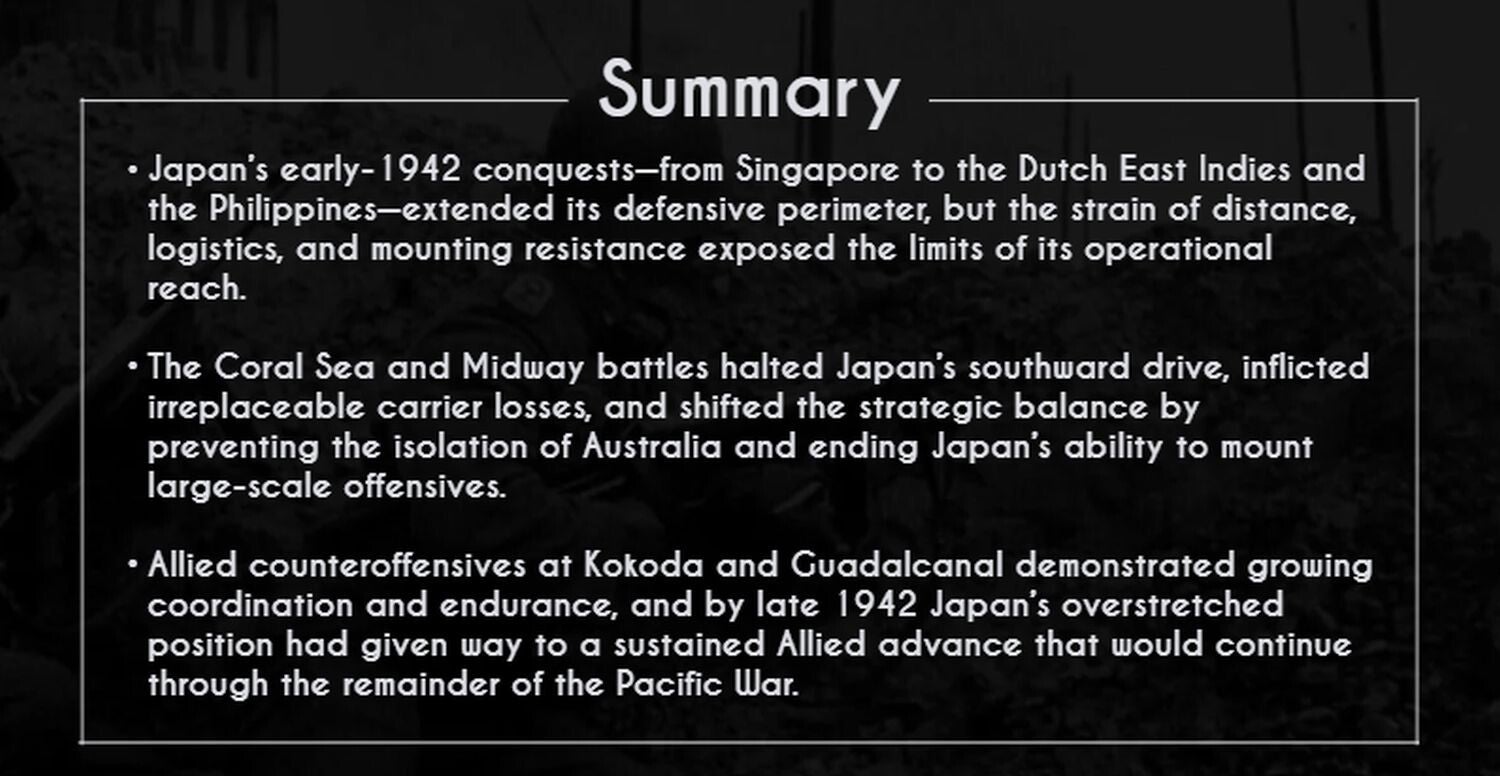
In early 1942, Japan consolidated its conquests following the attacks of late 1941.
The fall of Singapore in February was one of the most significant Allied defeats, eliminating a major British stronghold and demonstrating Japan’s ability to conduct complex operations far from its home islands.
The capture of the Dutch East Indies soon followed, securing vital oil resources that Japan considered essential for sustaining its war effort.
Meanwhile, American and Filipino forces on the Bataan Peninsula resisted until April, when they were compelled to surrender, followed by the fall of Corregidor in May. T
hese losses gave Japan control over the Philippines and further extended its defensive perimeter.
...halted Japan’s attempt...
Japan’s strategic outlook changed with the Battle of the Coral Sea in May 1942.
Although tactically inconclusive, the battle halted Japan’s attempt to isolate Australia by seizing Port Moresby.
It was also the first major naval engagement fought entirely by carrier aircraft, demonstrating the evolving nature of naval warfare.
The subsequent Battle of Midway in June proved decisive.
American codebreaking enabled U.S. forces to anticipate Japan’s plans, resulting in the destruction of four Japanese fleet carriers.
This loss significantly weakened Japan’s ability to conduct large‑scale offensive operations and shifted the strategic balance in the Pacific.
...fought in difficult terrain...
Following Midway, Japan attempted to secure its southern perimeter by advancing along the Kokoda Track in New Guinea.
The campaign, fought in difficult terrain, saw Australian forces conduct a determined defence that ultimately halted the Japanese advance.
The failure to capture Port Moresby prevented Japan from threatening Australia directly and marked another strategic setback.
...a prolonged struggle...
In August 1942, the Allies initiated their first major offensive of the Pacific War with the landings on Guadalcanal in the Solomon Islands.
The campaign became a prolonged struggle for control of Henderson Field, a critical airstrip. Both sides committed significant naval, air, and ground forces, resulting in a series of intense engagements, including the Eastern Solomons and Santa Cruz battles.
By late 1942, Japan’s inability to sustain operations at Guadalcanal, combined with mounting losses, forced a gradual withdrawal.
By the end of the year, Japan’s strategic situation had deteriorated. Its early gains had overstretched its resources, while the Allies had begun to exploit their industrial and logistical advantages.
The events of 1942 transformed the Pacific War from a period of Japanese expansion into one of sustained Allied counteroffensives that would continue until 1945.
The Island Hopping Strategy
The Island‑hopping strategy was a central Allied method for advancing across the Pacific and overcoming Japan’s extensive defensive network.
Rather than attacking every Japanese‑held island, Allied planners selected specific locations that offered strategic value - airfields, anchorages, or positions that enabled further operations.
By capturing these key islands and bypassing others, the Allies isolated Japanese garrisons, cut supply lines, and avoided costly assaults on heavily fortified positions.
This approach allowed steady progress across vast distances while conserving manpower and resources.
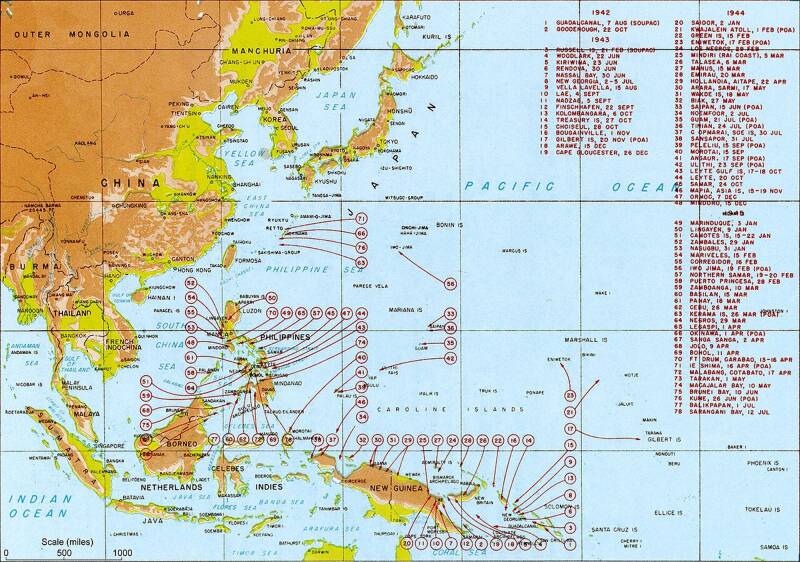
Allied landings in the Pacific Theatre of operations, August 1942 to August 1945. Island‑hopping was the Allied strategy of bypassing heavily fortified Japanese positions and capturing key islands that offered airfields and naval bases. By seizing only strategically essential locations, the U.S. advanced across the Pacific efficiently, isolating Japanese strongholds, cutting supply lines, and creating a direct route toward Japan’s inner defensive perimeter.
...would result in high casualties...
The strategy was shaped by Admiral Chester W. Nimitz and General Douglas MacArthur, who recognised that direct attacks on major Japanese strongholds such as Rabaul would result in high casualties and prolonged campaigns.
Instead, they used naval mobility, air superiority, and amphibious capability to seize islands that could support forward bases.
Once secured, these bases enabled air strikes, interdiction of Japanese shipping, and the gradual erosion of Japan’s defensive perimeter.
...enabling sustained strategic bombing...
Several operations demonstrated the effectiveness of island hopping.
The Battle of Tarawa in November 1943 revealed the intensity of Japanese resistance and the challenges of amphibious assault, but its capture provided a vital airfield and key lessons for future operations.
The assault on Kwajalein in early 1944 applied these lessons, combining extensive bombardment with coordinated landings to reduce casualties and secure another important base.
The Marianas campaign in mid‑1944 - Saipan, Tinian, and Guam - was decisive.
These islands placed Japan within range of B‑29 bombers, enabling sustained strategic bombing of the Japanese home islands.
...entrenched Japanese defenders...
Island hopping required overcoming significant logistical and environmental challenges, including remote locations, coral reefs, tropical climate, and entrenched Japanese defenders.
Despite these obstacles, the strategy steadily weakened Japan’s ability to resist, enabling the Allies to advance toward the Philippines, Iwo Jima, Okinawa, and ultimately Japan itself.
Island hopping proved essential in breaking Japan’s defensive system and shaping the final phase of the Pacific War.
1943 - The tide begins to turn
The year 1943 marked the transition from defensive stabilisation to sustained Allied offensive operations across the Pacific.
Japan entered the year strategically overstretched, facing mounting logistical pressures and the cumulative effects of losses suffered in 1942.
Although Japanese forces continued to resist with determination, the balance of initiative had shifted decisively.
Allied operations in 1943 focused on isolating Japanese strongholds, reducing their capacity to manoeuvre, and exploiting growing American industrial superiority.
...months of attritional fighting...
The Guadalcanal campaign concluded in February 1943 after months of attritional fighting.
Japan’s withdrawal ended its attempt to secure the southern Solomon Islands and marked its first major strategic defeat of the war.
The loss forced Japan to adopt a more defensive posture, reorganising its perimeter and attempting to preserve remaining carrier and ground forces.
For the Allies, Guadalcanal provided a critical foothold from which further operations in the Solomons and New Guinea could be launched.
...difficult terrain, disease, and intense resistance...
In New Guinea, the Allies continued their advance following the failure of Japan’s 1942 Port Moresby campaign.
Operations at Buna, Gona, and Sanananda early in the year were characterised by difficult terrain, disease, and intense resistance.
By mid‑1943, Australian and American forces had secured the northern coast, enabling subsequent operations aimed at neutralising Japanese bases at Lae and Salamaua.
The September airborne and amphibious assaults on Lae demonstrated improved Allied coordination and mobility, forcing Japanese forces to retreat into the interior.
The capture of Finschhafen later in the year further consolidated Allied control and opened the way for future advances along the northern coastline.
...defending heavily fortified positions...
In the Solomon Islands, the Allied strategy centred on isolating the major Japanese base at Rabaul.
The campaign progressed through a series of sequential operations, including landings on New Georgia in June.
Fighting on New Georgia and nearby islands was protracted, with Japanese forces defending heavily fortified positions.
Nevertheless, by August the Allies had secured the island group, enabling further moves toward Bougainville.
The November landings at Cape Torokina established a beachhead that allowed construction of airfields to support the broader campaign against Rabaul.
Rather than assaulting Rabaul directly, the Allies adopted a strategy of bypassing and neutralising it through air power, effectively rendering the base operationally irrelevant by the end of the year.
...increasingly dominated key areas...
At sea, Japan’s ability to contest Allied advances diminished. Losses in carriers, trained aircrews, and fuel supplies limited Japan’s capacity to mount large‑scale naval operations.
Allied air and naval forces increasingly dominated key areas, disrupting Japanese supply lines and isolating garrisons.
The U.S. Navy expanded rapidly in 1943, commissioning new carriers, cruisers, and destroyers that strengthened its operational reach.
By the end of 1943, the strategic situation in the Pacific had shifted decisively. Japan retained strong defensive positions but lacked the means to regain the initiative.
The Allies, benefiting from growing logistical strength and improved joint operations, had established a pattern of sequential offensives that would continue into 1944 and ultimately carry them toward Japan’s inner defensive perimeter.
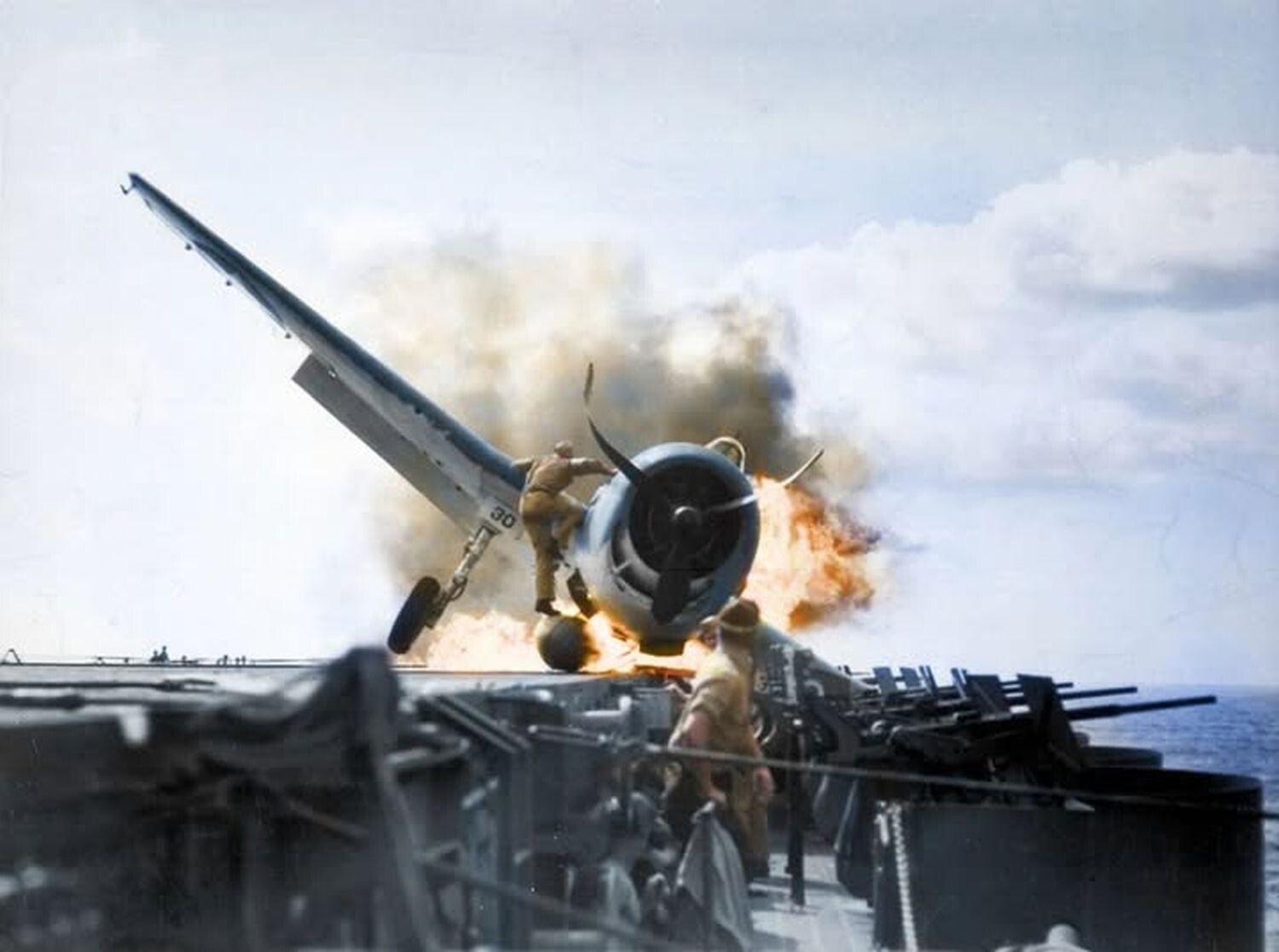
Lt Walter Chewning, a catapult officer, is shown climbing up the side of a F6F to help the pilot, Ens. Byron Johnson, out of the flaming cockpit, after a crash landing on the flight deck of the USS Enterprise. The vessel was en route to attack Makin Island in the Pacific, November 1943.
Desperate Defence: Forts, tunnels and bunkers
As the Allies advanced through the Pacific, Japan adapted its defensive doctrine to transform each island into a protracted and costly battleground.
Recognising that perimeter defenses could no longer stop amphibious assaults supported by overwhelming naval and air power, Japanese commanders shifted to an inland, fortified strategy designed to prolong resistance and inflict maximum casualties.
This approach relied on extensive bunker systems, tunnel networks, concealed firing points, and hardened artillery positions capable of surviving pre‑invasion bombardments.
...complex defensive networks...
Early Japanese defenses placed troops near beaches to repel landings, but battles such as Tarawa demonstrated that American forces could reach the shore despite heavy resistance.
In response, Japan constructed complex defensive networks across key islands.
On Iwo Jima, General Tadamichi Kuribayashi oversaw the creation of an elaborate subterranean system stretching more than eleven miles.
These tunnels connected bunkers, command posts, ammunition stores, and firing positions, allowing Japanese troops to relocate rapidly, withstand bombardment, and launch coordinated counterattacks.
Similar fortifications appeared on Okinawa, where natural ridges and escarpments were integrated into defensive lines, creating layered positions that forced Allied troops into sustained close‑quarters combat.
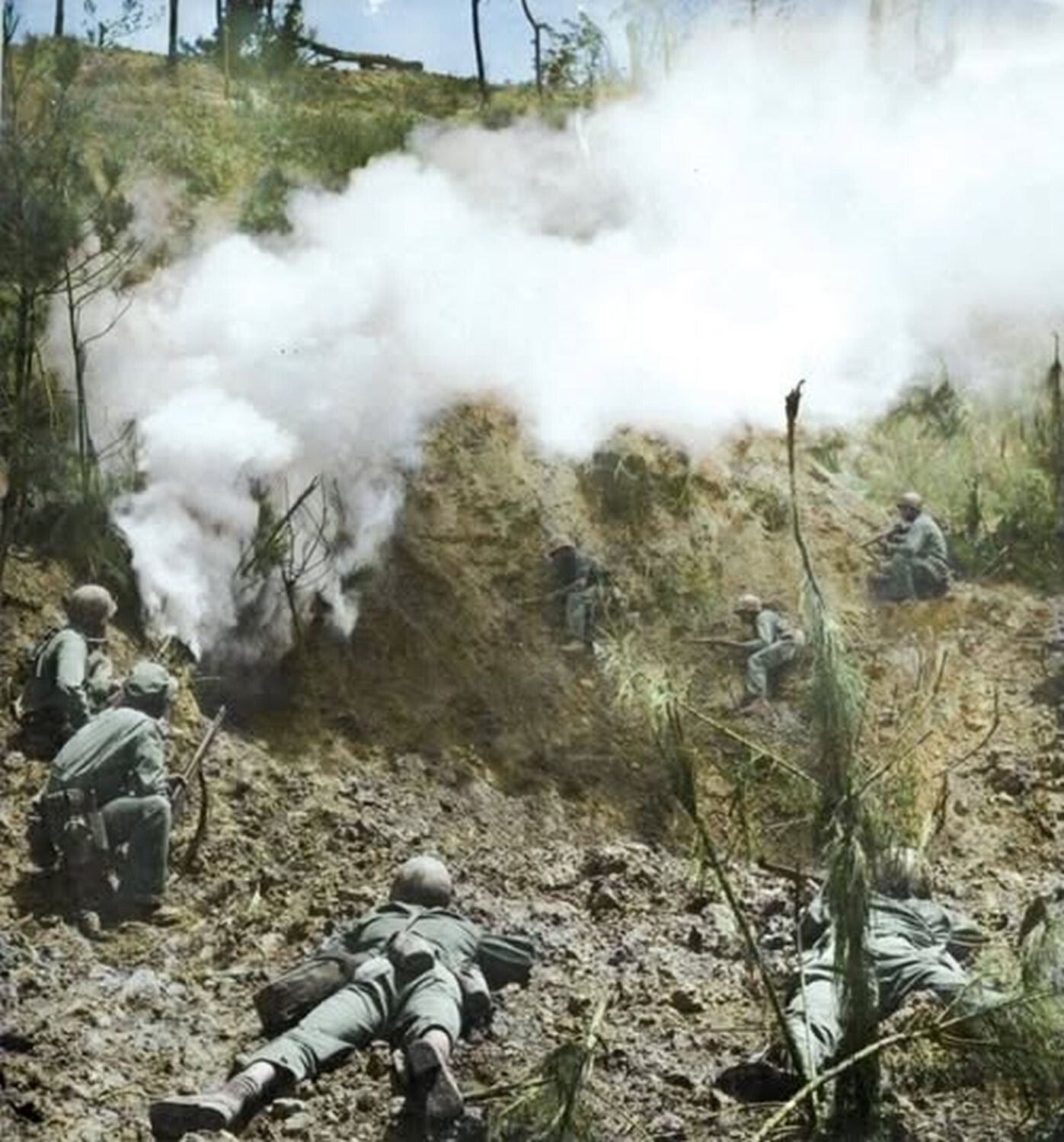
After setting off explosives, Marines wait at entrance to a cave where Japanese soldiers are hiding. Japanese forces across the Pacific War made systematic use of caves as defensive strongpoints. They expanded natural caverns and blasted new chambers to create interconnected bunker systems resistant to bombardment. Caves housed command posts, hospitals, ammunition stores, and concealed troop positions. On islands such as Saipan, Peleliu, Iwo Jima, and Okinawa, these fortified cave networks enabled prolonged resistance, forcing Allied troops into close‑quarters assaults that were slow, costly, and tactically exhausting.
...demonstrating Japan’s determination...
These fortified systems meant that pre‑landing bombardments could not neutralise Japanese defenses.
American soldiers and Marines frequently encountered ambushes, concealed firing points, and interconnected underground positions that required flamethrowers, grenades, and systematic clearing operations.
Small Japanese garrisons were able to delay much larger Allied forces, demonstrating Japan’s determination to make each battle as costly as possible.
As the war neared Japan’s home islands, these defensive measures were supplemented by kamikaze attacks - suicidal air strikes intended to damage Allied ships and disrupt operations.
Together, fortified island defenses and kamikaze tactics shaped the final phase of the Pacific War, challenging Allied morale, complicating operational planning, and prolonging the conflict at significant human cost.
1944 – Japan on the defensive
The year 1944 represented the decisive shift from incremental Allied advances to large‑scale, coordinated offensives that dismantled Japan’s outer defensive perimeter and exposed the strategic vulnerabilities of the Japanese Empire.
By this stage of the war, Japan faced severe shortages in fuel, trained aircrews, and shipping capacity, while the Allies possessed overwhelming industrial strength and increasingly refined joint operational methods.
The campaigns of 1944 systematically reduced Japan’s ability to manoeuvre, resupply, and defend its remaining territories.
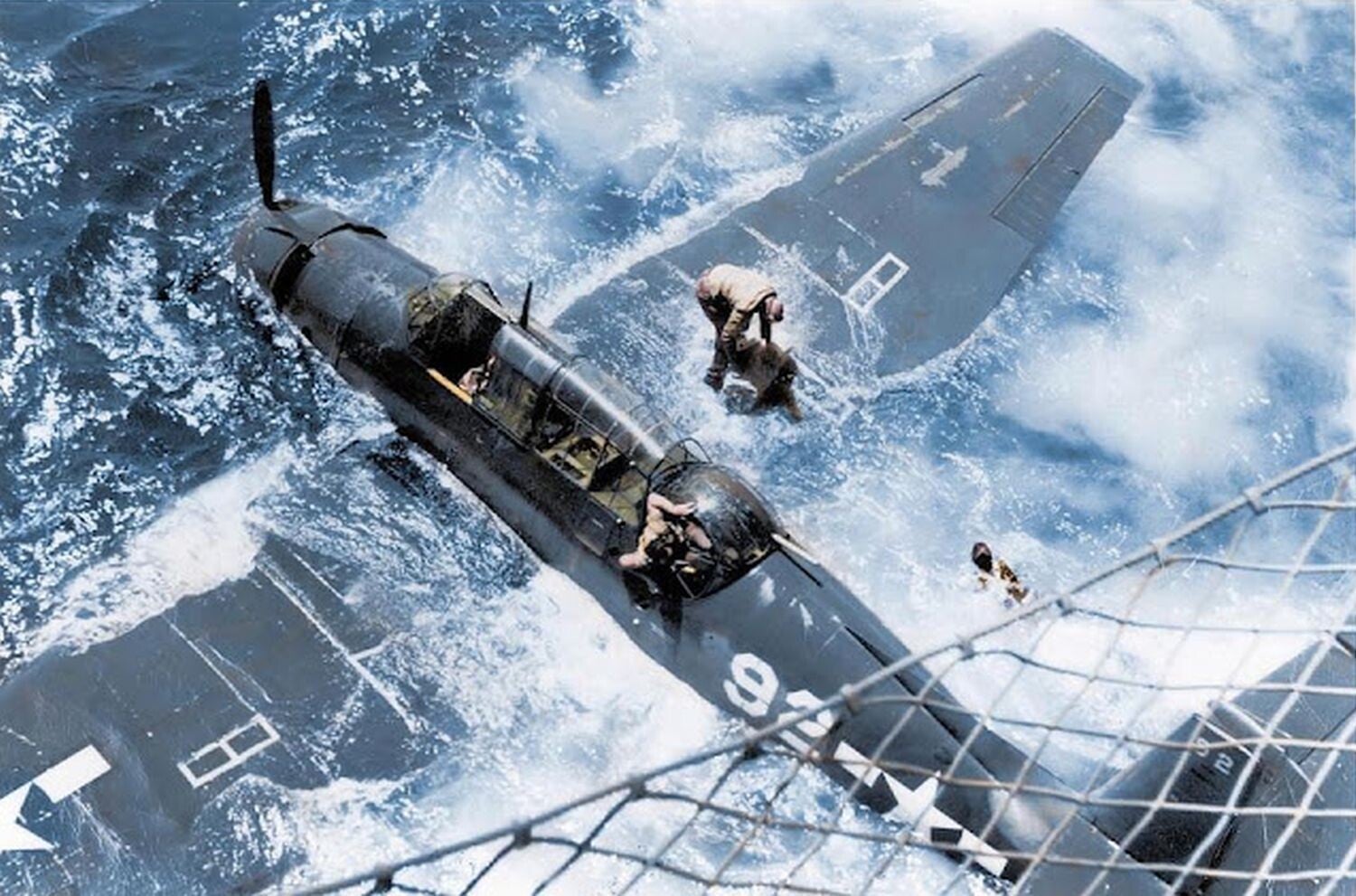
An Avenger aircraft from the squadron VT-26, after engine failure and a catapult mishap on board the aircraft carrier USS Bataan CVE-29. March 13, 1944.
...disrupted Japanese command...
In early 1944, the Allies intensified operations in New Guinea and the Solomon Islands.
The Admiralty Islands campaign, launched in February, established key air and naval bases that supported subsequent operations across the western Pacific.
In New Guinea, General Douglas MacArthur’s forces advanced along the northern coast, capturing Hollandia in April through a combination of surprise amphibious landings and air superiority.
The seizure of Hollandia disrupted Japanese command and logistics in the region, enabling further advances toward Wakde, Biak, and Noemfoor.
These operations demonstrated the Allies’ growing proficiency in bypassing heavily fortified Japanese positions, isolating them rather than engaging in costly frontal assaults.
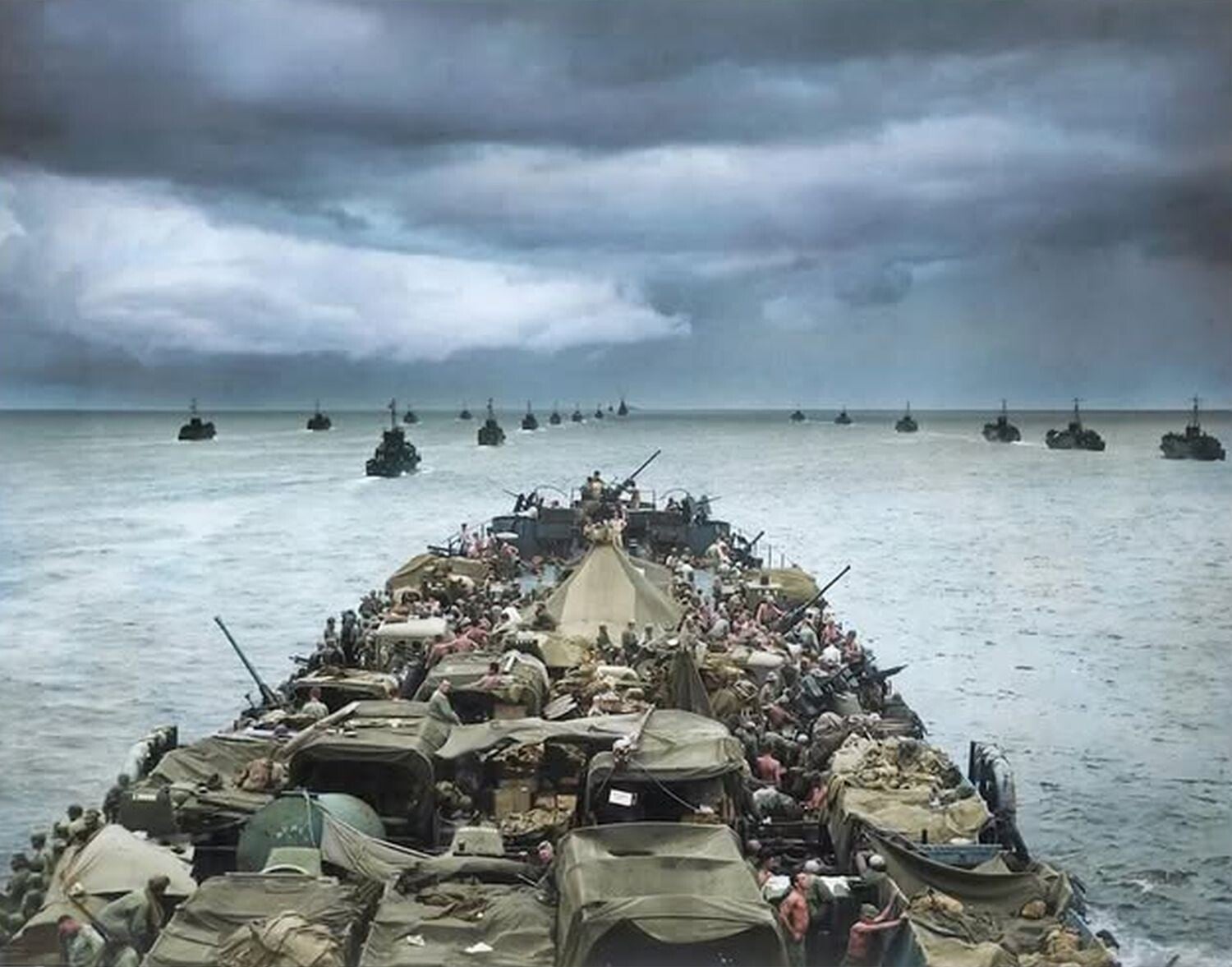
Troops and vehicles en route for the invasion of Cape Sansapor, New Guinea, July 1944.
...resulted in catastrophic losses...
In the Central Pacific, Admiral Chester Nimitz directed a major offensive against the Marshall and Mariana Islands.
The capture of Kwajalein and Eniwetok early in the year provided forward bases for the assault on the Marianas.
The June landings on Saipan, Tinian, and Guam triggered one of the most significant naval battles of the war: the Battle of the Philippine Sea.
Japan attempted to counter the invasion with its remaining carrier forces, but the battle resulted in catastrophic losses for Japanese naval aviation.
The destruction of hundreds of aircraft and the loss of experienced pilots effectively eliminated Japan’s ability to conduct large‑scale carrier operations.
The fall of Saipan in July also placed Japan within range of American strategic bombers, enabling the subsequent air campaign against the Japanese home islands.
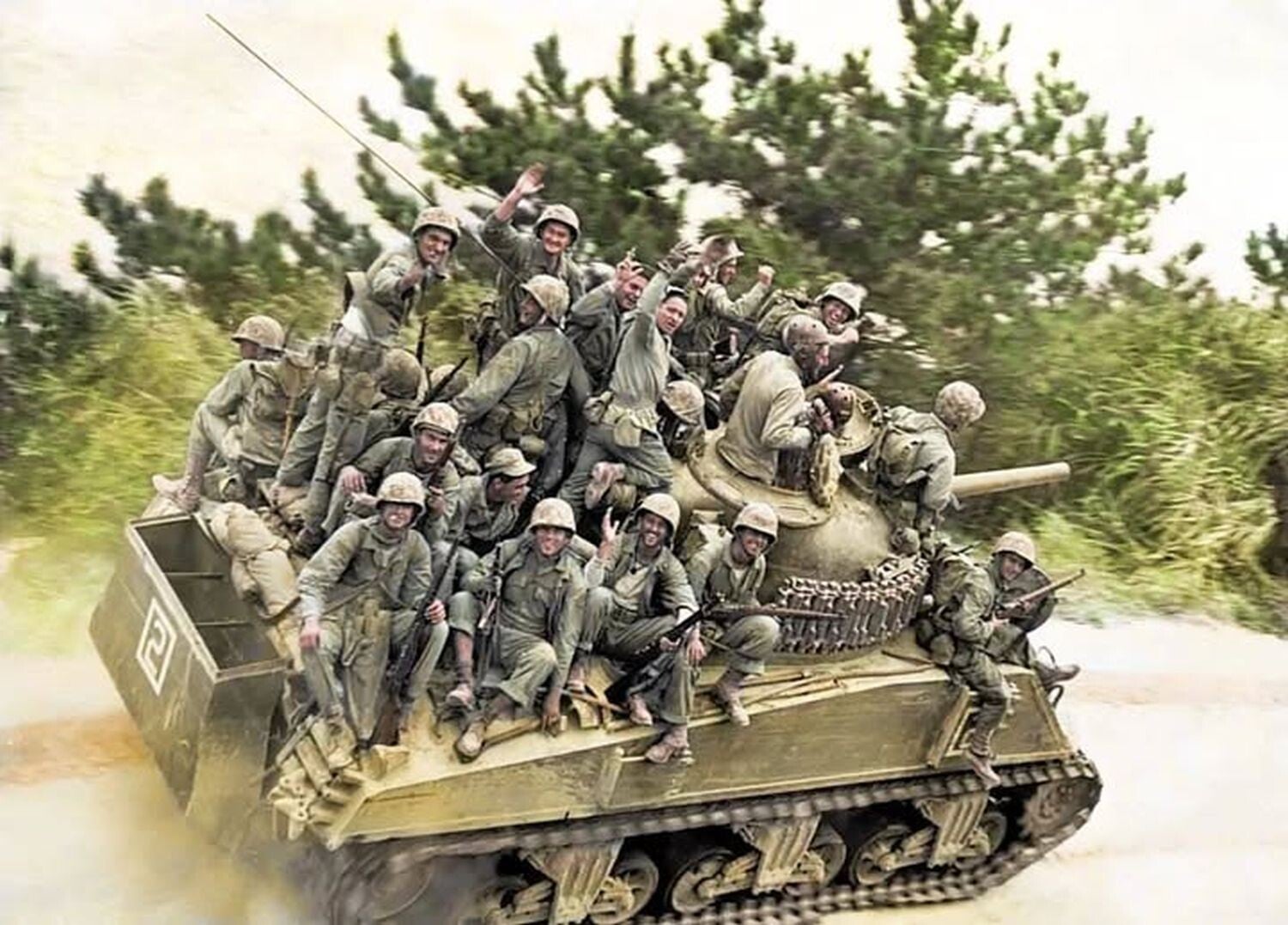
Tank-borne infantry moving up to take the town of Ghuta before the Japanese can occupy it. The men are members of the 29th Marines. Ghuta, a small Bougainville settlement, became tactically important during the 1943–44 campaign as Allied forces pushed inland to prevent Japanese units from re‑establishing control over key tracks and villages. Tank‑borne infantry of the 29th Marines advanced quickly to secure the area, using armour for protection while navigating dense jungle and narrow routes. Though engagements were brief, they were often close‑quarters. Actions like Ghuta’s capture steadily expanded the American perimeter and denied the Japanese any chance to regroup.
...the strategic situation had become untenable...
The Marianas campaign had profound political consequences.
The loss of Saipan contributed to the resignation of Prime Minister Hideki Tojo, reflecting the growing recognition within Japan’s leadership that the strategic situation had become untenable.
Nevertheless, Japan continued to resist across multiple fronts, relying increasingly on defensive attrition and fortified positions.
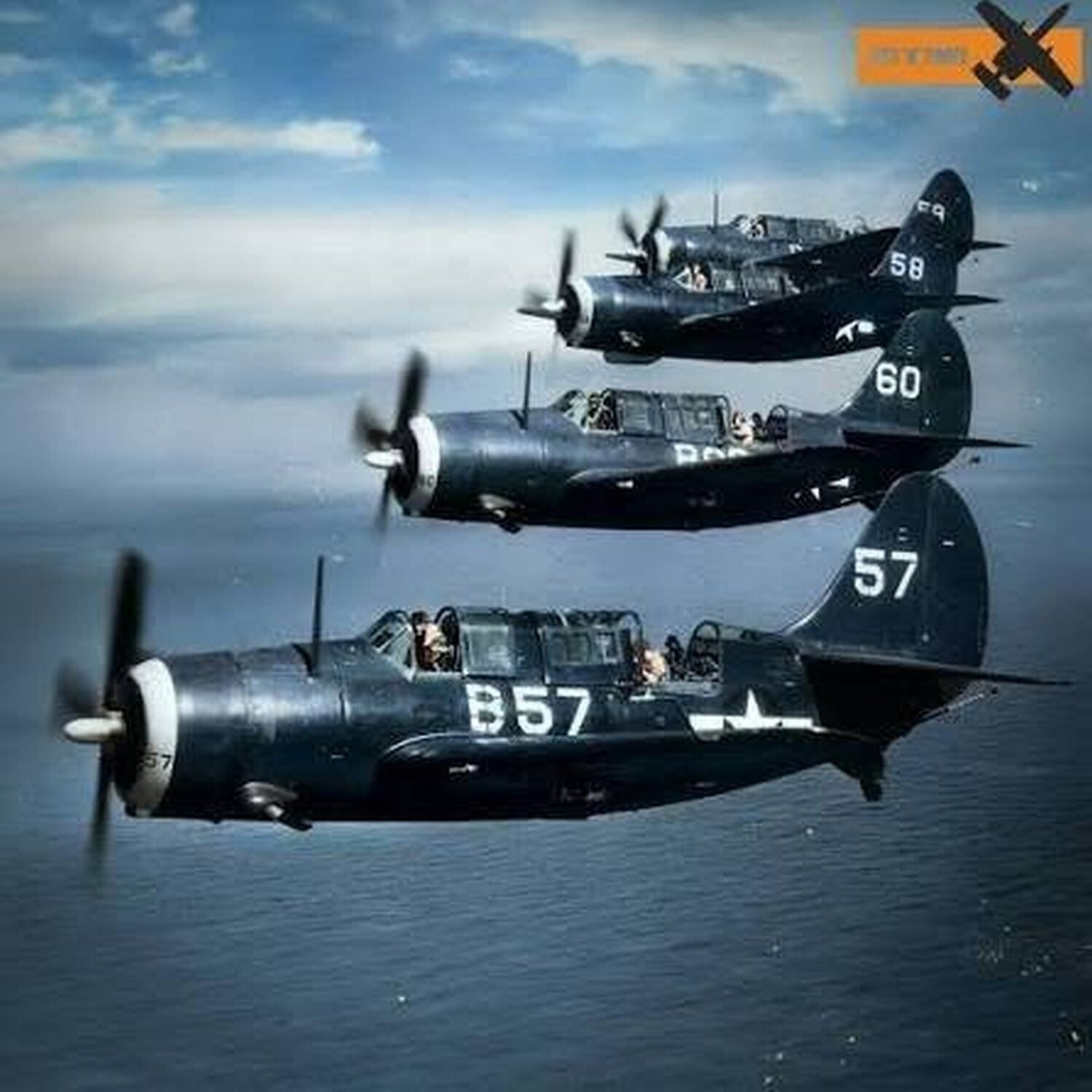
A formation of carrier-based Curtiss SB2C Helldiver dive bombers from Bombing Squadron 7 (VB-7). 1944. Bombing Squadron 7 (VB‑7) flew Curtiss SB2C Helldiver dive bombers in 1944, operating from U.S. Navy carriers in the Pacific. Their missions included precision strikes against Japanese naval units, airfields, and fortified positions during the final year of the war. VB‑7’s Helldivers formed tight, disciplined formations, delivering heavy ordnance that supported major fleet operations and helped weaken Japan’s remaining defensive capacity.
...largest naval engagement of the war...
In the southwest Pacific, Allied forces advanced toward the Philippines.
The capture of Morotai in September provided a staging area for the return to the Philippine archipelago.
The October landings on Leyte initiated the Battle of Leyte Gulf, the largest naval engagement of the war.
Japan committed its remaining major fleet units in an attempt to disrupt the landings, but the battle resulted in decisive Allied victory.
Japanese losses included multiple battleships, cruisers, and destroyers, further weakening Japan’s naval capacity.
...deteriorated irreversibly...
By the end of 1944, Japan’s strategic position had deteriorated irreversibly.
The Allies had penetrated deep into Japan’s defensive perimeter, secured bases for sustained air operations, and severed key supply routes.
The campaigns of 1944 set the conditions for the final offensives of 1945 and the eventual collapse of Japan’s ability to continue the war.
Kamikaze
As Allied forces closed in on Japan’s home islands, Japanese military leadership adopted increasingly extreme defensive measures, most notably the use of kamikaze attacks.
Beginning on a large scale during the Battle of Leyte Gulf in October 1944, kamikaze operations involved pilots deliberately crashing their aircraft into Allied ships to inflict maximum damage.
This tactic emerged from Japan’s deteriorating military position: shortages of trained pilots, declining aircraft quality, and overwhelming Allied air superiority made conventional aerial combat increasingly ineffective.
Kamikaze attacks allowed Japan to convert even obsolete aircraft into weapons capable of damaging or sinking major Allied vessels.
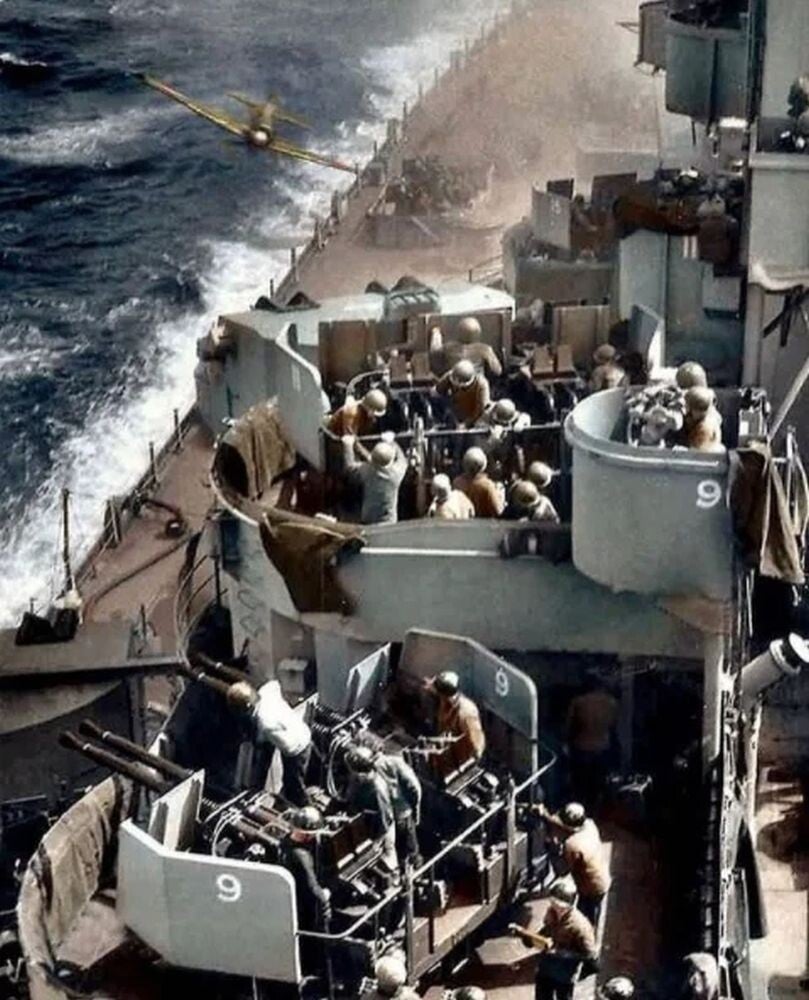
A Kamikaze pilot piloting a Mitsubishi A6M Zero, about to hit a US ship from the starboard side.
...no expectation of survival...
Cultural factors reinforced this shift. Japanese military doctrine emphasised self‑sacrifice, loyalty to the emperor, and the honour associated with dying in service to the nation.
Propaganda portrayed kamikaze pilots as heroic defenders of Japan, encouraging volunteers and fostering a sense of duty within training units.
This ideological framework supported a strategy that relied on pilots undertaking missions with no expectation of survival.
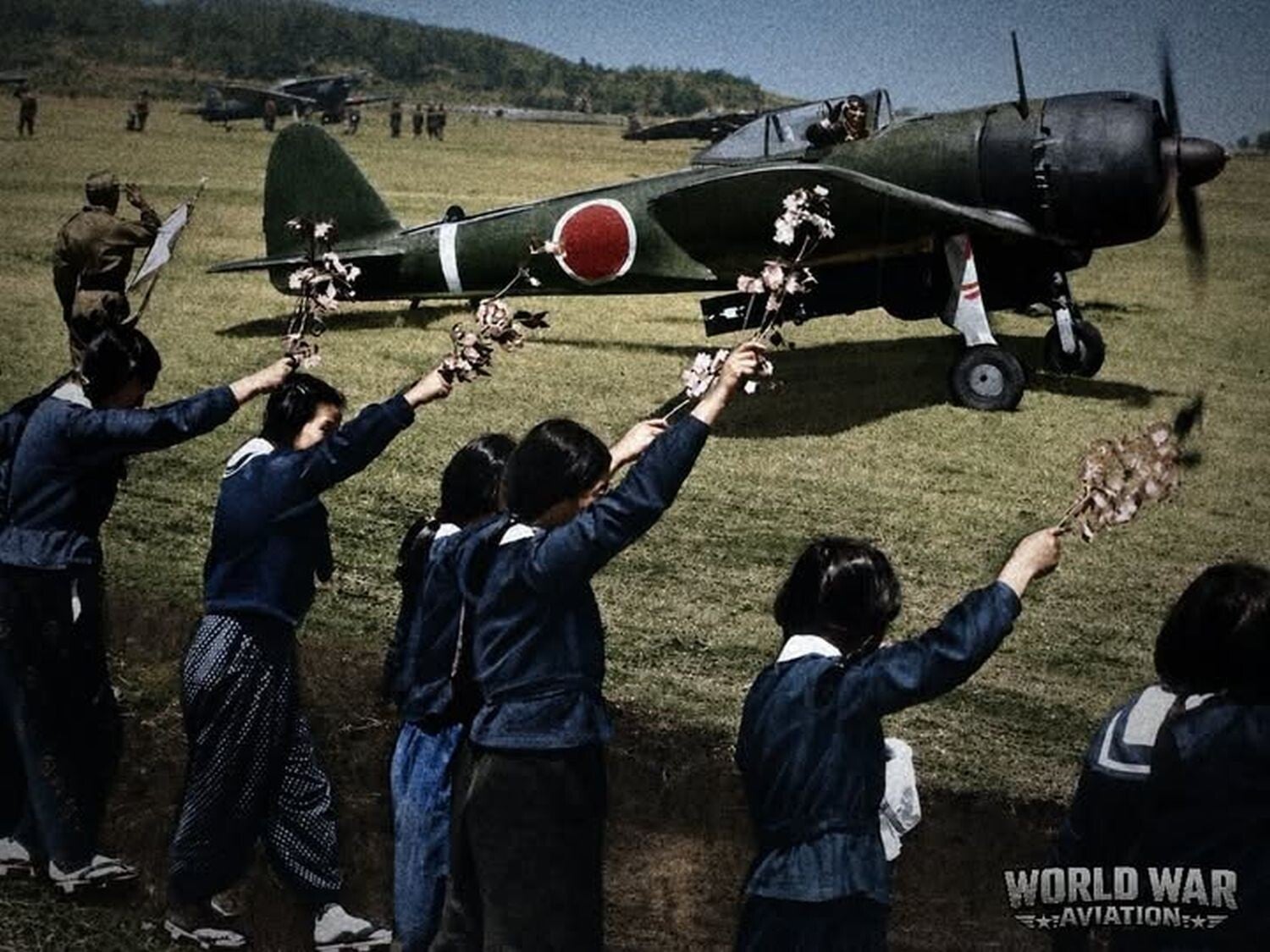
Japanese high school girls wave farewell to departing Kamikaze pilots. Japanese civilians supported kamikaze units through labour, logistics, and morale‑building activity rather than direct operational involvement. Communities prepared farewell ceremonies, supplied comfort items, and maintained airfields and barracks. Schoolchildren and women’s associations stitched senninbari belts, packed personal effects, and assisted with last‑minute practical needs. Local authorities organised send‑offs and upheld the ideological framework that framed these missions as duty and sacrifice. Civilian support was symbolic, emotional, and logistical, not tactical.
...constant vigilance...
Kamikaze attacks had both tactical and psychological effects.
A single successful strike could cause severe damage, and large‑scale attacks - such as those during the Battle of Okinawa - forced Allied fleets to maintain constant vigilance.
Anti‑aircraft fire, radar picket ships, and combat air patrols were expanded to counter the threat, but the unpredictability and intensity of kamikaze operations placed significant strain on Allied crews.
By war’s end, thousands of kamikaze sorties had sunk or damaged numerous Allied ships, contributing to rising fatigue and war‑weariness.
...aiming to force Japan’s surrender...
The ferocity of Japanese resistance, combined with fortified island defenses and kamikaze tactics, influenced Allied strategic planning.
Anticipated casualties for an invasion of Japan were extremely high, and the expectation of even more intense kamikaze attacks contributed to Allied consideration of alternatives.
These factors played a role in the decision to employ atomic weapons, aiming to force Japan’s surrender without a costly invasion.
Kamikaze warfare thus shaped the final phase of the Pacific War and had lasting implications for its conclusion.
1945 – Impending defeat and the Atomic age
The year 1945 marked the final phase of the Pacific War, defined by sustained Allied offensives against Japan’s inner defensive perimeter, the collapse of Japan’s capacity to resist, and the sequence of events that culminated in Japan’s surrender.
By this stage, Japan faced acute shortages in fuel, shipping, aircraft, and trained personnel.
Its defensive strategy centred on inflicting maximum attrition in hopes of delaying Allied advances and securing more favourable terms, but the scale of Allied operations made such objectives unattainable.
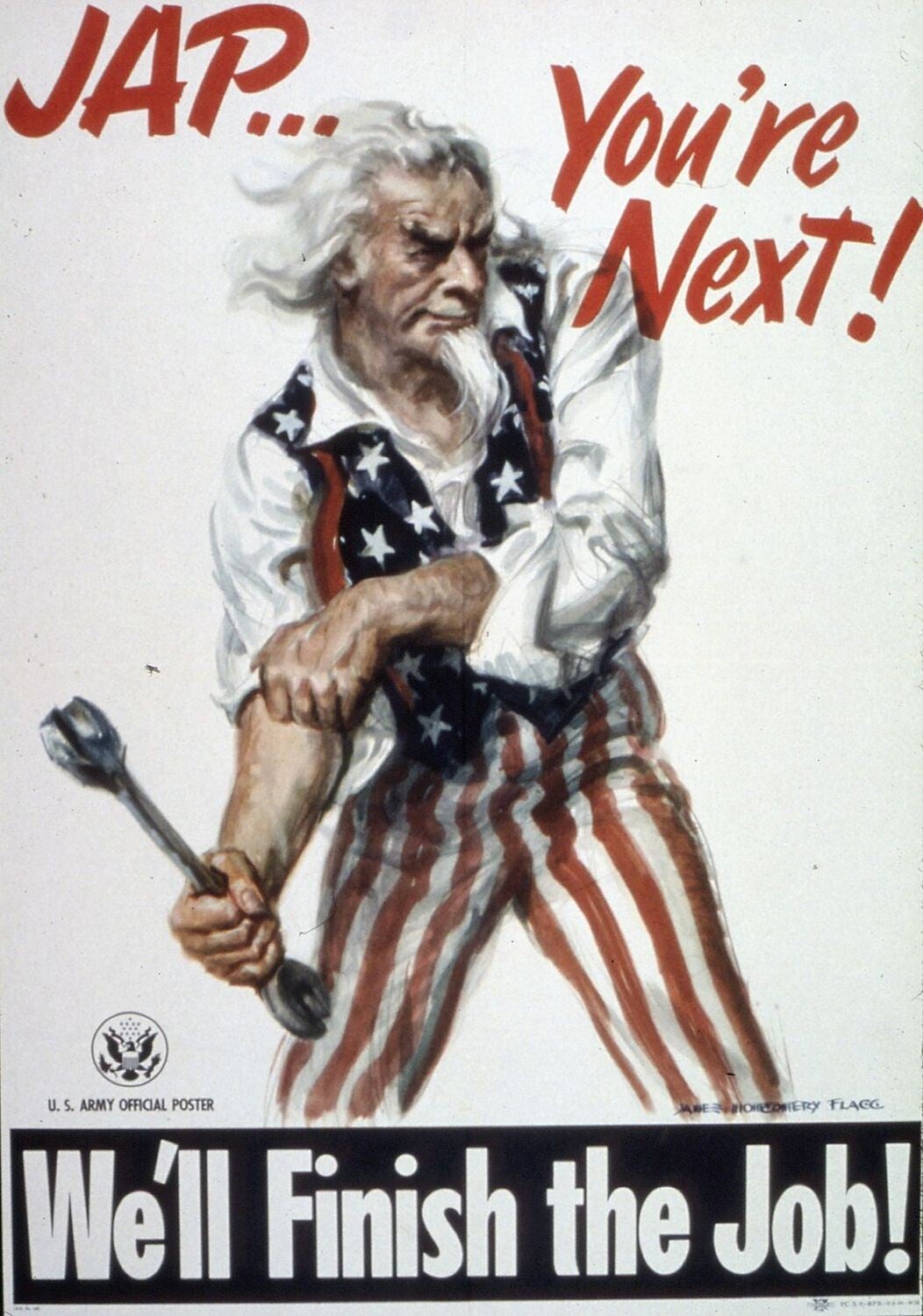
U.S. Army propaganda poster depicting Uncle Sam preparing the public for the invasion of Japan after the end of the war with Germany and Italy.
https://en.wikipedia.org/wiki/Atomic_bombings_of_Hiroshima_and_Nagasaki
...gradually isolated and destroyed...
In the Philippines, the campaign that began in late 1944 continued into 1945.
The Battle of Luzon, launched in January, saw American forces advance rapidly against Japanese units that had withdrawn into mountainous terrain.
Although organised resistance persisted for months, Japan’s ability to manoeuvre was limited, and its forces were gradually isolated and destroyed.
Operations on Palawan, Mindanao, and other islands followed, eliminating Japan’s remaining positions in the archipelago and securing Allied control of critical air and naval bases.
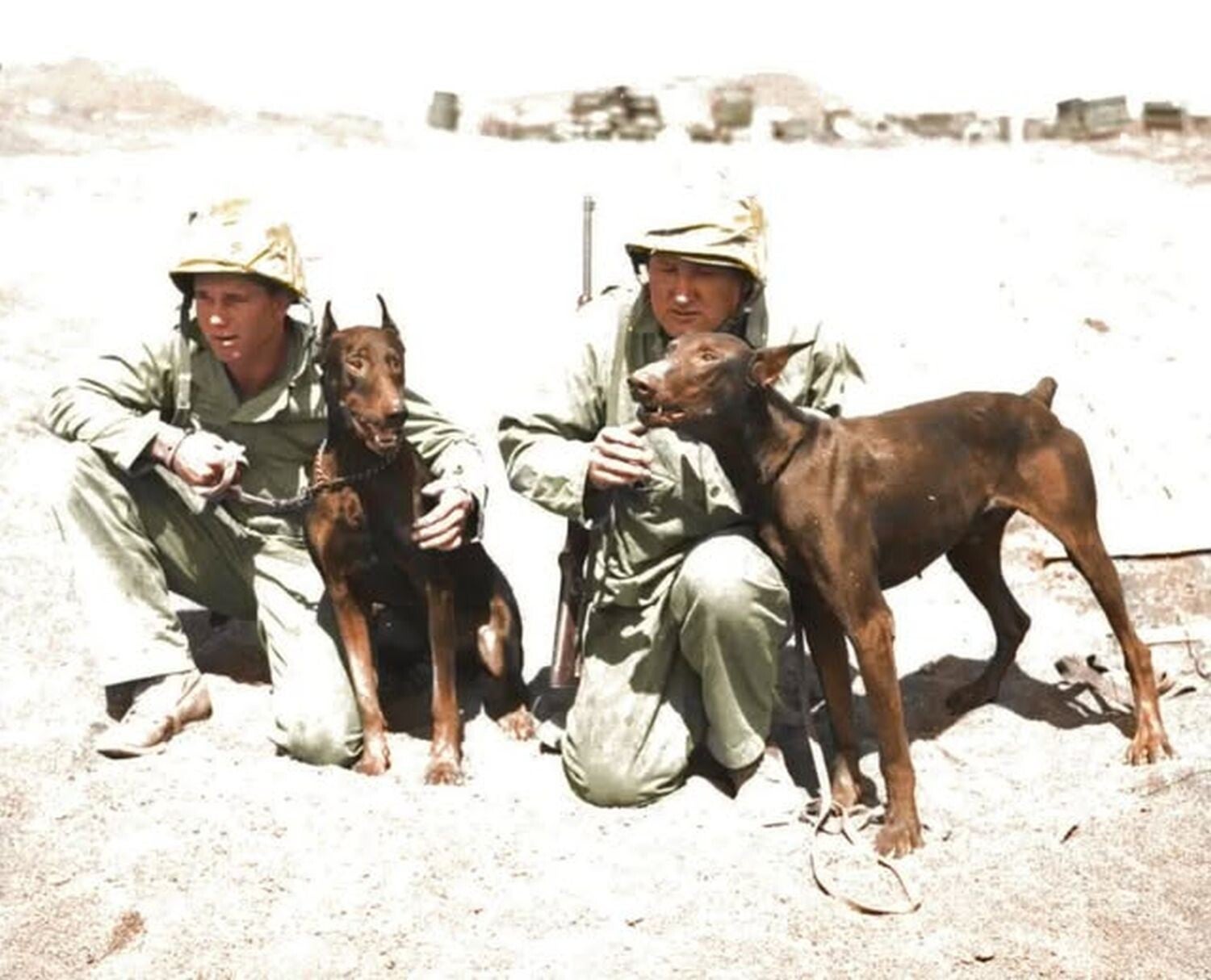
his photo from March 1945 shows U.S. Marines with Doberman Pinscher war dogs in the Pacific theatre. The U.S. Marine Corps War Dog Platoons heavily relied on Dobermans, nicknamed "Semper Fi Dogs," for scouting, detecting hidden Japanese forces, and carrying vital messages across treacherous terrain.
...constructed extensive defensive networks...
In the Central Pacific, the Battle of Iwo Jima began in February.
The island’s strategic value lay in its airfields, which provided emergency landing sites for B‑29 bombers and bases for fighter escorts.
Japanese forces constructed extensive defensive networks, resulting in one of the most intense battles of the war.
After five weeks of fighting, American forces secured the island, though at significant cost.
The battle demonstrated Japan’s commitment to protracted defence and foreshadowed the scale of resistance expected in future operations.
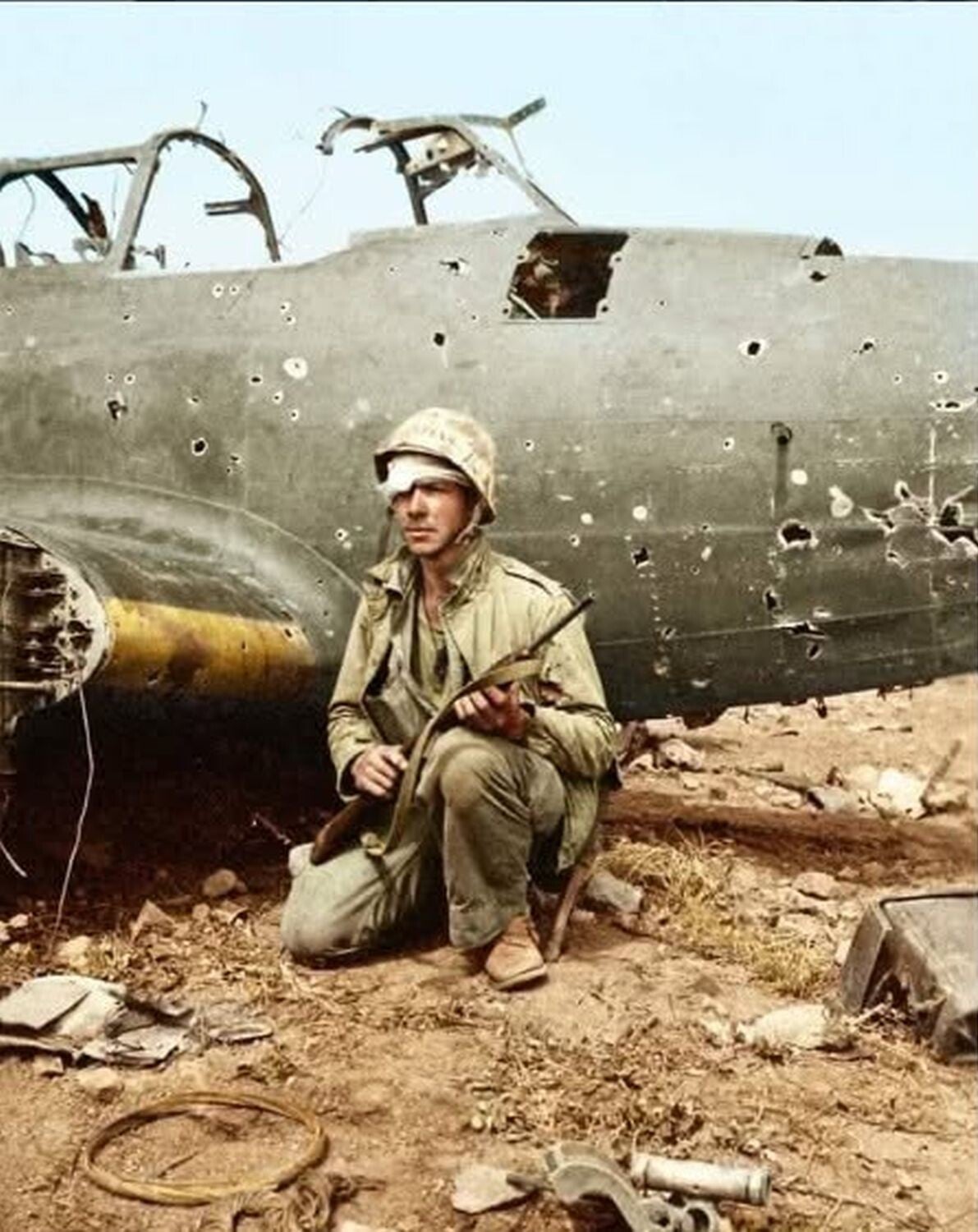
US 5th Marine Division Sergeant David G. Christian, sits wounded beside destroyed Japanese Nakajima J1n 'Gekko' at an airfield in Iwo Jima, 24 February 1945. The Battle of Iwo Jima, fought from February 19 to March 26 1945, was a critical U.S. assault aimed at capturing airfields needed for operations against Japan. Marines faced entrenched Japanese forces who defended a dense network of bunkers, tunnels, and fortified positions, most famously around Mount Suribachi. Fighting was intense and attritional, producing heavy casualties. Securing the island provided vital emergency landing fields for B‑29 bombers and marked one of the Pacific War’s most costly victories.
...inflicted heavy losses...
The Battle of Okinawa, launched in April, represented the largest amphibious operation of the Pacific War.
Okinawa’s proximity to Japan made it essential for staging air operations and preparing for a potential invasion of the home islands.
Japanese forces adopted a defence‑in‑depth strategy, withdrawing into fortified positions in the island’s southern region.
The battle involved extensive ground combat, naval engagements, and kamikaze attacks, which inflicted heavy losses on Allied ships.
By June, organised Japanese resistance had collapsed, but the scale of casualties on both sides underscored the anticipated cost of invading Japan itself.
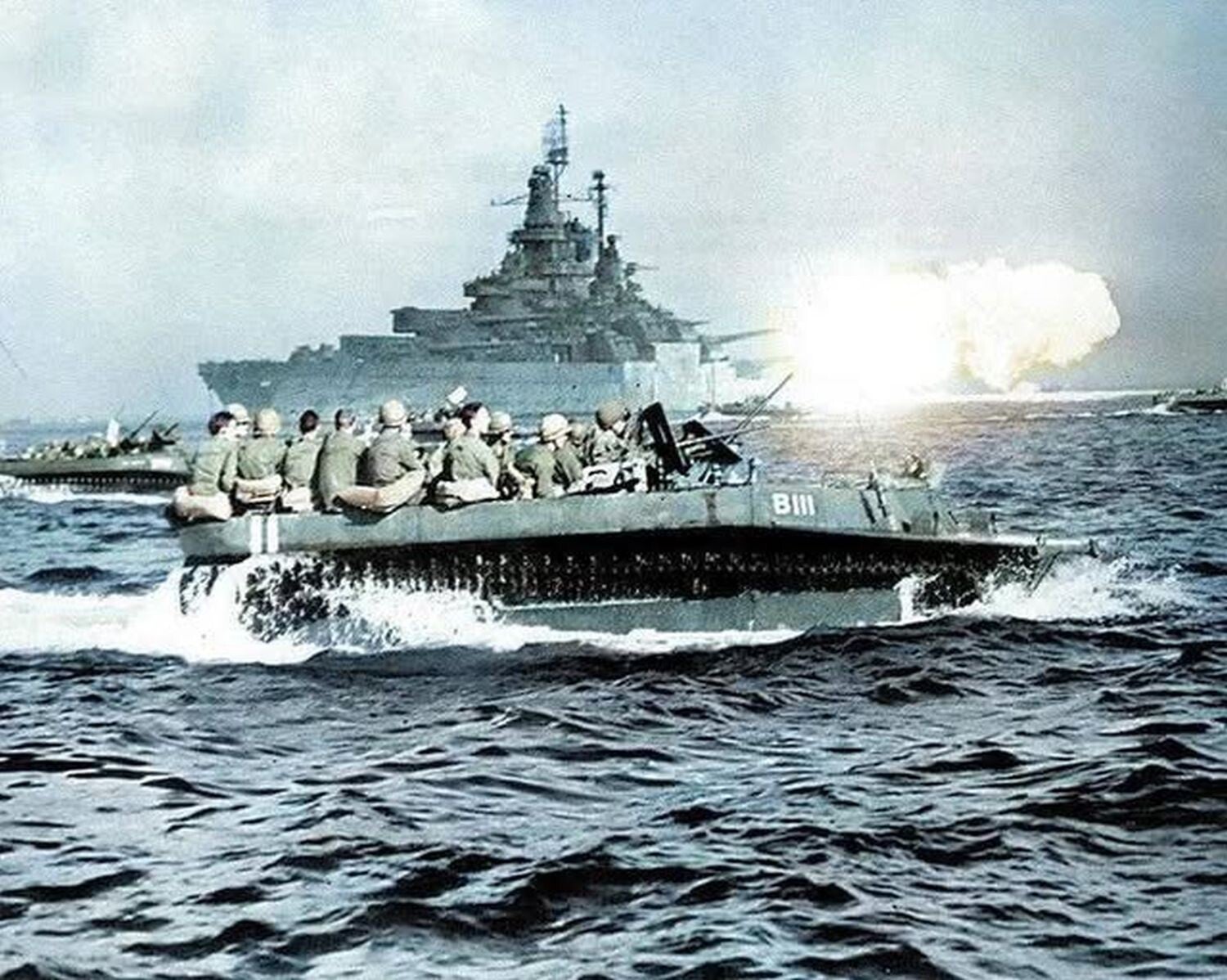
USS Tennessee bombards Okinawa with her enormous guns, as troops are carried to the invasion beaches. The Battle of Okinawa, fought from April to June 1945, was the Pacific War’s largest and bloodiest amphibious assault. U.S. forces sought a base for the planned invasion of Japan, facing entrenched Japanese defenses and relentless kamikaze attacks. The fighting devastated the island’s civilian population and destroyed Japanese ground forces. Okinawa’s capture gave the Allies a strategic foothold, but its immense casualties underscored the cost of any direct invasion of the Japanese home islands.
...caused extensive destruction...
While ground operations progressed, the strategic bombing campaign intensified.
From bases in the Marianas, B‑29 bombers conducted systematic attacks on Japanese industrial centres.
The March firebombing of Tokyo caused extensive destruction, and subsequent raids targeted transportation networks, factories, and urban areas.
Japan’s diminishing fuel reserves and loss of air power limited its ability to counter these operations.
...impossibility of continued resistance...
The final months of the war saw Japan’s strategic position deteriorate further.
The Soviet Union’s entry into the conflict in August, with rapid advances in Manchuria, eliminated Japan’s last hope of negotiating through Moscow.
The atomic bombings of Hiroshima and Nagasaki demonstrated the destructive capacity of new weapons and reinforced the impossibility of continued resistance.
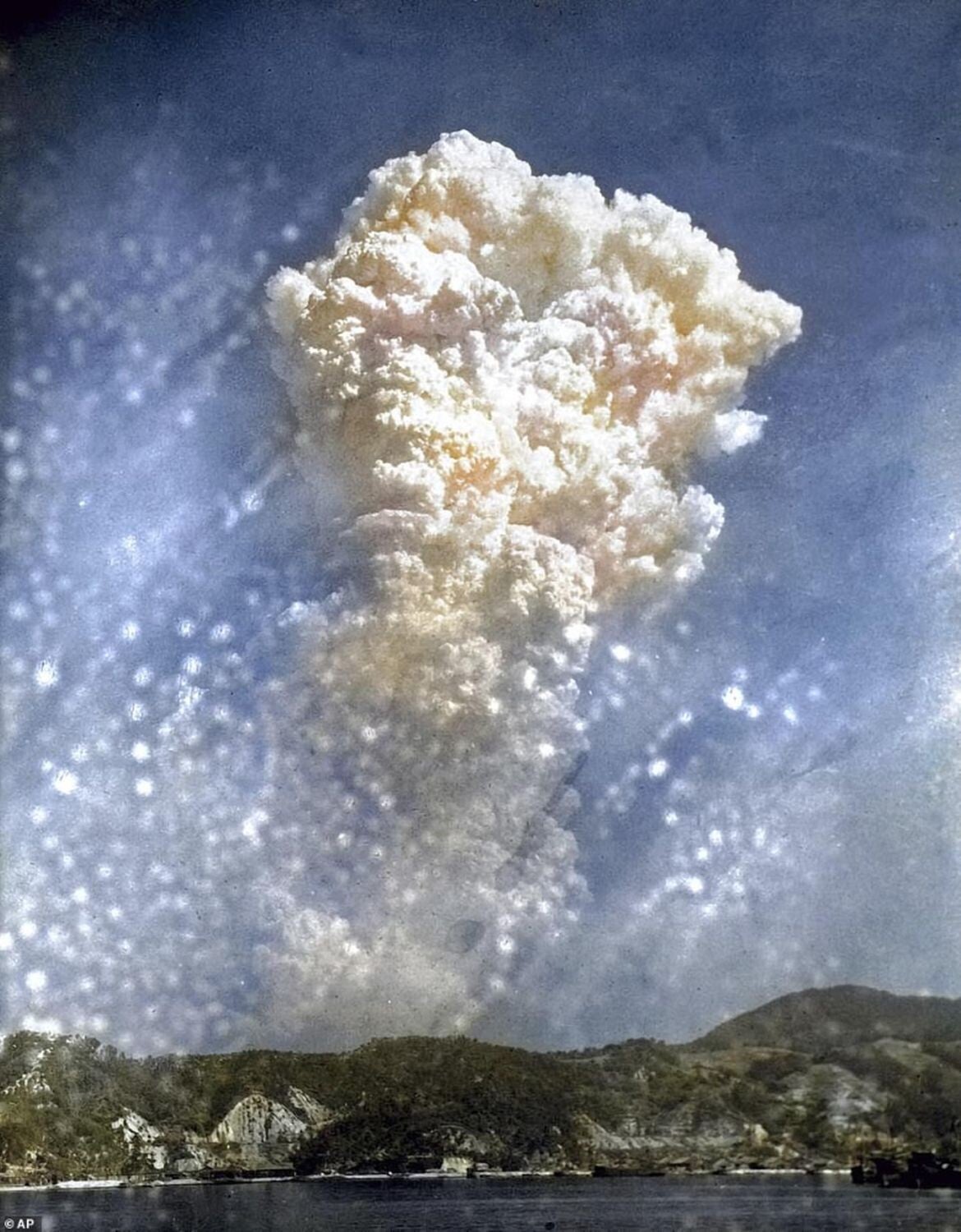
Smoke rises around 20,000 feet above Hiroshima after the first atomic bomb was dropped on the city by the United States on August 6, 1945. 'Little Boy' - the first nuclear weapon used in war - was dropped on the city, killing between between 90,000 and 146,000 people.
The Use of Atomic Bombs and the Japanese Surrender
The decision to use atomic bombs on Japan in 1945 emerged from a combination of military necessity, strategic calculation, and political considerations.
By mid‑1945, Japan had demonstrated a capacity for prolonged resistance despite catastrophic losses.
Battles such as Iwo Jima and Okinawa produced extremely high Allied casualties, and Japanese defensive doctrine - fortified positions, attritional tactics, and preparations for mass civilian resistance - indicated that an invasion of the home islands would be far more costly.
U.S. planners estimated that Operation Downfall, the planned invasion, could result in hundreds of thousands of American casualties and millions of Japanese deaths.
These projections shaped President Harry S. Truman’s search for an alternative means to force Japan’s surrender.
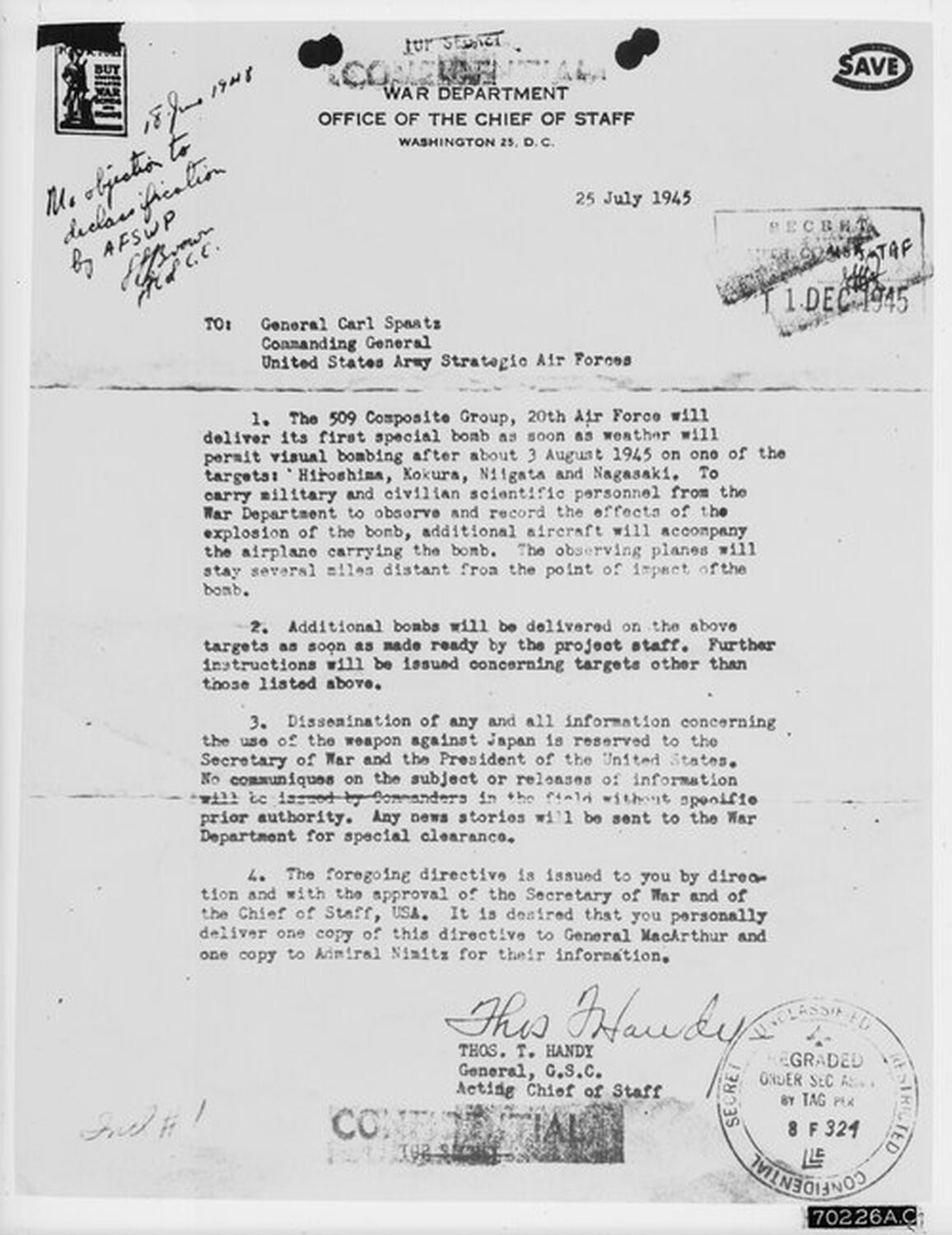
General Thomas Handy's order to General Carl Spaatz ordering the dropping of the atomic bombs.
https://en.wikipedia.org/wiki/Atomic_bombings_of_Hiroshima_and_Nagasaki
...overwhelming destructive capability...
The atomic bomb, developed under the Manhattan Project, offered a potential solution.
Its use promised to demonstrate overwhelming destructive capability, shock Japanese leadership, and end the war without an invasion.
Political factors reinforced this decision. Demonstrating nuclear capability would strengthen the United States’ post‑war position, particularly in relation to the Soviet Union, and limit Soviet influence in Asia by ending the conflict before large‑scale Soviet operations could occur.
...unprecedented destruction...
On 6 August 1945, the U.S. dropped the first atomic bomb, “Little Boy,” on Hiroshima, killing an estimated 140,000 people by year’s end.
The second bomb, “Fat Man,” struck Nagasaki on 9 August, causing approximately 70,000 deaths.
The unprecedented destruction, combined with Japan’s deteriorating military situation, compelled Emperor Hirohito to intervene and support surrender.
On 15 August 1945, Japan announced its acceptance of Allied terms, and formal surrender followed on 2 September aboard USS Missouri.
The bombings ended the war but ushered in the nuclear age, raising enduring ethical questions about civilian targeting, deterrence, and the long‑term consequences of nuclear weapons.
Hiroshima and Nagasaki remain central to debates on warfare, morality, and international security.
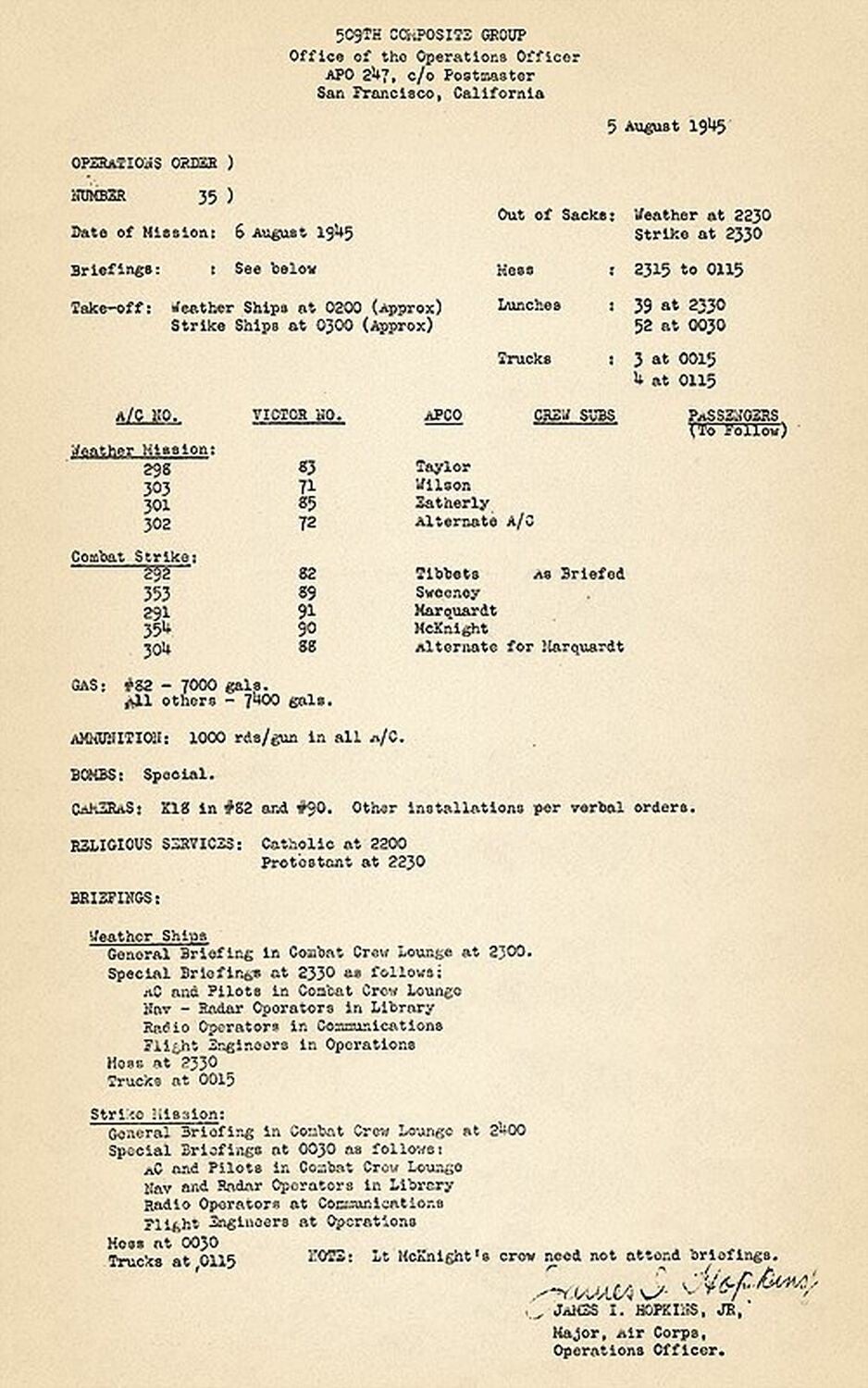
Strike order for the Hiroshima bombing as posted on 5 August 1945.
https://en.wikipedia.org/wiki/Atomic_bombings_of_Hiroshima_and_Nagasaki
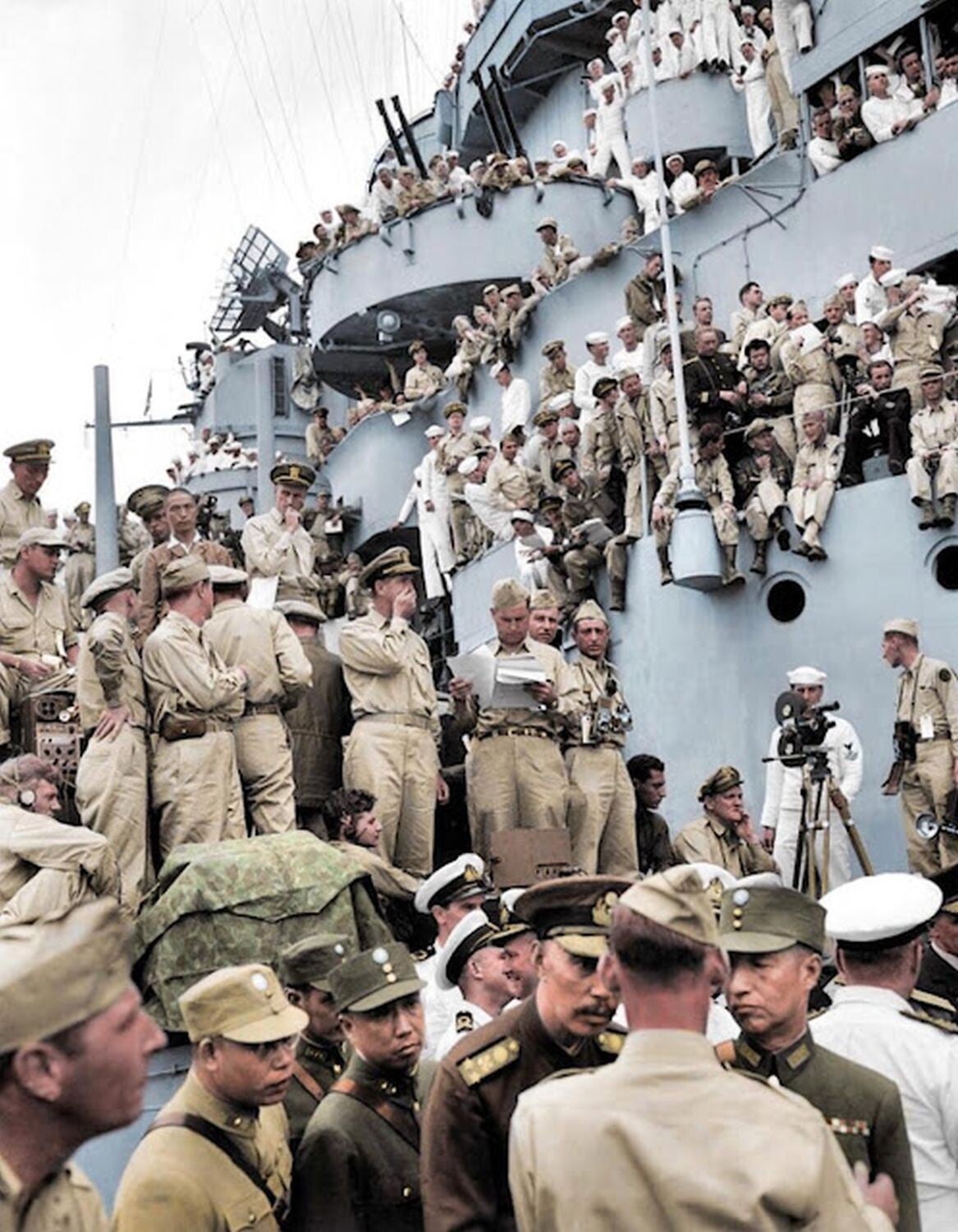
Spectators from all over the world pick vantage positions on the deck of the USS Missouri, in Tokyo Bay in September 1945, to watch the Japanese surrender ceremony marking the end of World War II.
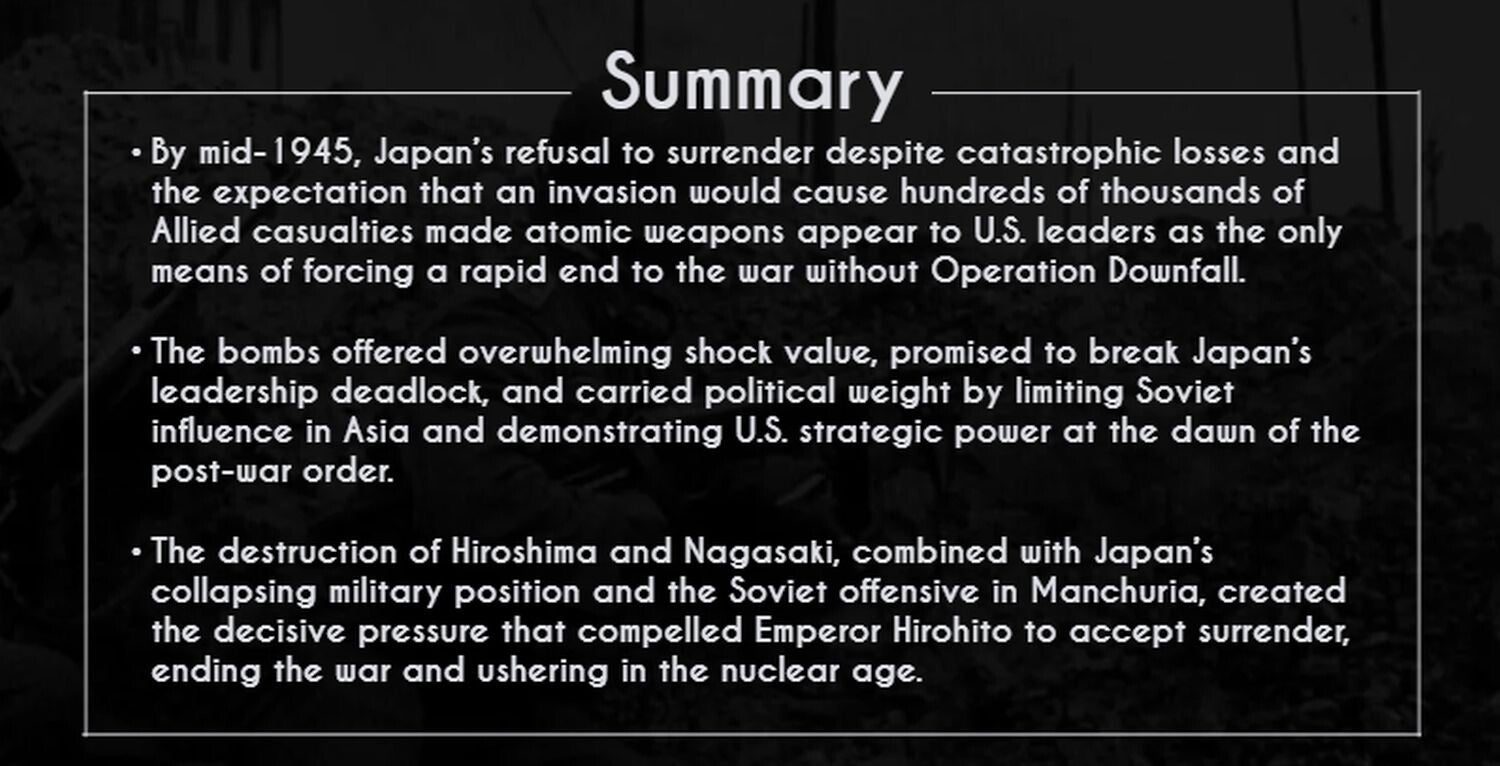
The Role of Technology and Innovation in the Pacific Theatre
Technological and strategic innovation was essential to Allied success in the Pacific, where operations spanned vast distances, isolated islands, and extreme climates.
The Pacific Theatre forced rapid adaptation, and advances in naval aviation, intelligence, logistics, and medical care provided the Allies with decisive advantages over Japanese forces.
Aircraft carriers became the central instrument of naval power. Traditional battleships lacked the range needed for dispersed island campaigns, while carriers enabled long‑distance airstrikes and flexible force projection.
Their importance was demonstrated at the Coral Sea in May 1942, the first naval battle fought entirely by carrier aircraft, which halted Japan’s southward expansion.
...ambush and destroy...
At Midway in June 1942, U.S. codebreakers uncovered Japanese plans, allowing American carriers to ambush and destroy four Japanese carriers.
This loss permanently weakened Japan’s naval aviation and shifted the strategic balance of the war.
The introduction of Essex‑class carriers further strengthened Allied capabilities, providing larger air groups, improved radar, and rapid aircraft handling.
...intelligence shaped operations...
Intelligence breakthroughs were equally significant.
The U.S. Magic program decrypted Japanese communications, including the JN‑25 naval code, enabling Allied commanders to anticipate Japanese movements.
This intelligence shaped operations at Midway, Guadalcanal, and throughout the Solomon Islands. British ULTRA intelligence, though focused on Europe, contributed to broader Allied coordination.
These efforts marked one of the earliest large‑scale uses of cryptographic intelligence, establishing information superiority as a critical component of modern warfare.
...the Pacific’s harsh conditions...
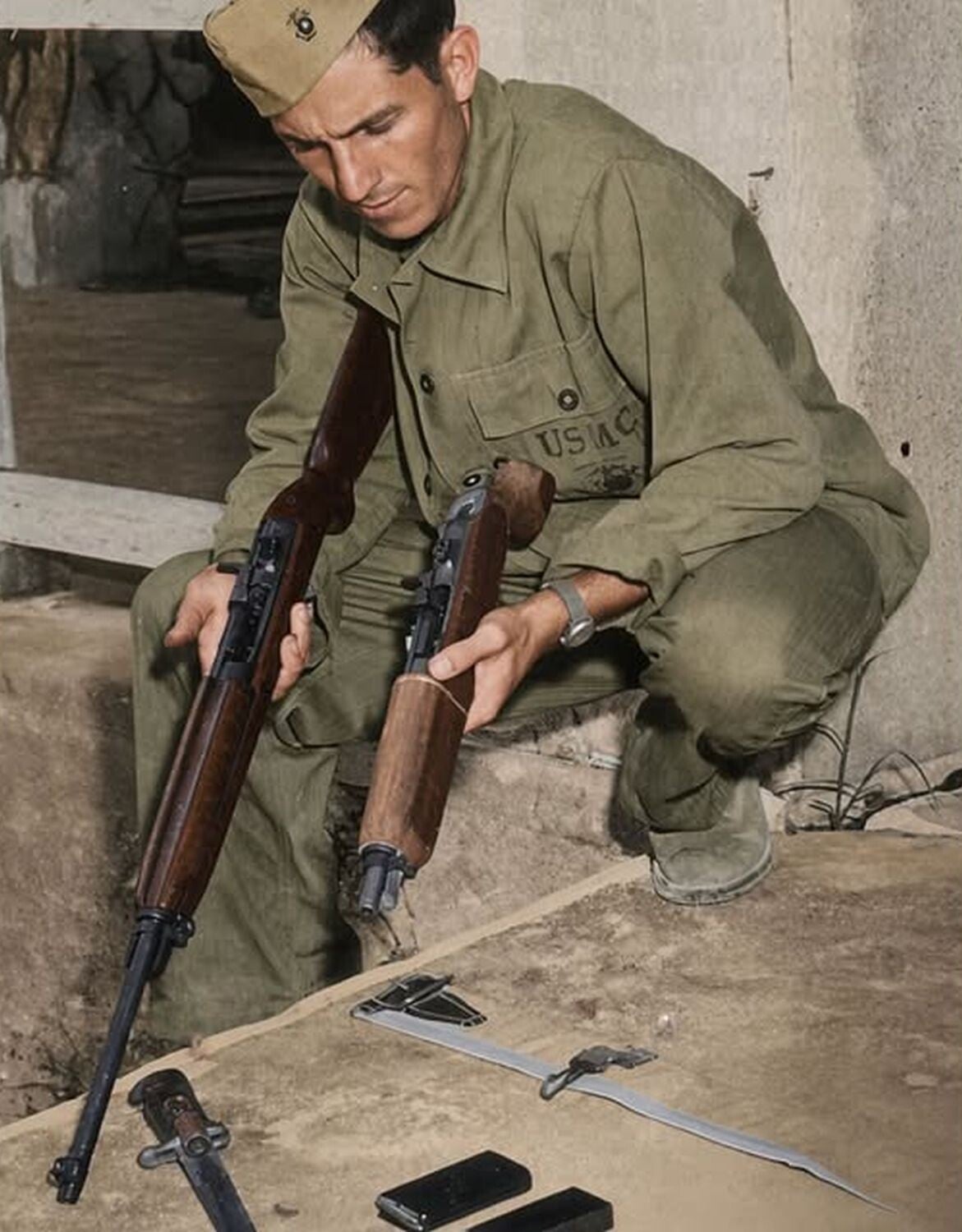
USMC officer holding a regular M1 Carbine next to an M1 that was captured by Japanese forces, chopped down, and converted to fire full auto.
Logistical and medical innovations addressed the Pacific’s harsh conditions.
Forward medical units, hospital ships, and improved treatments - such as plasma transfusions and early antibiotics - reduced mortality and maintained troop readiness.
Preventative measures against malaria and other tropical diseases were essential.
Logistically, amphibious operations relied on Higgins boats for rapid beach landings and Seabees for constructing airfields, roads, and supply bases on captured islands.
Floating depots and forward bases sustained long campaigns across remote regions.
Together, these innovations enabled the Allies to overcome the Pacific’s operational challenges and shaped the foundations of post‑war military strategy.
Human Impact and Aftermath of the Pacific War
The Pacific War inflicted immense human suffering across the Asia‑Pacific region, with an estimated 20–30 million deaths resulting from combat, occupation, starvation, and disease.
Civilians bore a substantial portion of this toll as cities were bombed, communities displaced, and populations subjected to harsh occupation policies.
Japan suffered heavily: conventional bombing, food shortages, and the atomic attacks on Hiroshima and Nagasaki caused catastrophic loss of life and left survivors with long‑term physical and psychological trauma.
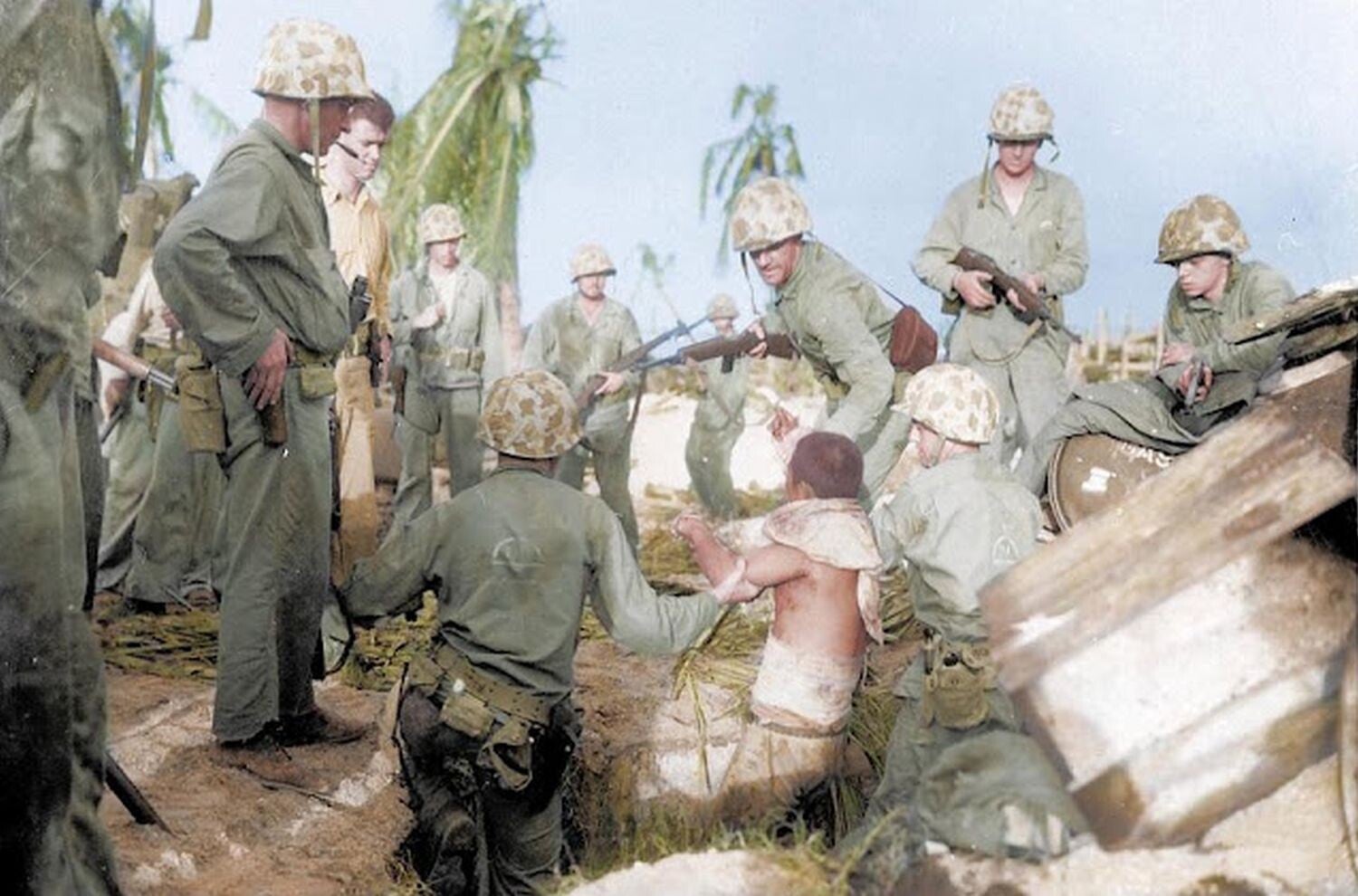
Captured wounded Japanese soldier surrounded by Marines on Kwajalein Atoll, Marshall Islands. During World War II, it's estimated that between 19,500 and 50,000 members of the Imperial Japanese military surrendered to the Allies.
...endured severe mistreatment...
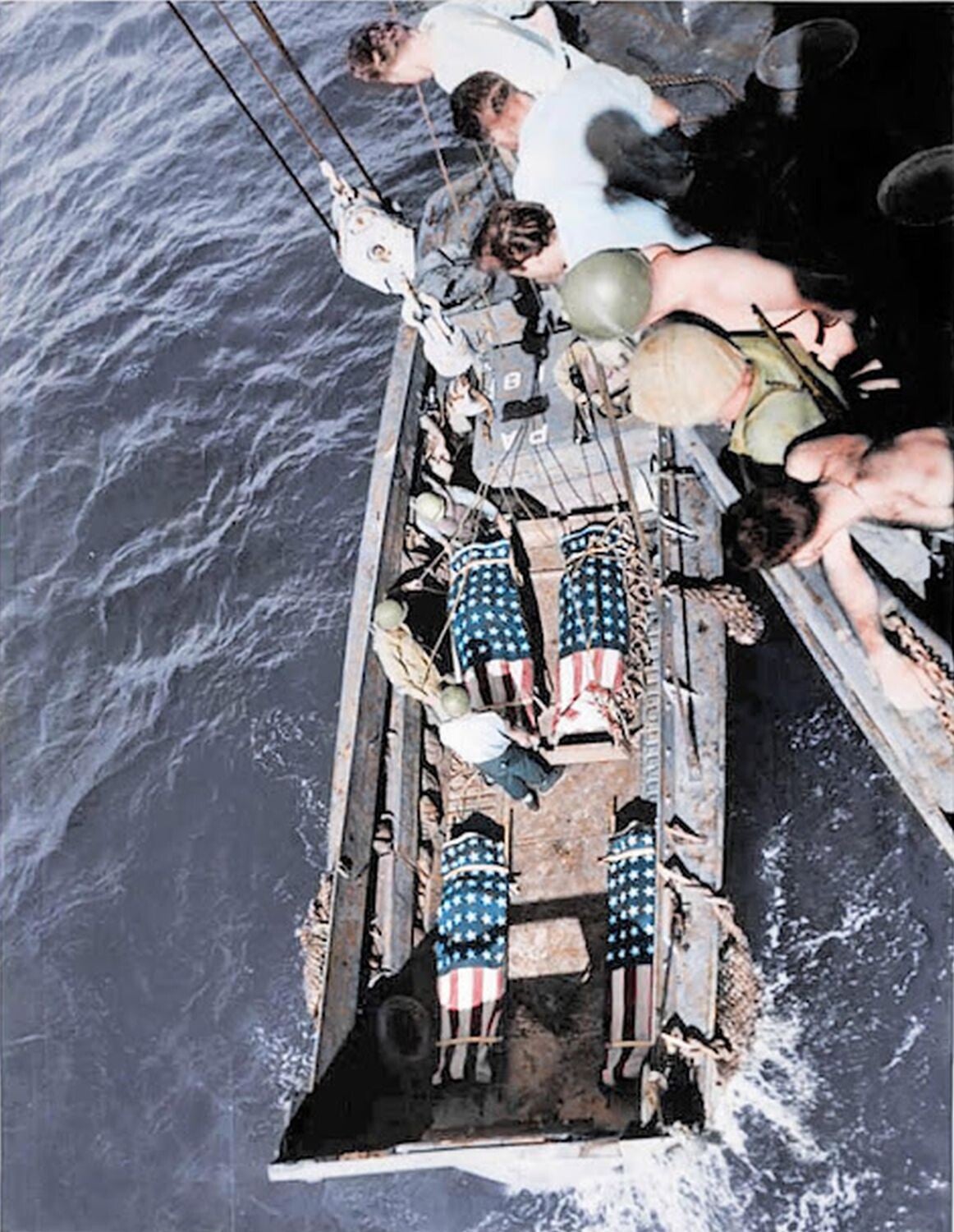
Deceased US soldiers are wrapped in their national flag and carefully lowered down onto a ship by comrades ready for burial.
Prisoners of war endured severe mistreatment under Japanese custody.
Thousands of Allied POWs faced starvation, forced labour, disease, and brutality in camps throughout Southeast Asia and the Pacific.
The Bataan Death March exemplified these conditions.
After the fall of the Philippines in 1942, American and Filipino troops were forced to march over 60 miles in extreme heat with little food or water; many died from exhaustion, dehydration, or execution.
Such events highlighted the severe human cost of the conflict and the widespread violations of international norms.
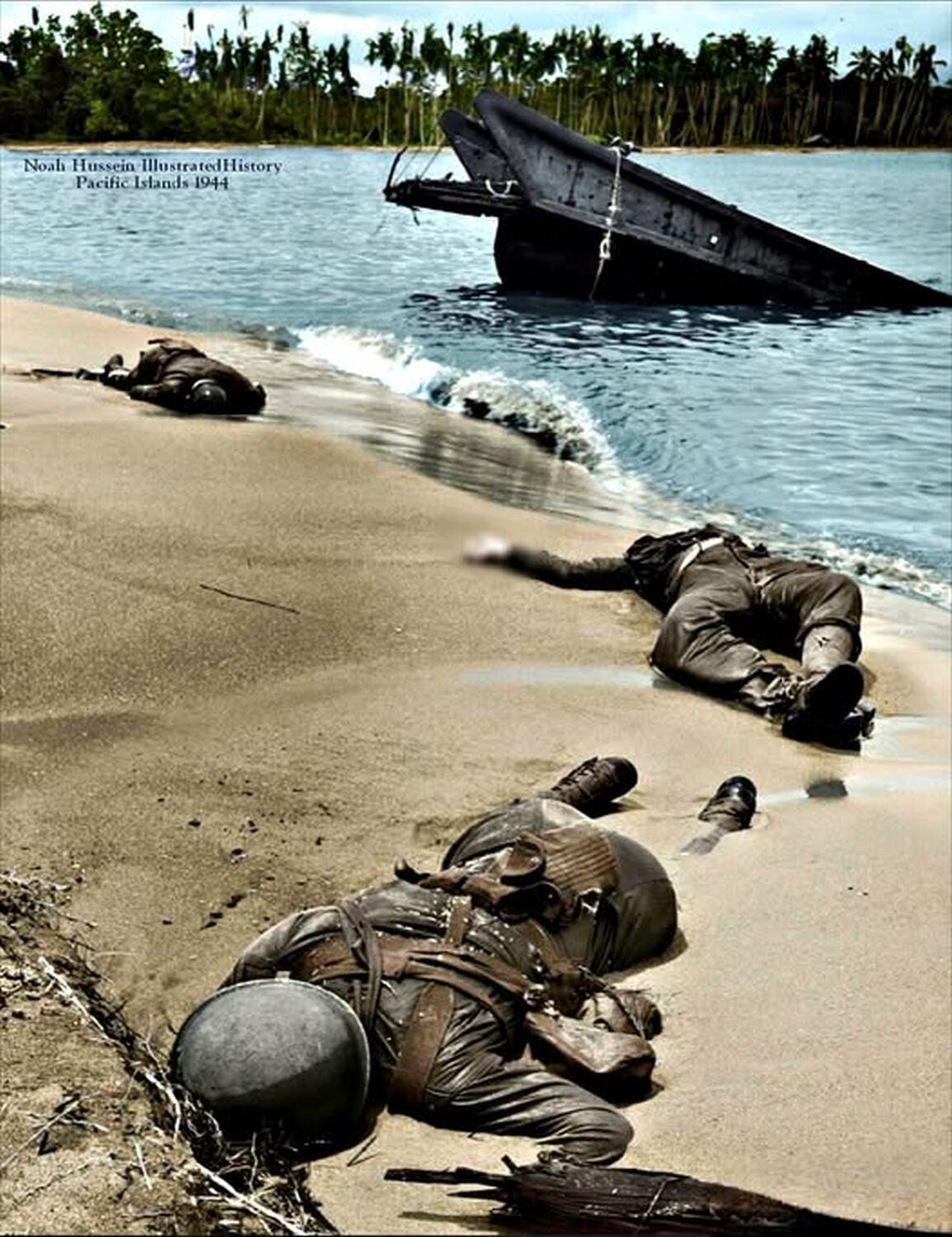
Three American soldiers lay dead on the beach at Buna during the New Guinea fighting in late 1942. The shoreline became so choked with bodies after repeated assaults that Allied troops grimly referred to it as “Maggot Beach.” The battle formed part of the Buna–Gona campaign, a brutal series of operations fought in dense jungle and swamp conditions as Allied forces pushed to break Japanese positions along Papua’s northern coast.
...the renunciation of war...
Japan’s defeat led to a U.S.-led occupation from 1945 to 1952, overseen by General Douglas MacArthur.
The occupation aimed to demilitarize Japan, establish democratic governance, and rebuild its economy.
A new constitution introduced civil liberties, women’s rights, and the renunciation of war.
Land reforms redistributed property to tenant farmers, while educational changes promoted democratic values.
Economic stabilization programs, including the Dodge Plan, helped revive industry and lay the foundation for Japan’s post‑war economic expansion.
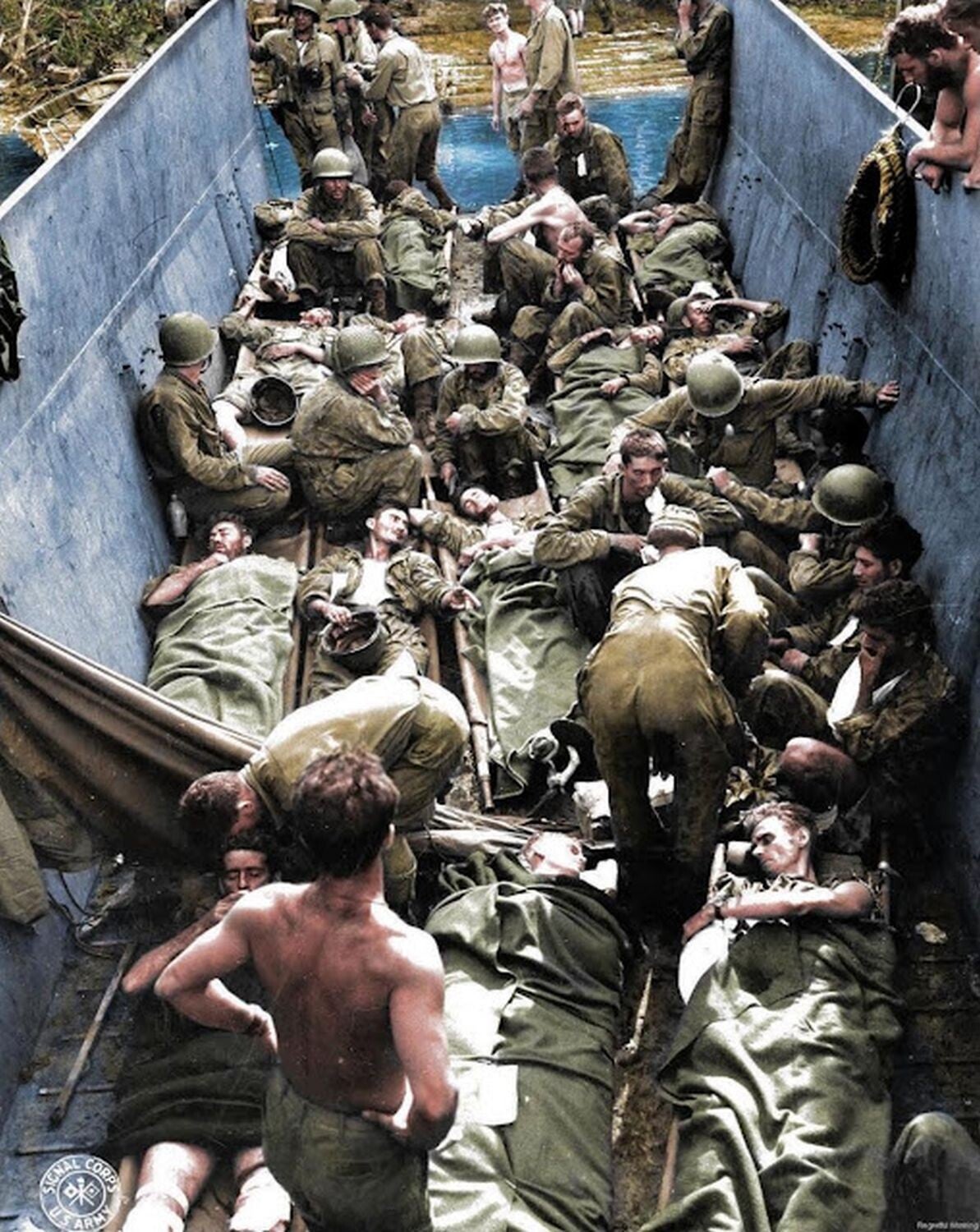
Wounded troops lying on stretchers aboard a lighter in Munda Point, New Georgia. The Pacific War caused an estimated 20–30 million deaths across Asia‑Pacific. This figure includes military personnel from all combatant nations and very large civilian losses from bombing, occupation, famine, and disease. No precise total exists, but the consensus range reflects the scale of regional devastation.
...accelerated independence movements...
The war’s aftermath reshaped the wider Asia‑Pacific region.
The collapse of Japanese and European imperial structures accelerated independence movements in Indonesia, Vietnam, the Philippines, and elsewhere.
Japan’s later economic rise influenced regional development, contributing to new trade networks and political realignments.
The Pacific War’s human and political consequences continue to shape regional identities, security policies, and collective memory.
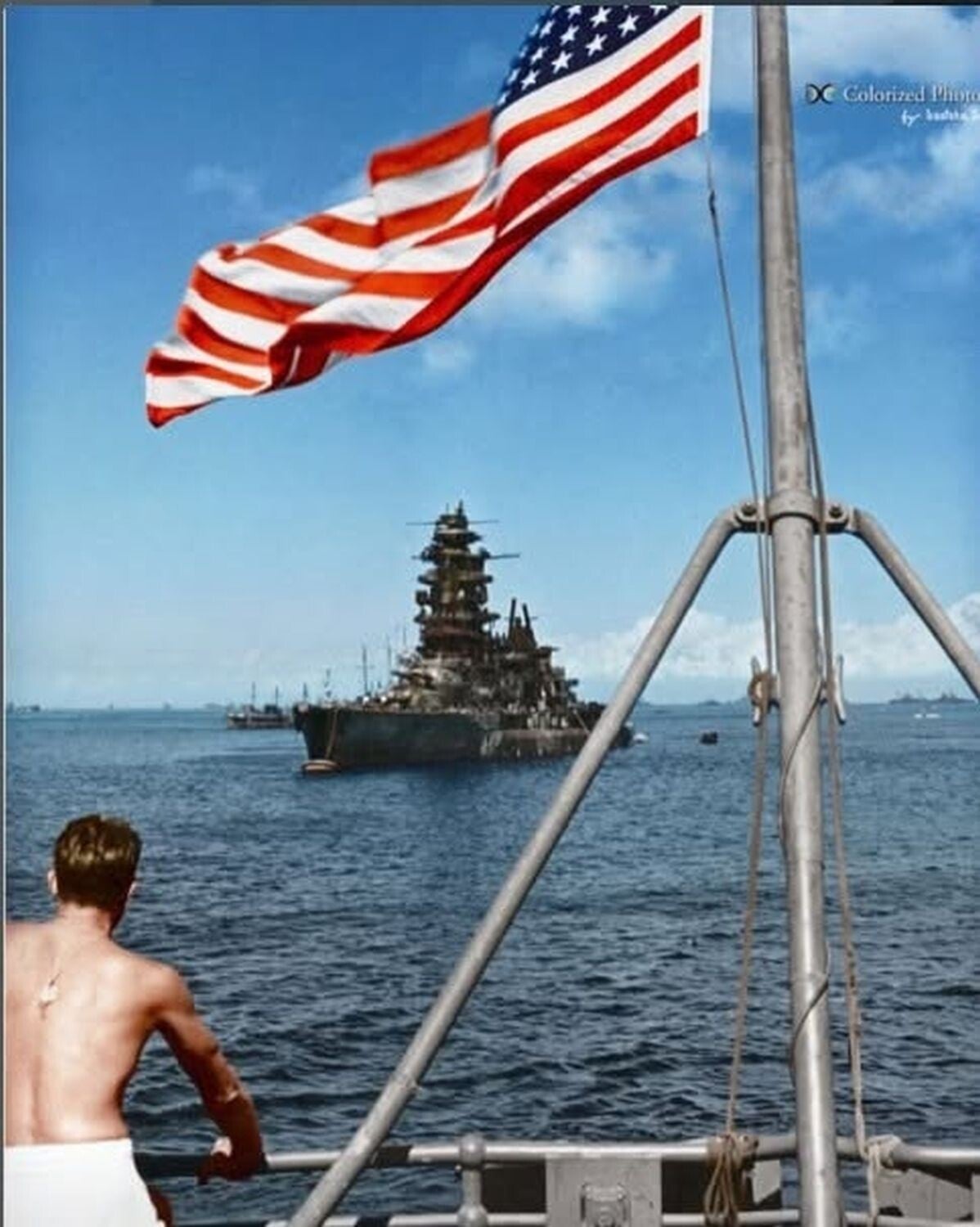
The battleship Nagato at Bikini Atoll in May 1946. By the end of the war, the Imperial Japanese Navy was running out of fuel and decided to convert the Nagato into a floating anti-aircraft platform and assign it to coastal defense duties. It was attacked in July 1945 as part of the American campaign to destroy the last remaining capital ships of the Imperial Japanese Navy, but suffered only minor damage and went on to be the only Japanese battleship to survive the Second World War. In mid-1946, the ship was a target for nuclear weapons testing during Operation Crossroads. It survived the first test with little damage, but sank in the second.
Legacy of the Pacific Theatre
The legacy of the Pacific Theatre profoundly shaped post‑war military doctrine, international politics, and regional memory.
The campaigns across the Pacific forced the United States to refine amphibious warfare, joint operations, and carrier‑based strategy.
Battles such as Iwo Jima and Okinawa demonstrated that large‑scale amphibious assaults required precise coordination between naval gunfire, carrier aviation, and ground forces.
These operations became foundational to U.S. Marine Corps doctrine and influenced Cold War planning, including contingency operations in Korea and later Vietnam.
Carrier warfare, proven decisive at Coral Sea and Midway, established aircraft carriers as the central instruments of naval power, prompting global militaries to reevaluate fleet composition and contributing to the Cold War naval arms race.
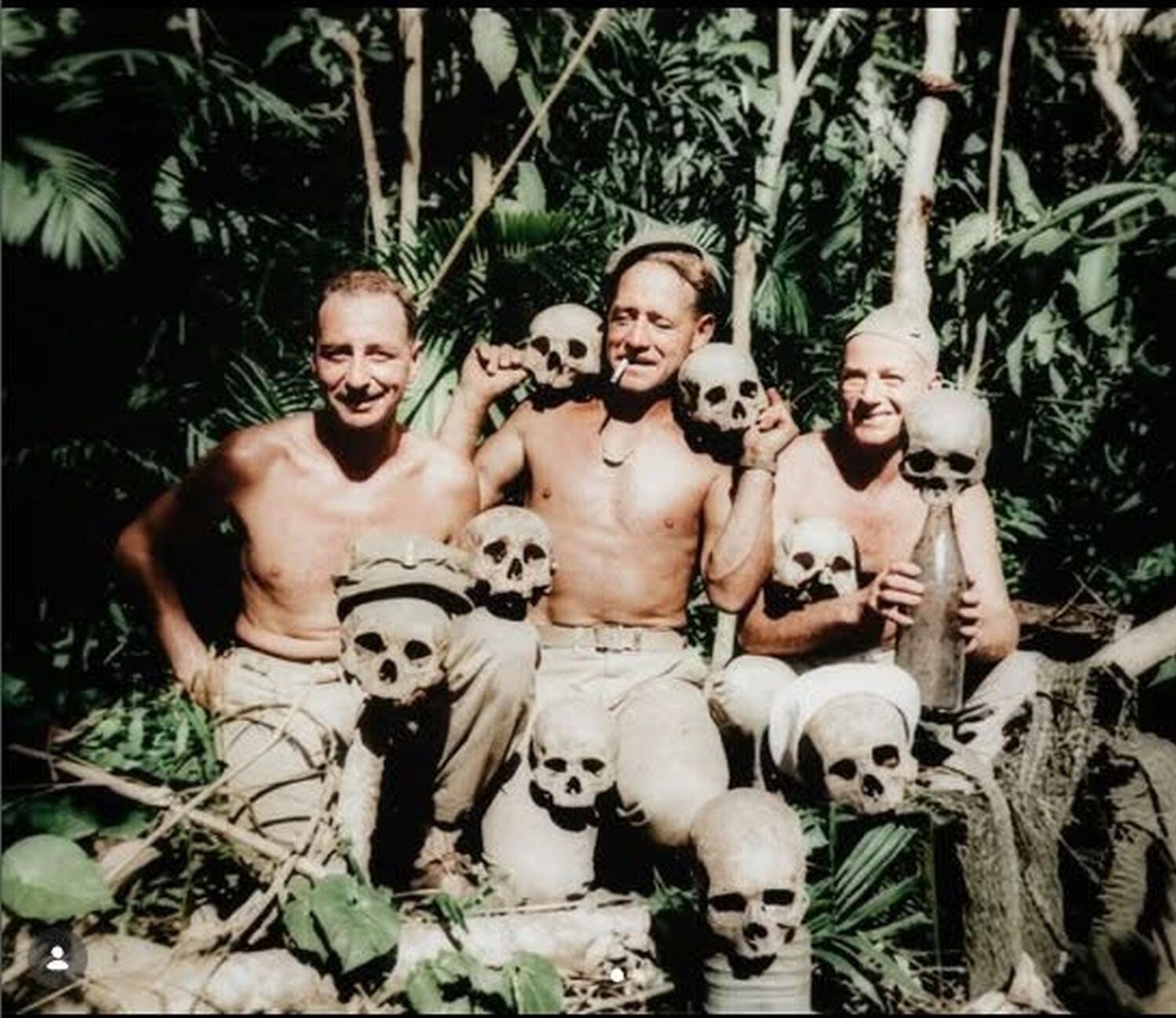
The photograph shows American Marines posing with Japanese skulls in 1944. While the image is often miscaptioned or staged, the taking of human remains as trophies in the Pacific War was a documented practice. Some U.S. servicemen collected skulls or bones from Japanese casualties, a violation of military law that reflected the brutalisation of the campaign and intense racial hostility. Such acts were condemned by commanders but occurred nonetheless across several island battles.
...the renunciation of war...
The Pacific War also transformed U.S.–Japan relations.
After Japan’s defeat, the U.S.‑led occupation introduced democratic reforms, demilitarization, and economic restructuring.
The 1947 constitution institutionalised civil liberties and the renunciation of war, while land and educational reforms reshaped Japanese society.
By the 1960s, Japan had become a key U.S. ally, supporting American strategy in Asia and contributing to regional stability during the Cold War.
Security treaties and economic cooperation solidified a partnership that remains central to East Asian geopolitics.
...narratives of sacrifice...
The war’s memory continues to influence national identities. In the United States, the Pacific War is remembered through narratives of sacrifice and decisive battles.
In Japan, the atomic bombings and wartime devastation fostered a culture of pacifism and a commitment to peace.
Memorials in Hiroshima and Nagasaki emphasise the human cost of conflict and the dangers of nuclear weapons.
The conflict’s legacy remains embedded in contemporary discussions of security, diplomacy, and reconciliation, underscoring its enduring impact on East Asia and the wider world.
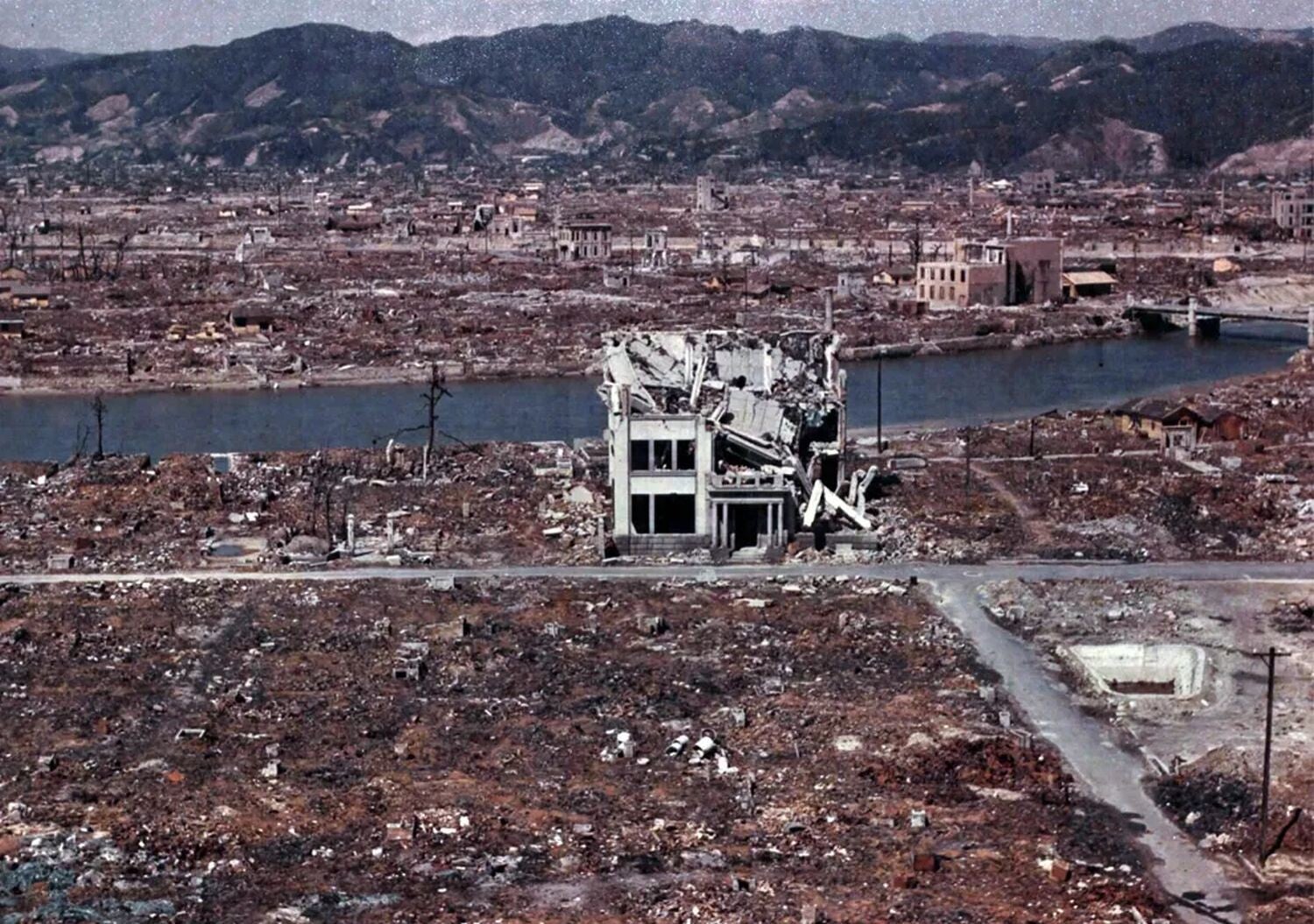
Hiroshima in March 1946 shows a city largely cleared of debris only months after the atomic bombing. Roads are visible and orderly, indicating extensive cleanup, and no bodies remain. A few reinforced concrete structures stand amid vast emptiness, highlighting how little survived the blast. The scene reflects both the scale of destruction and the early efforts to stabilise and rebuild a devastated urban landscape.
https://blog.nuclearsecrecy.com/2013/03/22/hiroshima-and-nagasaki-in-color/
Conclusion
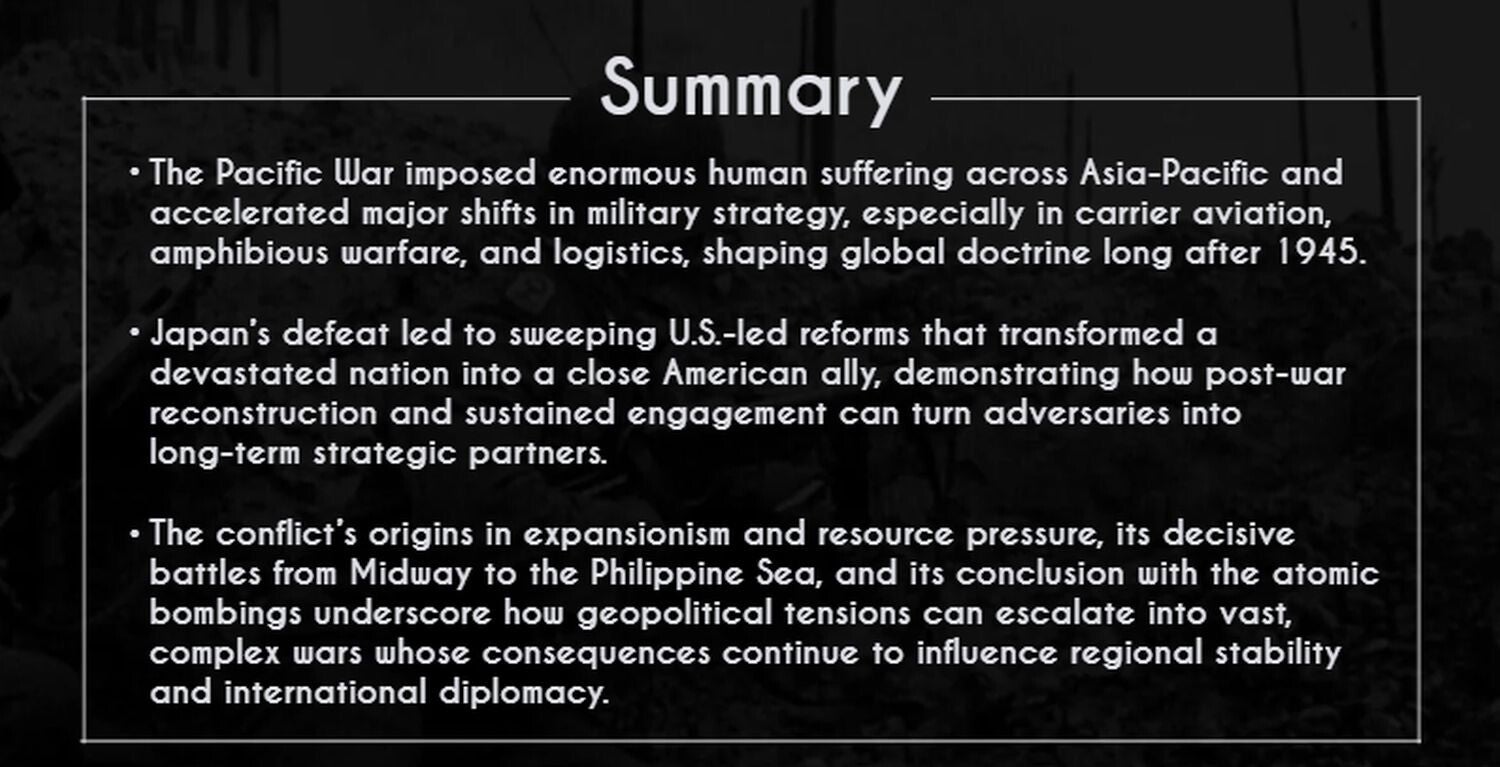
The Pacific War was one of the most demanding and transformative arenas of the Second World War, defined by vast distances, intense combat, and consequences that reshaped the modern international order.
Its human cost was severe. Across the Asia‑Pacific region, military personnel, prisoners of war, and civilians endured displacement, deprivation, and violence that left lasting physical and psychological scars.
The conflict also accelerated major developments in military strategy, particularly in naval aviation, amphibious operations, and logistical planning, influencing global doctrine for decades after 1945.
...dramatic shift in relations...
A central legacy of the Pacific Theatre is the dramatic shift in relations between the United States and Japan.
The war ended with Japan devastated and occupied by U.S. forces, who oversaw sweeping political and economic reforms.
Within a few years, the two nations transitioned from bitter adversaries to close strategic partners.
This transformation demonstrated how reconciliation, sustained engagement, and institutional rebuilding can convert wartime hostility into long‑term stability.
The resulting alliance remains a cornerstone of security and diplomacy in the Asia‑Pacific region.
...unresolved geopolitical tensions...
The origins of the conflict highlight how expansionist policies, resource pressures, and unresolved geopolitical tensions can escalate into full‑scale war.
Japan’s pursuit of regional dominance, driven by nationalism and economic necessity, collided with Western interests and led to sanctions that Tokyo viewed as existential threats.
The attack on Pearl Harbor was the culmination of years of confrontation rather than an isolated act.
...a campaign of extraordinary complexity...
Once war began, the Pacific Theatre’s immense scale - from Southeast Asia to the central Pacific -created a campaign of extraordinary complexity.
Key battles such as Midway, Guadalcanal, and the Philippine Sea shifted momentum decisively toward the Allies, while the island‑hopping strategy steadily dismantled Japan’s defensive perimeter.
The final phase, including the atomic bombings of Hiroshima and Nagasaki, ended the conflict and reshaped Asia’s political landscape.
Remembering the Pacific War underscores the cost of conflict and the enduring importance of diplomacy, cooperation, and stability in international affairs.