
Overview
The Matanikau Offensive, fought from 1 to 4 November 1942, was a major American attack during the Guadalcanal campaign. Following the Japanese defeat at Henderson Field in late October, Major General Alexander Vandegrift sought to exploit the weakened enemy position by driving Japanese forces westwards from the Matanikau River and securing the western approaches to the American perimeter.
On 1 November, seven battalions of United States Marine and Army troops crossed the Matanikau under the tactical command of Colonel Merritt Edson. Approximately 4,000 Americans faced around 1,000 Japanese troops, principally from the 4th Infantry Regiment commanded by Colonel Nomasu Nakaguma. The Japanese occupied defensive positions between the river and Point Cruz on Guadalcanal's northern coast.
American troops advanced westwards while artillery and other supporting weapons struck the Japanese positions. Fighting became particularly intense around Point Cruz, where Japanese soldiers defended bunkers and fortified positions across difficult jungle terrain. Despite determined resistance, the Americans steadily compressed the defenders into an increasingly restricted pocket.
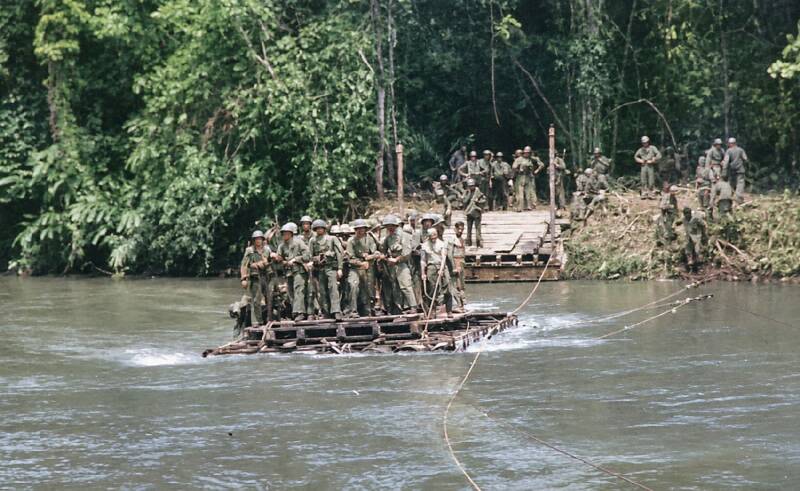
U.S. Marines cross the Matanikau River on Guadalcanal on a raft ferry in November, 1942.
By 3 November, the Japanese position around Point Cruz had been overwhelmed. The fighting inflicted severe losses on Nakaguma's forces and opened the possibility of continuing the advance towards Kokumbona, an important Japanese base farther west. American forces had gained the initiative along this section of the Guadalcanal front.
However, developments elsewhere forced Vandegrift to abandon the advance. Reports that Japanese troops had landed at Koli Point, east of the American perimeter, raised concerns about a new threat to Henderson Field. On 4 November, the offensive was halted and troops were redirected eastwards.
The operation ended as an American tactical victory. Around 400 Japanese soldiers were killed, compared with 71 Americans. Although the advance towards Kokumbona was suspended, the offensive further weakened Japanese forces and demonstrated the Americans' growing ability to operate beyond their defensive perimeter.