
Overview
The Battle of Okinawa, fought from 1 April to 22 June 1945, was the final major campaign of the Pacific War and the largest amphibious assault mounted by U.S. forces in the theatre. The island’s strategic value lay in its proximity to Japan—roughly 340 miles from Kyushu—making it a critical staging area for the planned invasion of the Japanese home islands. American forces, primarily the U.S. Tenth Army under General Simon Bolivar Buckner Jr., faced entrenched Japanese defenders commanded by General Mitsuru Ushijima, who adopted a defence‑in‑depth strategy rather than attempting to repel the initial landings.
The early phases saw limited resistance on the beaches, but once U.S. troops advanced inland they encountered a network of fortified ridges, caves, and bunkers forming the Shuri defensive line. Fighting became attritional, characterised by close‑quarters assaults, flamethrowers, demolition charges, and persistent artillery duels. The Japanese employed extensive kamikaze operations against the U.S. fleet offshore, inflicting significant losses, including the sinking of the battleship USS Arizona’s sister ship USS Pennsylvania and severe damage to numerous destroyers and support vessels.
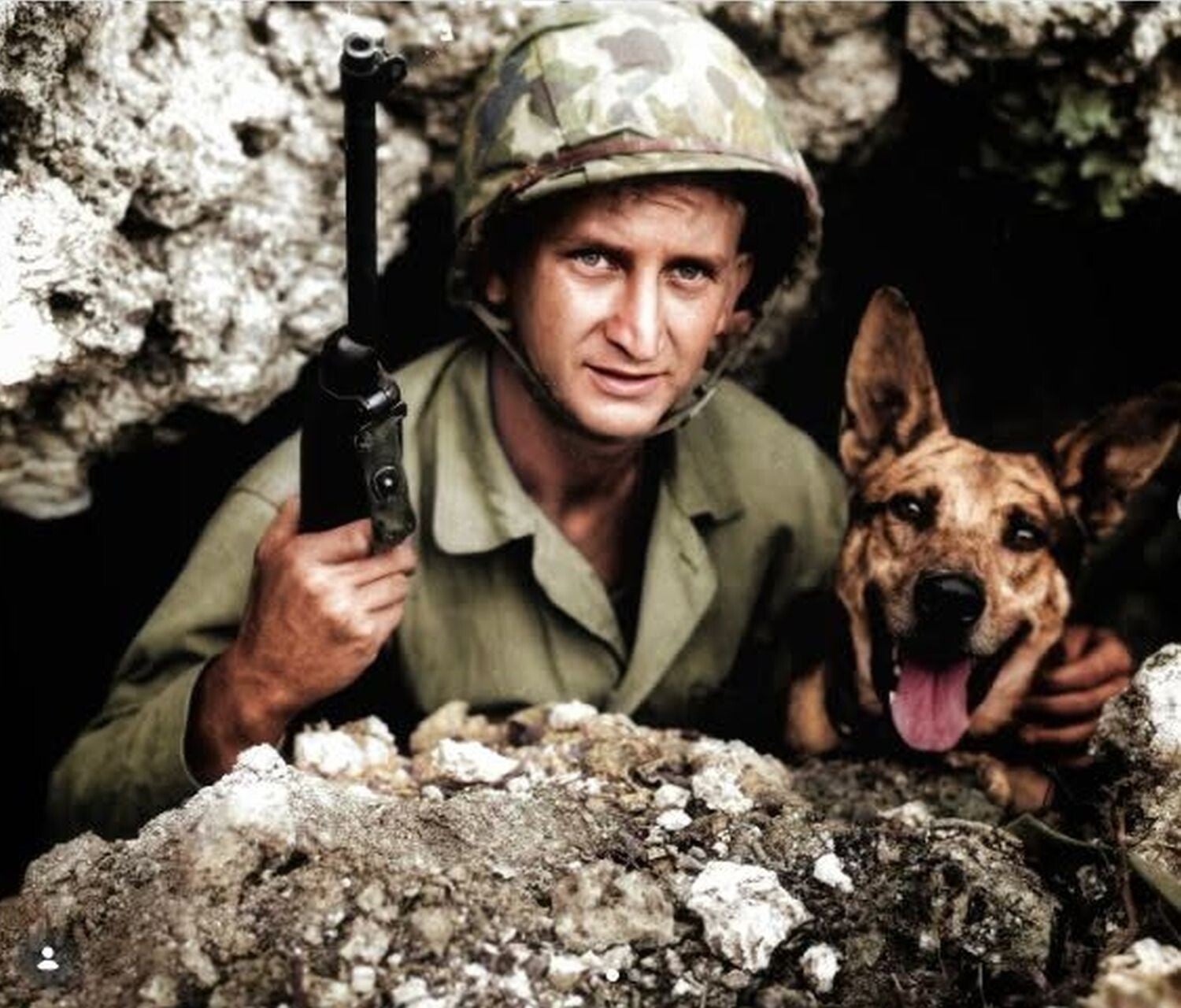
Private John L. Drugan and his dog Pal on Okinawa, May 1945. Pal saved a platoon of Marines from an ambush by alerting his handler of a hidden Japanese machine gun nest. Okinawa, May 1945.
Civilian suffering was extensive. Okinawan non‑combatants were caught between advancing American forces and Japanese directives that discouraged surrender. Many civilians were displaced, forced into caves, or killed during bombardments. The battle resulted in more than 100,000 civilian deaths, alongside approximately 12,500 American combat fatalities and over 90,000 Japanese military dead.
By late June, organised Japanese resistance collapsed with the fall of the Shuri line and the deaths of Ushijima and his chief of staff, General Isamu Cho. Okinawa’s capture provided the United States with airfields and logistical bases for intensified bombing of Japan. The scale of casualties and ferocity of the fighting influenced American strategic thinking, contributing to the decision to employ atomic weapons rather than undertake a direct invasion of the Japanese mainland.
By early 1945, the Pacific War had entered its final and bloodiest phase.
American forces had fought their way across the vast ocean through a relentless island-hopping campaign, capturing key Japanese strongholds at Guadalcanal, Tarawa, Saipan, Peleliu, Leyte, and Iwo Jima.
Each battle brought the Allies closer to Japan, but each also revealed a grim reality: Japanese defenders were prepared to fight to the death.
The fierce resistance encountered on these islands convinced American planners that any future invasion of the Japanese homeland would be extraordinarily costly.
Information
Okinawa, the largest of the Ryukyu Islands, lay just 340 miles from Kyushu, Japan's southernmost main island.
Its airfields and anchorages made it the ideal staging area for the planned invasion of Japan itself, known as Operation Downfall.
Capturing Okinawa would provide a base for heavy bombers, fighter aircraft, and the enormous logistical network required for the final assault.
As a result, American commanders under Admiral Chester Nimitz and General Douglas MacArthur viewed the island as a crucial strategic objective.
Information
Operation Iceberg, the invasion of Okinawa, became the largest amphibious operation of the Pacific War.
More than half a million Allied personnel were assigned to the campaign, supported by an immense fleet of warships, landing craft, and aircraft.
Detailed planning focused on overwhelming Japanese defences through naval bombardment, air superiority, and the rapid deployment of troops ashore.
Information
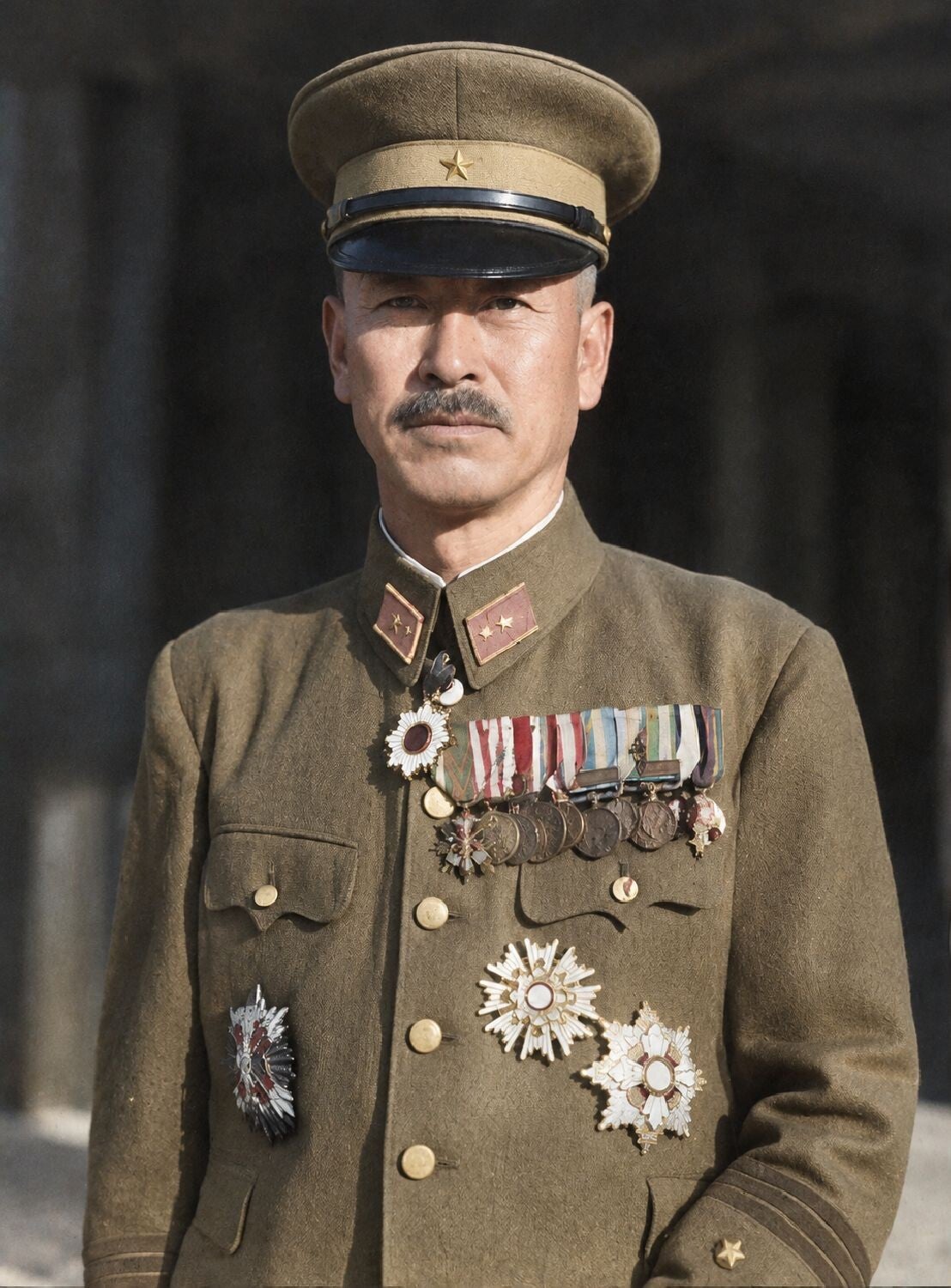
Lieutenant General Mitsuru Ushijima, commander of the 32nd Army on Okinawa
The Japanese, meanwhile, understood Okinawa's importance just as clearly.
Rather than attempting to repel the invasion on the beaches, Lieutenant General Mitsuru Ushijima and his staff prepared a defence in depth.
Extensive networks of caves, tunnels, bunkers, and fortified ridgelines were constructed across southern Okinawa.
Tokyo also committed large numbers of aircraft to mass kamikaze attacks against the approaching Allied fleet, hoping to inflict such severe losses that American leaders might reconsider an invasion of Japan.
When Allied forces landed on 1 April 1945, both sides knew they were beginning a battle that would help determine the final outcome of the Pacific War.
Evacuation
As the Pacific War intensified in 1944, Japanese authorities recognised that Okinawa was likely to become a battleground.
Following the American capture of Saipan, which brought U.S. forces significantly closer to Japan, military and civilian leaders feared that the Ryukyu Islands would soon lie directly in the path of invasion.
To reduce civilian casualties and ease pressure on limited local resources, a large-scale evacuation programme was organised across Okinawa.
Information
The effort was overseen by Okinawan prefectural authorities, school administrators, local officials, and the Japanese government.
Particular priority was given to schoolchildren, who were viewed as especially vulnerable in the event of air raids and invasion.
Thousands of children were separated from their families and assigned to organised groups supervised by teachers and chaperones.
Women, the elderly, and other non-essential civilians were also encouraged or ordered to leave the islands for mainland Japan, Taiwan, and other safer locations.
Information
Among the ships employed in this effort was the Tsushima Maru, a civilian passenger vessel requisitioned for wartime transport duties.
On 21 August 1944, it departed Naha carrying approximately 1,788 passengers and crew. Among them were more than 1,400 civilian evacuees, including hundreds of schoolchildren and their teachers.
The voyage formed part of the wider programme to remove Okinawan civilians from an increasingly threatened region.
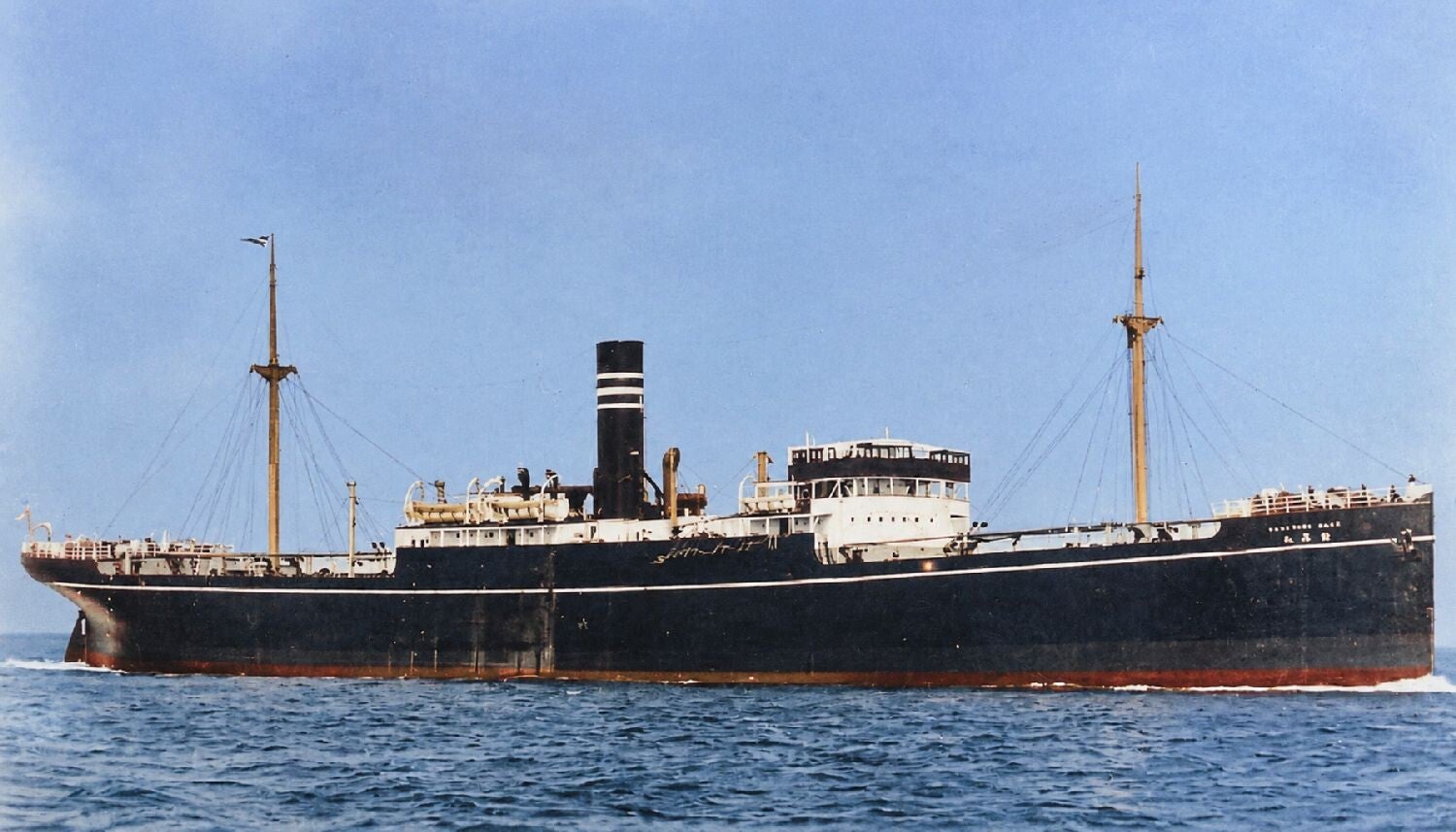
Tsushima Maru was a Japanese passenger-cargo ship used to evacuate Okinawan civilians during the Pacific War. Torpedoed on 22 August 1944, it sank with over 1,500 people aboard, including hundreds of schoolchildren.
Information
Tragically, on the night of 22 August, the vessel was torpedoed by the American submarine USS Bowfin. The ship sank rapidly, claiming the lives of more than 1,500 people.
Around 780 schoolchildren were among the dead, making it one of the worst civilian maritime disasters of the Pacific War.
Survivors struggled in the sea for hours before rescue, while many families remained unaware of their loved ones' fate for months.
Despite the catastrophe, evacuation efforts continued.
Tens of thousands were eventually moved from Okinawa, but many civilians remained behind.
When American forces landed in April 1945, large numbers of Okinawan men, women, and children would find themselves caught in the devastating Battle of Okinawa.
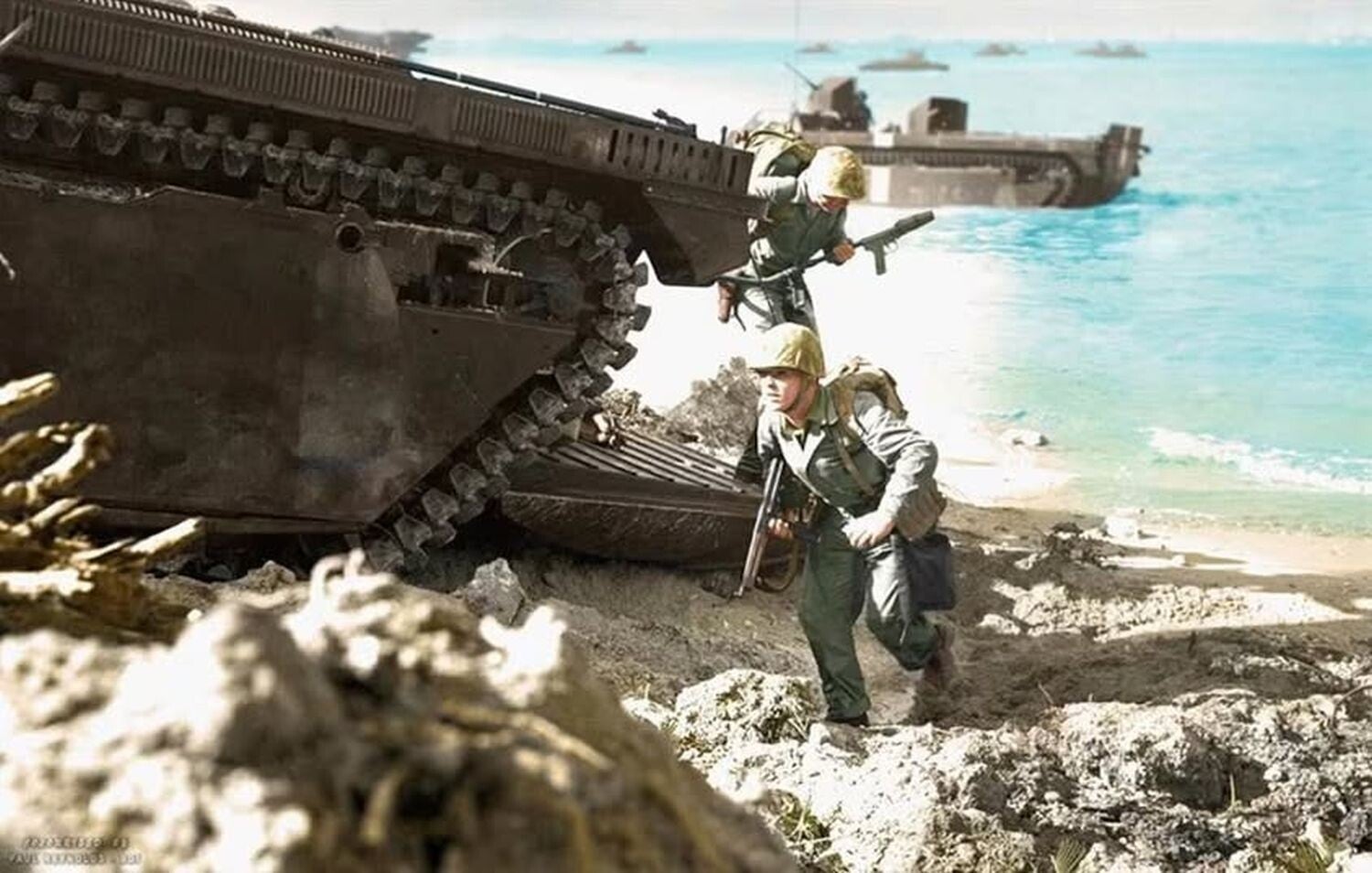
US Marines of the 2nd Battalion, 22nd Regiment, land at Green Beach One, Okinawa. At 08:30 on Easter Sunday, 1 April 1945, the 22nd Marines landed on Green Beach One during the invasion of Okinawa, securing the left flank of the assault force. Advancing north with the 6th Marine Division, they helped clear the island's northern sector. On 13 April, the 2nd Battalion reached Hedo Misaki, Okinawa's northernmost point. The regiment was later redeployed south, where it joined the fighting for Naha and suffered heavy casualties. On 16 May, the 22nd Marines and 29th Marines captured Sugar Loaf Hill after two days of fierce combat. Following victory on Okinawa, they moved to Guam to rest and refit.
(Note: The lead Marine carries an M1 Thompson submachine gun, while the second Marine is equipped with an M2 flamethrower and a Colt .45 pistol.)
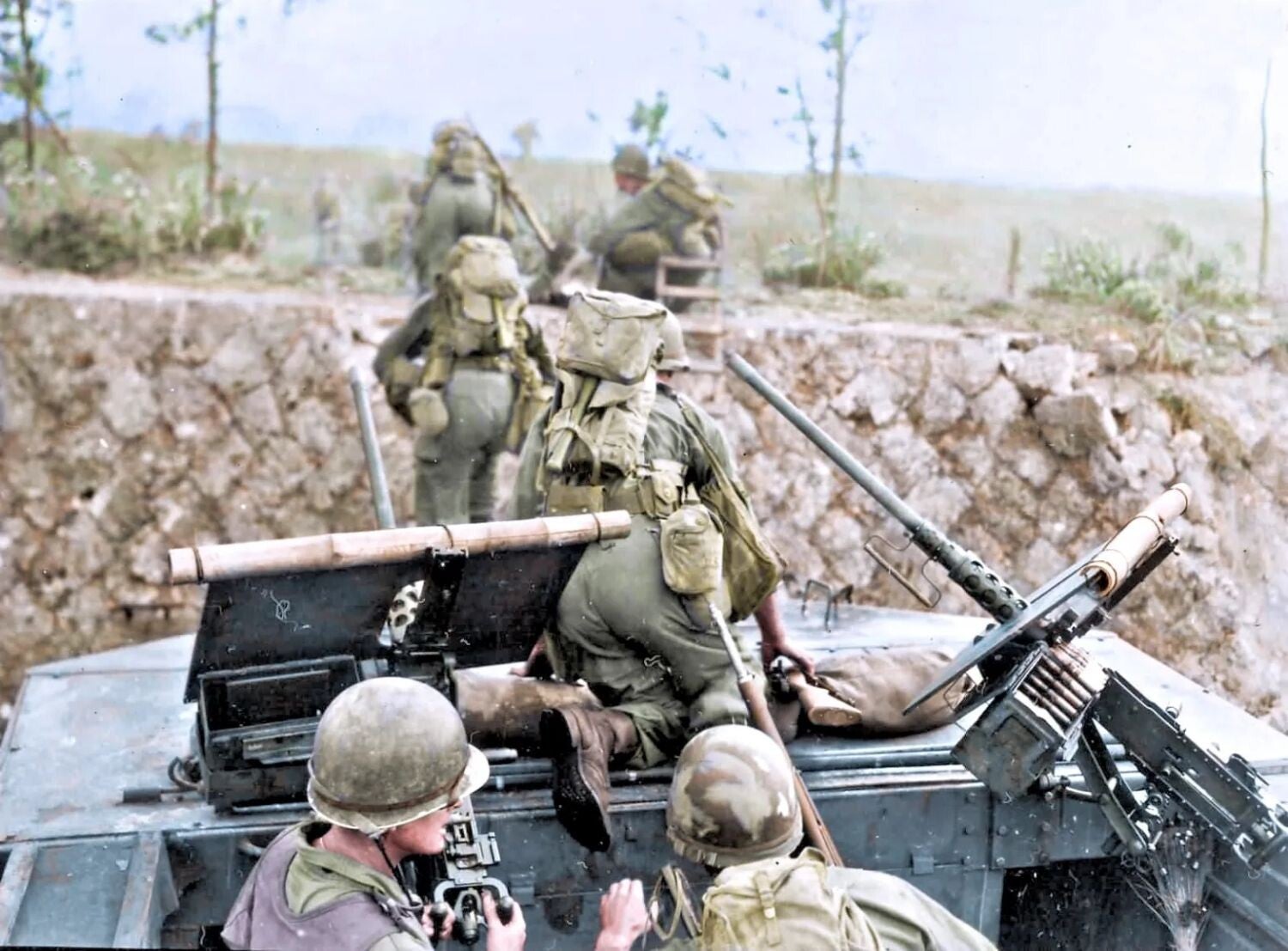
An assault group from the 96th division launch themselves over the sea wall during the assault on Okinawa.
Colourised by Royston Leonard
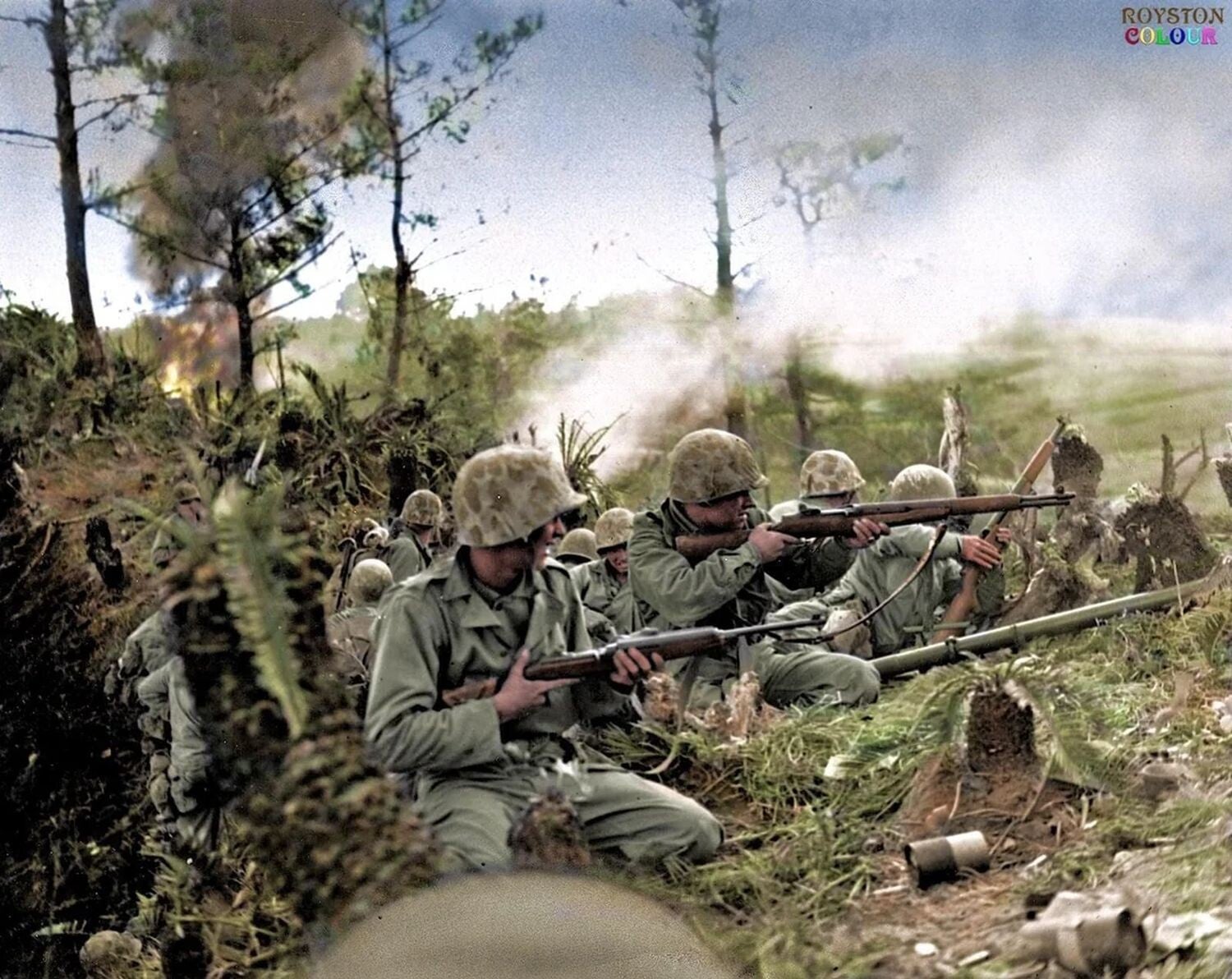
U.S. Marines battling for control of a ridge near Naha, Okinawa, May 1945.
Colourised by Royston Leonard
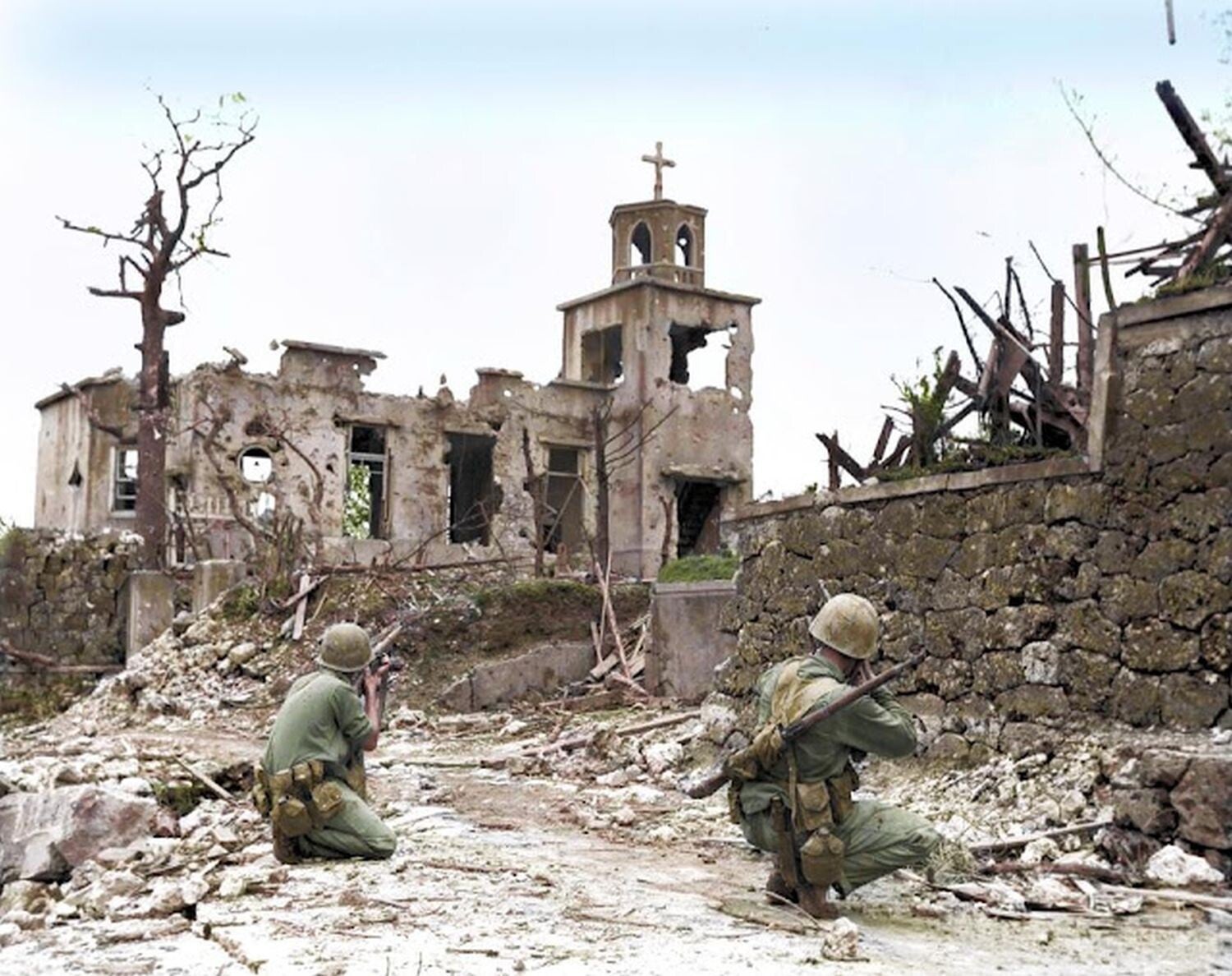
While a patrol moves in from the rear, two United States Marines cover a Japanese sniper hiding in a church, below Shuri Castle on Okinawa, 1945.
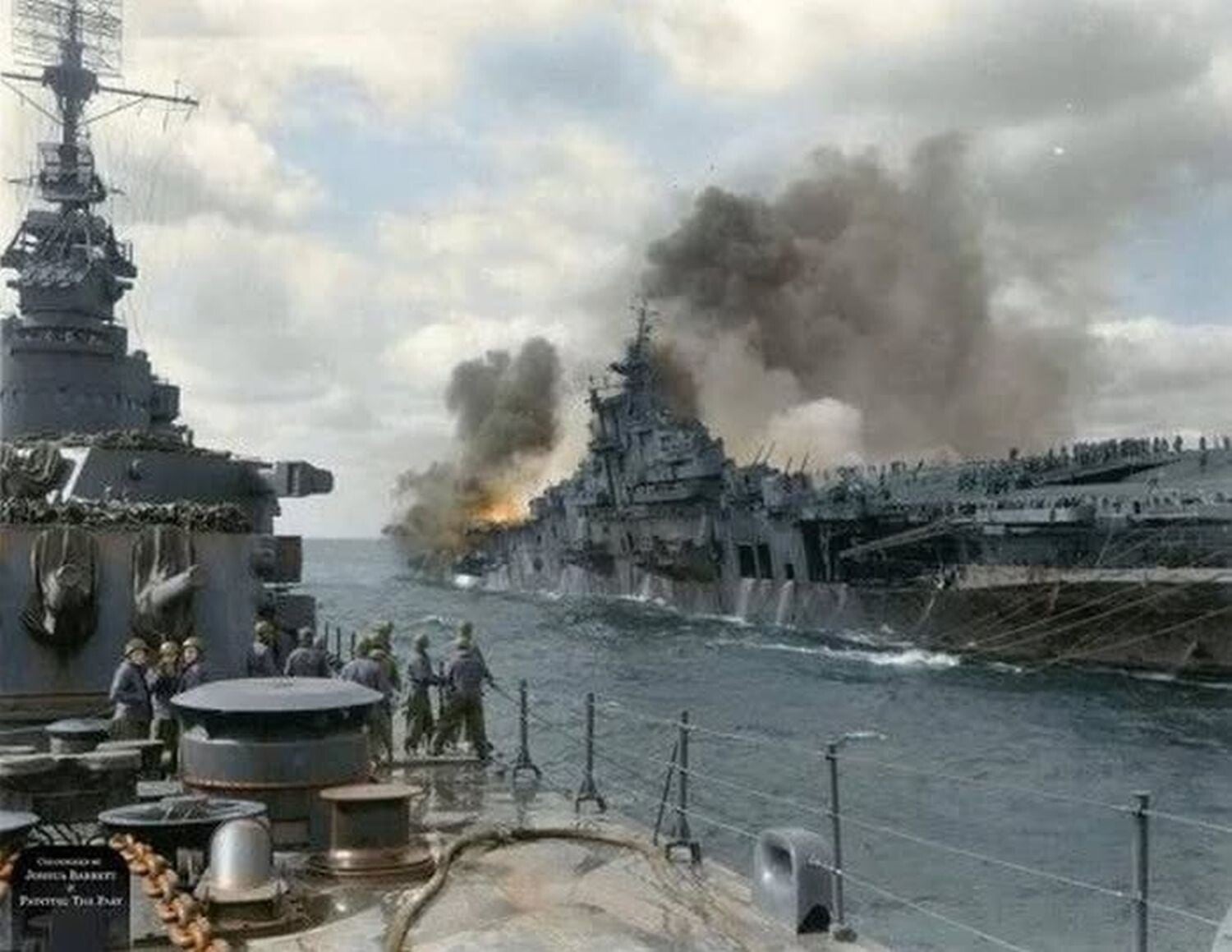

The light cruiser USS Santa Fe (CL‑60) distinguished itself on 19 March 1945 after the carrier Franklin (CV‑13) was devastated by two armour‑piercing bombs near Okinawa. With the carrier ablaze and repeatedly rocked by exploding ordnance, Santa Fe closed in at once, holding position alongside despite smoke, debris, and the threat of further attack. Her crew evacuated casualties, recovered men swept overboard, and provided critical firefighting and damage‑control support. More than 800 survivors were taken aboard. Santa Fe’s actions enabled Franklin to regain propulsion and ultimately survive, earning widespread praise for exemplary seamanship and discipline.
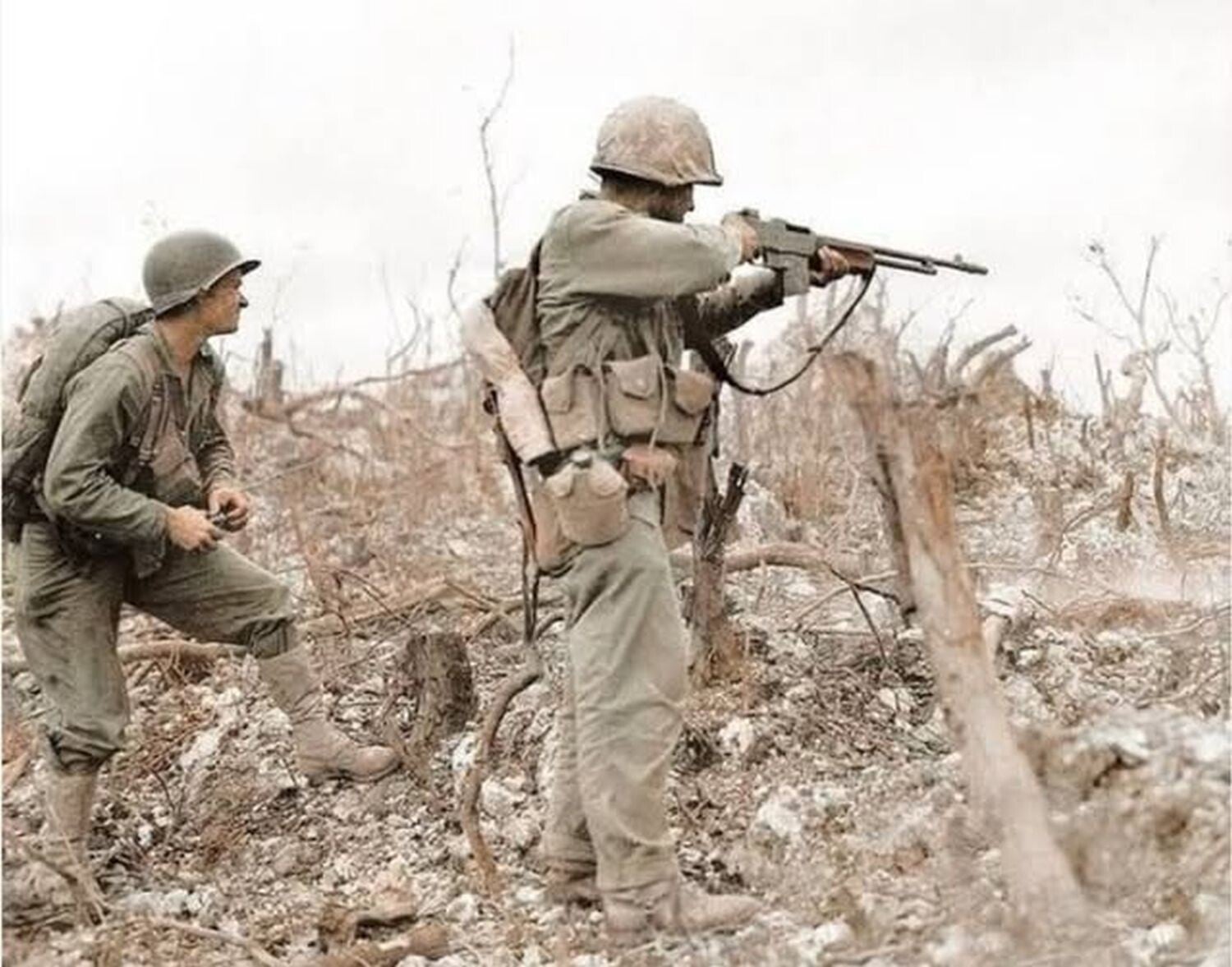
A U.S. Marine from the 1st Marine Division aims a Browning Automatic Rifle (BAR) while a fellow Marine prepares a grenade on Wana Ridge during the Battle of Okinawa in 1945.Key DetailsLocation: Wana Ridge, Okinawa, JapanDate: 1945 (during the Battle of Okinawa)Personnel: U.S. Marines of the 1st Marine DivisionAction: One soldier aims an M1918 Browning Automatic Rifle (BAR) while the second soldier prepares to pull the pin on a hand grenade.
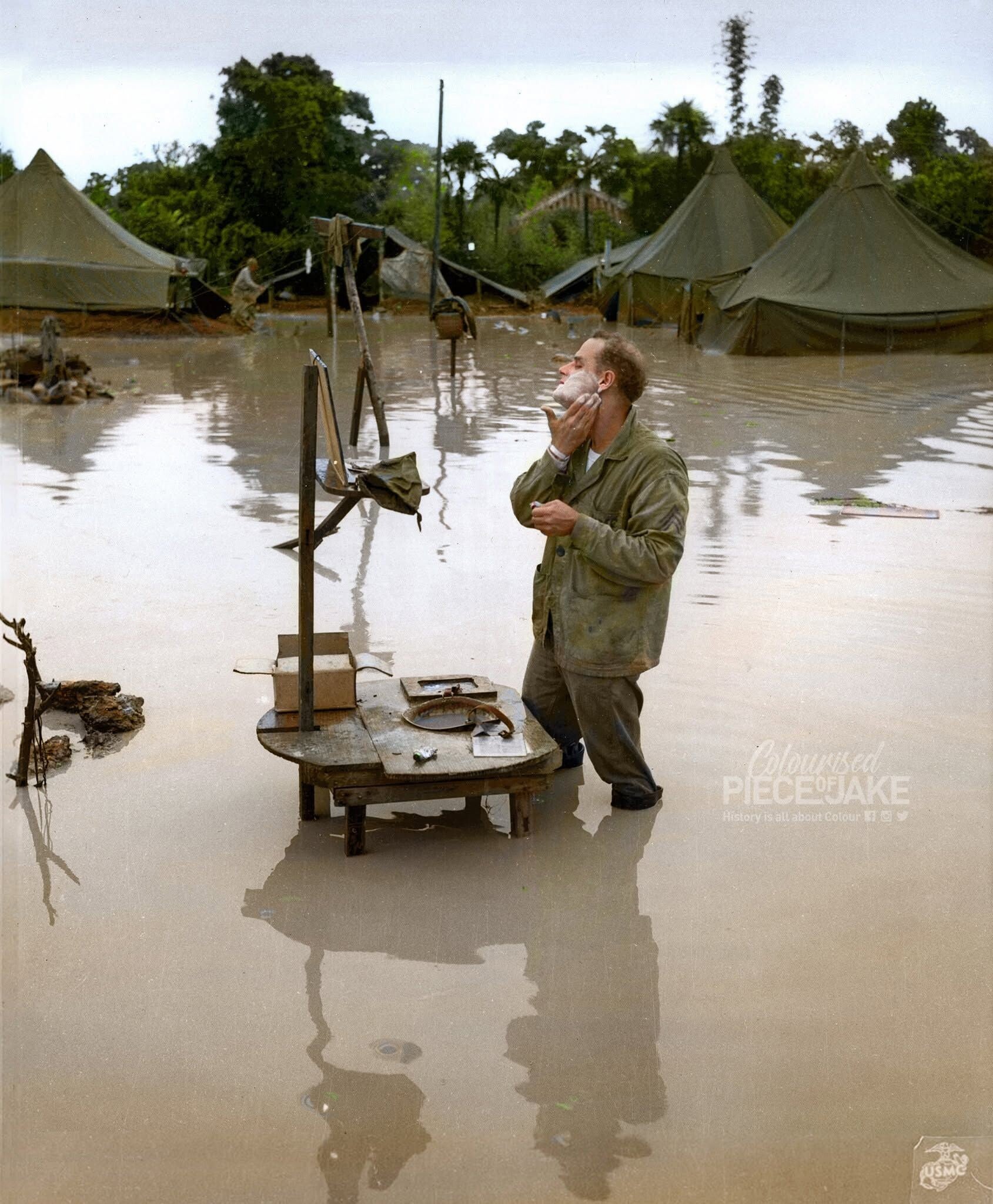
Ignoring the heavy monsoon rains, Marine Staff Sergeant A.S. Barnacle, of Minneapolis, Minnesota, stands knee deep in muddy waters to shave at his "Rube Goldberg" washstand." 28 May 1945, Okinawa, Japan.
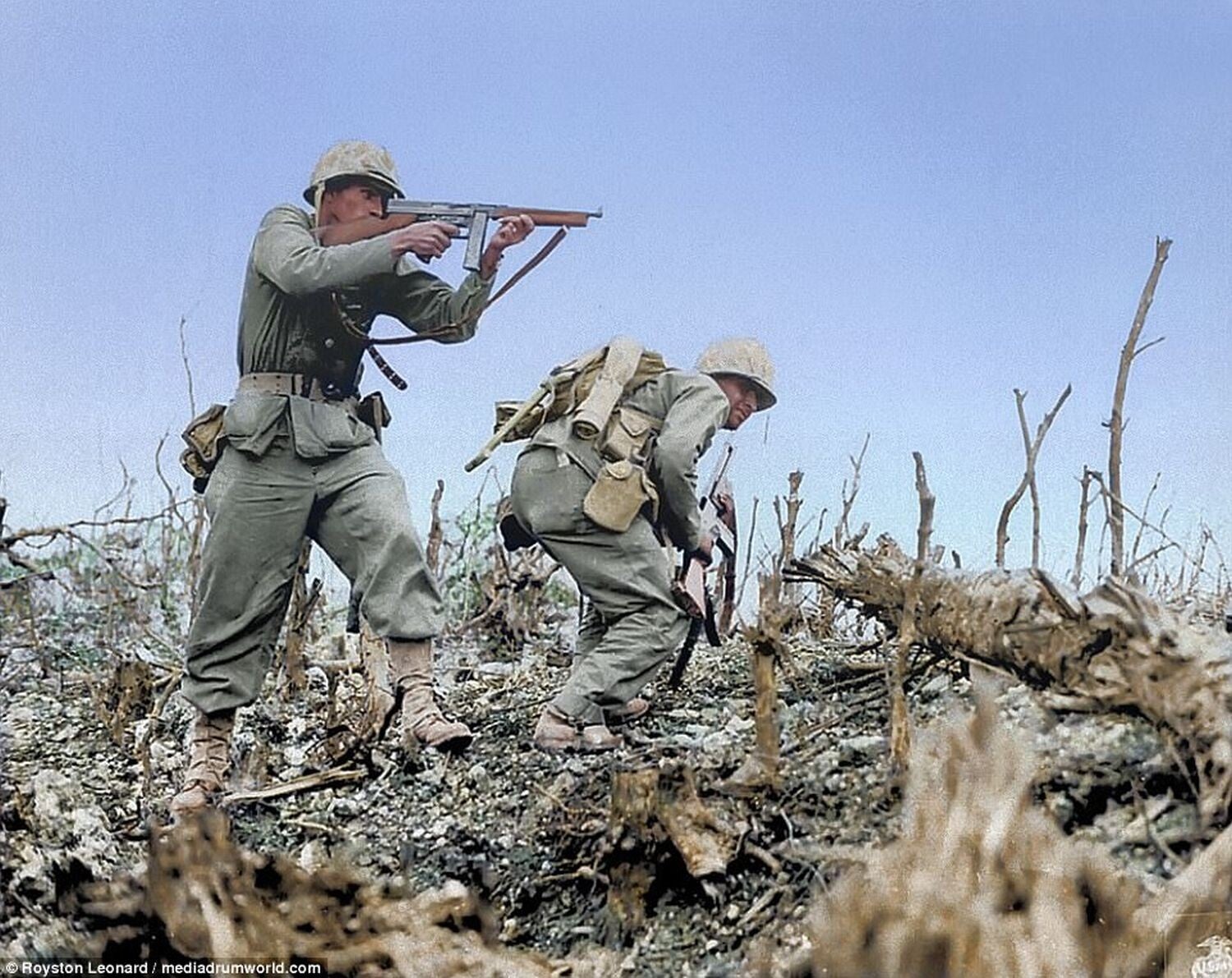
Marines from the 2nd Battalion, 1st Marine Regiment during fighting at Wana Ridge during the Battle of Okinawa, May 1945.
Colourised by Royston Leonard
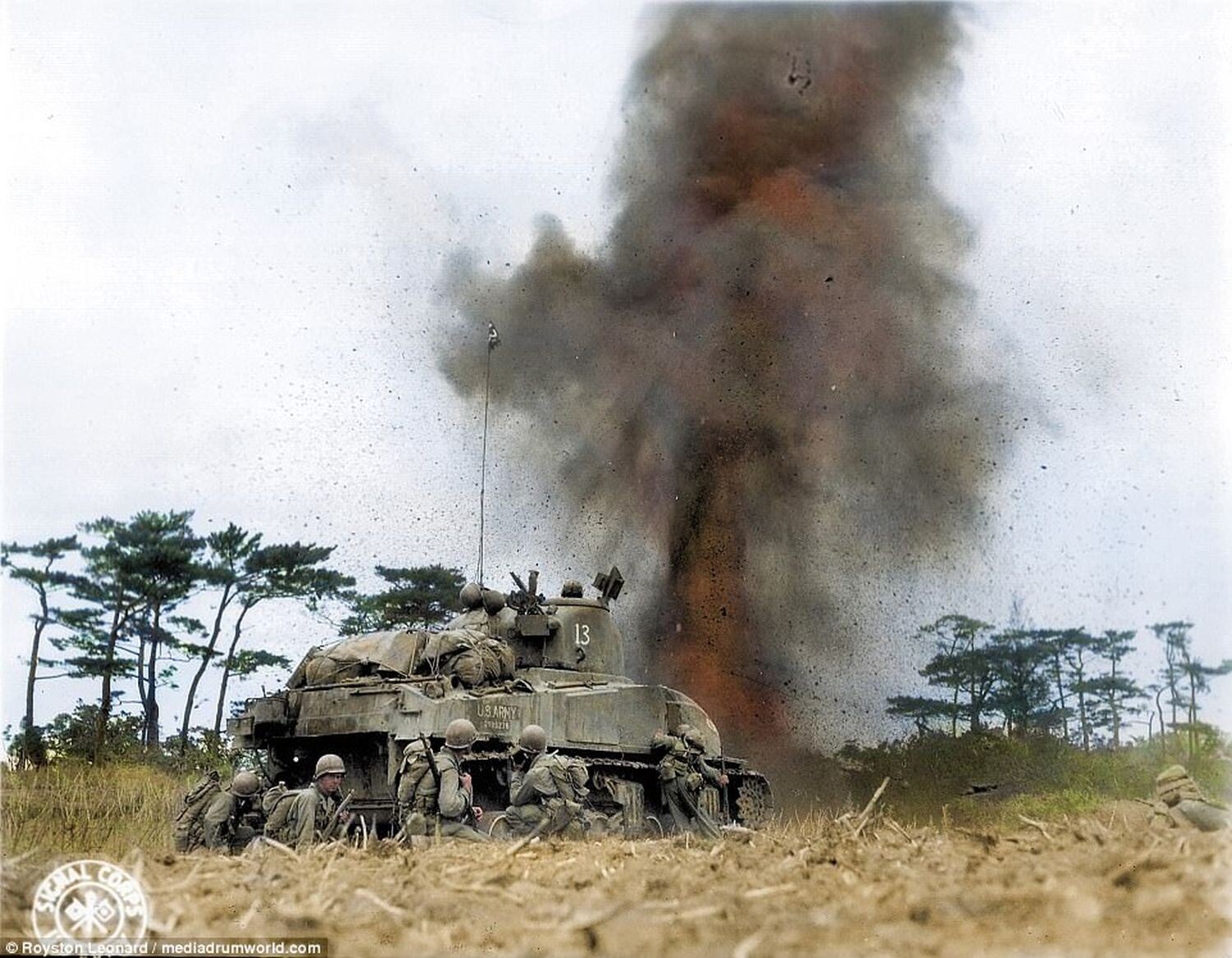
M4 Sherman of 'A' Company 763rd Tank Battalion and troops from the 96th Infantry Division in battle at Okinawa, April 1945.
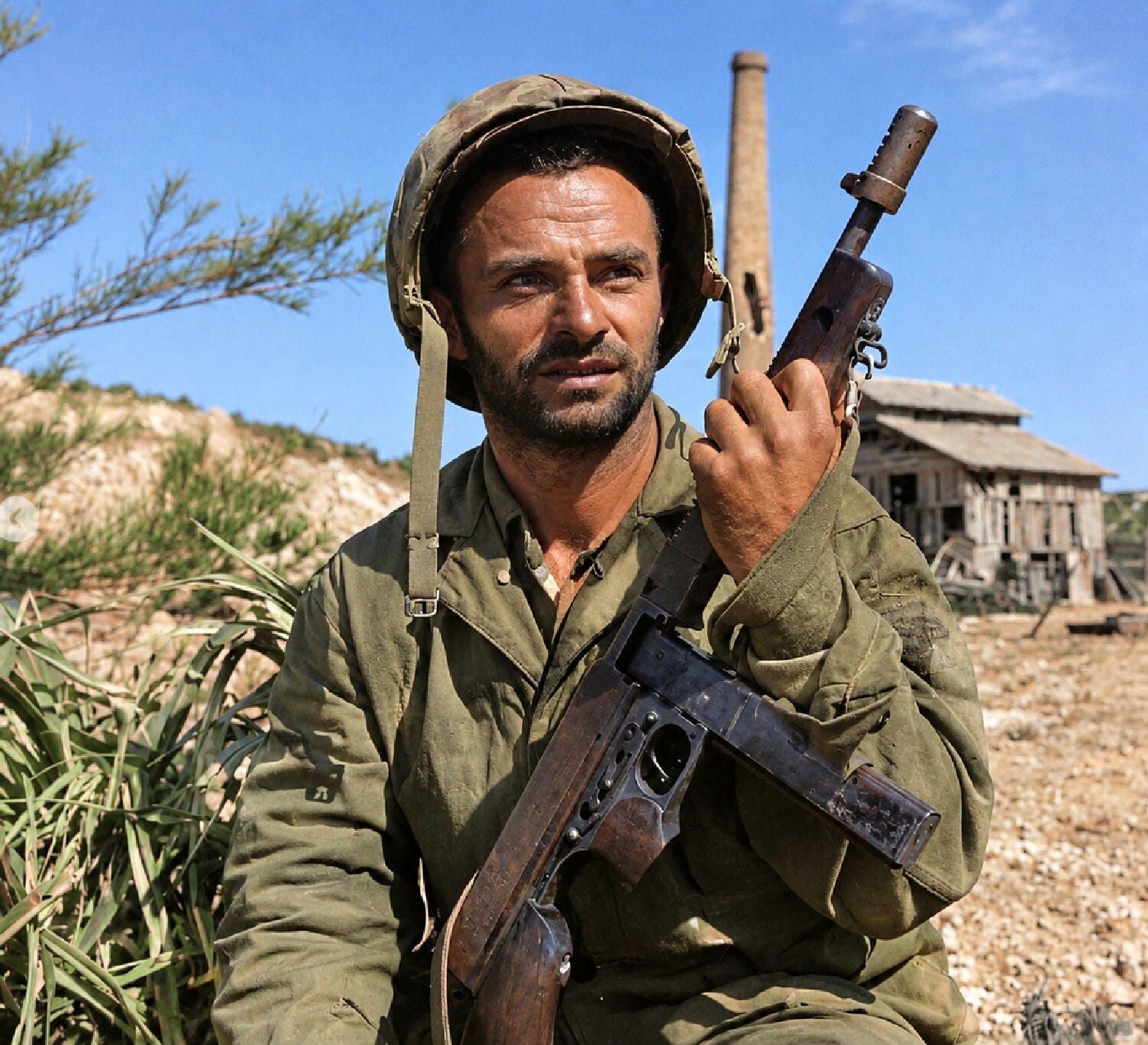
Okinawa, 1945. A U.S. Marine carries a Thompson submachine gun featuring an unusual detail: an early Remington/Colt horizontal foregrip fitted with Enfield-style sling swivels, a rare wartime modification.
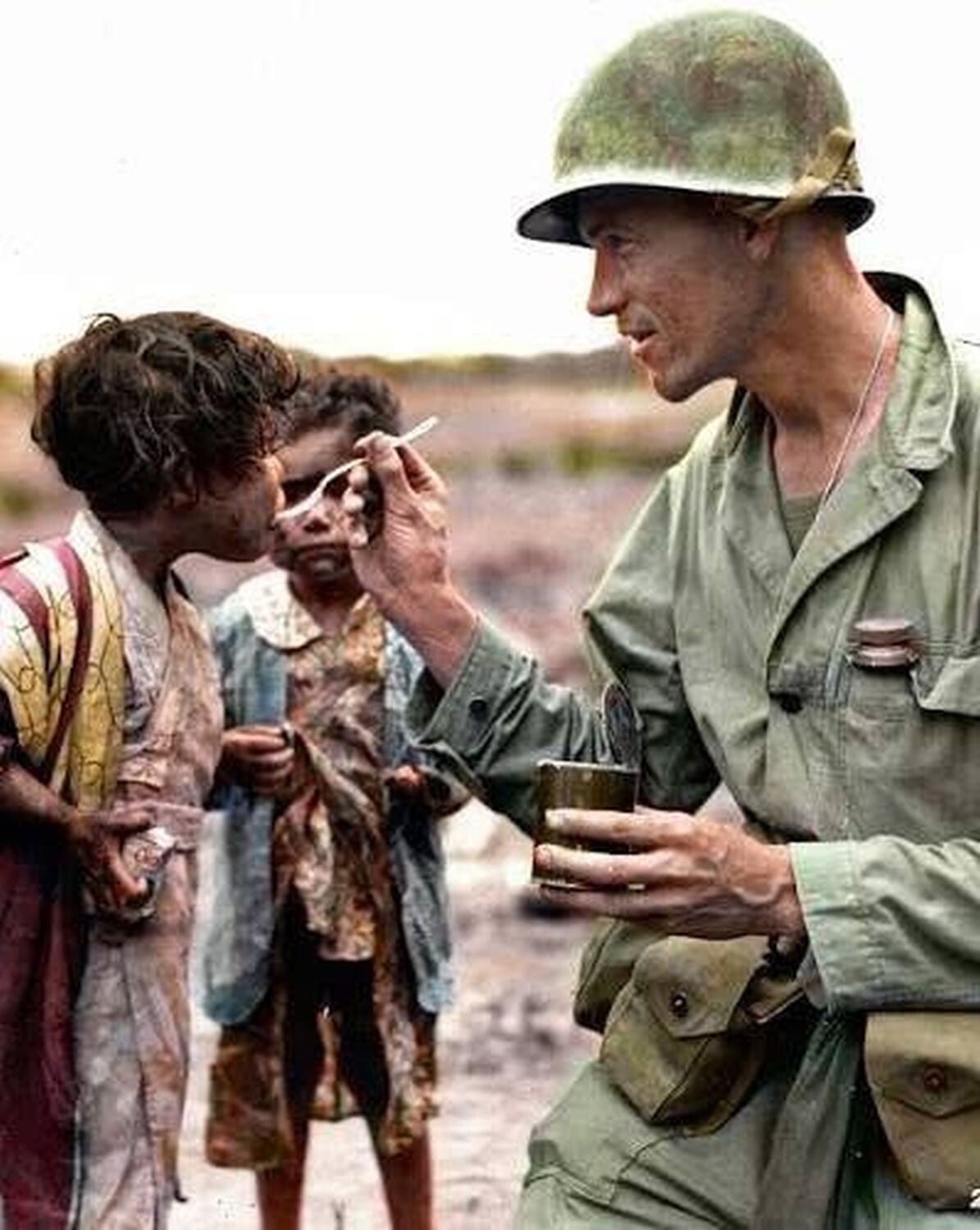
Lt. Richard K. Jones of the 3235th Signal Service Detachment sharing his food rations with local Okinawan children who were hiding in an abandoned tomb near the front lines during the Battle of Okinawa, 31st May 1945.
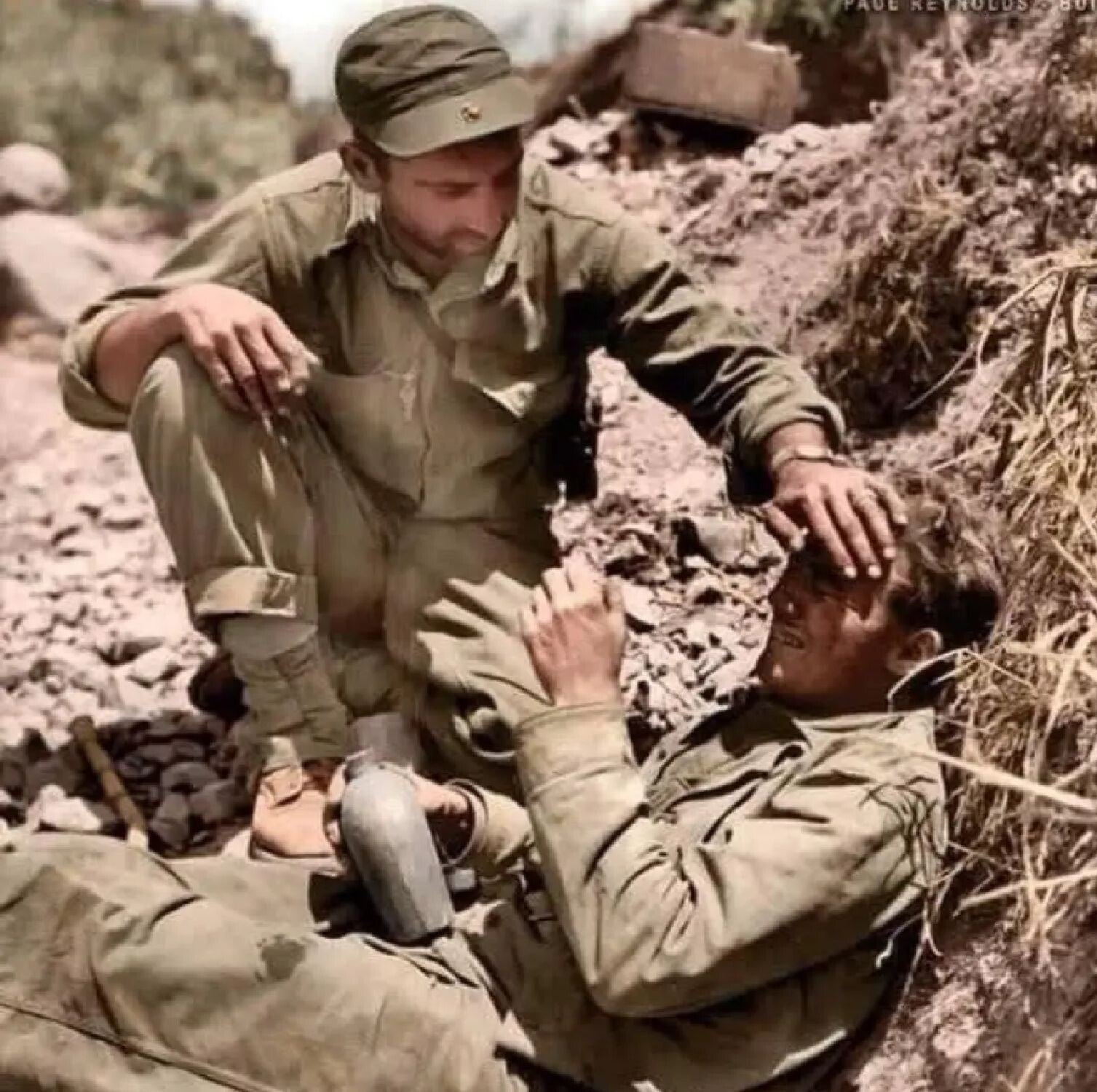
A marine comforts his comrade breaking down after witnessing the death of one of his buddies on an Okinawa hillside. The marines of the First Division were part of the drive on Shuri Castle in may of 1945.
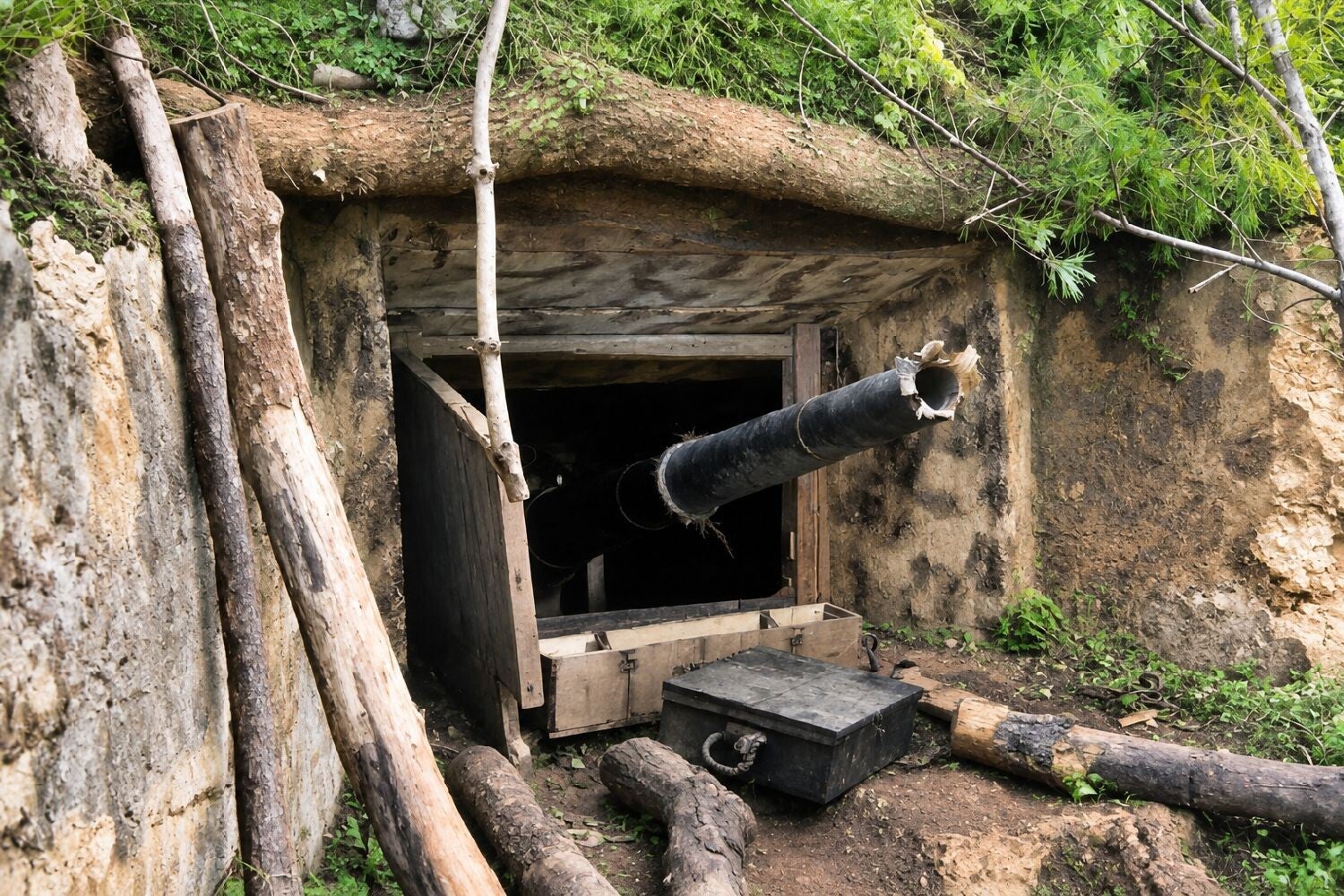
A camouflaged Japanese field gun on Okinawa captured by the Americans. During the Battle of Okinawa, Japanese forces relied on an extensive network of bunkers, caves, and underground tunnels centred on the Shuri Line. Rather than defending the beaches, commanders positioned troops in heavily fortified interior strongholds designed to withstand naval bombardment and air attacks. These interconnected defences enabled Japanese soldiers to launch surprise attacks, delay Allied advances, and inflict heavy casualties. The effectiveness of Okinawa’s bunker system contributed significantly to one of the longest and bloodiest campaigns of the Pacific War.