
Overview
The Marshall Islands became a central staging ground for the U.S. Navy’s advance across the Central Pacific in 1944, marking a shift from attritional island fighting to a strategy of rapid, decisive amphibious operations. The archipelago, a wide chain of coral atolls and lagoons, had been fortified by Japan before the war and formed part of its outer defensive perimeter. Capturing these islands would give the United States forward bases for fleet anchorages, airfields, and logistical hubs essential for the next phase of operations toward the Marianas and the Philippines.
Operation Flintlock, launched in January 1944, targeted Kwajalein and Majuro Atolls. The assault on Kwajalein involved coordinated naval bombardment, carrier air strikes, and amphibious landings by the 4th Marine Division and the 7th Infantry Division. Japanese resistance was determined but ultimately overwhelmed by superior firepower and methodical American tactics. Kwajalein’s capture provided the first major breach in Japan’s central defensive line. Majuro, taken without opposition, quickly became a major fleet anchorage, offering sheltered waters for fast carriers, battleships, and support vessels.
Operation Catchpole followed in February, securing Eniwetok Atoll after sharp fighting. With these victories, the U.S. Navy gained a network of bases that allowed sustained carrier operations deep into Japanese‑held territory. Airfields built on the atolls supported long‑range reconnaissance, bomber missions, and fighter sweeps, tightening the pressure on Japanese positions throughout Micronesia.
The Marshall Islands campaign demonstrated the effectiveness of integrated amphibious doctrine: naval gunfire, carrier aviation, and ground forces working in concert. It also showcased the growing logistical sophistication of the Pacific Fleet, which could now operate continuously across vast distances. By mid‑1944, the Marshalls had become a secure forward area, enabling the leap to the Marianas and accelerating the collapse of Japan’s defensive perimeter.
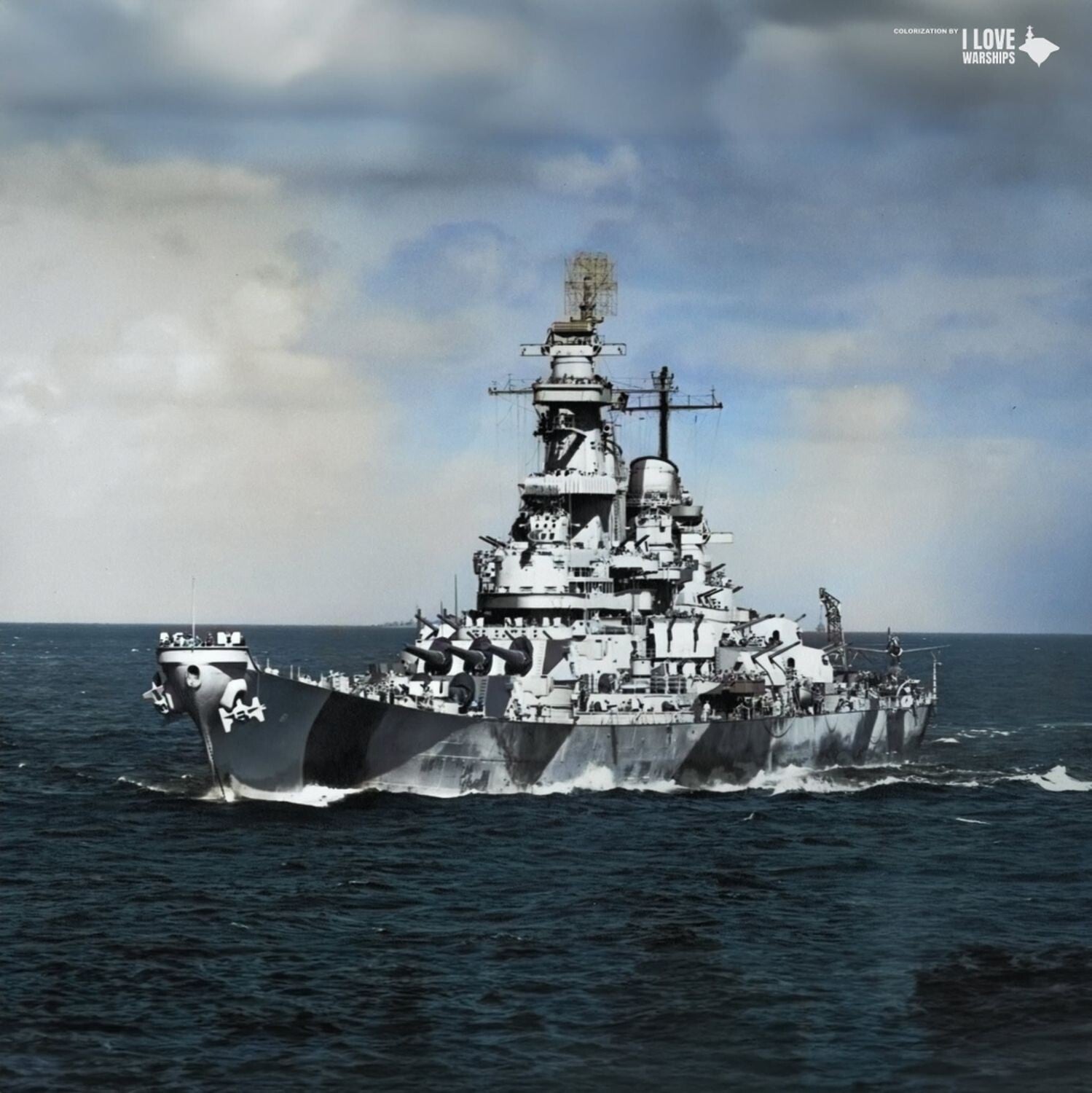
Battleship USS Iowa entering Majuro anchorage on the morning of 4 February 1944. The Iowa’s arrival at the Marshall Islands in early 1944 reflected the growing strength and reach of the U.S. Pacific Fleet. Entering Majuro anchorage after operations in the Marshalls, the fast battleship joined carrier task groups preparing for further strikes across the Central Pacific. Her speed, heavy armament, and modern systems made her a key asset in screening carriers, delivering bombardment, and supporting the accelerating American advance toward the Marianas and beyond.