
Overview
The Guadalcanal campaign, fought between August 1942 and February 1943, marked the first major Allied ground offensive against Japan and a decisive turning point in the Pacific War. Following months of Japanese expansion, the Imperial Japanese Navy began constructing an airfield on Guadalcanal in the Solomon Islands, threatening Allied supply routes to Australia. In response, the United States committed the 1st Marine Division to seize the island and deny Japan a strategic foothold.
On 7 August 1942, U.S. Marines landed on Guadalcanal, Tulagi, and nearby islands. Initial resistance was light, allowing the Marines to capture the unfinished airfield—soon named Henderson Field. Its possession became the central objective of the campaign. Japanese forces launched repeated attempts to retake the airfield, resulting in a series of night battles, coastal engagements, and infantry assaults through dense jungle terrain. The environment itself posed severe challenges: heat, humidity, disease, and supply shortages shaped daily operations.
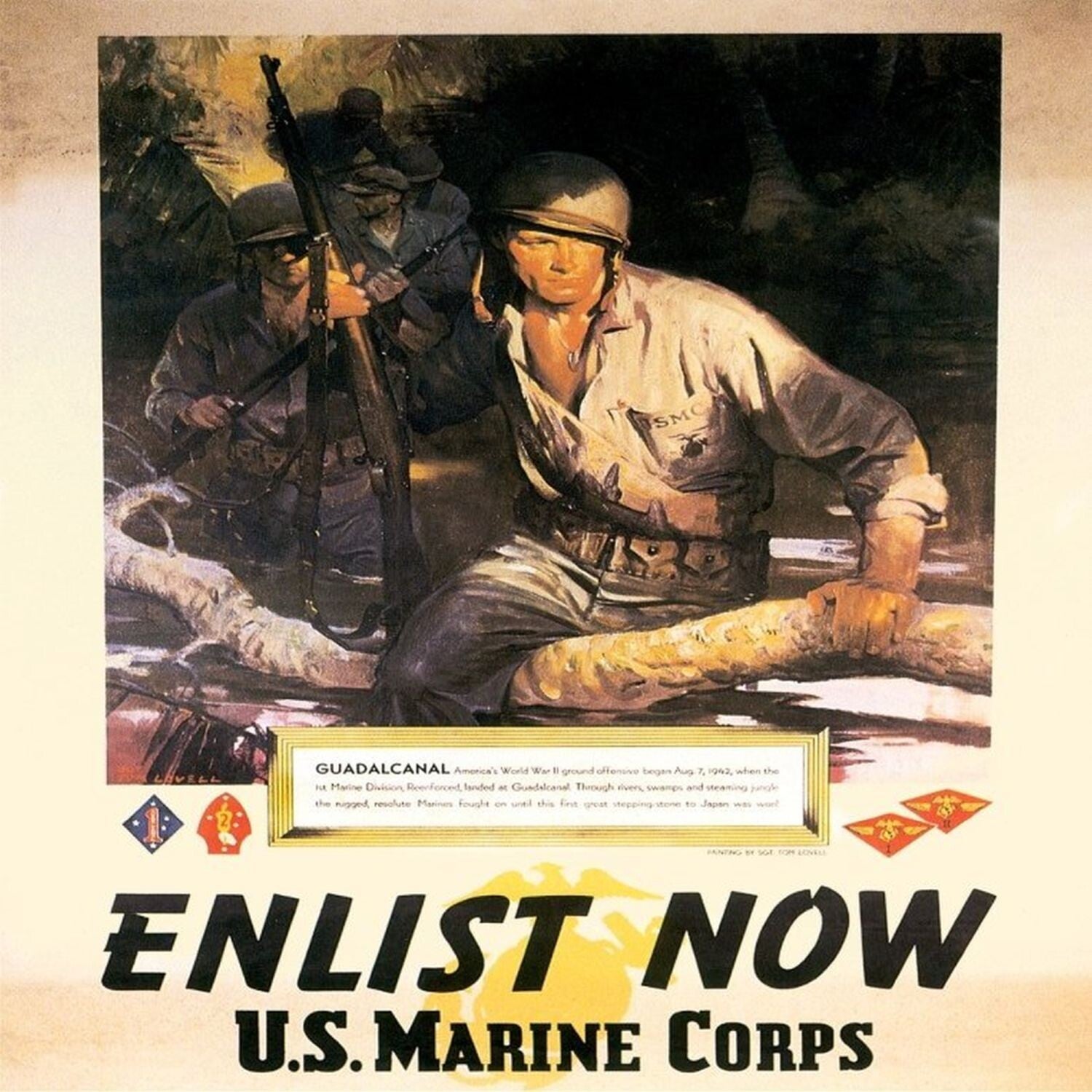
This U.S. Marine Corps recruiting poster uses a dramatic Guadalcanal scene to emphasise determination and combat readiness. Two Marines advance through dense jungle, one crouched behind a fallen tree and the other moving forward with his rifle. The text highlights the 1st Marine Division’s August 1942 landing and the harsh terrain they fought through. The bold “Enlist Now” message links the campaign’s significance to a direct call for volunteers.
https://homeloft.uk Sgt Tom Lovell
At sea, the waters around the island—later called “Ironbottom Sound”—became the site of intense naval combat. Both sides suffered heavy losses in night actions involving cruisers, destroyers, and carriers. Control of the sea determined whether Henderson Field could be reinforced and supplied. The “Cactus Air Force,” a composite group of Marine, Navy, and Army pilots, operated from the airfield under constant pressure, providing essential air defence and striking Japanese shipping.
By late 1942, Japan’s ability to sustain offensive operations weakened. Repeated ground attacks failed, naval losses mounted, and logistical strain increased. In early February 1943, Japanese forces evacuated the island. The campaign ended with a clear Allied victory. Guadalcanal demonstrated that Japan’s expansion could be halted and reversed. It marked the beginning of a sustained Allied advance across the Pacific, shifting strategic momentum and establishing the pattern of amphibious, air‑supported operations that would define the remainder of the war.