
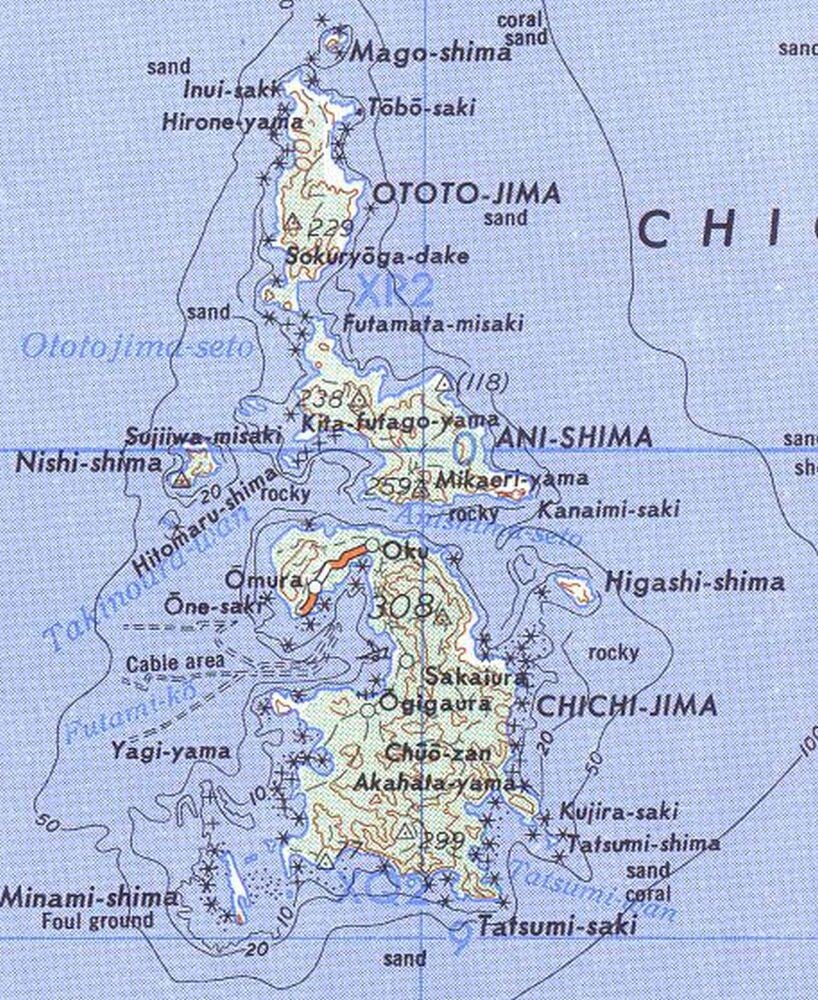
Chichijima, the largest island in the Ogasawara (Bonin) group, held significant strategic value for the Imperial Japanese military during the Second World War.
Its location, roughly midway between Japan and the central Pacific, made it a natural relay point for long‑range communications, weather reporting, and naval coordination.
By the late 1930s, the island had become the primary site for Japan’s long‑range radio stations in the Nanpō Shotō, forming a critical link between the Home Islands and the scattered outposts of the central Pacific.
As tensions in the Pacific increased, Chichijima’s importance grew, and it developed into the heaviest‑garrisoned island in the chain.
Information
The Pacific War
By 1944 the Pacific War had entered a phase defined by sustained Allied offensives and the progressive isolation of Japanese strongholds.
In the Central Pacific, U.S. forces advanced through the Marshall and Mariana Islands, capturing Saipan, Tinian, and Guam between June and August.
These operations provided airfields for B‑29 bombers, enabling direct strikes against the Japanese Home Islands.
The loss of the Marianas also contributed to the destruction of Japan’s carrier aviation during the Battle of the Philippine Sea in June 1944.
Information
In the southwest, Allied forces under General Douglas MacArthur moved through New Guinea and into the Philippines.
The Leyte campaign began in October 1944, followed by the Battle of Leyte Gulf, one of the largest naval engagements of the war. By early 1945, U.S. forces had secured Luzon and were advancing toward Manila, where urban combat caused extensive destruction.Japan’s defensive perimeter contracted sharply.
Supply lines deteriorated, garrisons became isolated, and air and naval strength declined. In February 1945, the assault on Iwo Jima commenced, driven by the need for emergency landing fields for B‑29 operations.
The battle lasted until March, marked by high casualties on both sides.By early 1945, Japan faced mounting strategic pressure, with Allied forces preparing for further operations toward Okinawa and the Home Islands.
Information
The Garrison
At the time of the attack on Pearl Harbor in December 1941, Chichijima hosted a substantial military presence.
Contemporary accounts indicate that an Imperial Japanese Army force of approximately 3,700 to 3,800 men formed the core of the garrison.
Alongside them were roughly 1,200 naval personnel responsible for operating the island’s naval base, seaplane facilities, radio and meteorological stations, and small craft units including gunboats, submarine chasers, and minesweepers.
The island’s defensive strength was further reinforced by a heavy artillery fortress regiment, which provided coastal defence and contributed to the broader defensive network intended to protect Japan’s eastern approaches.
Information
Occupation
The island’s civilian population, including the Oubeikei - descendants of Western settlers who had lived on the Bonin Islands since the nineteenth century - experienced increasing scrutiny as wartime controls tightened.
Japanese authorities viewed the Oubeikei with suspicion, concerned that their foreign ancestry and linguistic background might make them vulnerable to espionage or foreign influence.
Reports indicate that they were compelled to adopt Japanese names and conform to stricter cultural expectations.
Information
Despite these pressures, the community remained on the island until 1944, when the Japanese government ordered the evacuation of all 6,886 civilian inhabitants of the Ogasawara Islands to the Home Islands.
This evacuation included the Oubeikei and other long‑established families.
Notably, at least two American citizens of Japanese descent served in the Japanese military on Chichijima during the war, including Nobuaki “Warren” Iwatake, a Japanese‑American from Hawaii who had been drafted into the Imperial Army while living with relatives in Hiroshima.
Information
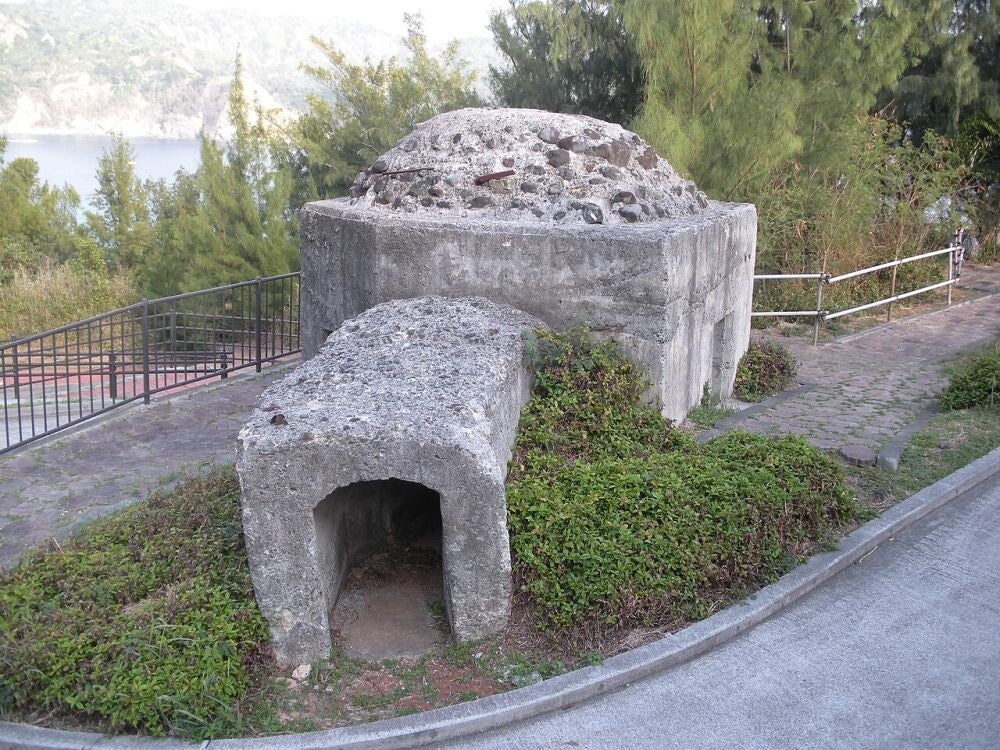
An old bunker on Chichijima.
https://en.wikipedia.org/wiki/Chichijima#/media/File:Bunker_in_Japan_Bonin_Islands.jpg