Overview
The battle for Guam in 1944 formed a central part of the American campaign to retake the Mariana Islands, a region whose capture would place Japan within range of sustained strategic bombing. Guam, the largest of the Marianas, had been an American possession until its rapid seizure by Japanese forces in December 1941. By mid‑1944, its geography and infrastructure—particularly its deep‑water harbour at Apra and its potential airfield sites—made it essential to the next phase of the Pacific war.
The island’s terrain shaped every aspect of the fighting. Guam is dominated by dense jungle, steep ridges, and coral cliffs, with a narrow coastal plain along the western shore. Japanese forces used this ground to their advantage, constructing caves, tunnels, and fortified positions that overlooked likely landing beaches. The northern plateau, more open and suitable for airfields, was heavily defended, while the southern highlands provided natural strongpoints that would require determined infantry assaults.
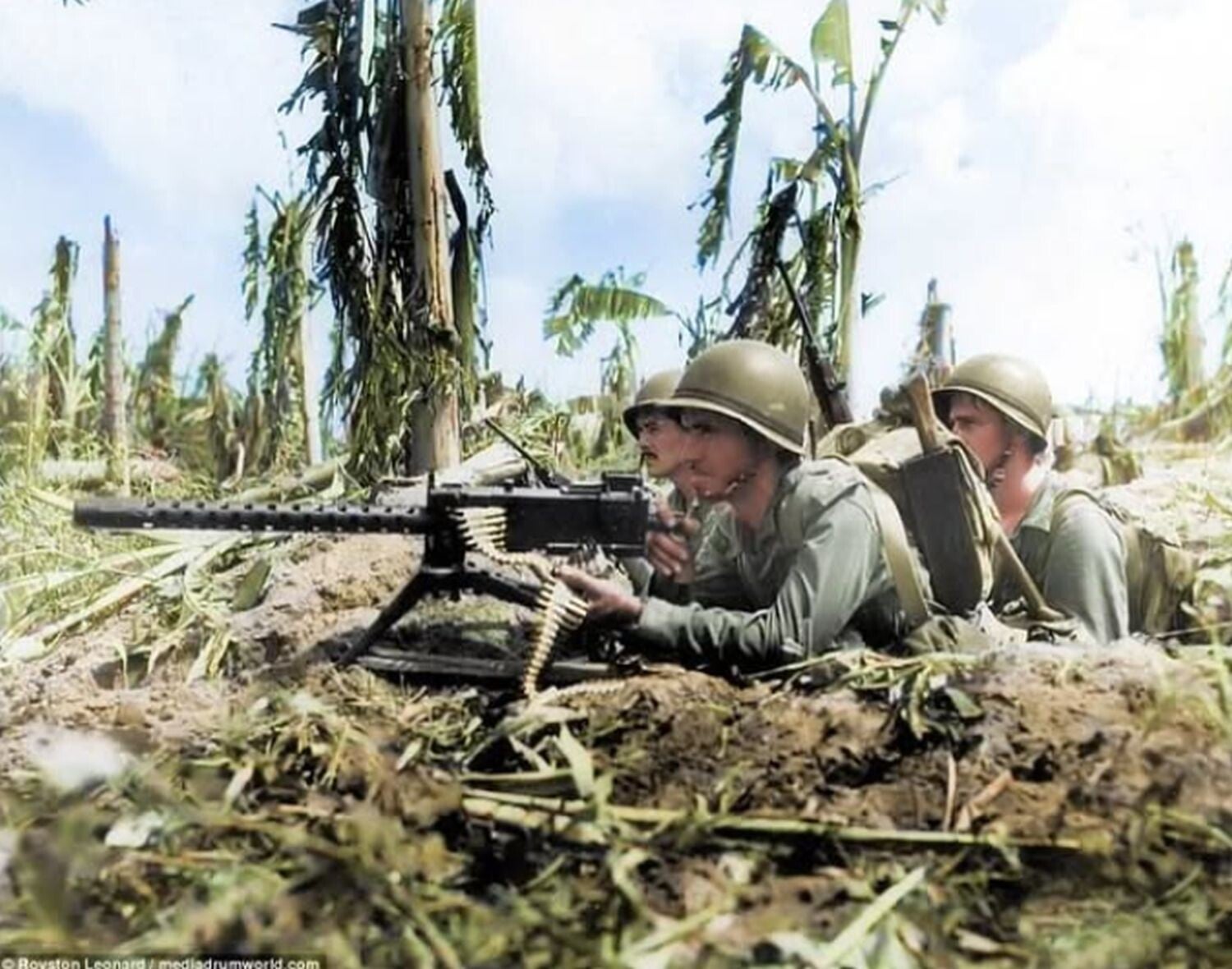
Marines Gunnery Sergeant J. Paget, Privates L.C. Whether and V.A. Sot fire on a nest of Japanese snipers in Guam in 1944.
Colourisation by Royston Leonard
American forces landed on 21 July 1944 at Asan and Agat, establishing two beachheads separated by rugged ground. Initial progress was slow, with Marines and Army units fighting through thick vegetation, heat, and well‑concealed Japanese positions. The Japanese counterattacked repeatedly, including a major night assault that inflicted heavy casualties but failed to break the American perimeter. Once the beachheads linked, U.S. forces pushed north toward the plateau, overcoming successive defensive lines in close‑quarters combat.
By early August, organised Japanese resistance collapsed, though small groups continued to fight from the interior. The island was declared secure on 10 August. Its capture provided the United States with a major logistical and operational base. Airfields on Guam soon hosted B‑29 bombers of the Twentieth Air Force, while Apra Harbour became a key anchorage for the Pacific Fleet. The 1944 campaign restored American control and transformed Guam into one of the most important forward bases of the final year of the war.