
Overview
The Battle of Kwajalein, fought from 31 January to 4 February 1944, marked the first major American assault on a heavily fortified Japanese position in the Central Pacific. As the opening operation of the Marshall Islands campaign, it demonstrated the maturation of U.S. amphibious doctrine and the growing effectiveness of coordinated naval, air, and ground power. Kwajalein Atoll, the largest in the Marshalls, contained a substantial Japanese garrison and served as a key node in Japan’s outer defensive perimeter. Its capture was essential for securing forward airfields and enabling subsequent operations toward the Marianas.
The assault unfolded in two principal phases. In the north, the 4th Marine Division landed on Roi and Namur on 1 February, supported by extensive pre‑landing bombardment from battleships, cruisers, and carrier aircraft. Roi fell within a day; Namur required more intensive fighting, including the containment of a large explosion caused by a Japanese bunker detonation. In the south, the Army’s 7th Infantry Division landed on Kwajalein Island on 31 January. The defenders, already weakened by sustained bombardment, mounted fragmented resistance. U.S. infantry advanced methodically through trench networks, blockhouses, and rubble, employing flamethrowers, demolitions, and close‑support armor to reduce strongpoints. Organised Japanese resistance collapsed by 4 February.
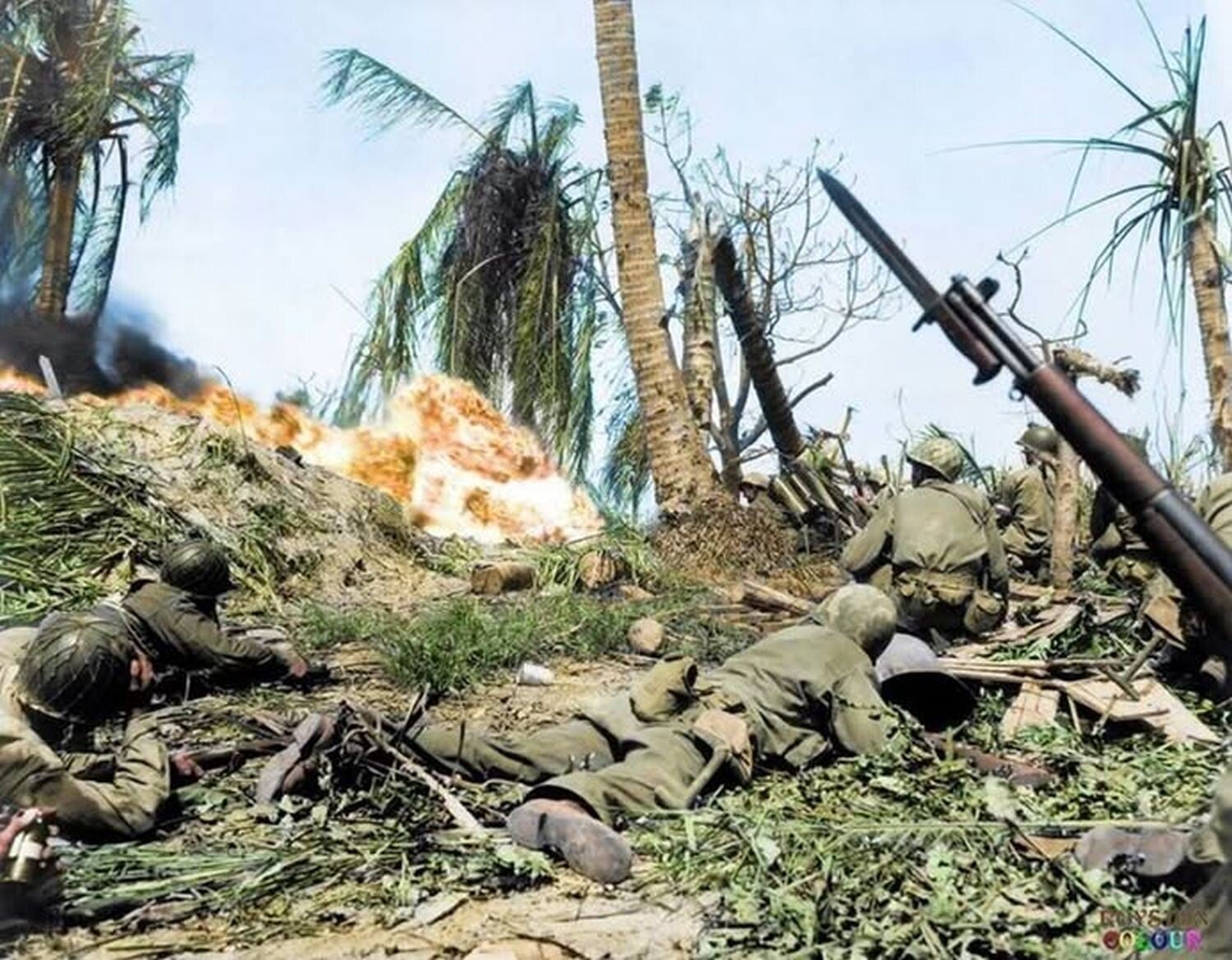
On 4 February 1944, during the final stages of the Battle of Kwajalein, men of the U.S. 7th Infantry Division advanced through the narrow, debris‑strewn terrain of the island, clearing the last pockets of Japanese resistance. In one documented action, flamethrower operators moved forward against a reinforced blockhouse while riflemen waited in covering positions, prepared to engage any defenders forced out by the flames. This method—flamethrowers supported by infantry—had become standard practice in the Pacific, where Japanese forces frequently fought from bunkers, trenches, and fortified pillboxes that resisted conventional small‑arms fire.
The battle’s outcome was decisive. American forces secured the atoll with significantly fewer casualties than earlier Central Pacific operations, reflecting improved planning, reconnaissance, and fire support. The destruction of the Japanese garrison—over 4,900 killed—eliminated a major defensive hub and exposed the vulnerability of Japan’s perimeter strategy. Kwajalein’s airfields were rapidly expanded for bomber and reconnaissance use, enabling strikes deeper into the Marshalls and supporting the subsequent seizure of Eniwetok.
Kwajalein’s capture accelerated the Allied advance across the Central Pacific and set the conditions for the strategic offensive against the Marianas later in 1944.