
Overview
Bougainville became one of the Pacific War’s longest and most attritional campaigns. The island’s terrain—steep mountains, dense jungle, heavy rainfall, and limited infrastructure—favoured defence and complicated every Allied advance. When U.S. forces landed at Cape Torokina in November 1943, their objective was not full island conquest but securing airfields to support operations against Rabaul. Japanese commanders responded with repeated counterattacks, attempting to dislodge the beachhead before it could be fortified. These assaults, often launched through difficult terrain with limited artillery support, failed at heavy cost.
By early 1944, Allied airfields on Bougainville were operational, enabling sustained strikes that neutralised Rabaul as a major base. U.S. forces then shifted to a defensive posture, holding the perimeter while avoiding deeper penetration into the island’s interior. In late 1944, responsibility for Bougainville passed to Australian forces, who adopted a more aggressive strategy aimed at eliminating remaining Japanese resistance. This phase produced intense fighting along the Numa Numa Trail, the northern coast, and the southern Buin region, where Japanese units—isolated, short of supplies, and suffering from disease—continued to resist.
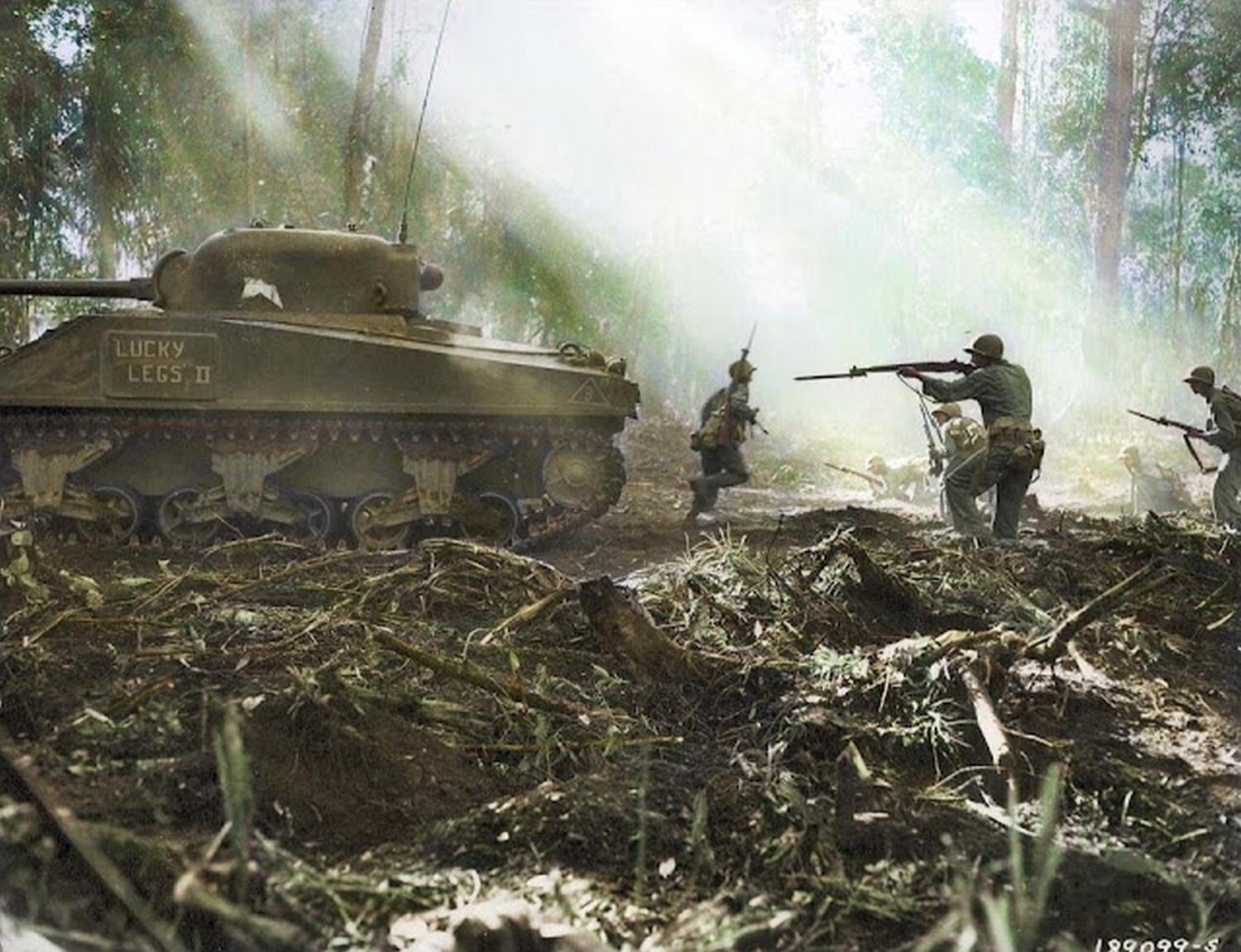
U.S. Army soldiers on Bougainville, an island in Papua New Guinea, taking cover behind an M4 Sherman tank in February 1943.
Japanese troops on Bougainville endured severe deprivation. Cut off from external support after Rabaul’s isolation, they relied on subsistence agriculture, improvised medical care, and dispersed jungle positions. Despite these conditions, their defensive persistence forced the Australians into slow, methodical advances supported by artillery, armour, and extensive patrolling.
By the time of Japan’s surrender in August 1945, more than 40,000 Japanese personnel remained on Bougainville, many in poor health. The campaign demonstrated how terrain, logistics, and strategic priorities shaped operations in the South Pacific: an initial U.S. lodgement for airpower, followed by an Australian effort to clear the island, all against a determined but increasingly isolated Japanese defence.